SNES – BS Legend of Zelda

BS (Broadcast Satellaview) Zelda for the Super Nintendo Entertainment System BS (Broadcast Satellaview) Zelda for the Super Nintendo Entertainment System
This cartridge version allows you to choose between Map 1 or Map 2 - the layouts of the overworld and dungeons are different in each. This cartridge version allows you to choose between Map 1 or Map 2 – the layouts of the overworld and dungeons are different in each.

Note 1:  Check out my reviews of Ancient Stone Tablets, Chapters 1 and 2!

Note 2:  This game was played on an original model SNES console using S-video cables connected to a 32-inch HD tv.

Quick History:  The history of BS Legend of Zelda isn’t really ‘quick,’ but I’ll try to keep it as uncomplicated as possible.  BS Zelda is known as BS Zelda no Denetsu in Japan and was released for download in 1995 and 1996 for the Broadcast Satellaview.  The Broadcast Satellaview was an attachment to the Super Famicom (Japanese SNES).  BS Zelda was essentially a re-make of the original NES Legend of Zelda with updated graphics and other minor differences.  The first release is known as ‘Map 1,’ and the second release is known as ‘Map 2.’  The gameplay was the same in both, but the design of the overworld and dungeons differed in each version.  In the original download release, players chose either a boy or a girl character (neither of them was Link from the Zelda series).  The two characters were the ‘mascots’ from the Broadcast Satellaview system.  The game never saw release in cartridge form in Japan, and many gamers, including Zelda enthusiasts, never knew about it.  It wasn’t until some wonderful and ingenius modders were able to work wonders with the rom of the game, translate it to English, and tweak some of the gameplay elements (like adding Link as the main character), and make the game playable on cartridge form almost 20 years after its release.  This review is for the SNES reproduction cartridge, BS Legend of Zelda.

You can see your Episode's Objectives by Pressing Select. You can see your Episode’s Objectives by Pressing Select.

How the game works:  BS Zelda was originally split into 4 separate downloads (on 4 consecutive Sundays in a month, so I’ve read) for the Broadcast Satellaview – each download was for a different ‘episode’ of the game.  The episodes all made up one continuous story.  You had approximately one hour to play the game during each of the 4 episodes.  During each episode, you basically beat two dungeons and collected all of that week’s items before you ran out of time and the game stopped.  You would save your progress at the end of your hour, and continue the game the next week.  Since the entire game all takes place on the same overworld map, certain obstacles would prevent you from entering a particular area until you reached the next episode.  So, essentially, you were able to explore a wider portion of the overworld map every week, as new areas became open to you.  This SNES reproduction cartridge combines all 4 episodes, making it possible to play through the entire game without having to wait.
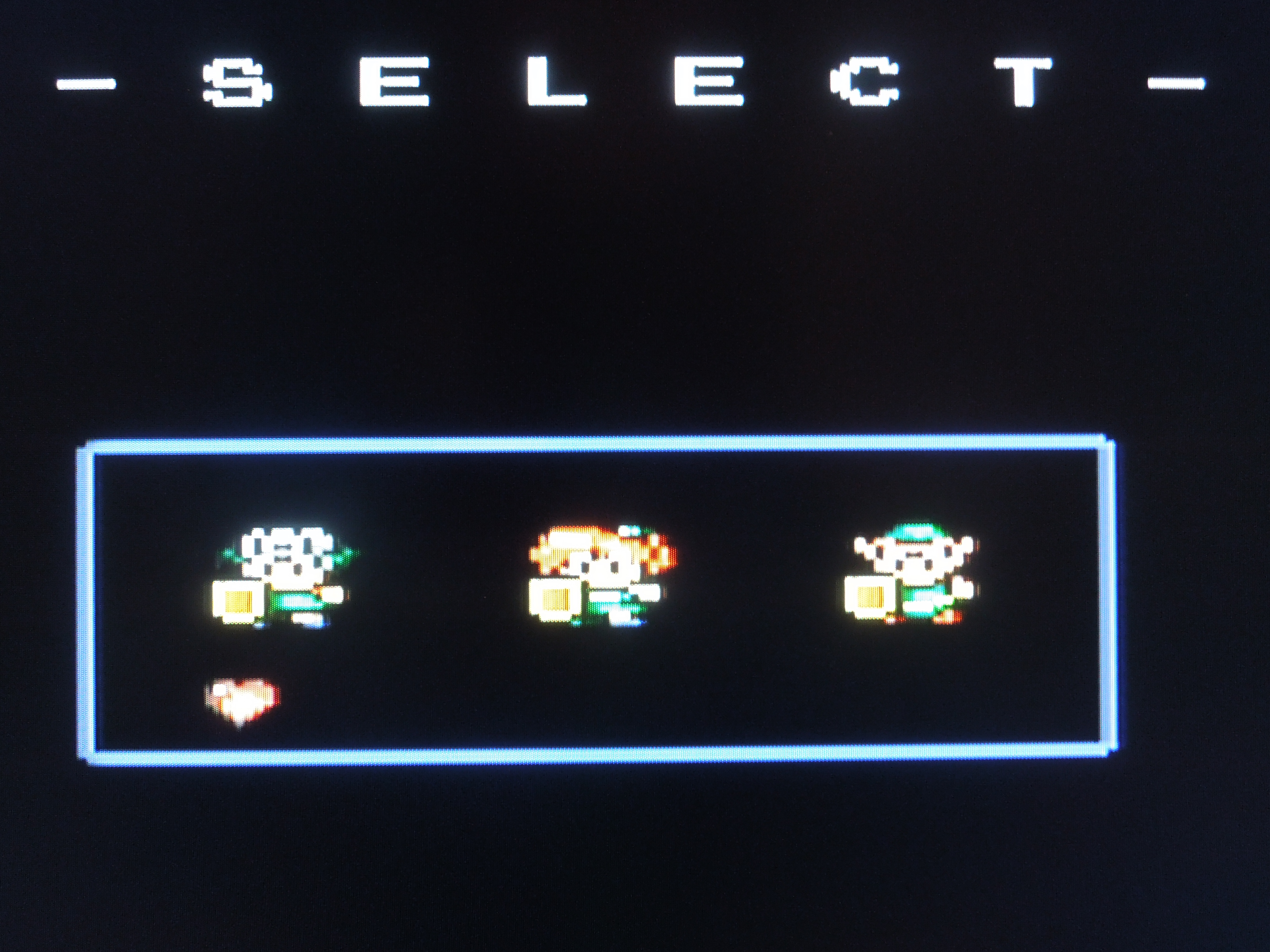
Choose among the original Broadcast-Satellaview mascots, or Link, the titular hero. Choose among the original Broadcast-Satellaview mascots, or Link, the titular hero.

Story:  Choose among Link, a redheaded girl, or a boy with a baseball hat turned backwards to begin the game.  In the land of Hyrule, you’ll have to conquer 8 dungeons and recover 8 pieces of the powerful ‘Triforce.’  Doing so will allow you to open a sealed passage and fight the evil Ganon, who kidnapped the King’s daughter, Princess Zelda.  *Note: the original BS Zelda no Denetsu had a different story that involved the boy or girl character being transported to Hyrule to rescue Zelda.  This reproduction cartridge version alters the story to be more in line with the original NES version.

Gameplay: The game takes place in 4 episodes.  Each episode lasts 50 minutes – there is a clock in the top right corner of the screen called ‘Zelda Time’ that you should keep your eye on.  Episode 1 is from 1:07-1:57.  Episode 2 is from 2:07-2:57.  Episode 3 is from 3:07-3:57.  Episode 4 is 4:07-4:57.  During each 50 minutes, you are tasked with conquering two dungeons, finding two pieces of the Triforce, and acquiring certain items.  At certain pre-determined minutes, random ‘acts’ will happen, like fairies appearing on-screen, infinite arrows being given to your character, or the sky turning dark and rain beginning to fall.  If you complete all of your tasks before the clock reaches the end of the episode, you can ‘fast-forward’ to the next episode – all of your progress carries over.  Once you have beaten all 8 dungeons and collected all 8 pieces of the Triforce (over all 4 episodes), you’ll be ready to face Ganon and rescue Zelda.

Sound and Music:  Top notch.  The familiar Zelda theme plays throughout the game, and the sound effects sound like a mixture of 8-bit and 16-bit pieces.
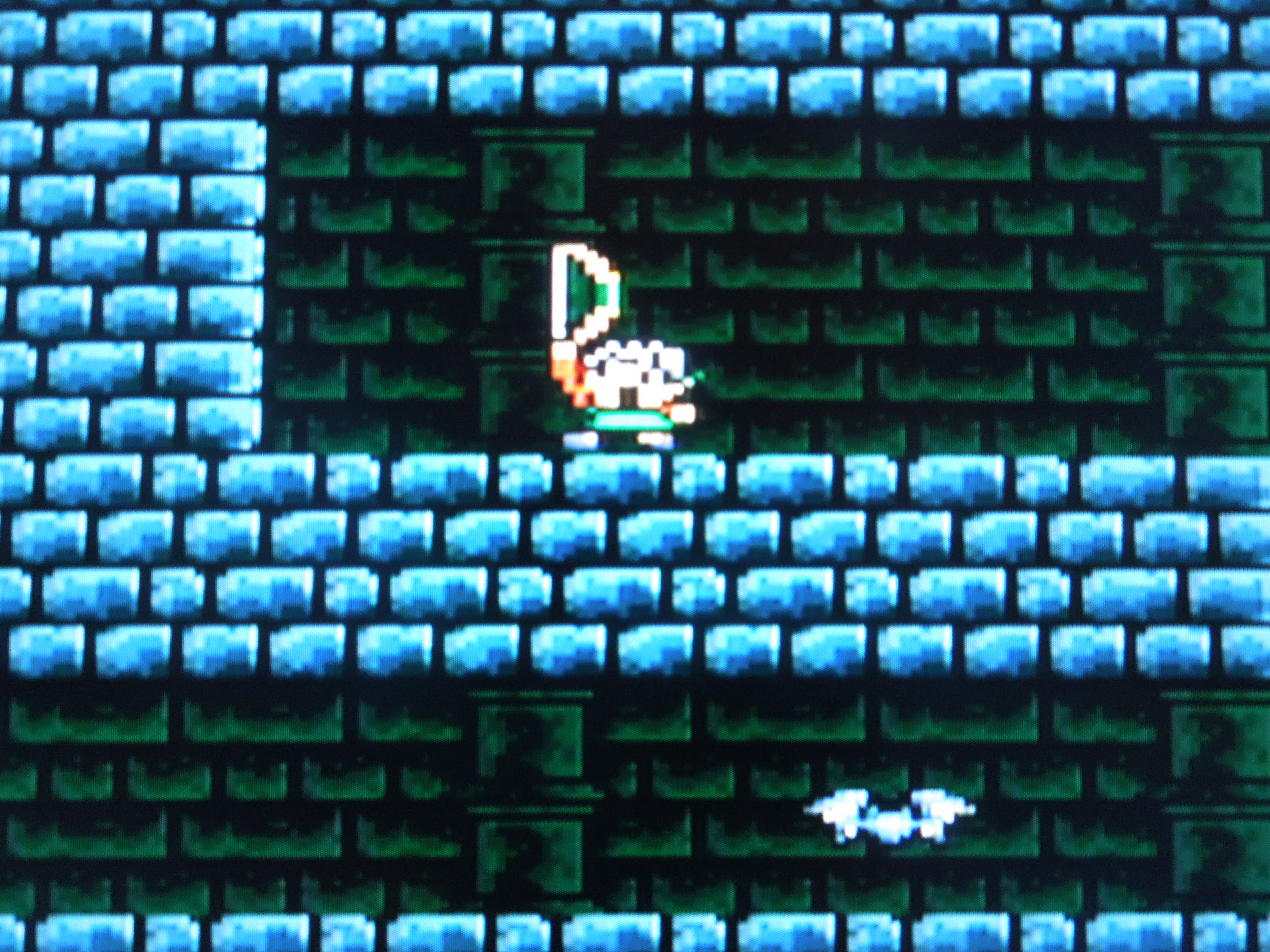
You'll find various items and weapons in the dungeons you explore. You’ll find various items and weapons in the dungeons you explore.
The game is a re-make of the original NES Legend of Zelda, although there are many noticeable differences. The game is a re-make of the original NES Legend of Zelda, although there are many noticeable differences.

Control:  A uses the sword, which you get at the beginning of the game.  B uses an alternate item, like a bomb or the boomerang.  Start pulls up a menu where you can view your items, change alternate weapons, see your progress, etc.  Select pulls up a screen where you can see the Week’s (Episode’s) Objectives.  The Week’s Objectives screen is handy because you’ll see exactly what items you’re expected to have before you advance to the next episode.  If you have achieved all of your objectives early, and want to ‘fast-forward’ to the next episode, press Start, then, on the menu screen, press and hold L, R, Y, B.  The clock will roll forward until you’re in the next episode.  You can save your game to this cartridge’s battery as well.  To do this, press Start to pull up the menu screen, then press and hold, L, R, Up.  The game will save to the exact minute of gameplay you were on.  If you want to continue playing after a save, however, you’ll need to reset the game.

Ganon:  You cannot face Ganon in Episode 4 until the clock reaches 4:45.  If you haven’t beaten him before the clock hits 4:57, you’ll get the ‘bad ending.’

Map 1 or Map 2?   You can choose which one you want when you start a new game.  The differences are in the layout of the overworld and the 8 dungeons.
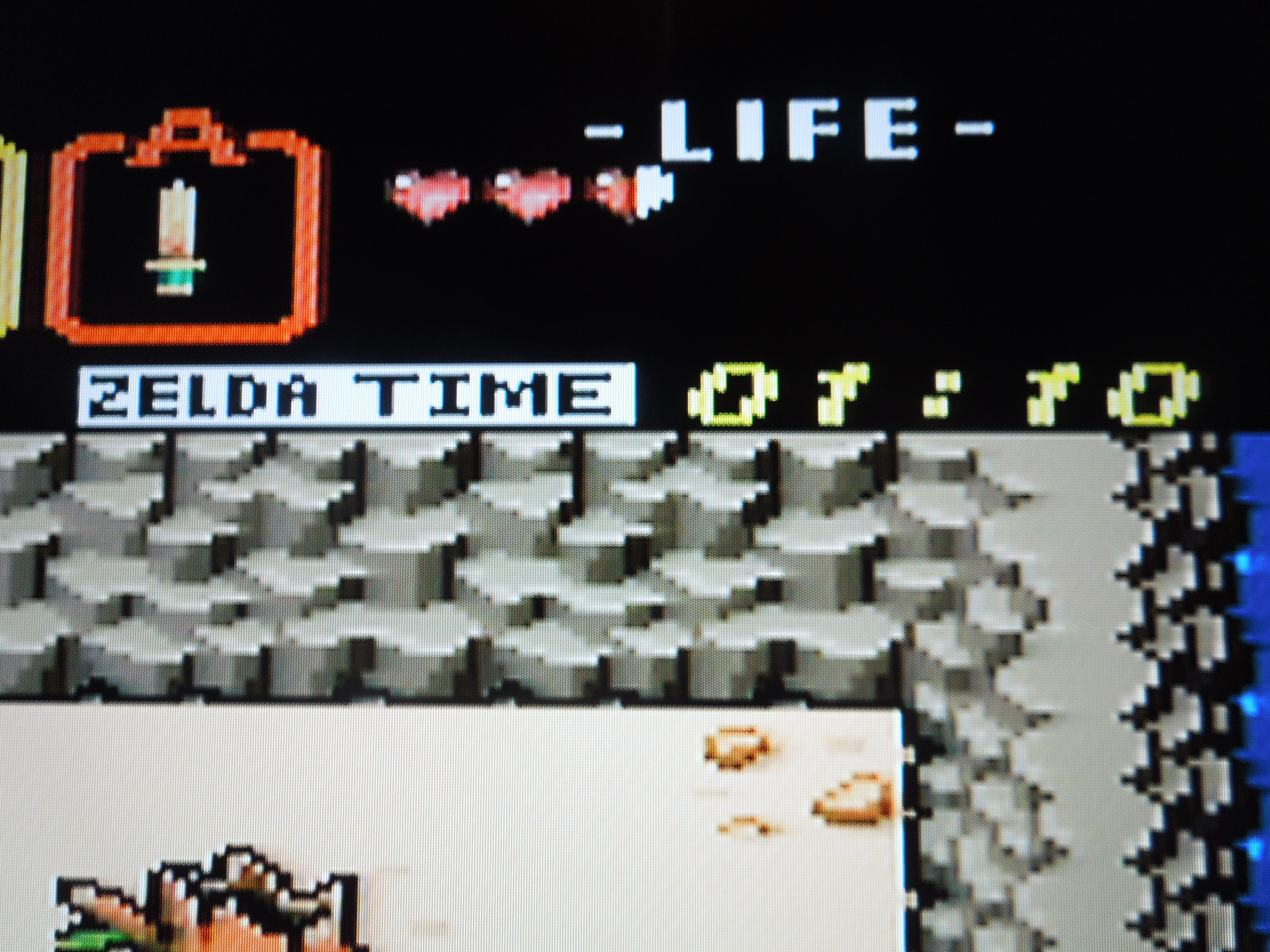
Keep an eye on the clock - you only have 50 minutes per episode. Keep an eye on the clock – you only have 50 minutes per episode.

So, where can I find this game? For the longest time, it was only available for play on emulators on your computer.  Now, however, it can be put onto cartridge form for play on your SNES.  You can google ‘SNES reproductions’ to find sellers who may offer it.

Conclusion:  Although it sounds confusing, BS Zelda for the SNES is a very simple game to play, and is very similar to its NES counterpart.  BS Zelda is actually a shorter game than the original, and the overworld map is smaller as well.  The update to the graphics is great, leaving this game looking a little more like the popular and well-known SNES game, A Link to the Past.

The Southern Gentleman’s Opinion and Letter Grade:  Terrific and obscure Zelda game?  Hard to turn down, even if it is mostly an update of the original.  Recommended.  A

God Bless! Proverbs 3:6

After finding 8 pieces of the Triforce, you'll fight Ganon and attempt to rescue Princess Zelda. After finding 8 pieces of the Triforce, you’ll fight Ganon and attempt to rescue Princess Zelda.
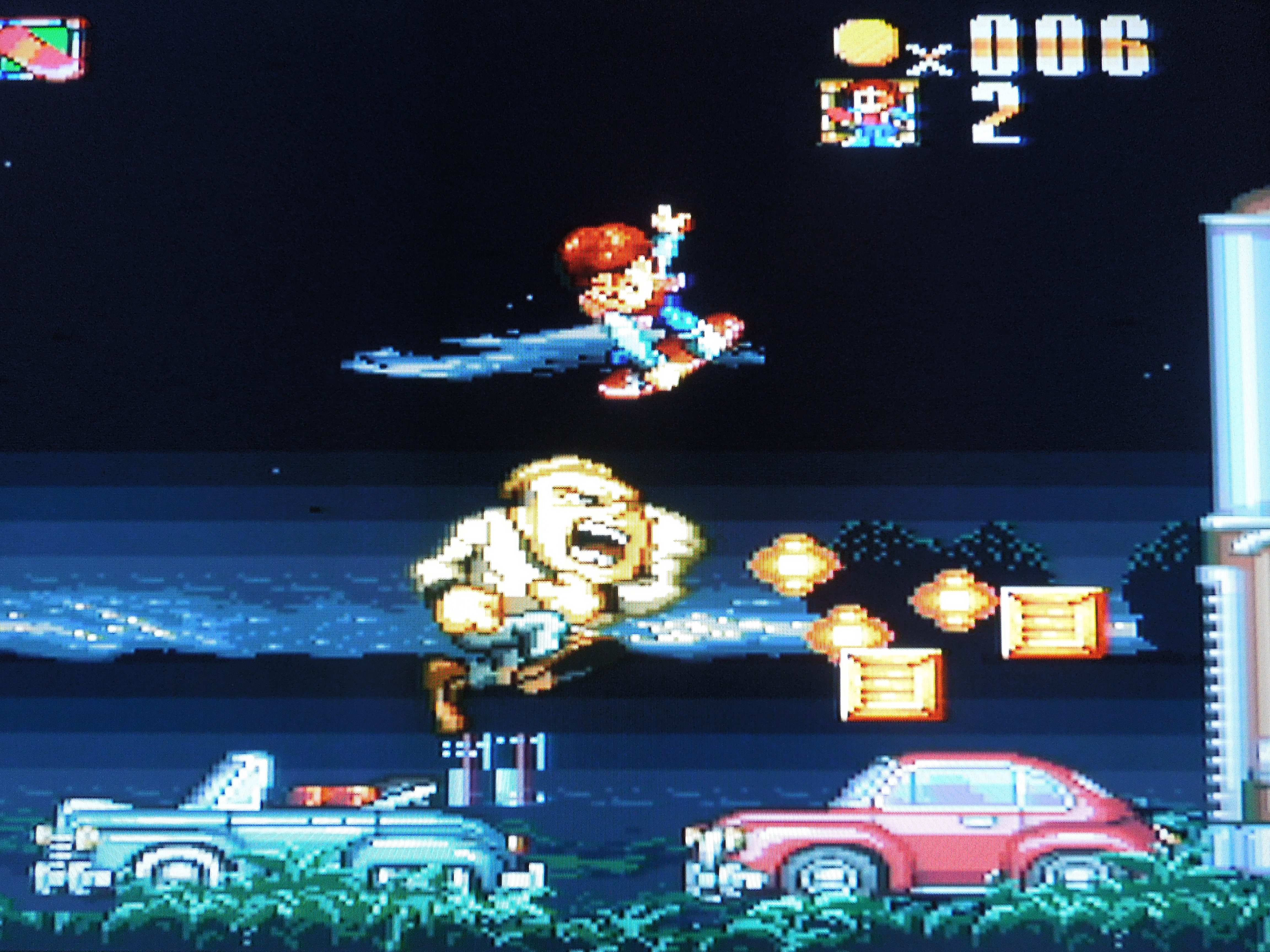
Super Famicom – Super Back to the Future, Part II

Super Back to the Future, Part II for the Super Famicom Super Back to the Future, Part II for the Super Famicom
Sadly, Super Back to the Future, Part II was only released in Japan in 1993. It never had a U.S. release. Sadly, Super Back to the Future, Part II was only released in Japan in 1993. It never had a U.S. release.

Note 1:  Like platforming/action games?  Check out my reviews of Doki Doki Panic, Kid Dracula, I’m Kid Dracula, and Splatterhouse!

Note 2: This game was played on an original model U.S. Super Nintendo with S-Video cables connected to a 32-inch HD tv.  The plastic tabs that prevent Japanese Super Famicom games from being inserted into the Super Nintendo console were removed, allowing the game to be inserted for play.

Cutscenes play between levels. Cutscenes play between levels.

Quick History:  Released only in Japan in 1993, Super Back to Future, Part II for the Super Famicom (Japanese SNES) followed the story of the movie with the same name.  Perhaps one reason this game was never released in the United States for the Super Nintendo was the timing of its release.  The film, Back to the Future, Part II had been released 4 years earlier, in 1989.  Perhaps there was a fear that, after 4 years, U.S. gamers would have lost interest in the film, and therefore the game would hold no interest either.  That is a shame, however, because previous Back to the Future games (released for the NES and Sega Genesis) were not well-received by U.S. gamers, and this game likely would have, in the least, been an acceptable version of a Back to the Future video game.

You'll face all sorts of strange enemies and obstacles throughout the game. You’ll face all sorts of strange enemies and obstacles throughout the game.

Story:  If you aren’t familiar with the film, Back to the Future, Part II, here’s the gist:  Marty, a 17-year old kid, travels via DeLorean time machine from 1985 to 2015 (along with his mentor and buddy Doc) to stop his kids from making horrible mistakes that tear his family apart.  While in 2015, he buys Gray’s Sports Almanac, a sports book that lists scores from the past 50 years – his intention is to bet and win on sporting events back in his own time.  Naturally, the book gets stolen, and hijinks and adventure ensue as Marty tries to make things right.  I highly recommend the entire movie trilogy, if for some strange reason you haven’t seen it (which is unlikely, I guess, if you’re even reading this).

Control: Marty, who rides on his ‘hover board’ at all times, only has two functions – Dash and Jump.  To dash (or move really fast on your hover board), press and hold B, X or R.  To jump, press Y or A.   You can’t change the control scheme, but I recommend holding the shoulder button R for Dash, and using A for jump.  When jumping, Marty somersaults repeatedly, and he is essentially invincible while doing so.  He’ll destroy enemies and bounce into the air while somersaulting/spinning.  Dashing is great for…moving fast…but you have to be careful not to dash into an enemy, which can happen easily once you really get moving.

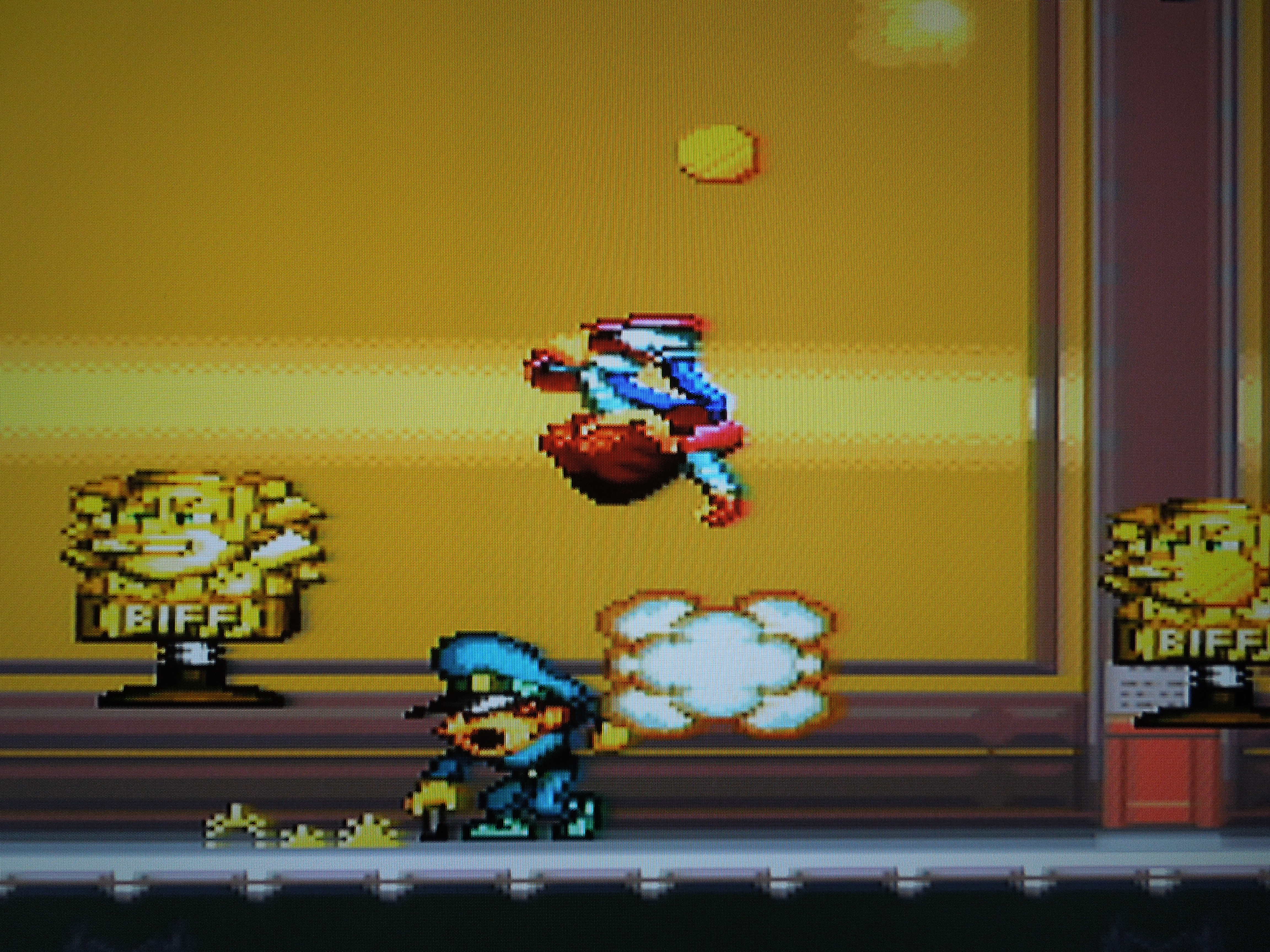
“Biff’s guys chased me into the gym, and they’re gonna jump…ME!”…not me, the other me, the one on stage playing Johnny B. Goode!”

Gameplay:  You guide Marty throw 6 levels of platforming action.  The levels, however, are broken down into hypenated sub-levels.  For example, level 1-2, level 5-3.  It’s similiar to Super Mario Brothers, but not every level has the same amount of sub-levels.  The levels include areas from the movie, like Hill Valley in 2015, Biff’s Paradise Casino & Hotel in Alternate 1985, and Hill Valley High School in 1955.  Marty can take 3 hits per level before dying, and his ‘energy’ is in the form of 3 hover-board icons in the top left corner of the screen.  Throughout each level (excluding ‘boss fight’ levels), you’ll collect coins that can be used to buy extra energy or protective barriers at certain machines you’ll encounter while zooming around.  If you lose all of your energy in a level, you’ll have to start back at the very beginning – no check points are in the levels.  Many levels have ‘secrets’ – hidden areas that have extra coins or shortcuts.  You’ll encounter all forms of enemies throughout the game, some that have a passing resemblance to something from the movie, some that seem to be completely new to the BTF II world.  By jumping (and automatically spinning), you can attack these enemies.  Additionally, for every enemey (or obstacle, like boulders) you hit while spinning, Marty will be able to continue spinning and move upwards.  In fact, many levels have you ‘climbing’ – having Marty continue to jump into obstacles to continue spinning upwards to a certain point in a level.  You’ll fight bosses every few levels – some of these you’ll recognize, like 2015 Griff, while some have been created for this ‘version’ of Back to the Future II.

Sound and Music:  The music is well-done.  The main theme from the movie plays as soon as you power on the system, and that’s a great way to introduce the game.  That same Back to the Future theme plays during several levels as well, and frankly, doesn’t get old.  However, because that one song is so great, when other songs play during other levels, it’s just not the same.  The sound effects are passable.

Additional Notes:

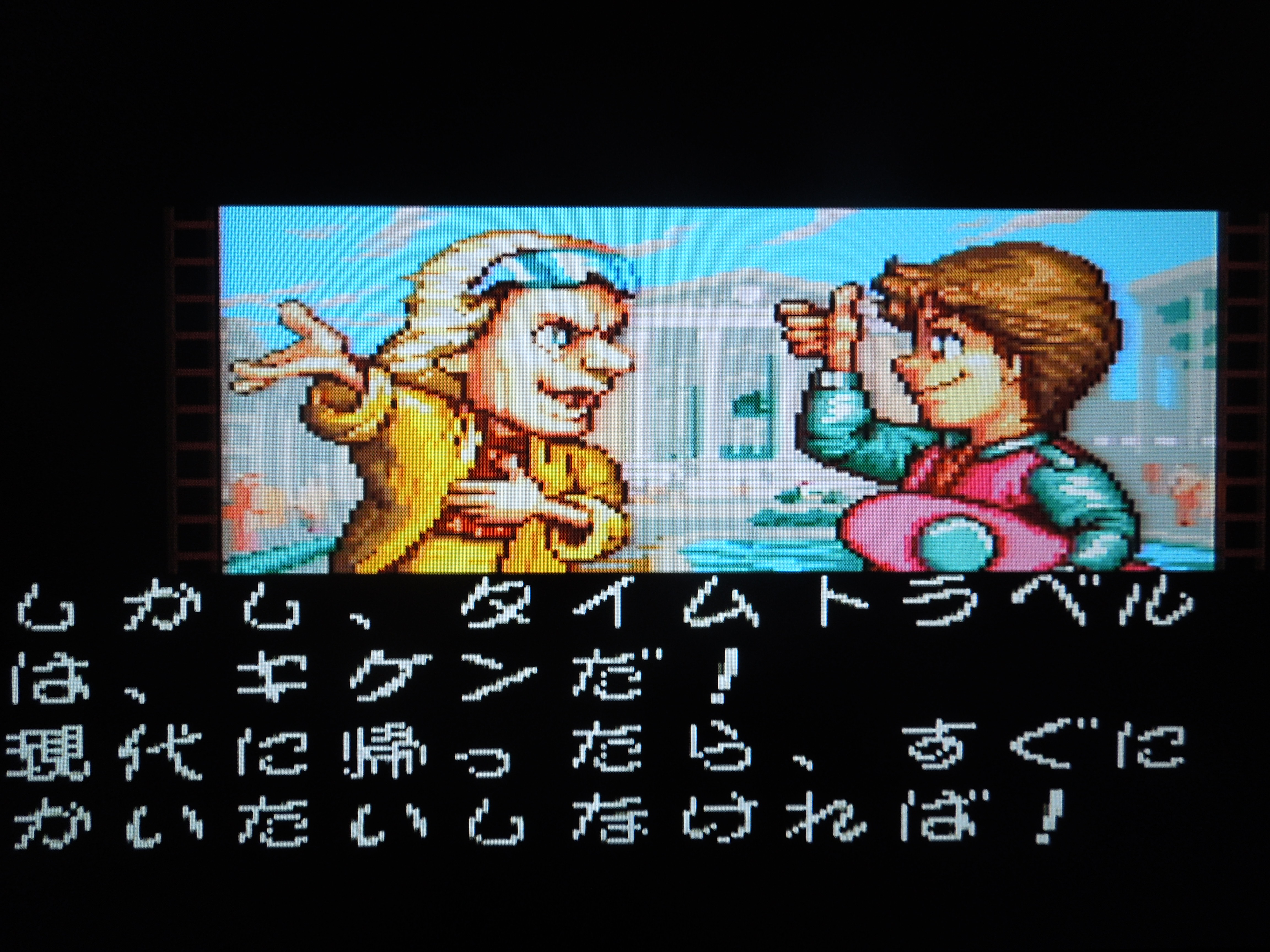
Language Barrier?  No.  The Start Screen, Continue Screen, Password, and Options are all in English.  You can listen to music from the game or increase your total number of lives (up to 5) in the Options menu.  The only thing in Japanese is the story that plays during a few cut-scenes throughout the game.  If you’re familiar with the movie, you won’t need to read the language anyway.  I do suppose you would be confused if you had never seen the movie.

You'll get a 4-digit passcode at the beginning of each level. You’ll get a 4-digit passcode at the beginning of each level.

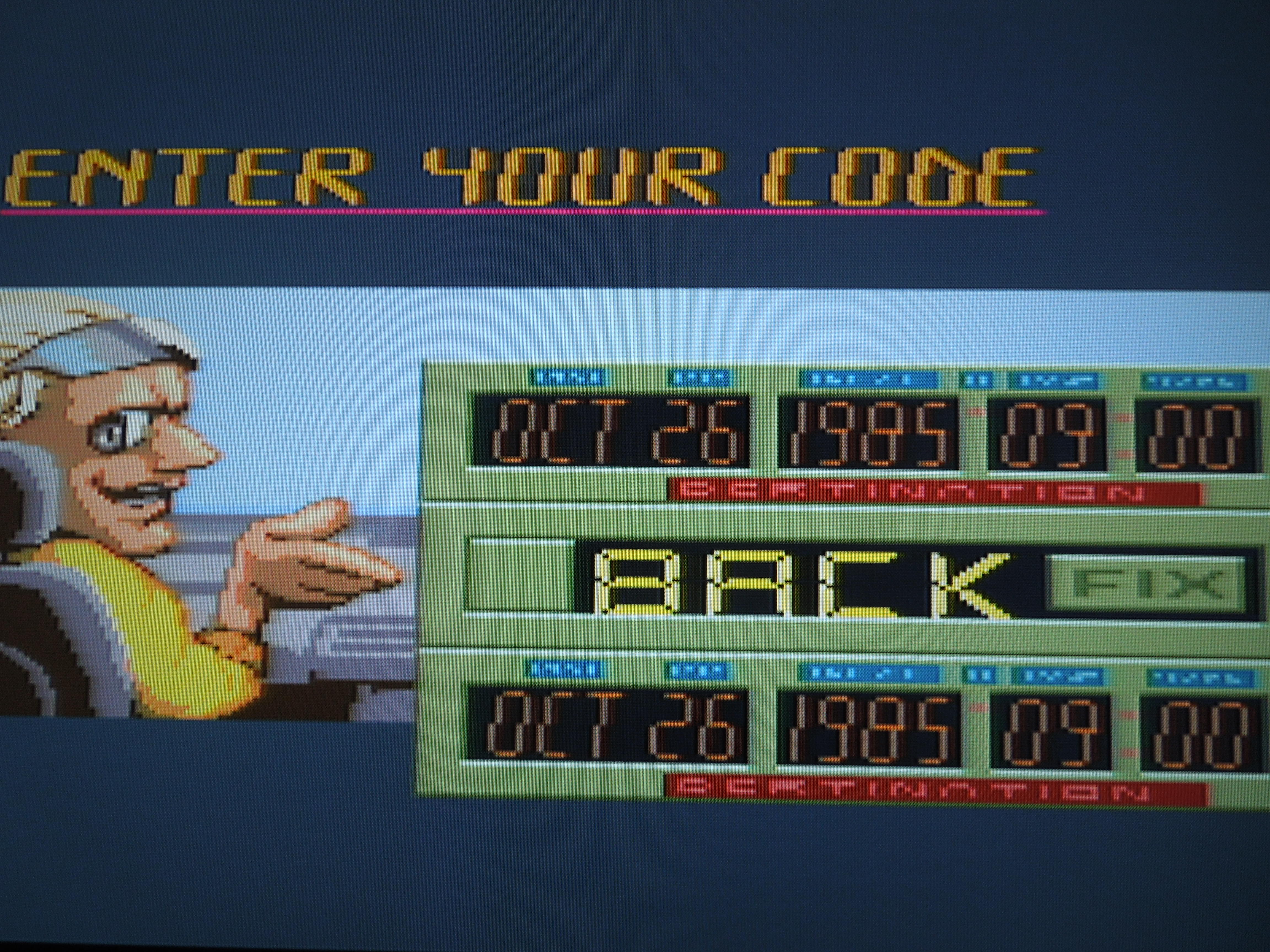
Password:  At the beginning of every sub-level, you’ll receive that level’s password.  They are all 4-letter words, like ‘FROG’ or ‘KING.’  It’s handy.

So, where can I find this game?  Ebay for a Super Famicom, original Japanese version.  This game has been translated and is now being sold by SNES reproduction websites across the Internet.  You can always download the rom for play on a computer emulator.

Conclusion:  If you’re a huge Back to the Future trilogy fan, then Super Back to the Future, Part II may be just the video game you’re looking for.  It looks great – very anime and cartoony – but eye-catching.  The original movie music really adds to the experience.  But, be warned – this game is HARD.  You will die, repeatedly, as you try to conquer each level.  The first few aren’t too hard, but it gets tough quickly.  It will take memorization, patience, and all your ‘old school gamer’ skills to beat this one.  Fortunately, there are passwords after every level.

The Southern Gentleman’s Opinion and Letter Grade:  Honestly, buy this only if you’re a die-hard BTF fan.  Otherwise, stick to to easier Platformers like Mario or Sonic.  B

God Bless! Proverbs 3:6

The story is in Japanese, but everything else is in English. The story is in Japanese, but everything else is in English.

Neo Geo – Flying Power Disc

Flying Power Disc for the Neo Geo AES Flying Power Disc for the Neo Geo AES

Note 1:  Like Neo Geo games?  Check out my reviews of Sengoku 3, Football Frenzy, Dunk Dream, Neo Bomberman, Super Dodge Ball, and Shock Troopers: 2nd Squad!

Note 2:  This game was played on a Neo Geo AES home console that has been modified to output in component video (green, blue, red).  The Neo Geo AES was connected to a 32-inch HD tv.

Flying Power Disc was released in Japan. In the U.S., the game was called Windjammers. Flying Power Disc was released in Japan. In the U.S., the game was called Windjammers.

Quick History:  Flying Power Disc was released for the Neo Geo AES home console and Neo Geo arcade cabinent (called MVS) in Japan in 1994.  In the United States, the game is called Windjammers, but the two games are basically the same.  Interestingly, if you play a Windjammers cartridge on a Japanese Neo Geo AES, it will have the Japanese title, Flying Power Disc.  Likewise, if you play a Flying Power Disc cartridge on a U.S. Neo Geo AES, it will have the U.S. title, Windjammers.  Basically, it’s the console – not the cartridge – that determines what screen you see.  Many Neo Geo games had different titles depending on where they were released, as well as other small in-game differences.  Japanese consoles played cartridges assuming they were for a Japanese audience, and U.S. consoles played cartridges assuming they were for an American audience, regardless of where the cartridges came from.  This review is specifically for the Japanese version, Flying Power Disc.

What is Flying Power Disc?  Simply put, Flying Power Disc is a one-on-one game where you try to throw a disc (frisbee) into your opponents goal.  The game has been compared to Pong, and also Air Hockey.  The game is played on a court similiar to a tennis court, but the size and layout of the court varies.  You occupy one half of the court, and your opponent occupies the other.  You cannot cross to his or her half, and vice versa.  You play a ‘Set’ of matches, and it’s the best of 3.  Each match is 45 seconds long, and you play to 15 points.  If the clock runs out before either player has reached 15, then the player with the most points wins.  If the game is tied after the first match, then the winner of the next match wins the game.  If you win the first game, your opponent wins the second, and you tie the third, then you’ll play Sudden Death.  If the clock runs out without a winner in Sudden Death, you both lose.
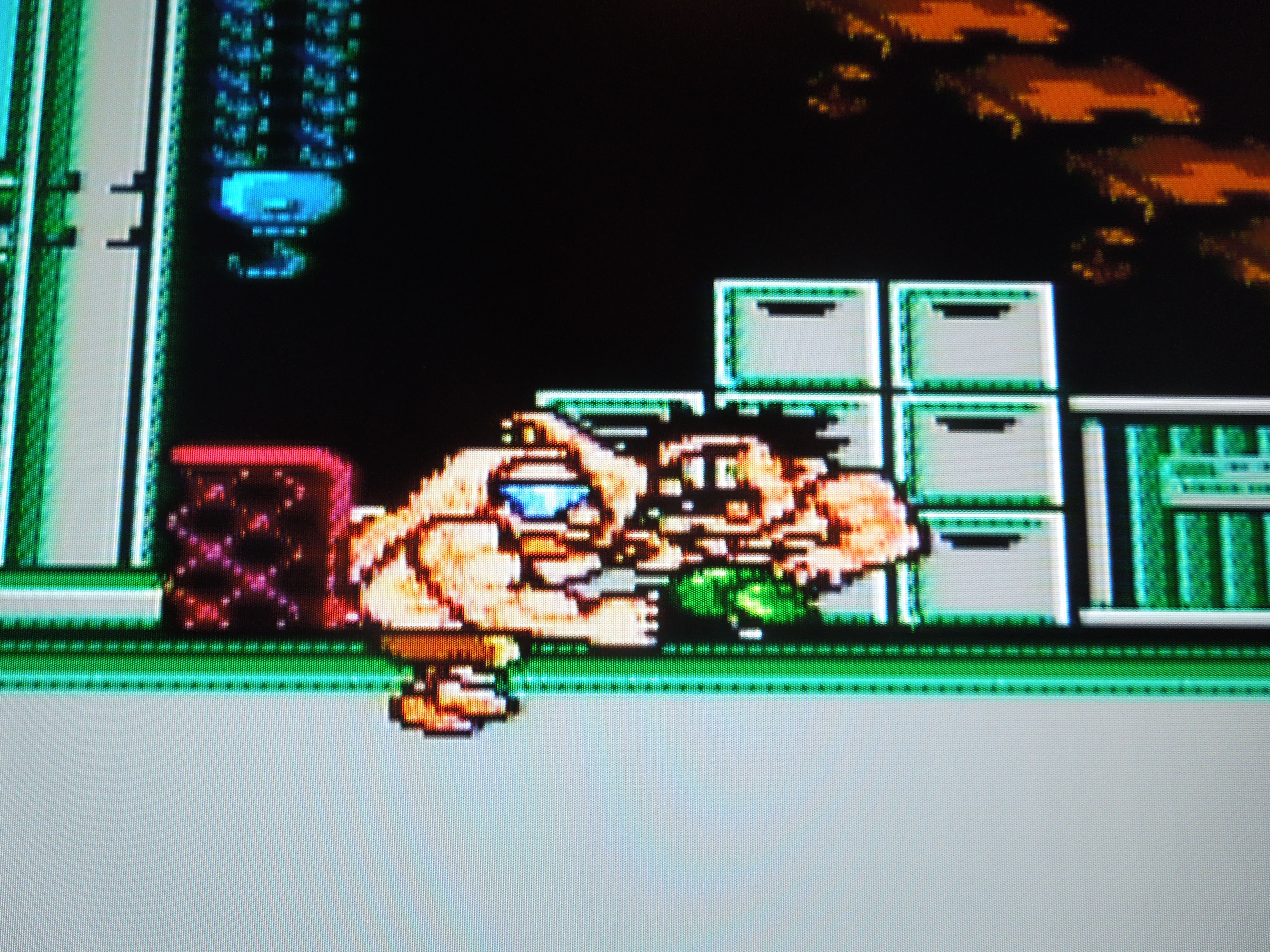
You play 'best of 3' matches vs each opponent. You play ‘best of 3’ matches vs each opponent.

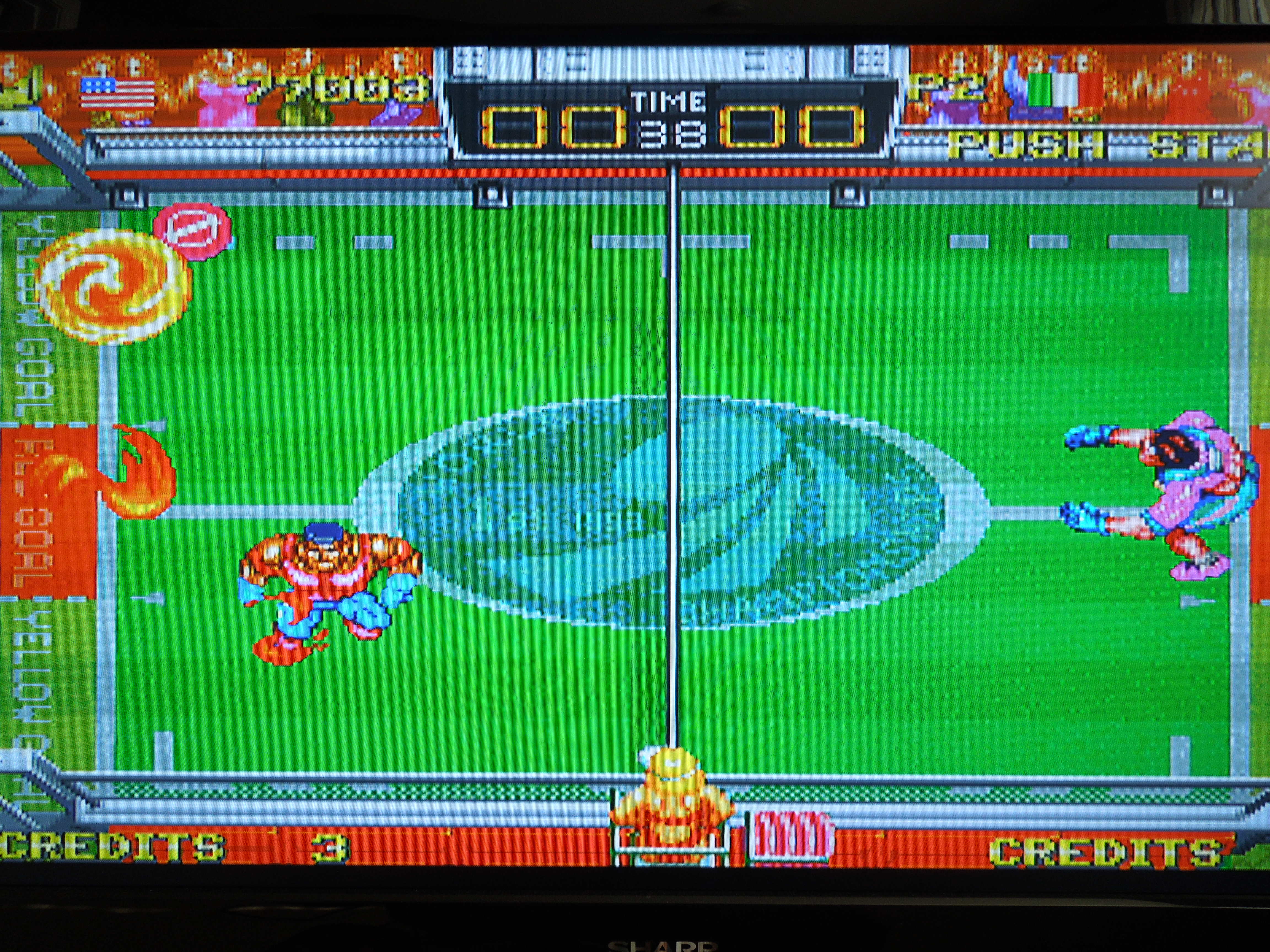
Scoring:  You must simultaneously attack your opponent’s goals and defend your own goals.  Typically, each side of the court will have two larger 3 point goals and one smaller 5 point goal.  Throwing your disc into your opponent’s goal will net you the appropriate number of points.  Also, if you throw the disc into the air and it hits the ground on your opponent’s side before he can catch it, you’ll get 2 points.

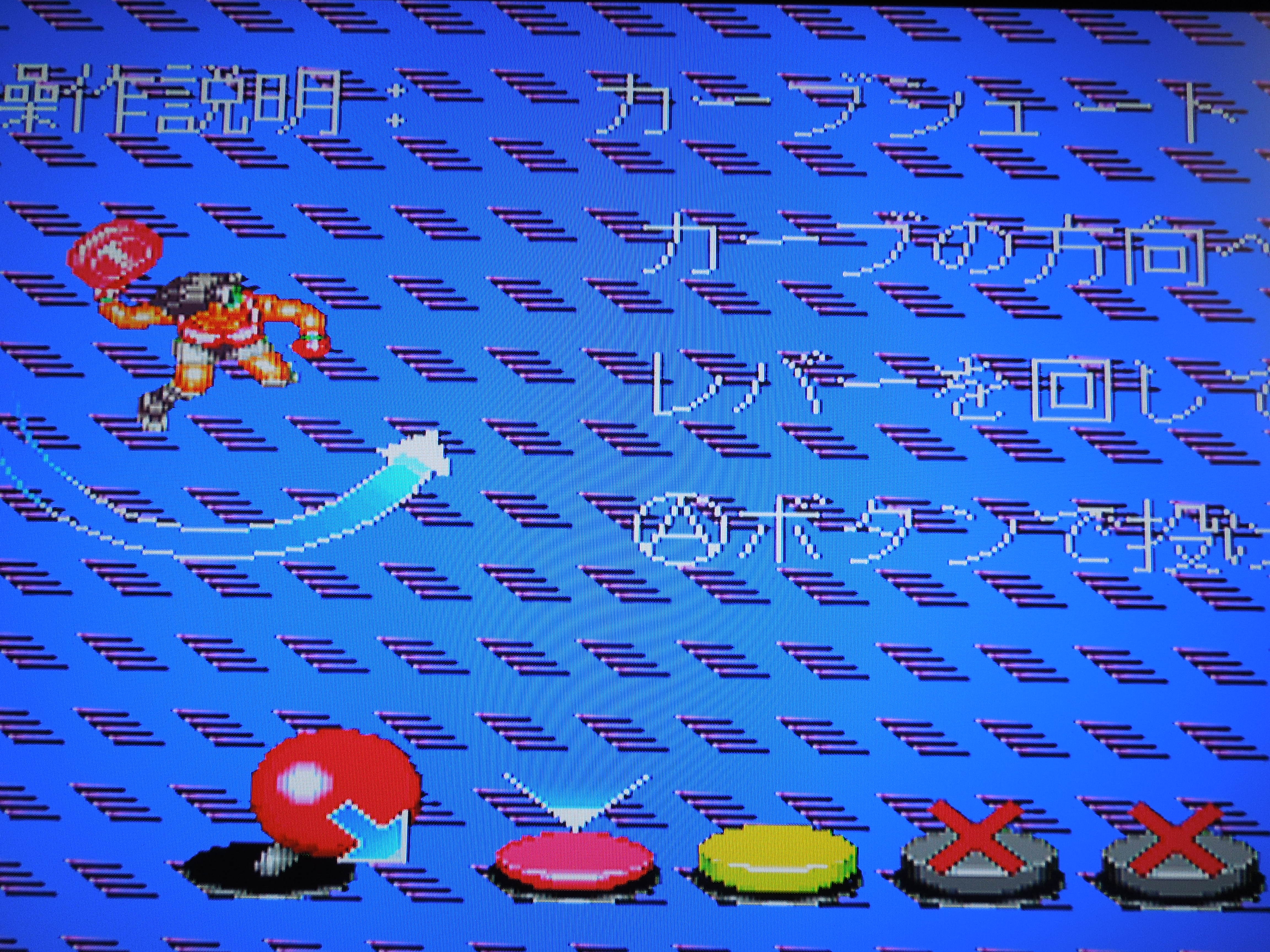
Control:  Flying Power Disc only uses 2 of the Neo Geo AES’ buttons:  A and B.  A throws the disc, and you can angle or curve the disc by rotating or pointing the joystick in a certain direction while pressing A.  The disc will bounce off walls and sometimes small ‘bumpers’ in the center of the court (only on certain courts).  B lobs the disc high into the air.  The purpose of the lob is to try to throw the disc to an area of your opponent’s side where he or she won’t be able to get to it – remember, if it hits the floor before they catch it, you’ll get two points.  You can move around your side of the court as long as you don’t have the disc, but when you possess it, you’ll be stationary.  The faster you press A to throw the disc back once you catch it, the faster your throw will be.  You can’t hold the disc for more than 1-2 seconds before you’ll automatically throw it back.  Sometimes, the disc will pop up into the air, and come down to you slowly.  During this time, hold A or B to ‘power up’ your player for a Super Shot, which is hard to catch and sometimes changes directions quickly.  Your character will also slide in any direction for amazing saves if you press the joystick towards the area where the disc is headed.

Using Super Shots increases your chances of scoring. Using Super Shots increases your chances of scoring.

Sound and Music:  Really great.  Each character has their own voice clips, all of which are supposed to sound like their character’s country of origin.  The American says, “Right on!” when he wins.  The German issues an intimidating “Woooo!” when you select him.  They’re quite amusing.  The sound effects for the disc – flying all over the court, smashing off the arena walls, and crashing into the goals – are fantastic.  There are also different songs for each court, all of which are great.  One even has some type of rap song playing!

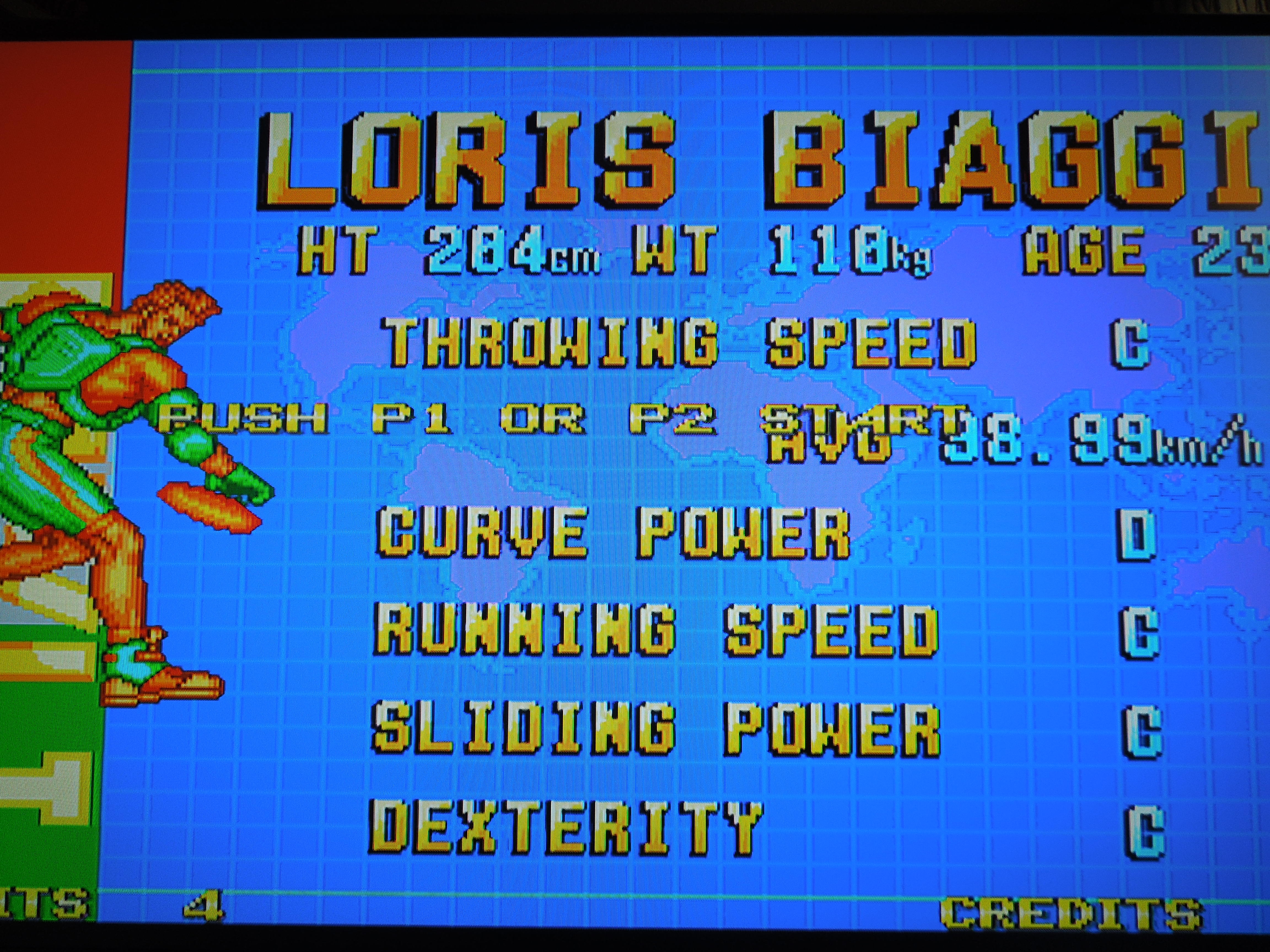
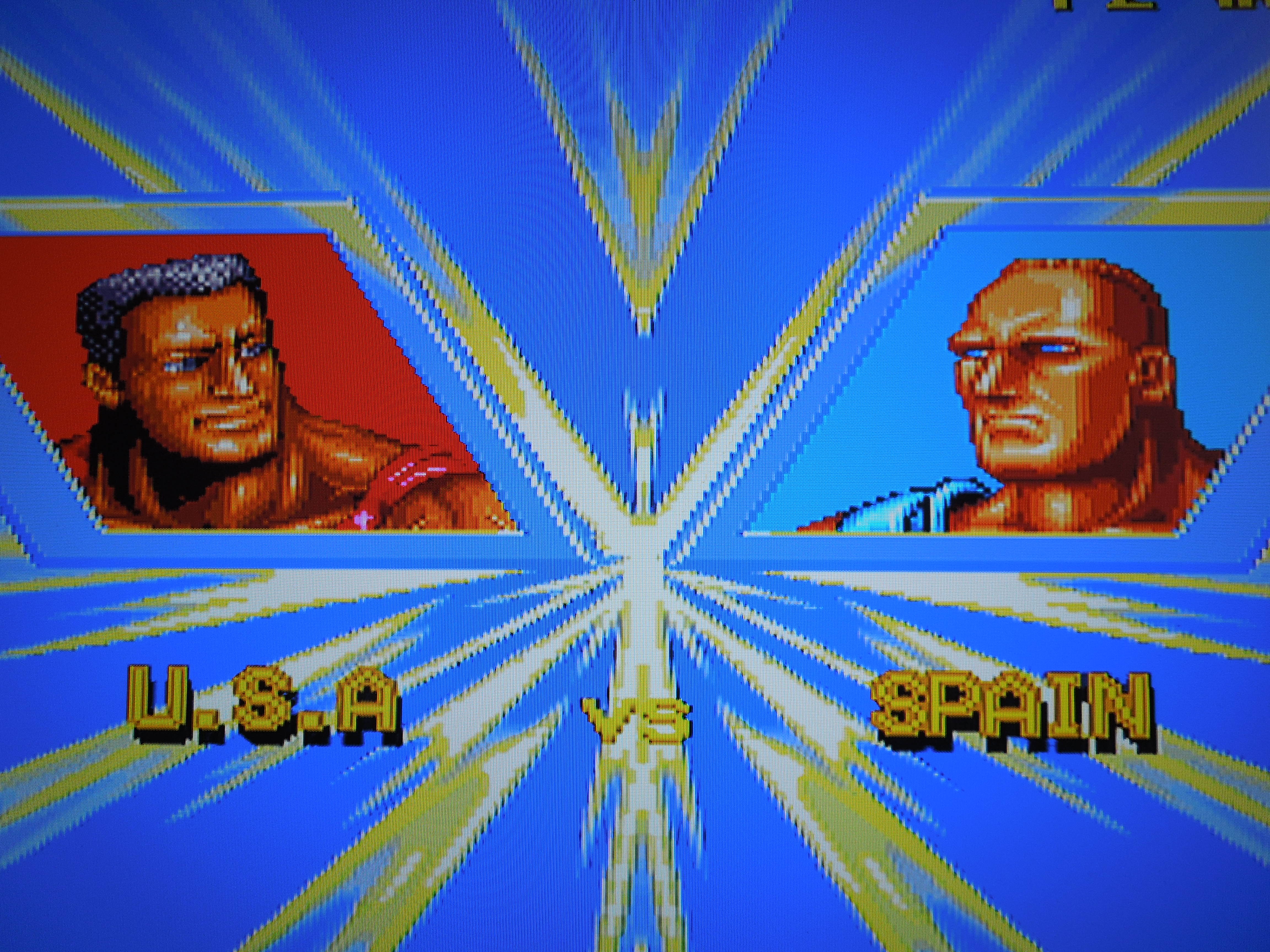
Characters:  The game is relatively short, with only 6 selectable characters.  You’ll face off against all 6 in an International Flying Power Disc Tournament (you’ll play a mirror match versus yourself to bring the total to 6).  There are 6 countries represented:  U.S., Japan, United Kingdom, Germany, Spain, and Italy.  Each character has their own strengths and weaknesses.  Some are quicker but throw the disc more slowly, and some throw the disc quite fast but move slowly.  All characters have different Super Shots.

Courts: There are 6 different courts avaliable to play on.  Some are smaller, some are larger.  The size of the opponent’s 3 and 5 point goals vary based on the court, as do the ‘bumpers’ that appear in the middle of some of the courts.  In one-player mode, you cannot select the court you play your opponent on – it will be selected for you.  In 2 player VS, you do have the option to choose your court.

Your opponent typically has larger 3 point goals, and a smaller 5 point goal. Your opponent typically has larger 3 point goals, and a smaller 5 point goal.
You get some basic info about the characters on the 'Character Select' screen, or you can see a more detailed account if you don't press Start to begin the game. You get some basic info about the characters on the ‘Character Select’ screen, or you can see a more detailed account if you don’t press Start to begin the game.

Options:  You can set the difficulty from 4 choices: Easy, Normal, Hard, and MVS (arcade difficulty – between Normal and Hard).  Beating the game on anything above Easy is tough.  Oh, and you have a pre-set limit of 4 credits per game, which you cannot add to or substract from (like many NEO GEO AES games).  So if you lose 4 times, it’s Game Over and back to the Start screen.  However, if you have a Neo Geo Memory Card, you can save your game and re-start from where you left off.

Additional Notes:

Language Barrier?  No.  The only Japanese you’ll see is when the controls are being explained, after you’ve selected your character.  However, the controls take all of 1 game to figure out, and you can always just watch the image of the control stick, buttons, and character during this demo to see what buttons do what.  Everything else is in English.

So, where can I find this game?  You can look on ebay for the Neo Geo AES cartridge of Flying Power Disc or Windjammers.  Remember, depending on what region your console is from (U.S. or Japan) affects which title screen you’ll see.  Oh, also – if you play the game as Windjammers on a U.S. console, you’ll have 30 second matches to 12 points instead of 45 second matches to 15 points.  I prefer the Flying Power Disc version for this reason.  Both Windjammers and Flying Power Disc were released for the Neo Geo CDZ also.  I believe the CDZ games even extended the time limit on matches to 99 seconds.  I don’t believe the game has been made avaliable for download on any modern-gaming consoles in the U.S.  You can always play it on an emulator on your computer.

Despite being released in Japan, everything in the game is in English, except for the 'Controls Explanation' demo. Despite being released in Japan, everything in the game is in English, except for the ‘Controls Explanation’ demo.

Conclusion:  This is a wonderfully addictive, super-fast-moving game.  There’s nothing else quite like it.  Frankly, it’s hard for me to imagine a gamer picking it up and not enjoying himself or herself.  It’s simple, yet you can practice and learn to do the different Super Shots and angle or curve your throws to become quite proficient at the game, adding some complexity.  2-Player VS is really fun, of course.  It’s the kind of 2-player game that hearkens back to the old video game saying, “Just one more game.”  Short, simple, and really fun.

The Southern Gentleman’s Opinion and Letter Grade:  Recommended, if you’re up for trying a sports game that is something different altogether, A

God Bless! Proverbs 3:6

Game On! Game On!

Game Boy – Kid Dracula

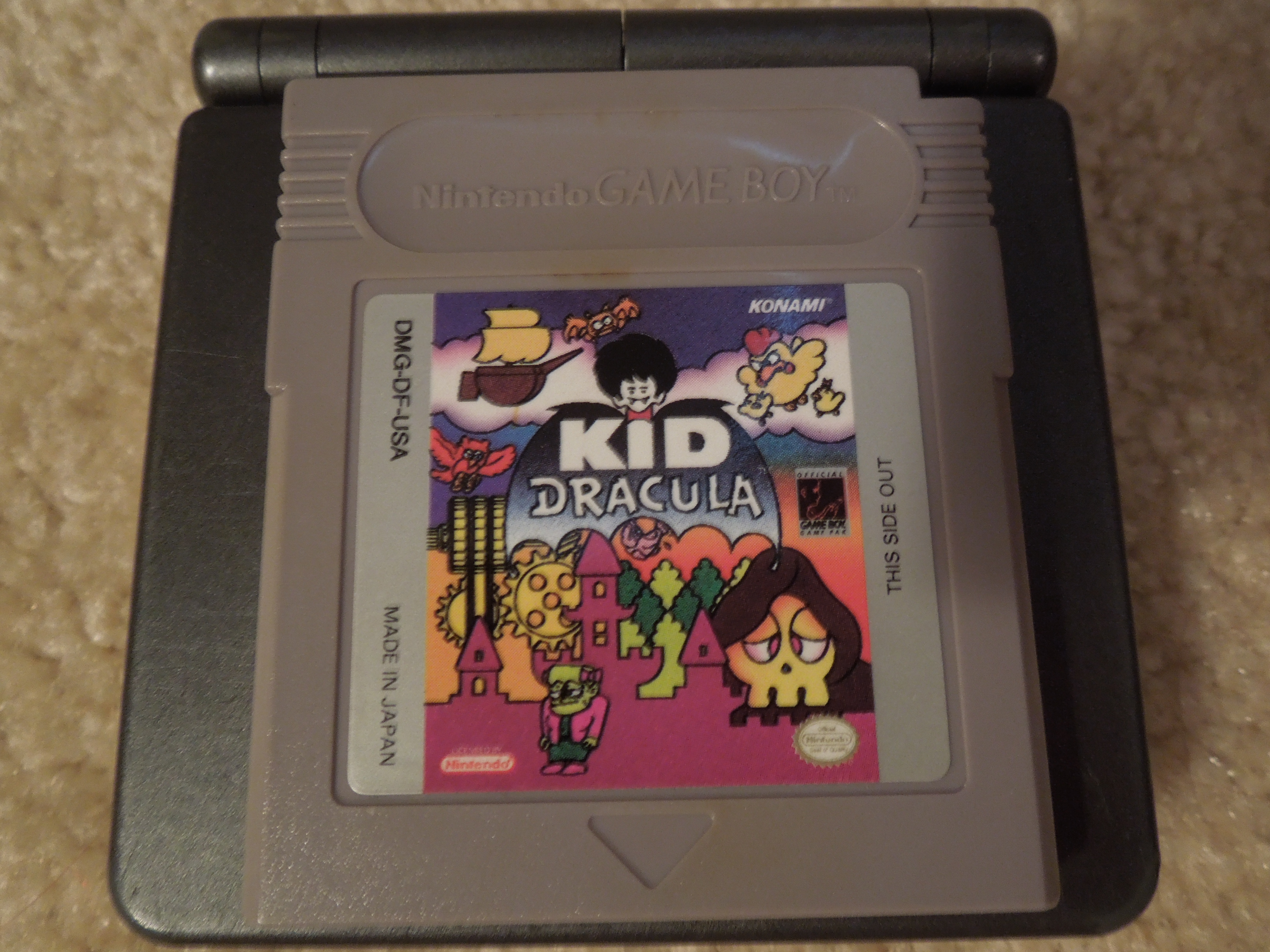
Kid Dracula for the Game Boy Kid Dracula for the Game Boy
Playing Kid Dracula on a Game Boy Advance AGS-101 provides excellent color and lighting. Playing Kid Dracula on a Game Boy Advance AGS-101 provides excellent color and lighting.

Note 1:  Want more Kid Dracula?  Check out the prequel, I’m Kid Dracula!  Also, if you enjoy platforming/action games, check out my reviews of Splatterhouse, Doki Doki Panic, and Super Back to the Future, Part II!

Note 2:  This game was played on a Game Boy Advance AGS-101 model (the one with the really bright back light).  Original Game Boy games like Kid Dracula are compatible with all flip screen Game Boy Advance handhelds, as well as original Game Boys and Game Boy Colors.  This game can also be played on a Super Game Boy on your television.

Quick History:  This game is a spinoff of the popular Castlevania games for the NES and Game Boy, although many gamers who are familiar with Castlevania games are completely unaware of Kid Dracula’s existence.  One of the tie-ins comes from this game’s main antagonist, Garamoth, who evidently appears as a boss in one of the Castlevania games (there are other tie-ins, too, that have something to do with the game’s Japanese title).  The game was released in 1993, and is a sequel to the Japan-only release of Akumajo Special: Boku Dracula Kun for the Famicom (Japanese NES).  Like the Castlevania games, Kid Dracula is a Platformer.  Although the title ‘Kid’ is in the title, this was not a ‘just for kids’ game – not at all.  It’s almost a light-hearted parody of Castlevania with super deformed graphics – it’s also rather tough.

Story:  Garamoth, Kid Dracula’s arch enemy, is up to no good, and Kid Dracula must stop him.  Don’t you miss uncomplicated plot lines?

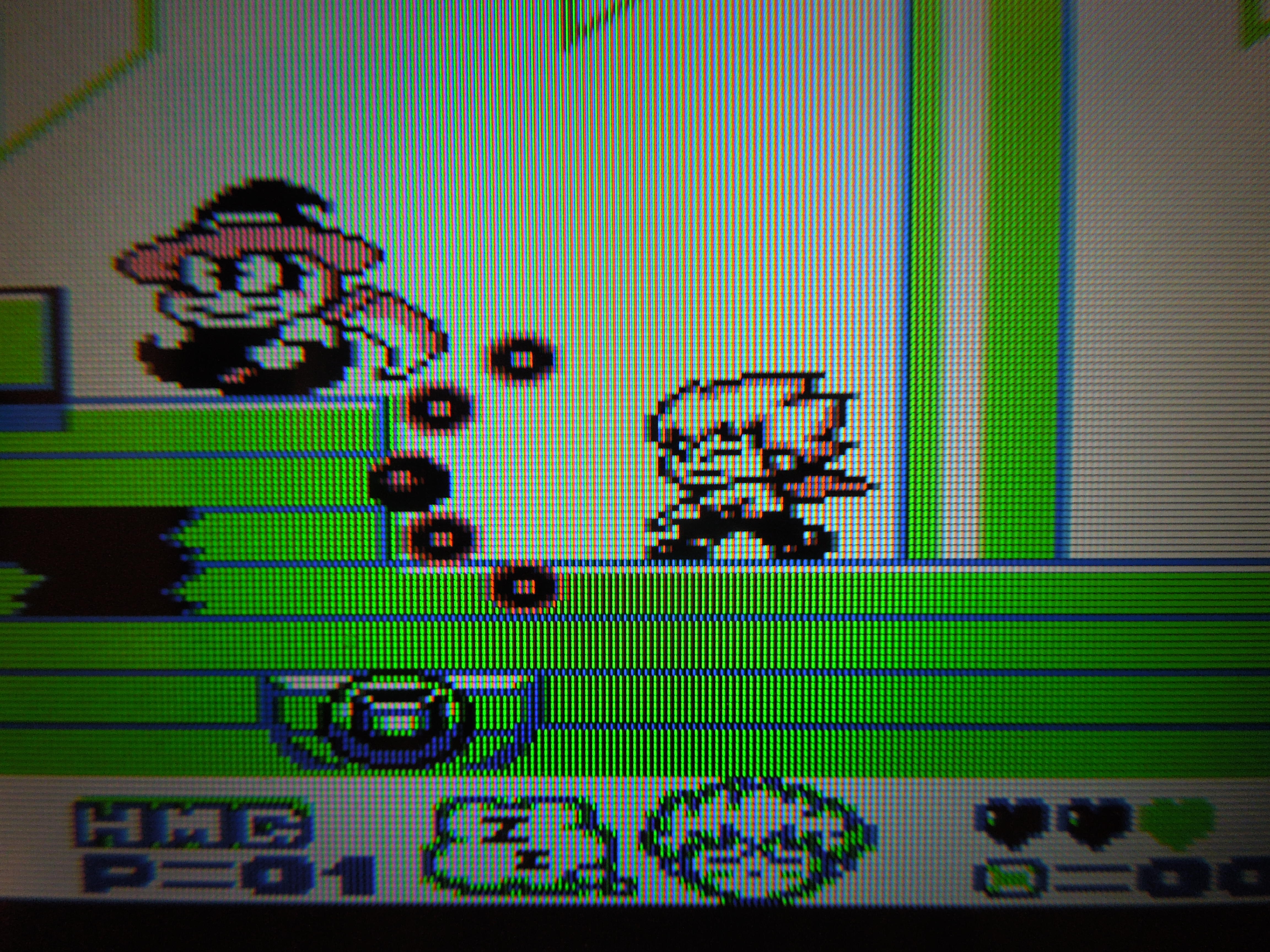
Many of the enemies look friendly, but they definitely have cruel intentions. Many of the enemies look friendly, but they definitely have cruel intentions.

Control: As Kid Dracula was made for the original Game Boy handheld system, it only uses 4 buttons:  Start, Select, B, A.  B shoots a small fireball.  Holding B for a few seconds causes you to flash, then releasing it fires a huge fireball (or executes a different spell you have selected – more on this in a bit).  A jumps.  Start pauses the game.  Select switches among different spells you acquire.  Because this is a platform game, you can duck by pressing down.

Gameplay: You guide Kid Dracula through 8 levels, from a Clocktower Castle to a Roller Coaster to a Pirate Ship.  Each level is made up of a few different areas.  Along the way, you’ll encounter all sorts of bizarre enemies, that, like Kid Dracula, are drawn’in the ‘super deformed’ art style.  You can shoot the enemies with your ‘Normal’ fireball, but you also learn a new spell after each level.  Some of these spells are useful and you’ll use often, and some of them you won’t use much at all.  One spell turns you into a bat, allowing you to fly for approximately 5 seconds; another allows you to walk on ceilings for the same amount of time; yet another spell fires homing missiles at your enemies.  Activating spells is simple: just hold B until Kid Dracula flashes, and then release.  Pressing Select cycles through your spells, remember.  Between each stage, there is usually a cutscene with Kid Dracula and his ‘counselor,’ Death, or his sidekicks, some bats – these advance the very simple plot.

Sound and Music:  This Game Boy cartridge has some great music on it.  The very up-beat tunes work well with the ‘parody of Castlevania’ atmosphere.  There are a variety of sound effects for the different spells at your disposal.

You'll learn a different spell after every level, like the Homing Missile Spell. You’ll learn a different spell after every level, like the Homing Missile Spell.
A 4-digit password allows you the luxury of not having to beat the game in one sitting. A 4-digit password allows you the luxury of not having to beat the game in one sitting.

Coins: If you power up an attack shot by holding B and use it to kill an enemy, the enemy will drop a coin.  Accumulating coins will allow you to play mini-games in-between stages for a chance to either earn more coins or earn extra lives.  A good way to earn coins is to continue killing enemies, which will re-spawn endlessly if you walk away from where you encountered them and then walk back.

Hearts: You start the game with 3 hearts, and lose 1 every time you take a hit.  You can find heart containers, however, to bring up your total number of hearts.  Your limit is 5.  You can also find single hearts dispersed throughout the levels to restore 1 heart, or flashing hearts that will re-fill all of your containers.

Passwords: This game has a simple 4-digit password system to allow you to pick up where you left off.  Unfortuantely, if you’ve gained 2 heart containers and are at 5 total, or if you’ve gained 50 lives in the mini-games, they will be lost if you turn off the system, despite the fact that you can get back to a particular level by using the password.

You'll face a different bizarre boss at the end of all 8 levels. You’ll face a different bizarre boss at the end of all 8 levels.

Difficulty:  The first few stages are easy enough, but it gets tough soon enough.  You’ll die a lot in some levels as you memorize the patterns of enemies and obstacles.  Also, you can continue, but it’s limiting – if you lose all of your lives in Area 2 of Level 2, and then select to Continue, you’ll have to go back to Area 1 of Level 2.  This game has what I’d call an ‘old school difficulty.’  It will push you and frustrate you (in the mostly good way), but it’s rewarding when you finally beat a challenging level.

Between levels, you can play 1 of 4 mini-games to earn extra lives. Between levels, you can play 1 of 4 mini-games to earn extra lives.

So, where can I find this game?  Ebay.  You can buy the Japanese version (if you don’t mind reading Japanese) or the North American version – both will play on your Game Boy, Game Boy Color, Game Boy Advance (not the micro edition), or Super Game Boy.  You can also download the rom for play on an emulator on your computer.

Conclusion:  Don’t let the name or the super deformed graphics deceive you – Kid Dracula is a lot of fun, and no ‘kids’ game.  It plays in a way that is similiar to the well-known Mega Man games for the NES, and it’s difficulty, while perhaps not on a Mega Man level, is certainly present, and you won’t cruise through this one in an hour.  It takes practice and patience to beat Kid Dracula.  As a game in the Castlevania series (ok, technically a spinoff), I prefer this to any of the NES or Game Boy Castlevanias.

The Southern Gentleman’s Opinion and Letter Grade: If you love excellent old-school Platformers with difficulty slightly weighted towards the high end, you should check out Kid Dracula.  A

God Bless! Proverbs 3:6

The elevator level is TOUGH. Expect to die A LOT before you make it to the top. The elevator level is TOUGH. Expect to die A LOT before you make it to the top.

Controllers – Sega Saturn VF Dash

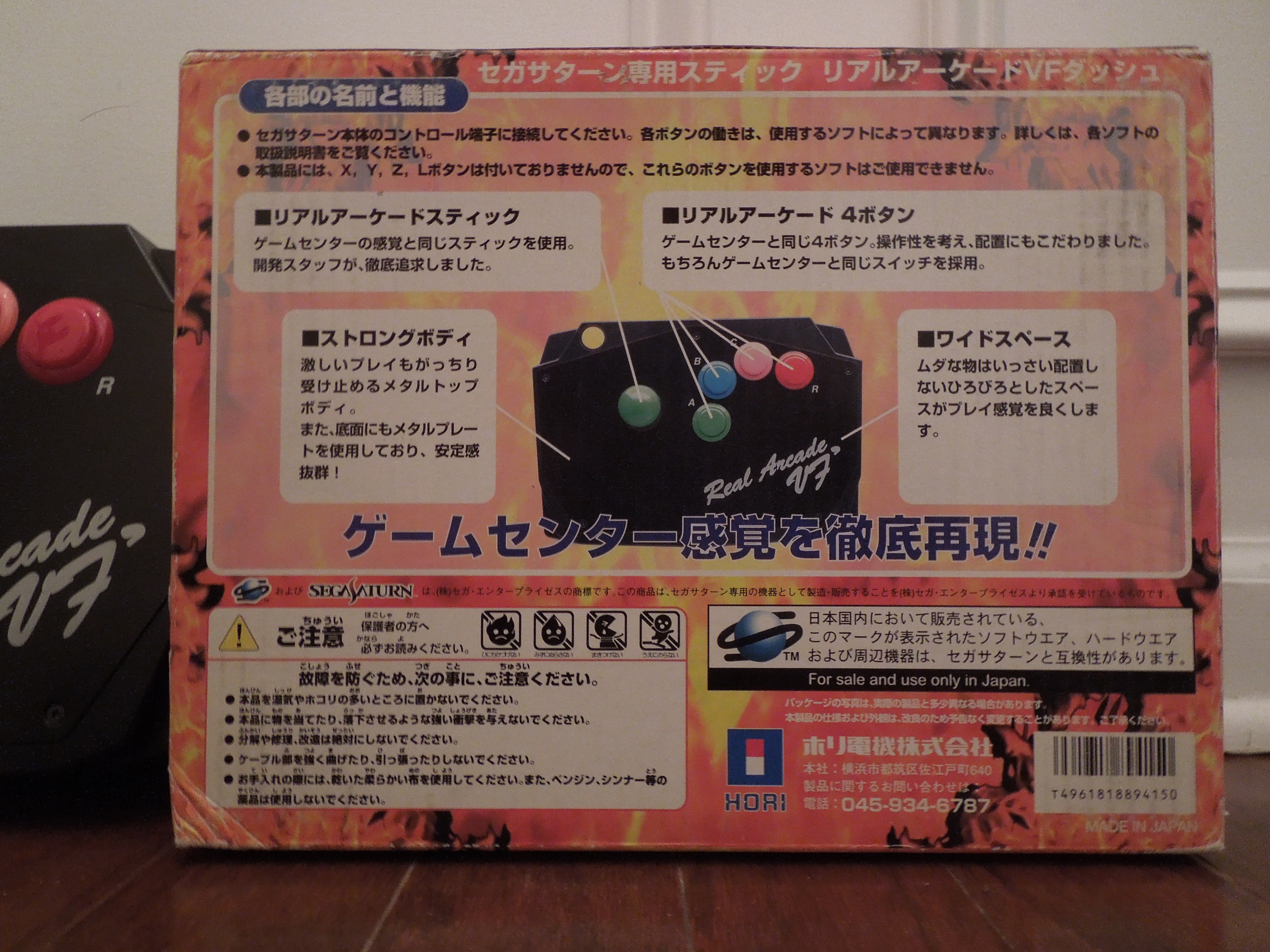
The Real Arcade VF Dash, model HSS-12, for the Sega Saturn The Real Arcade VF Dash, model HSS-12, for the Sega Saturn
The HSS-12 dwarfs the Saturn's model 2 control pad, yet has half as many buttons! The HSS-12 dwarfs the Saturn’s model 2 control pad, yet has half as many buttons!

Note:  Interested in the Sega Saturn?  Check out my reviews of the Saturn games D & D: Tower of Doom, D & D: Shadow over Mystara, Crows: The Battle Action, Nekketsu Oyako, and Warriors of Fate!

Quick Saturn Controller History: Many different controllers were released for the Sega Saturn home console.  The Sega Saturn used 8 buttons (in addition to the control pad and Start button): A, B, C, X, Y, Z, L, R).   While the console, released in 1995, included a basic, well-made game pad (and later a 2nd release that changed some things up), Arcade Sicks were soon released to present an alternative way to play Saturn games.  The Virtua Stick was the most common.  It included all of the necessary buttons, plus turbo switches and an arcade-style stick rather than a control pad.  A second controller, the Virtua Stick HSS-0136, was also released (only in Japan).  The HSS-0136, released by Hori, was huge and extraordinarily similiar to what you would find in an arcade.  It included all 8 buttons, and they were large and round, like those on an arcade cabinent.  Also, the control stick was clicky, much like those in the arcade.  For many Saturn gamers, the HSS-0136 is the pinnacle of controllers for the Saturn.  However, there was another arcade stick that is extremely obscure that was made for the Saturn and was only released in Japan – the Real Arcade VF Dash, model no. HSS-12, which was also made by Hori (a company famous for making great controllers) – this a review of that controller.

Why is the Real Arcade VF Dash controller obscure?  Well, first, there were actually 2 versions of this controller made:  The HSS-09 and the HSS-12.  The HSS-09 had only 3 buttons (in addition to Start and the control stick): A, B, & C – this version doesn’t include ‘Dash’ in its title.  The HSS-12 had only 4 buttons (in addition to Start and the control stick): A, B, C, R.  The 3-button HSS-09 is much more common, with many availiabe on ebay and other online stores.  The 4-button ‘Dash’ version, however (the HSS-12), is much more difficult to find.  I’ve only ever seen one copy ever on ebay, and I bought it new and unused, still in the box (although it’s close to 20 years old) from Japan.  If you google it, you may find a used one from an Asian gaming website.  I’m not sure why less of the HSS-12 model controllers were made, but there are certainly less than the HSS-09.  I could not find much information at all on the Internet about either controller, especially the Dash – I believe both versions were released in 1995.

The 'Dash' is approximately the same size and weight as the Saturn console. The ‘Dash’ is approximately the same size and weight as the Saturn console.

So, why does the controller only have 4 buttons when regular Saturn controllers had 8?  The letters ‘VF’ are in the controller’s title, and perhaps this stood for ‘Virtual Fighter,’ a game that was released when the Saturn came out – perhaps this controller was made for that game, and it only needed 3 or 4 buttons to play (I can’t confirm any of this – just an educated guess).  I think the lack of buttons is the reason the controller possibly didn’t sell well in Japan, or if it did, why it isn’t known in the U.S.  Most Saturn games use more than just buttons A, B, C, and R.  Therefore, you aren’t able to play many Saturn games with the HSS-12 (or the HSS-09, which didn’t even have the R button).  What happens when you need to press X in Marvel Super Heroes vs. Street Fighter?  You can’t because it’s not there!

Compatible games: I sought out this controller for one reason: to play Dungeons & Dragons: Tower of Doom and Dungeons & Dragons: Shadow over Mystara, two games released in Japan.  Those games are arcade-perfect ports and the games use exactly 4 buttons: Attack, Jump, Scroll through items, and Magic (you can change the button layout in the Options menu). Playing using the HSS-12 recreates the arcade experience of Dungeons & Dragons on the Saturn.  I soon discovered that many other Saturn games don’t need any other buttons to play besides A, B, C, and R.  Here is a short list of games compatible with the Dash:

The HSS-12 is approximately the same size as a Neo Geo X controller, yet much, much heavier. The HSS-12 is approximately the same size as a Neo Geo X controller, yet much, much heavier.

Dungeons & Dragons: Shadow over Mystara and Dungeons & Dragons: Tower of Doom (need all 4 buttons)

Warriors of Fate (only needs A, B, & C).

NBA JAM and College Slam (only need A, B, & C, but R or C can be used for ‘turbo’)

Nekketsu Oyako (uses all 4 buttons, but R [makes you run] performs the same task as double-tapping forward)

Crows: The Battle Action – (Technically, the game uses 6 buttons, but you can change the button layout in the Options menu – you don’t need ‘Taunt’ or ‘Block’ – you’ll never miss them)

Outrun: (2 buttons to play)

Cotton 2: (only needs A, B, & C).

Gunbird: (PERFECT controller for this shoot ’em up game!)

Astal: (buttons A, B, and C are of course the main attack, jump, and special buttons depending on how you set the configuration, and button R scrolls through the uses for the bird.  Excellent way to play Astal!)

Blazing Tornado: (this game is a port of an arcade wrestling game, and you only need A, B, and C)

Pocket Fighter: Unlike so many other CPS2 ports, this one doesn’t need any more than A, B, and C)

Elevator Action Returns: Only the A and B buttons are used for shooting and jumping.  You can, however, change the controls so that your ‘bombs’ button is mapped to the C button if you like (instead of having to press A+B).  Excellent arcade port already, but better when played with this controller!

The Controller Itself:…is AWESOME.  It is, beyond all doubt, the best video game controller I’ve ever played with.  It feels like you’re playing with a stick and buttons from a real, old-school arcade cabinent.  The controller is heavy, for starters.  The top and bottom plates are made of solid metal instead of plastic.  I’m not sure what’s inside, but this is one bulky controller (in the good way).  The stick itself works great.  It is an 8 way stick that ‘clicks’ in all directions.  The 4 buttons – A, B, C, R – are all HUGE, just like arcade buttons, and are great for rapid tapping in Beat ‘Em Ups and Shooters.  The controller works great on your lap or on a coffee table in front of you.  It comes with a 6 foot cord attached to it, so I recommend buying a Saturn controller extensi0n (really cheap online) if you sit further from your tv.

Where can I find this HSS-12/Dash controller?  It may pop up on ebay from time to time, but as I mentioned, I’ve only ever seen it once.  Doing a broad Internet search may come up with something.  You can easily find the HSS-09, which is exactly the same controller, except that it’s missing the R button.

Conclusion:  This controller is fantastic.  Sure, you can’t play all of your Saturn games with it because of it only having 4 buttons, but if you like Beat ‘Em Ups and Shooters, most of those games don’t need the extra buttons anyway.  Make sure you do your homework on what buttons individual games use, and if they have an option to change the button layout.

The Southern Gentleman’s Opinion and Letter Grade:  For compatible Saturn games (many of which are arcade-perfect ports anyway), this controller is the BEST.  A++

God Bless! Proverbs 3:6

The HSS-12 is hard to find, but the HSS-09 is more widely avaliable today - it's exactly the same, but has only 3 buttons, not 4. The HSS-12 is hard to find, but the HSS-09 is more widely avaliable today – it’s exactly the same, but has only 3 buttons, not 4.

Sega Saturn – Nekketsu Oyako

Nekketsu Oyako for the Sega Saturn Nekketsu Oyako for the Sega Saturn

Note 1:  Like Beat ‘Em Ups?  Check out my reviews of Double Dragon II, Sengoku 3, D & D, Bare Knuckle III, Crows: The Battle Action, Warriors of Fate, Nekketsu Oyako, Final Fight Guy, Final Fight 2, and Mighty Final Fight!

Note 2: This game was played on a U.S. Sega Saturn.  Because the game is a Japanese game, a 4M Action Replay cartridge was inserted into the Saturn’s cartridge slot, allowing games from all regions to play on the system.  The Saturn was connected to a 32-inch HD tv using S-video cables.

This game is one of only a handful of Beat 'Em Ups for the Saturn. This game is one of only a handful of Beat ‘Em Ups for the Saturn.

Quick History:  Nekketsu Oyako, or Hot Blooded Family, is a Beat ‘Em Up that was released for the Japanese Sega Saturn home console in 1995.  The previous year, 1994, saw the release of Nekketsu Oyako for the Japanese Playstation, and the Saturn game was essentially a port of that game, albeit with a few minor changes.  Despite the word ‘Nekketsu’ in the title, this game is not a game in the Kunio-kun series.

Story: I cannot read Japanese, but from what I can gather, a father named Rando, along with his son, Tora, and daughter, Rio, must rescue his wife and mother to his children.  You’ll have to fight through 5 stages, each with different areas, in order to rescue her.  Stages range from a bridge, to the insides of a giant whale (seriously), to an amusement park, to an underground mine.  The final boss of the game, Herograw, is as bizarre as some of the stages you fight in – after you best him physically, he transforms into some type of sadistic super hero for you to fight once again!

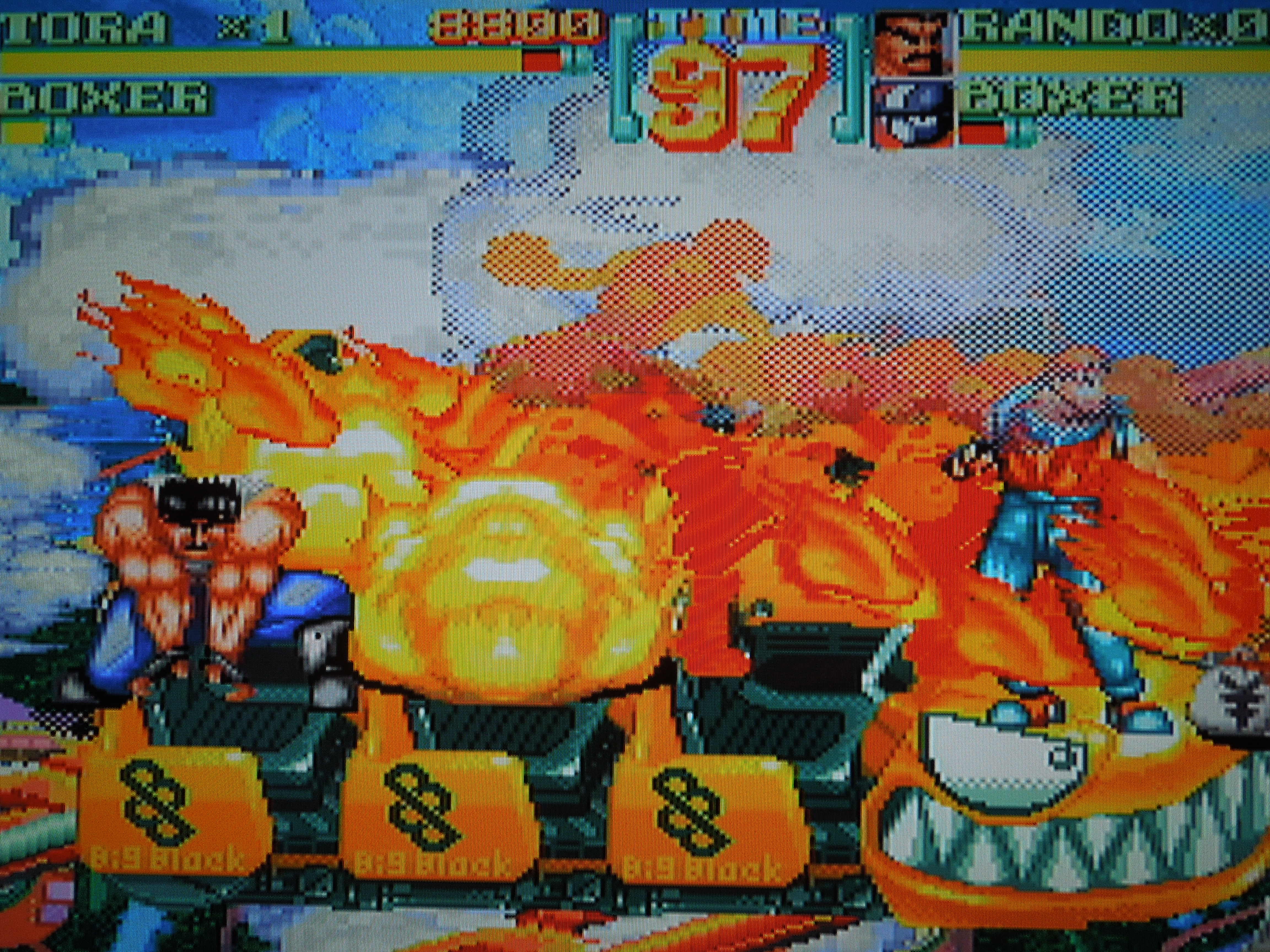
Gameplay:  Choose from among the 3 family members.  Rando, the father, is slow but strong (think ‘Haggar’ from Final Fight – he even looks like him!) and fights bare-handed.  Rio, the daughter, is quick but weak, and she carries a croquet mallet at all times to use on enemies.  Tora, the son, is average in strength and speed, and seems to have some type of ‘energy saber’ that he uses at certain times.  Like most games in the Beat ‘Em Up genre, you walk to the right, beating up everyone and everything in sight.  Bosses await you at the end of each stage, including a gauntlet of previously defeated bosses in the final stage before you face the game’s true antagonist, Herograw.

Rio fights with an obscure weapon - a croquet mallet. Rio fights with an obscure weapon – a croquet mallet.

Control:  A punches – pressing A rapidly performs a combo.  B jumps – pressing B again while in the air makes you double-jump.  C performs your character’s Super Move (tornado, explosion, or light-blast depending on your character), which knocks down all enemies, yet takes a bit of your health bar off.  R will cause your character to dash, although you can also double tap the control stick to achieve this.  Tora can dash non-stop, while Rando and Rio will only dash briefly.  When dashing, pressing A causes your character to do a running attack, like a running knee (Tora).  After jumping, pressing A will cause your character to do a jump kick.  Pressing A + Down while in the air will cause your character to knee drop (Tora), body press (Rando) or pogo (Rio).  For Rio, jumping, then pressing A + Down will cause her to do a ‘pogo-stick’ attack, and she can bounce off an enemy’s head several times for maximum damage, or even bounce back and forth between enemies – Tora can do a similiar move as well.  For all characters, quickly rolling the control pad in a toward, down, toward motion then pressing A will cause a special attack – a croquet mallet barrage for Rio, an energy saber barrage for Tora, and a super uppercut for Rando.  When close to an enemy, you will automatically grab him or her.  Pressing A will cause your character to punch the grabbed enemy, and pressing A + right or left will throw the enemy.  Additionally, Rando can jump with an enemy in hand by pressing B, then pile drive him or her from mid-air by pressing A.

Sound and Music:  Neither are particularly great.  The music is rather bland, and the sound effects, while decent enough, should have been a lot better on a powerful system like the Sega Saturn.  The sound effects for pummeling hordes of thugs works, but isn’t anywhere close to as good as the face-crushing sound effects in a similiar game like Final Fight.

Additional Notes:

Not so fast there, junior. Not so fast there, junior.

Language Barrier?  No and Yes.  There is nothing here to prevent you from enjoying the game.  The character names and enemy names are all in English.  Unfortunately, the story that plays when you beat the game is in Japanese, as is the Options menu.  The game’s difficulty setting (the top item in the Options menu), like most games, is pre-set to Normal, but you can move the symbol left once for Easy, right once for Hard, or right twice for Expert.  Luckily, there are numbers in place for your set number of lives, so it’s easy to move from the original setting of 2 lives to up to 4 lives per credit.

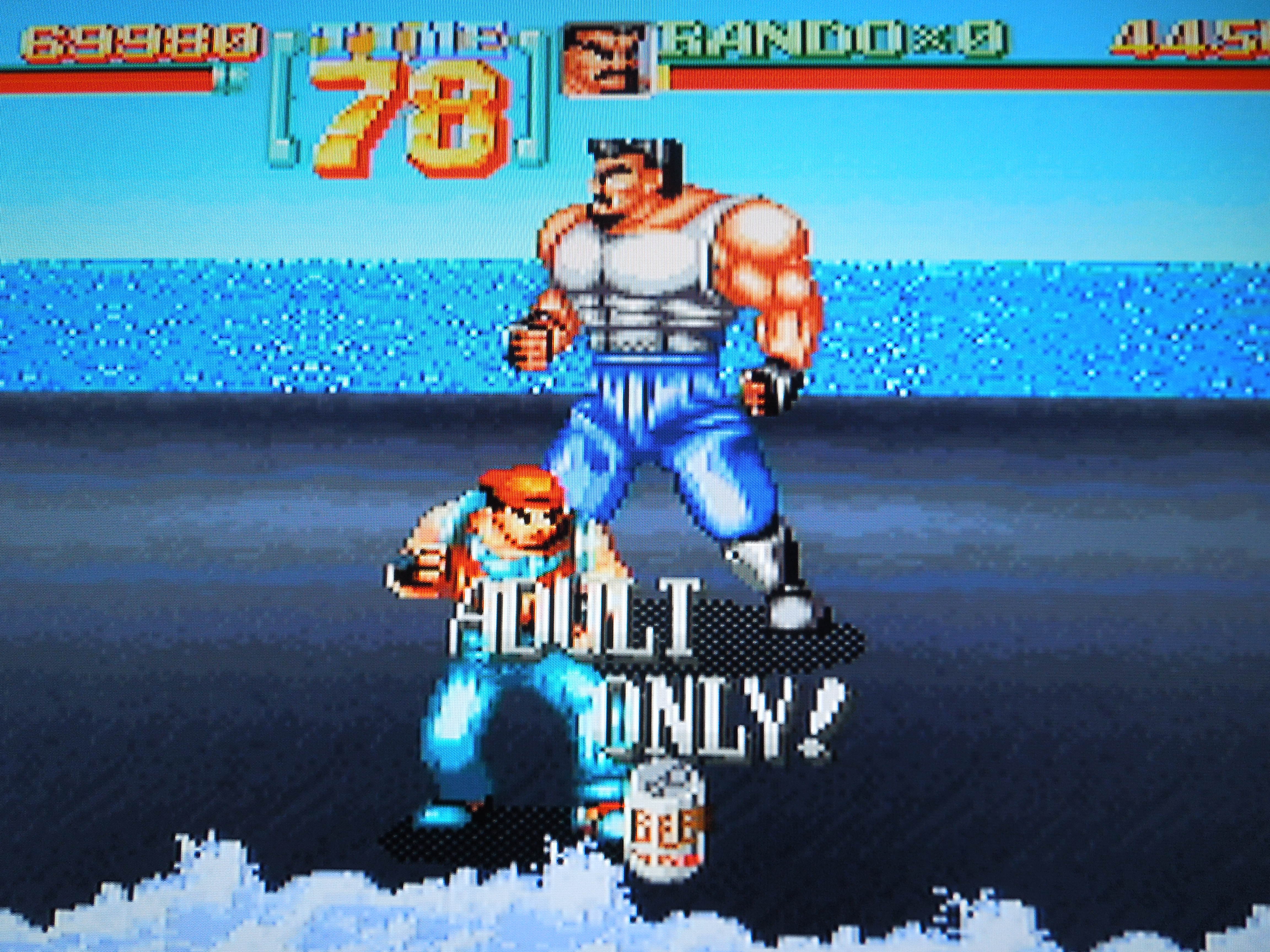
Items:  As you fight through the game, you’ll break open barrels to pick up health items, including chicken, burgers, pizza, milk, and beer.  Comically, if you try to pick up the beer food item with Tora or Rio, the words ‘Adult Only!’ pop up, and you can’t have it!  Different food items replenish a different amount of your health.  You also pick up other items that add points to your score.  These include yen, toy airplanes, teddy bears, and even a Sega Saturn console!  These are important to pick up, because at 200,000 points you’ll receive an extra life, and then again at 700,000.  You have to be careful not to pick up items when you’re fighting enemies.  Because the ‘pick up’ button is the same as the ‘punch’ button, your character may accidentally bend down to grab a pizza when you meant to punch the enemy, and you’ll be vulnerable to attack.

Not a lot of Beat 'Em Ups included guns - this one did, though. Not a lot of Beat ‘Em Ups included guns – this one did, though.

Weapons:  You pick up guns, bombs, razor-sharp discs, and knives in this game – all from breaking barrels open.  You throw or shoot all of these weapons.  As far as guns go, there are 3: machine guns, rifles, and a bazooka.  Tora and Rio can’t pick up the bazooka, which is understandable, I guess, because they’re smaller.  But, for some reason, Rando cannot pick up and use rifles or the machine gun – only the bazooka.  I guess the game developers wanted to keep things balanced.  You get approximately 5 shots with each gun.  The razor-sharp disc is the best weapon however, as it comes back to you when you release it, and can hit enemies multiple times in a single throw.

This game is bizarre:  Yes, it’s a little bizarre.  You’ll fight inside a whale (and on his back when he shoots you out of his blow-hole).  You’ll fight octopuses.  You’ll fight blobs of water.  All of the main enemies wear boxing gloves.  The final boss turns into a cape-wearing super villian.  It’s not always strange, but there are certainly times when you’ll say, “That was unexpected.”

So, where can I find this game?  Ebay.  You’ll probably have to buy it from Japan.  Remember, it was also released on the Playstation, but I believe you’d have to have a Japanese Playstation in order for the game to work.  You can also download the rom (I believe there’s even a translated one) for play on an emulator on your computer.

Each character has their own strengths and weaknesses, like in most of these type of games. Each character has their own strengths and weaknesses, like in most of these type of games.

Conclusion:  The Sega Saturn was sadly lacking in Beat ‘Em Ups, and there are only a small handful that were made for the system.  This game is the defintion of ‘average.’  The control is fine; everything works the way it should.  A lot of enemies can appear on screen at one time, which is awesome, although ‘slow-down’ occurs from time to time.  You have 4 different diffculty levels, and Hard and Expert are justly named.  You can’t change characters once you lose all your lives and continue (you have 4 continues), so whoever you start with, they’re in it to win it.  The sound and music are sorely lacking – many Super Nintendo games, which were made for a less powerful console, sound a lot better than this game.  The graphics also, while there’s nothing wrong with them, could have looked a lot better considering what the Sega Saturn can handle.  Other Saturn Beat ‘Em Ups, like Dungeons and Dragons: Tower of Doom, Warriors of Fate II, or Crows: The Battle Action look much better than this one.  If it weren’t for the multitude of enemies on screen, this game would look like a SNES game.  Comparatively, how does it stack up against a similiar game – say, Final Fight for the SNES?  It’s not nearly as good or memorable.  Still, it’s not bad – just not great.  It is 2 player co-op, and that always helps, of course.

The Southern Gentleman’s Opinion and Letter GradeIf you own a Sega Saturn and want a Beat ‘Em Up, this game is an OK choice.  Otherwise, there are many, many more engaging Beat ‘Em Ups out there.  C

God Bless! Proverbs 3:6

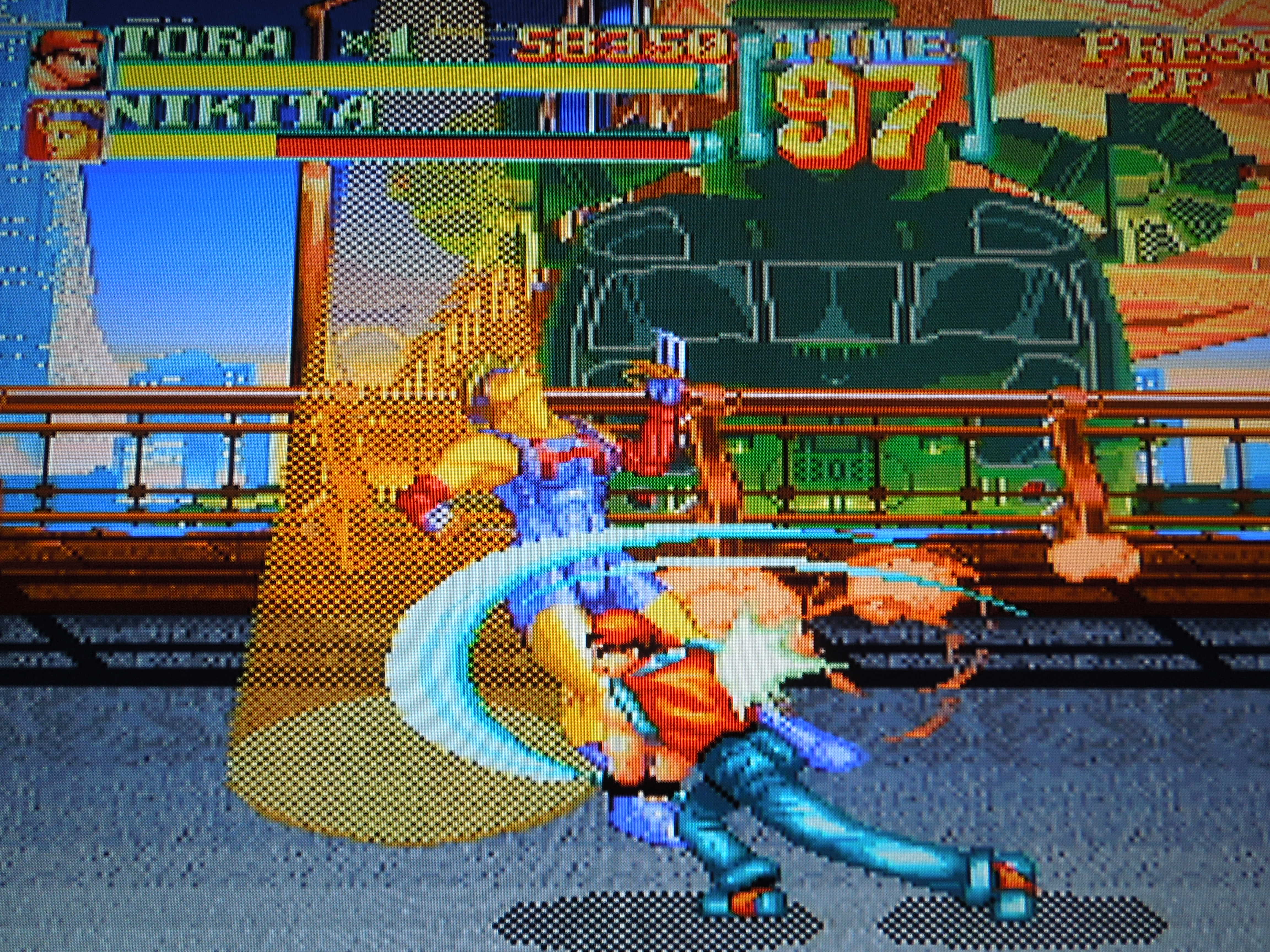
Each character has a special attack that is nearly impossible for enemies to avoid. Each character has a special attack that is nearly impossible for enemies to avoid.

NES – Mighty Final Fight

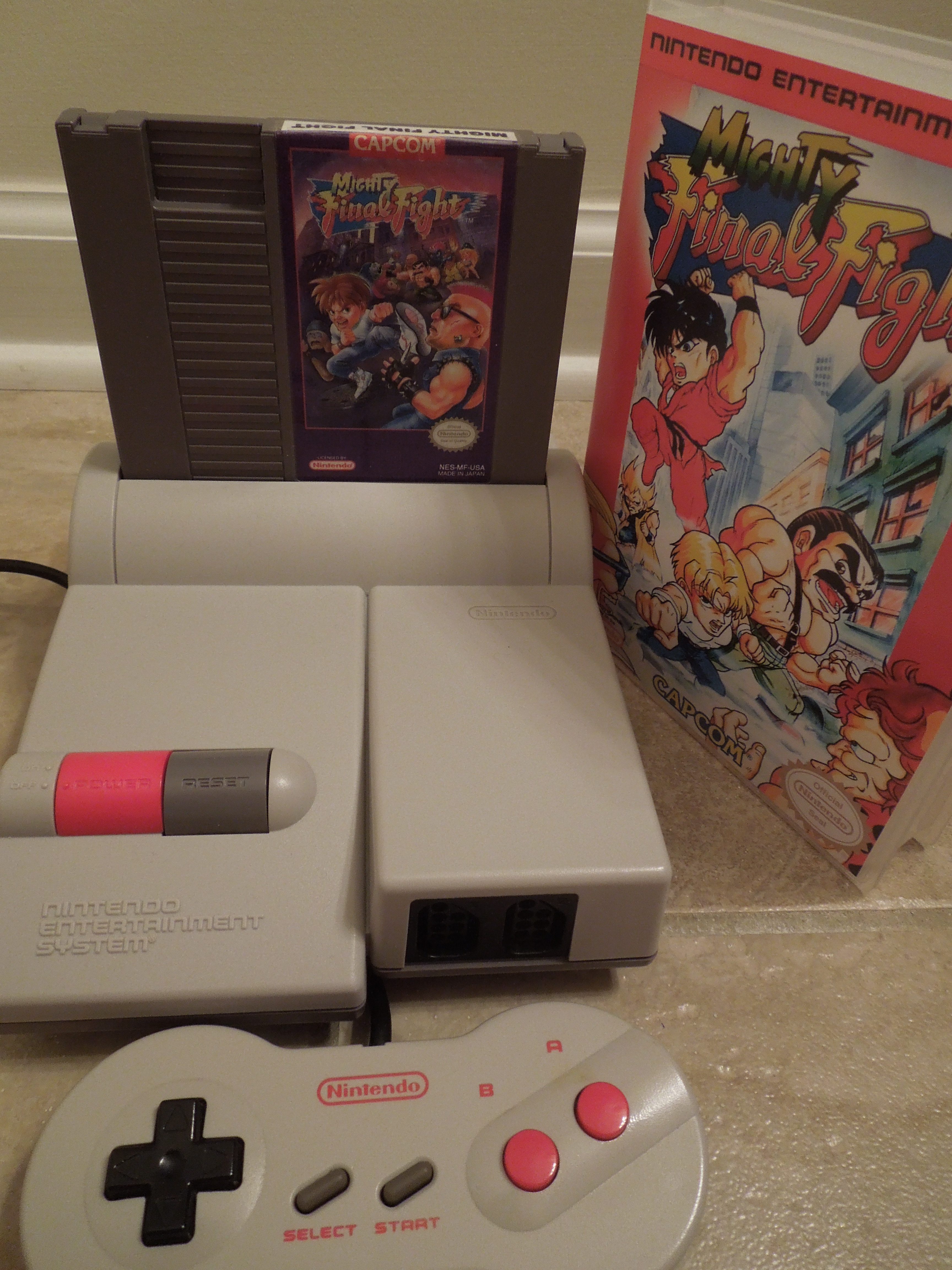
Mighty Final Fight for NES Mighty Final Fight for NES

Note 1: Like Final Fight games?  Check out my reviews of Final Fight Guy and Final Fight 2!  Also, check out my other other Beat ‘Em Up reviews of Sengoku 3, Double Dragon II, Warriors of Fate, Nekketsu Oyako, Crows: The Battle Action, D & D, and Bare Knuckle III!

Note 2:  This game was played on a NES 101 (top loader) console that has been modified to output in AV (red, yellow, white), just like the original NES.  The NES was connected to a 32-inch HD tv.

The NES 101 is much more reliable than the original model. The NES 101 is much more reliable than the original model.
Fight through 5 rounds of Beat 'Em Up mayhem. Fight through 5 rounds of Beat ‘Em Up mayhem.

Quick History:  Mighty Final Fight was released in 1993.  With the Nintendo Entertainment System’s big brother, the SNES, having been released 2 years earlier, the 8-bit NES was in its twilight by the time that Mighty Final Fight hit the market, with fewer and fewer games being released for the console.  Because of the SNES’ popularity, many gamers no longer purchased NES games, opting for the better graphics, sound, and overall ‘newness’ of the powerful 16-bit Super Nintendo.  So, unfortunately, great games like Mighty Final Fight went unnoticed by many gamers.  Had the game been released during the NES’ prime, it likely would be extremely well known, and may even have reached ‘classic’ status by this point in time.

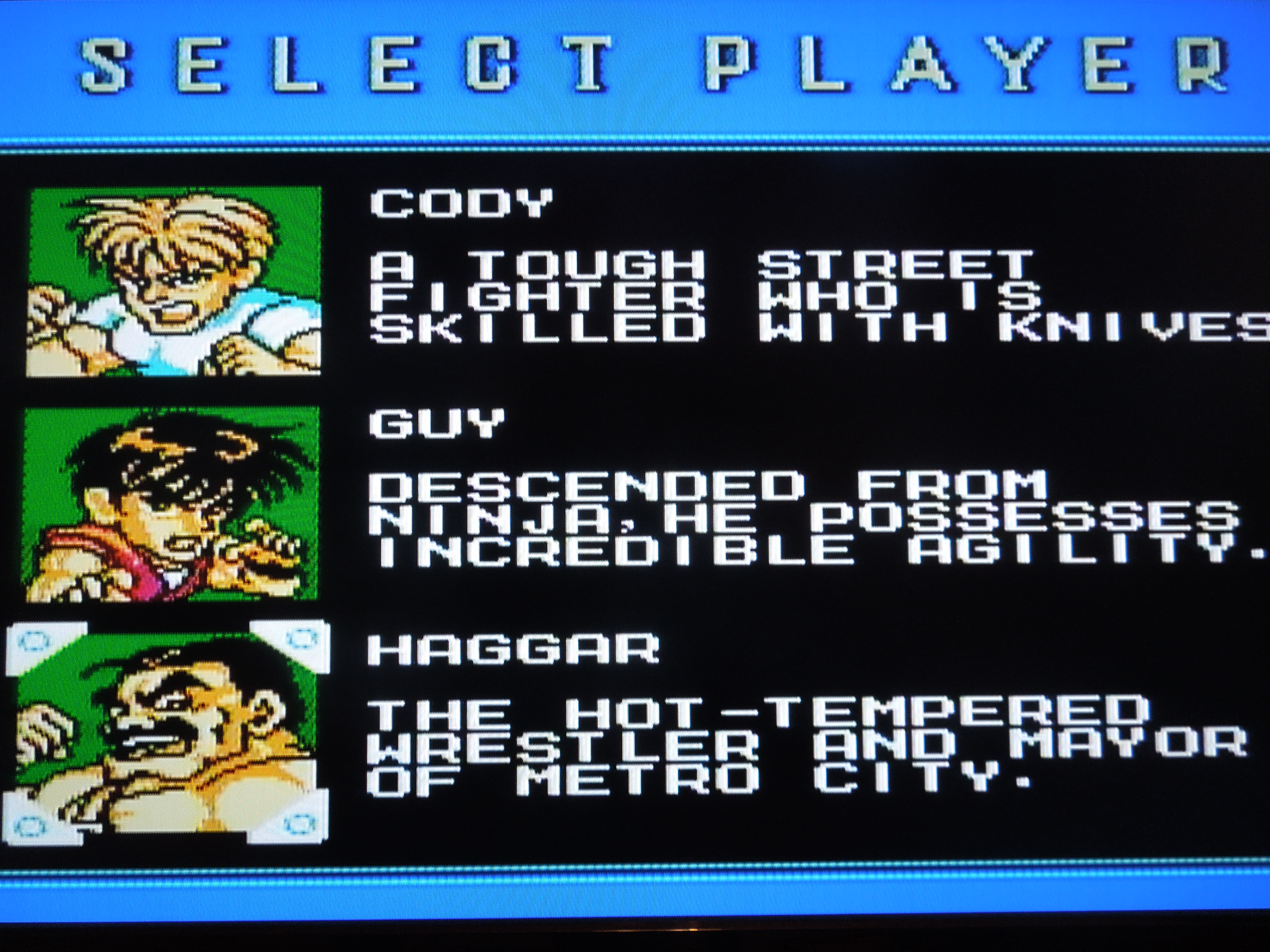
Story:  This game is essentially a parody of the arcade game, Final Fight, released for the arcades in 1989 and for the SNES in 1991.  In Final Fight, a vicious gang, led by a man named Belger, kidnaps the mayor’s daughter, Jessica, and you must fight to rescue her.  There is an implication in the arcade version, and somewhat in the SNES version, that Jessica’s virtue is in very serious danger at the hands of the gang members.  In Mighty Final Fight, however, Jessica has been kidnapped in order for Belger to marry her.  The entire story is presented in a much more light-hearted style with comical tones, much different from its arcade counterpart.  Mayor Haggar, Jessica’s boyfriend Cody, and his ninja friend Guy must thwart the gang and rescue Jessica.

Throwing enemies into other enemies? Check. Throwing enemies into other enemies? Check.

Gameplay:  This game is, of course, a Beat ‘Em Up.  Much like Final Fight, in Mighty Final Fight, you must brawl your way through hordes of Mad Gear gang members in order to rescue Jessica.  There are 5 Rounds in the game, each made up of a couple of different areas – these range from the streets, to a riverside area, to a factory.  At the end of each round, you fight a boss.  You select 1 of 3 characters:  Haggar, Guy, or Cody.  Haggar is slow but strong, Cody is well-rounded with average strength and average speed, and Guy is the quickest and weakest.  Much like the SNES version of Final Fight, this game is for 1 player only.  However, the fact that you could choose among 3 characters instead of 2 did give this game an advantage over the SNES game.  Mighty Final Fight added a unique ‘level up’ system to this game, however, that makes it a little more than your standard Beat ‘Em Up.  During gameplay, your character gains experience points after defeating enemies, and he will ‘advance’ levels after a set number of points has been gained – your life bar gets longer with each level gained, in addition to being re-filled.  Your character has 6 total levels he can advance to throughout the game.  Cody and Guy start the game at Level 1, but Haggar starts at Level 3.  At level 4, your chosen character will be able to execute a Super Attack for the rest of the game.  You can advance your character’s level faster by using different moves as the ‘kill move’ on an enemy.  For example, a regular punch kill will earn you 2 points, but a throw kill will earn you 4.  It’s fun to see play around with, but there are also detailed FAQs online about this Level Up system.  Also, there are never more than 2 enemies on screen at one time, but new ones come quickly as you make kills.

Damnd (in this pic), Sodom, Abigail, and Belger are the game's bosses, like in the original arcade Final Fight. Damnd (in this pic), Sodom, Abigail, and Belger are the game’s bosses, like in the original arcade Final Fight.
Guy's Super Attack is a lightning-fast Super Kick. Guy’s Super Attack is a lightning-fast Super Kick.

Controls: B punches (tapping rapidly executes a combo).  A jumps.  Jumping + pressing B executes a jump kick (Guy and Cody) or cannon ball (Haggar).  Jumping + down + B executes a knee drop for Cody and Guy.  Hitting A + B executes your Special Move, which clears out all enemies around you, but costs you a bit of health.  Getting in close causes you to automatically grab an enemy.  Simply pressing B when you grab an enemy will cause your character to knee smash (Guy and Cody) or headbutt (Haggar) them.  Pressing B + right or left when an enemy is grabbed will cause you to throw the enemy (Guy and Cody) or suplex them (Haggar).  Additionally, with Haggar, you can jump with a grabbed enemy in hand and press B while in the air to pile drive him or her.   Once you’ve reached your character’s Level 4, execute your character’s Super Attack by pressing B followed immediately by left or right on the control pad.  Cody throws a fireball, Guy lets loose a lightning super kick, and Haggar will race toward an enemy and grab them for a suplex or pile driver.

Earn 1-UPs and 2-UPs in bonus rounds. Earn 1-UPs and 2-UPs in bonus rounds.

Sound and Music:  For comparison’s sake, this music is more catchy than what’s found in the SNES’ Final Fight.  The sound effects are all well done – it sounds like you’re really getting into it (for a video game) with these street toughs.

Additional Notes:

Health items: As you fight your way through the game’s 5 rounds, you’ll encounter barrels to break open.  Sometimes food will pop out – food replenishes your life bar, or, if your life bar is already full, will add to your experience points total, helping your character ‘level up’ faster.  Other Items: During bonus rounds, in which you must break rolling barrels, you can earn hearts (1ups) or dolls (2ups).  Also, money bags can be found that grant an extra continue.  Weapons: Weapons can be found in barrels, and they are unique to which character you’ve chosen – Haggar gets a huge mallet, Guy gets throwing stars, and Cody gets a knife.

Roxy and Poison are in this game?  I thought Nintendo didn’t want any controversy over ‘violence against women.’  Yep, they’re here.  Although the enemies don’t have names like in the SNES’ Final Fight, these two female gang members are definitely in the game.  In 1991, when Final Fight was released for the SNES, Nintendo censored the game by removing Roxy and Poison and replacing them with male gang members named Billy and Sid (in the North American region).  However, I guess when Mighty Final Fight was released 2 years later for the NES, Nintendo of America decided it didn’t matter anymore, and included females.  Interesting.

Mighty Final Fight's story is much more comical in nature than the arcade Final Fight. Mighty Final Fight’s story is much more comical in nature than the arcade Final Fight.

So, where can I find this game?  Ebay, Amazon probably.  It was also made available for the Capcom Classics Mini-Mix for the Game Boy Advance handheld system.  You can play the rom on a computer emulator as well.

Conclusion: This is one heck of a Beat ‘Em Up.  The characters are big and detailed, and they’re drawn in that ‘super-deformed’ art style, which, personally, I’ve always thought works well in these type of games.  There is some very slight flicker, occasionally, with bigger enemies on screen.  The control, music, and sound are all great.  The addition of the ‘leveling up’ system is a nice touch, yet doesn’t detract from the simplicity of the game.  Is it repetitive?  Of course, and that’s what makes Beat ‘Em Ups so great!  Being able to choose among all 3 characters is great, instead of only 2 like in the SNES game.  You can change characters if you have to continue.  2 player co-op would have been a wonderful addition, but it’s sadly absent.  I’m not sure of another game quite like this one for the NES – perhaps River City Ransom is closest, but even that is a stretch.  Is this game better than the SNES’ Final Fight  or the lesser-known alternate version Final Fight Guy?  Yes, it is.  And that’s saying something, because those games are terrific.

The Southern Gentleman’s Opinion and Letter Grade:  If you have a NES and are looking for something new, try this one – you won’t be sorry.  A

God Bless! Proverbs 3:6

Some of Cody's moves have been borrowed from Street Fighter II. Some of Cody’s moves have been borrowed from Street Fighter II.

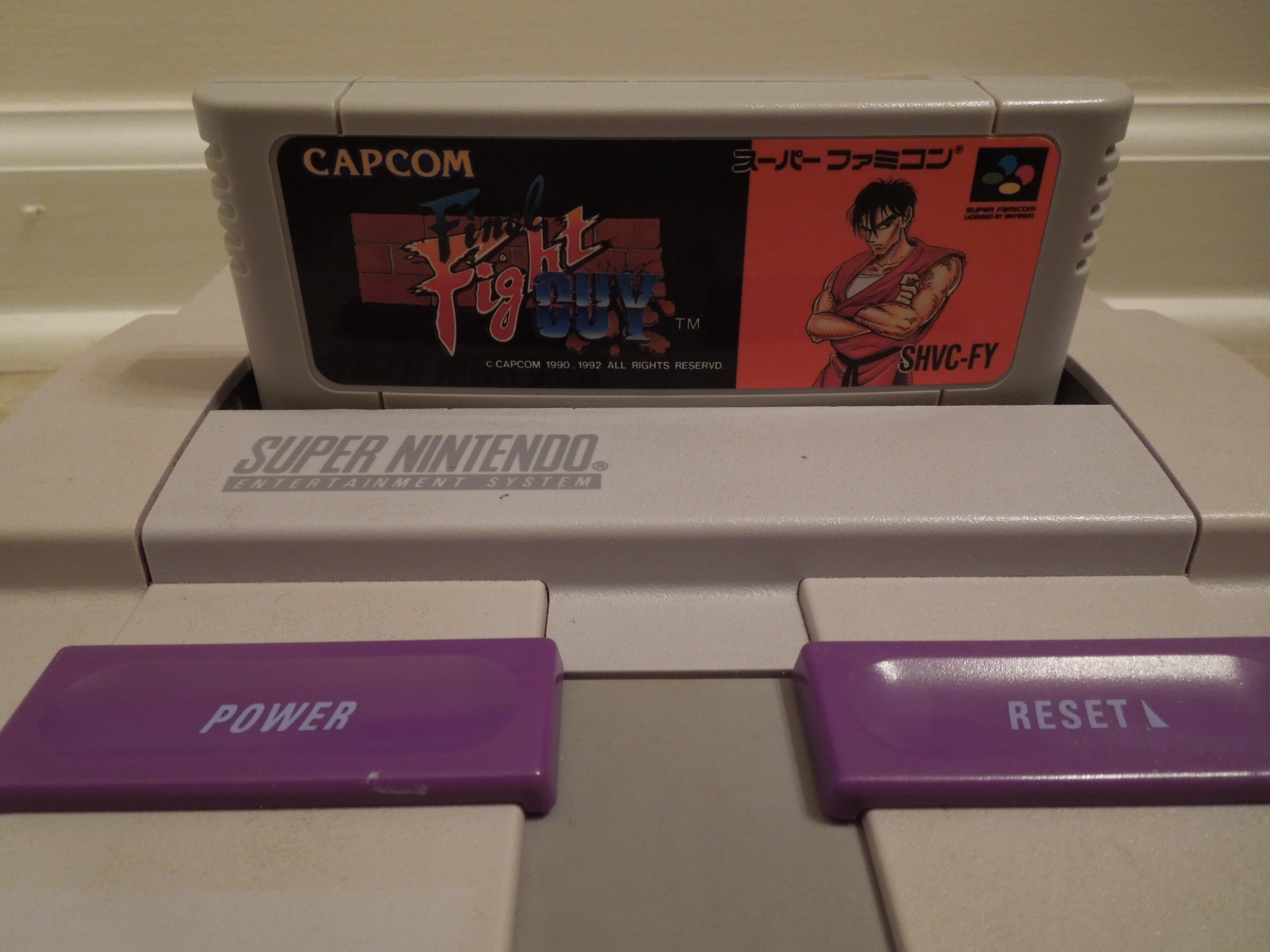
Super Famicom – Final Fight Guy

Final Fight Guy for the Super Famicom Final Fight Guy for the Super Famicom
You can play Super Famicom games on your SNES by removing 2 plastic tabs that are located inside the cartridge slot - it's not difficult. You can play Super Famicom games on your SNES by removing 2 plastic tabs that are located inside the cartridge slot – it’s not difficult.

Note 1:  Want more Final Fight?  Check out my reviews of MIghty Final Fight and Final Fight 2!  Also, if you’re interested in more Beat ‘Em Ups, check out my reviews of Double Dragon II, D & D, Warriors of Fate, Crows: The Battle Action, Bare Knuckle III,Sengoku 3, and Nekketsu Oyako!

Note 2: This game was played on a Super Nintendo Entertainment System. Although the game was released in Japan for the Super Famicom (Japanese SNES), it will play on the original model U.S. Super Nintendo IF you remove the two plastic tabs inside the SNES’ cartridge slot.  The game cannot be inserted with the tabs in place.  I removed the tabs in my SNES with a pair of needle-nosed pliers – it took about 10 minutes – now I can play all Super Famicom games from Japan!  The SNES was connected to a 32-inch tv via an S-Video cable.

Quick History:  Most gamers are familiar with Final Fight, the arcade game released in 1989, or rather, it’s SNES port, released in 1991.  The SNES version of Final Fight was a launch title for the SNES, and many who bought the system picked up this game, as it was one of only a few games avaliable at the time.  While the SNES version was well-received and, while not a direct arcade port, looks quite comparable to its arcade counterpart, it was criticized on a number of points, most notably (behind the removal of 2 player co-op) was the removal of one of the game’s 3 selectable characters: Guy (perhaps pronounced ‘Gui’ – I really have no idea).  The game’s other 2 characters, Cody and Haggar, were still included.  Additionally, the SNES version, released in the North American region, further edited or ‘censored’ the game by removing health pick-ups in the game like ‘Whiskey’ and ‘Beer’ and replacing female enemies with male ones (evidently Capcom didn’t want any issues being raised with violence against women).  In Japan, however, Final Fight for the Super Famicom left in these arcade features – but stil left out Guy.  So, in 1992, Japan released Final Fight Guy to appease fans who were displeased at Guy’s removal from the original Final Fight.  Guy replaced Cody this time, leaving still only 2 selectable characters:  Guy and Haggar.  Final Fight Guy was also released for the SNES in the U.S., but it was only avaliable for a very, very short time, and was more commonly avaliable as a Blockbuster Video exclusive rental.  While the SNES version did include Guy (while still removing Cody), it still kept the previously censored material intact – so still, ‘no alcohol health items’ and ‘no women enemies.’  Because of its limited release, the SNES Final Fight Guy cartridge goes for over $200.00 on ebay, while the Super Famicom Final Fight Guy, because of its broad commerical release (in Japan), is easily affordable.  This review is for the Super Famicom Final Fight Guy.  Regardless of the region, either U.S. or Japan, many game fans are unaware of the existence of Final Fight Guy, making it ‘obscure’ by the Southern Gentleman’s definition.

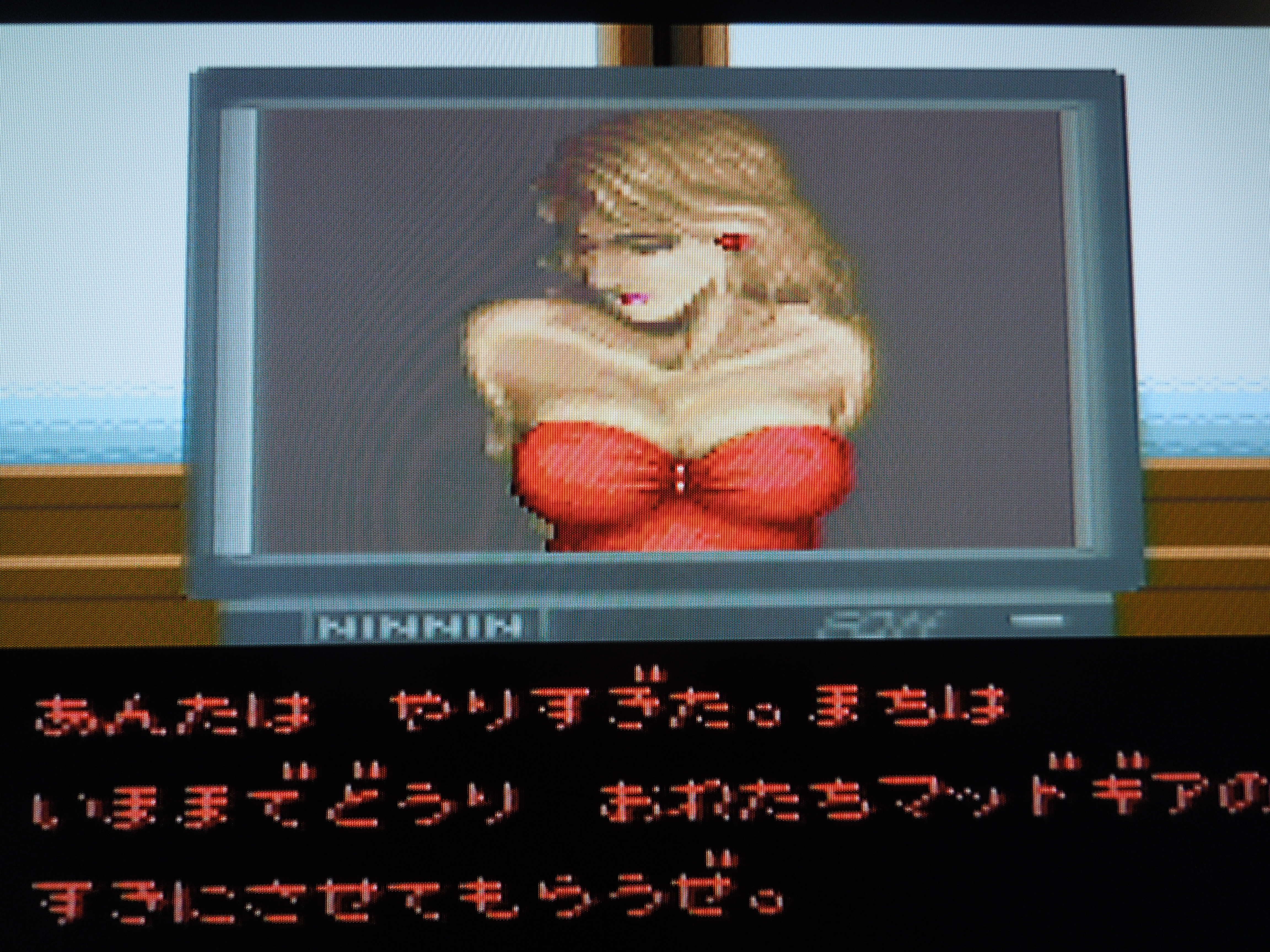
The story is in Japanese, and it goes like this: A gang kidnaps the mayor's daughter - you whip everybody in sight to get her back. The End. The story is in Japanese, and it goes like this: A gang kidnaps the mayor’s daughter – you whip everybody in sight to get her back. The End.

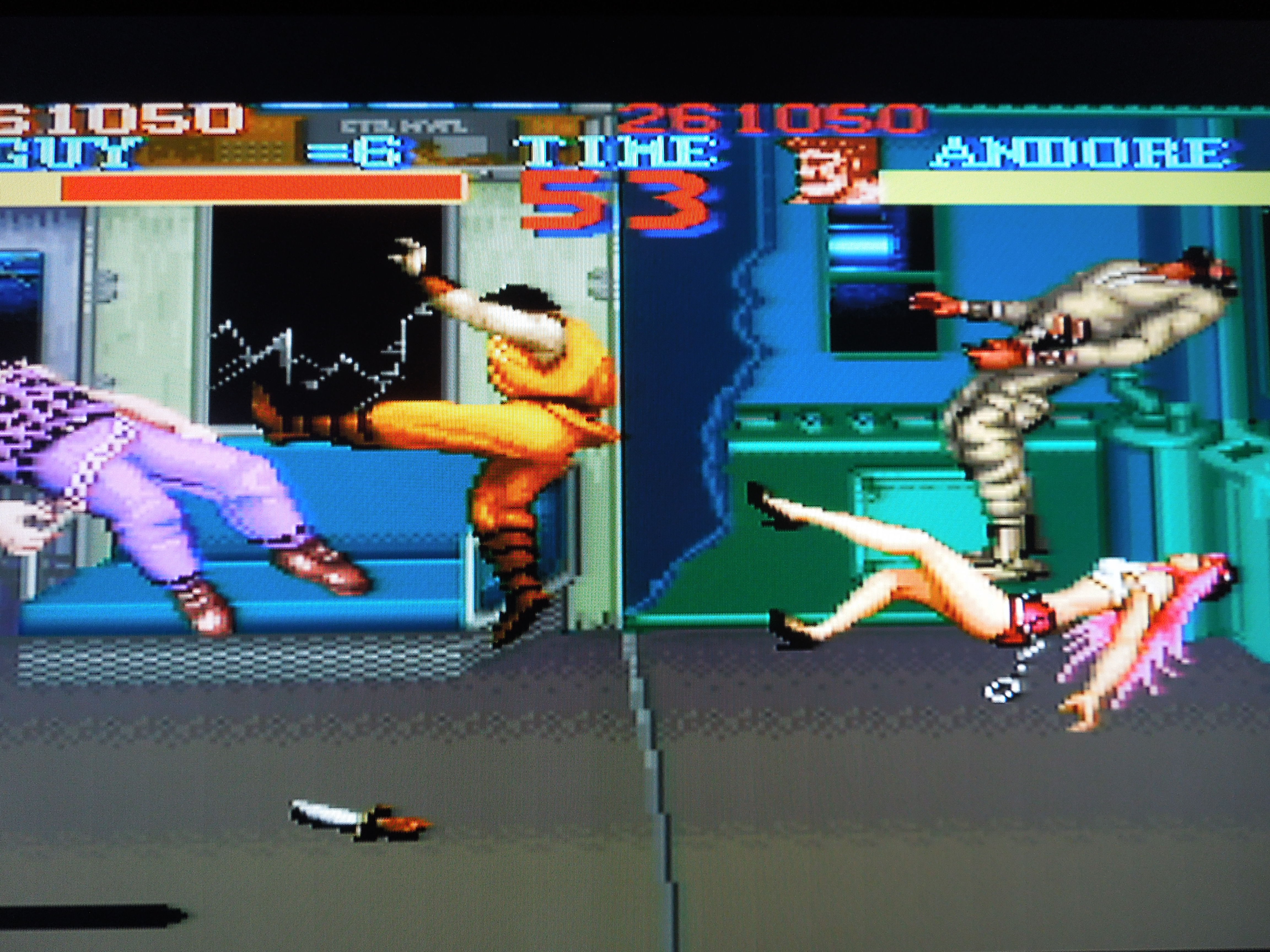
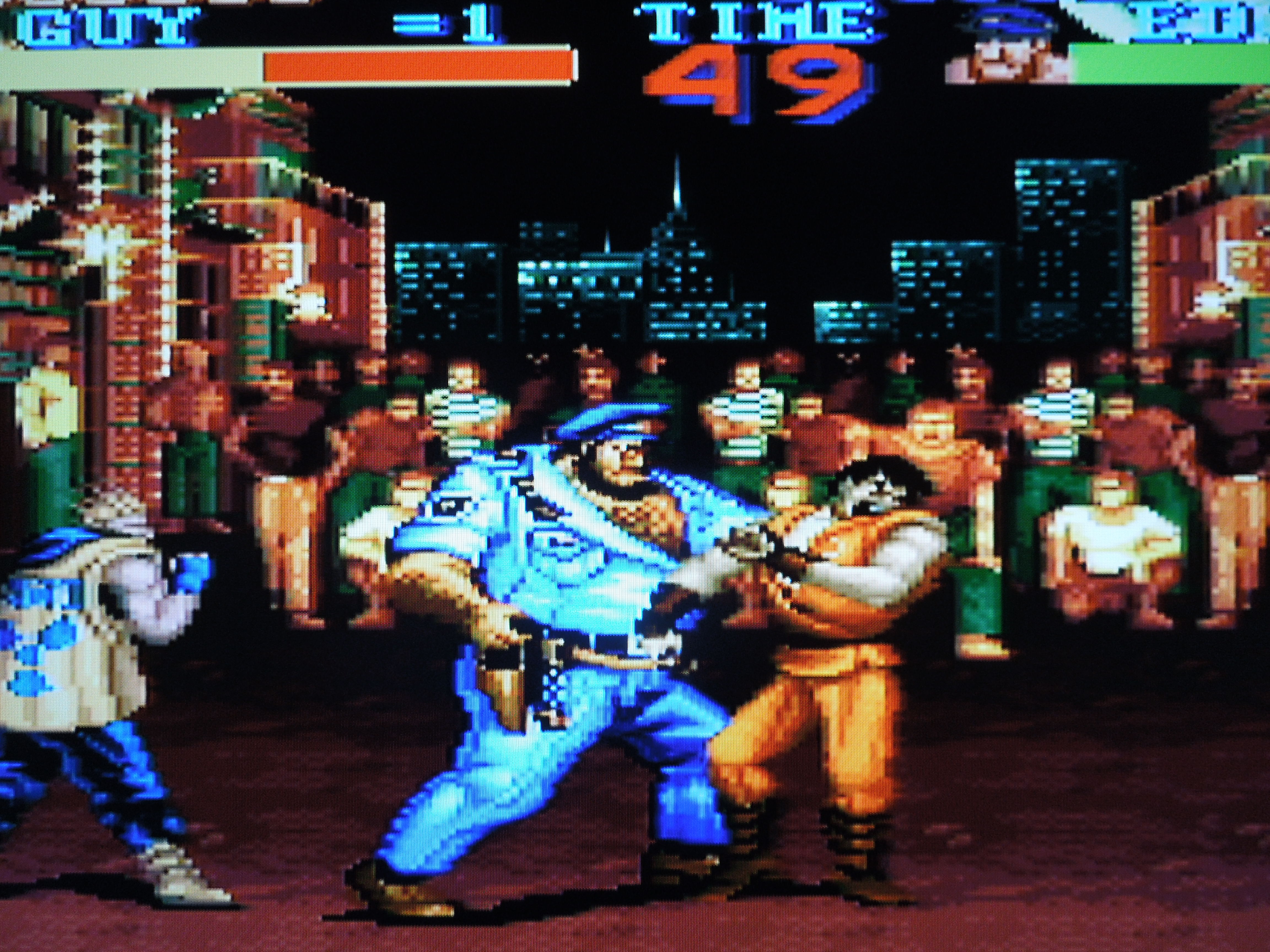
Gameplay:  The story is simple in Final Fight Guy:  Jessica, the daughter of Mayor Haggar, has been kidnapped by the Mad Gear Gang in crime-ridden Metro City in 1990.  Mayor Haggar and Guy, a ninja, decide to go after the Mad Gear gang, refusing any diplomatic relations, and basically beat up any thug who gets in their way.  Guy is quick and less powerful; Haggar is slower yet stronger.  You fight through 5 levels, from the streets of Metro City to the penthouse of the game’s final boss on your quest to rescue Jessica.  Along the way, you deal out your own brand of justice with your fists, knives, pipes, and swords.

Controls:  You use only 2 buttons in the game (aside from the control pad): B and Y.  Pressing Y punches – rapidly pressing it will create a combo.  B jumps.  Pressing B while standing will cause a vertical kick.  Jumping either right or left and pressing Y will execute a horizontal kick.  Jumping right or left and pressing Y while holding down will execute a knee smash (Guy) or flying body attack (Haggar).  Getting in close to an enemy will cause your character to automatically grab him or her.  When an enemy is grabbed, pressing Y will knee him in the face (Guy) or headbutt him (Haggar) – if you press Y + right or left, you’ll throw (Guy) or German-Suplex (Haggar) your opponent.  Additionally,  when an opponent is grabbed, Haggar can press B to jump with the enemy and then press Y to pile drive him. Guy can ‘wall jump’ by pressing B to jump left or right and then B again when contacting a wall.  Hitting B + Y will execute your character’s special move, which will drain some of your energy if you connect with an enemy.

Sound and Music:  Music is so-so; it works, but nothing will stand out to you.  The sound effects are great.  When you hit an enemy, it really sounds like you’re making it hurt.

The game's feature character, a ninja named Guy, is quick at dealing out justice. The game’s feature character, a ninja named Guy, is quick at dealing out justice.

Additional Notes:

Language Barrier?  No.  The only thing in Japanese is the story that plays in the game’s intro and ending.  You can gather what’s happening from the image screens, though.  Everything else is in English – Options menu, character and enemy names, item pickups.

Options?  The Options menu isn’t immediately accessible.  To access it, Hold button L on your SNES controller and press Start on the Start Screen.  Here, you can change the difficulty, add lives, and, most importantly, turn on ‘Extra Joy.’  This assigns your special attack to Button A, meaning you don’t have to press B + Y anymore.

Differences between Japanese Super Famicom Final Fight Guy and U.S. Super Nintendo Final Fight Guy: Remember, the Japanese version is more arcade accurate, while the U.S. version was heavily censored due to Nintendo of America’s strict policy of no drugs and alcohol in games, no religious references, etc.  The Japanese version had Poison and Roxy, two female enemies – they were replaced with Billy and Sid in the U.S. version.  This Japanese version has a small blood spurt when you stab an enemy – the SNES version removed it.  The Japanese version has Whiskey and Beer health items – the U.S. version removed these.  In the ‘car smash’ bonus round, the enemy proclaims ‘Oh my God!’ in the Japanese version – in the U.S. version, he says “Oh! My car!” Also, two enemies, Bred and Simmons, have very dark skin in the Japanese version and much lighter skin in the U.S. version.  Two of the game’s bosses, Damnd and Sodom, have had their names changed in the U.S. version to Thrasher and Katana, respectively.

Execute your special attack when you're surrounded. Execute your special attack when you’re surrounded.
The two female enemies found in this game, Roxy and Poison, were removed from the U.S. version. The two female enemies found in this game, Roxy and Poison, were removed from the U.S. version.

Items:  By breaking barrels, you can pick up knives, pipes, and swords to use on enemies.  You can also pick up health food items to regain your life bar: chicken, barbecue, oranges, apples, pineapples, beer, whiskey, sushi…to name a few.  You can also pick up a ‘Jessica doll’ for temporary invincibility or a ‘Guy doll’ or ‘Haggar doll’ for an extra life.

So, where can I find this game?  Ebay – remember, this exact game, Final Fight Guy for the Super Famicom, is quite common and cheaper, but the U.S. Final Fight Guy, which is censored, is much more expensive.  The arcade version of Final Fight, which is longer, includes all 3 characters, 2 player cooperative gameplay, and generally looks a little better, is avaliable on multiple modern-day gaming console’s download services.  They allow you to play online, have online leaderboards, etc.

Conclusion:  So, why would I hunt this game down when I can download a better version for my PS3, in HD, no less?  The only answer I have for that is the reason I started this website: playing hard copies of games on their original hardware console is the best way to go!  Final Fight Guy is interesting in that it is, essentially, the same game as Final Fight, with only 1 playable character being swapped out for another.  Of course, the differences between the Japanese and U.S. versions is intriguing.  The game should have been 2 player c0operative like the arcade game it is based on – not just 1 player.  Still, it is one of the smoothest, easiest-to-handle, and addictive Beat ‘Em Ups I’ve ever played.  Beating the living heck out of jerks never felt so good.  Good luck if you put it on the ‘Expert’ difficulty.

The Southern Gentleman’s Opinion and Letter Grade:  If you don’t already own Final Fight for SNES, pick up Final Fight Guy for the Super Famicom.  It’s simple, repetitive, and stress-relieving to pummel thugs for 40 minutes in order to save the girl, let’s face it.  Recommended, B+

God Bless! Proverbs 3:6

Some of the bosses are tough until you figure out their patterns. Some of the bosses are tough until you figure out their patterns.

Game Boy – Nekketsu Beach Volleyball

Nekketsu Beach Volleyball dayo Kunio-kun for Game Boy Nekketsu Beach Volleyball dayo Kunio-kun for Game Boy
Plug Nekketsu Volleyball into a Super Game Boy. Plug the Super Game Boy into a SNES. You're ready to go, even for 2 players. Plug Nekketsu Volleyball into a Super Game Boy. Plug the Super Game Boy into a SNES. You’re ready to go, even for 2 players.

Note 1:  Like Nekketsu games?  Check out all of my Nekketsu reviews (plus Super Dodge Ball!).  If you’re interested in other Game Boy reviews, check out my reviews of Fatal Fury 2 and I’m Kid Dracula!

Note 2:  This game was inserted into a Super Game Boy adapter and played on a Super Nintendo Entertainment System.  The SNES console was connected via S-Video cable to a 32-inch HD tv.

Quick History:  Released in 1994, Nekketsu Beach Volleyball dayo Kunio-kun was the last game in the Kunio-kun series released for the Game Boy.  The game was only released in Japan, and never received an English translation, therefore.  I cannot find much helpful information on the Internet about this particular game, so I felt it was a great ‘obscure’ candidate.  This is only speculation, but I think the game must have been released in smaller quanities than other Game Boy Kunio-kun games.  It is quite difficult to find a copy in online stores, ebay included.  Why is it so obscure?  Perhaps it didn’t sell well in Japan – but who knows?  I was able to find a solitary copy on ebay one day after having read about the game in one of the few other sites on the Internet that actually mention it.  In addition to playing on the original Game Boy handheld system and some versions of the Game Boy Advance, this game was made to play on the Super Game Boy system.  The Super Game Boy allowed you to slide Game Boy cartridges into its top, then plug the SGB into your Super Nintendo and play on your television.  Additionally, Nekketsu Volleyball was designed with extra character voice samples and specific color palettes when played in a Super Game Boy.

Gameplay:  In Nekketsu Volleyball, you have 2 modes.  First is Story Mode.  In Story Mode, you choose from among 8 different 2-person volleyball teams.  I can’t read Japanese, but based on each team’s uniform, this is my best guess as to the team names: 1. Team Kunio, 2. Matadors Team, 3. Masqueraders Team, 4. Karate Team, 5. Girls Team, 6. Weight Lifters Team, 7. Umbrella Team, 8. Soccer Team.  Each team looks and acts distinctly different.  For example, the Soccer Team wears soccer uniforms and kicks and heads the volleyball; the Matadors dress like…matadors…and they use a red cloth to swat the volleyball.  In Story Mode, each team has their own unique court as well.  For example, you play the Soccer team on a ‘soccer field volleyball court’ and you play the Weight Lifting Team in a ‘weight-lifting gym volleyball court.’  Some teams move faster, some slower, and there seem to be differences in how hard each team can spike the ball.  Each team also has their own unique Super Shot.  It’s worth playing as them all and finding a team that suits you.  The second mode is VS Mode.  Here, if you are playing on the Super Game Boy, you can play against a friend on your tv.  You each pick you own team (you cannot choose the same team).  You also have the option in VS to choose what court you play on, as well as the option to change how many points your match will be played to.

Not everything is in English, but fortunately, the Options are. Not everything is in English, but fortunately, the Options are.

Controls: The original Game Boy handheld system only had 4 buttons (in addition to the control pad):  Start, Select, B, A.  So, the SNES controller only uses those buttons to play the game.  *Note:  You can use buttons L and R on the SNES controller, when using the Super Game Boy, to pull up menus to change the color palettes and border images.  During gameplay, Select switches between your two volleyball teammates, although you won’t use this much.  On Offense, when serving, B tosses the ball straight up in the air, and hitting B again when the ball descends will strike it over the net.  Button A jumps, so you have to option to toss the ball up, then jump and strike the ball with B while it’s in the air – this type of serve sends the ball flying over the net much faster than the regular serve.  You can steer the ball, once you have served it, by using the control pad.  On defense, B will dig/hit the ball when your opponent has hit the ball over the net to your side.  A little cross (+) will appear on screen to show you where the ball is headed.  If you’re further away, head toward the + and hit B to do a sliding dig.  When in front of the net, on defense, button A, if pressed right when your opponent hits the ball over the net, will cause your player to jump straight up, arms extended, to block the shot.  Spikes: To spike the ball, wait until your opponent hits the ball back to your side – he’ll usually hit it towards you, not your computer-controlled partner.  Hit B to hit the ball up, then head towards the net.  The ball will head for your partner, who will then hit the ball for the ‘set.’  He will pop the ball up right in front of the net.  Stand just behind the + symbol that indicates where the ball is headed (do NOT stand underneath the + or you’ll miss the ball).  When the ball is at its highest, jump with the A button, then hit B to spike the ball!  You’ll often execute your player’s Super Shot this way.  It’s really easy to pull off spikes once you figure this out.  Remember, you can steer your spiked shot by using the control pad.

This game has some truly unique volleyball teams, like the Matadors and the Masqueraders. This game has some truly unique volleyball teams, like the Matadors and the Masqueraders.

Rules: This is beach volleyball, so it’s 2 on 2.  You play to a pre-determined number of points (you can change the number in Options – 5, 7, 10, or 15).  You also play a ‘Set,’ so it’s the best of 3 matches against each team you face (you can change this to just  1 match per opponent in Options, too) There is no time limit on matches.  You have to win by two points to win the match, also.  Be careful serving – if you mess up your serve, it will cost your team a point without your opponent having done a thing – you don’t have 2 chances to get the serve right like in other video game volleyball games.

Sound and Music:  On the Super Game Boy, this game sounds great.  Each team has their own music theme, and the spikes, digs, voice samples, and Super shots all sound nice.

Additional Notes:

Choose from among 8 volleyball teams. Choose from among 8 volleyball teams.

Language Barrier?  No and Yes.  No, if you just want to pick your team and play some arcade-style volleyball.  However, there are several times when reading Japanese would be useful.  First, when you choose your team in Story Mode, a graphic of your team and some text explains why they’re in this tournament, and you also get an ending for each team – because this is all in Japanese, you won’t know their story – no big deal, really.  However, after you choose your team, but before each match, you are presented with 3 options in English:  ‘Bomb, Drug, Etc.’  When you click on these, you evidently have the option to equip weapons or choose some helpful medicine.  I have NO IDEA how to use these or what they do because everything is in Japanese.  It doesn’t hurt the game to not know what these options are, but for curiosity’s sake, it would be nice to know.  Fortunately, the Options menu is in English, so you’ll know which difficulty you’ve selected, as well as the match points.

Password: There is a simple 4-digit and letter password so you can continue the game.  You’ll get a password whenever you lose a match.

So, where can I find this game?  Finding the cartridge online can be challenging!  Good luck!  I believe it’s avaliable for download on Nintendo’s eShop in Japan, but not the U.S.  You can play it on a Game Boy emulator on your computer.

Each team has their own specialized Super Shot. Each team has their own specialized Super Shot.

Conclusion:  Most retro gamers are familiar with only 1 volleyball game:  Super Spike V’Ball for the NES.  That is a great game, and one of its best features is 2 player co-op, which, sadly, Nekketsu Volleyball lacks.  Comparatively speaking, this game is slower than Super Spike V’Ball, but it does have a greater variety in character selection, with more selectable teams (and more diversity among teams).  It’s a fun, if quite simple, volleyball game.  Beating the game on Hard will take some skill.

The Southern Gentleman’s Opinion and Letter Grade: Advisable if you are a huge Kunio-kun sports fan, otherwise stick to Super Spike V’Ball, B

God Bless! Proverbs 3:6

The Weight Lifting team moves slowly, but they have a great Super Shot. The Weight Lifting team moves slowly, but they have a great Super Shot.

Sega Mega Drive – Nekketsu High School Soccer

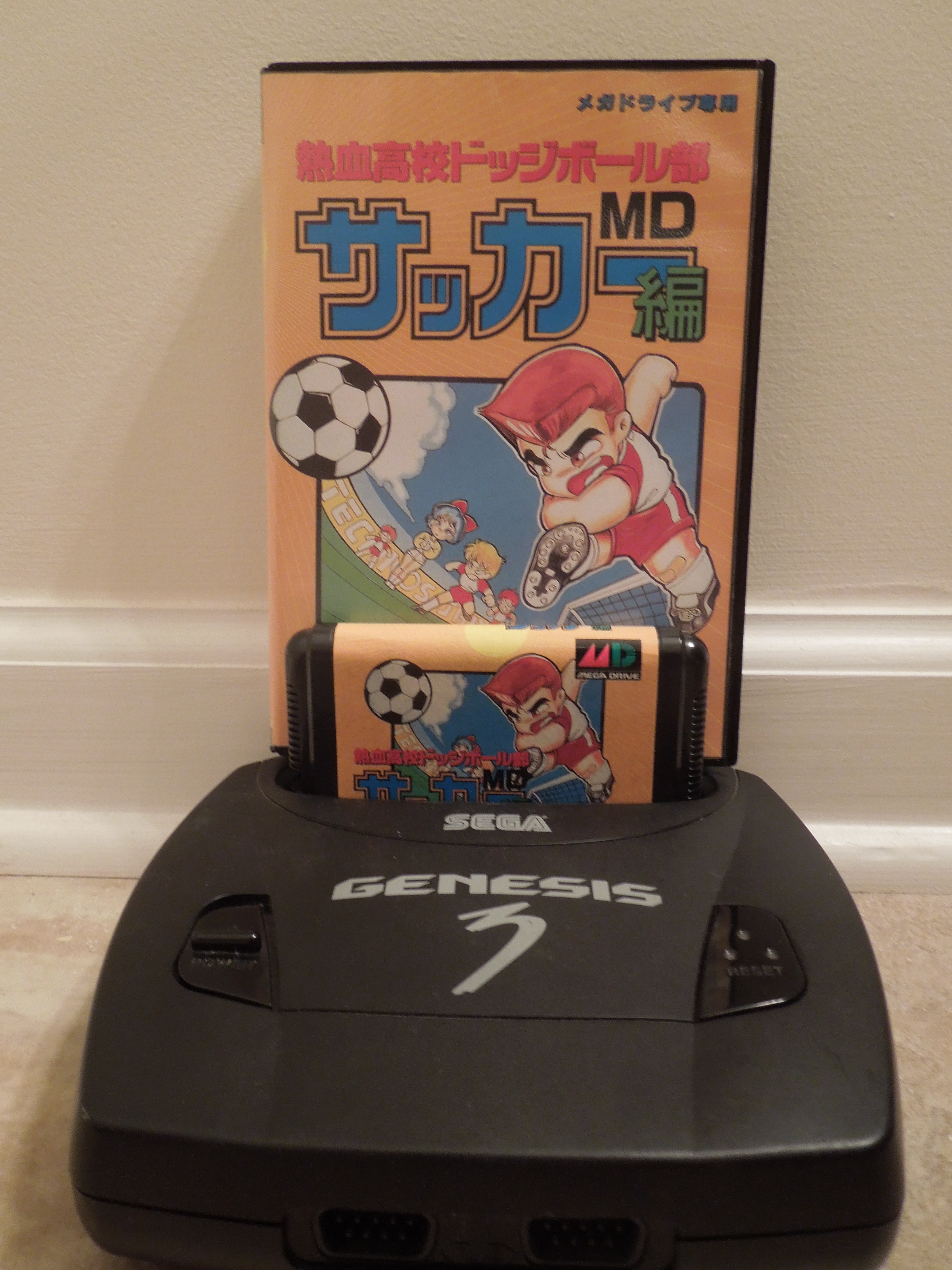
Nekketsu High School Soccer for the Sega Mega Drive Nekketsu High School Soccer for the Sega Mega Drive

Note 1:  Like Nekketsu games? Check out all my other Nekketsu reviews (and Super Dodge Ball)!  Like Sega Genesis/Mega Drive games? Check out my review of Bare Knuckle III.

Note 2: For a comparison and list of differences from the PC Engine version of this game, check that game’s review in my PC Engine section. 

Mega Drive games will fit into and play on a Sega Genesis 3 model. Mega Drive games will fit into and play on a Sega Genesis 3 model.

Note 2: This game was played on a Sega Genesis 3 console.  The Genesis 3, unlike the first 2 models, has a wide cartridge slot that can accomodate the slightly bigger Mega Drive cartridges.  The Sega Mega Drive is what the Sega Genesis is called in Japan; the systems are the same, but Mega Drive cartridges are slightly larger than Genesis cartridges.  The Sega Genesis 3 console was connected to a 32-inch HD tv using AV (red, yellow, white).

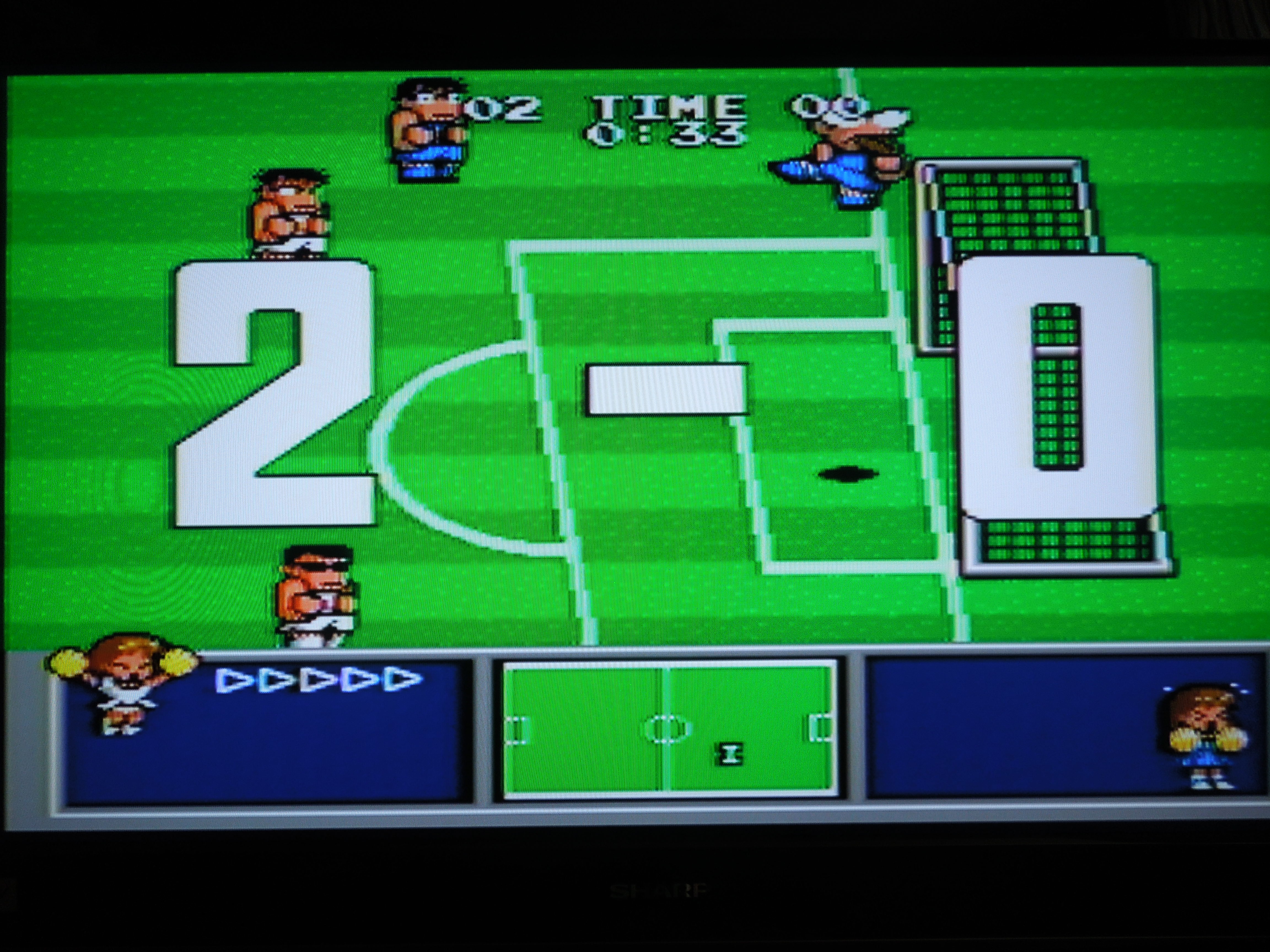
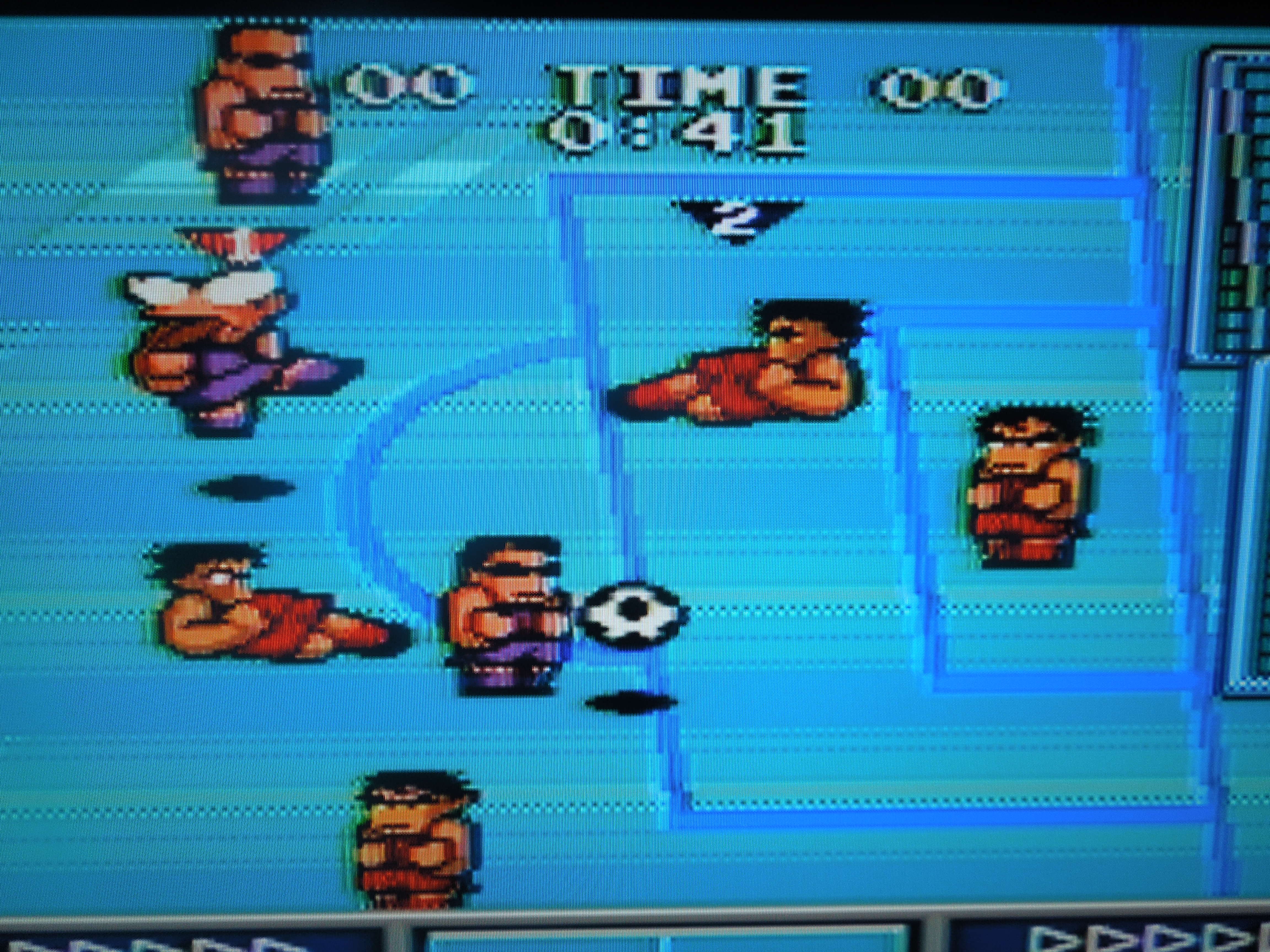
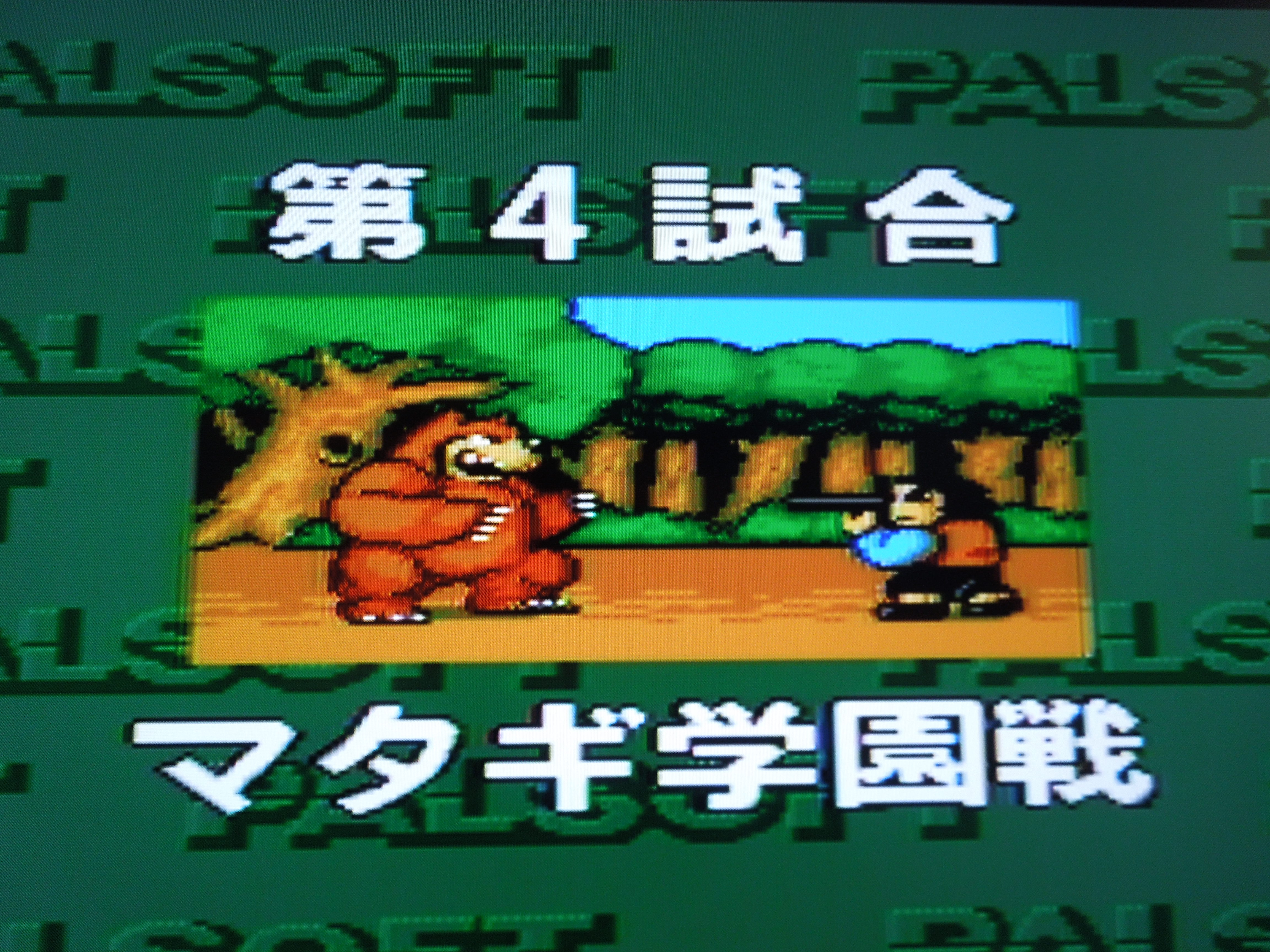
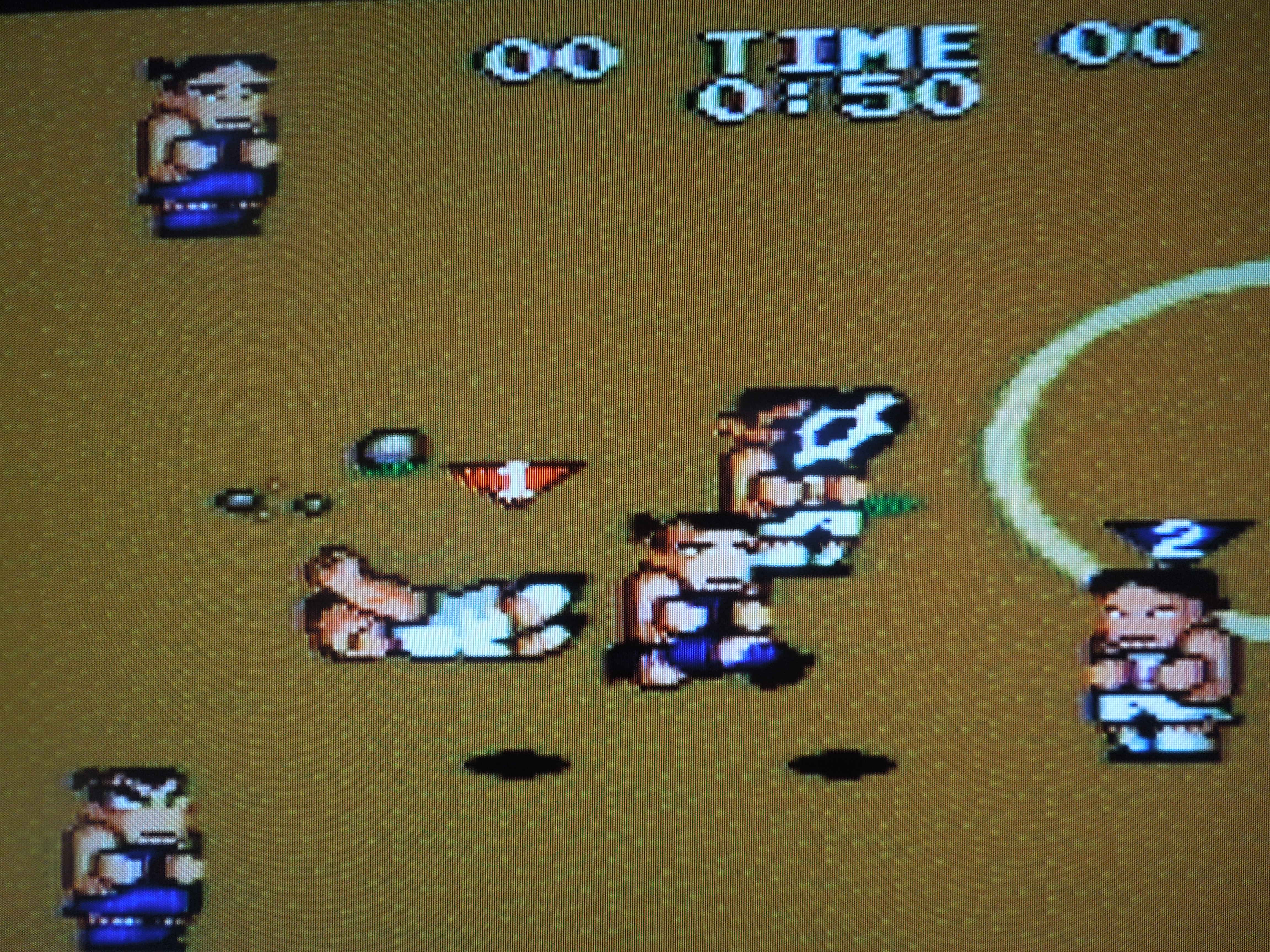
Quick History: Nekketsu High School Dodgeball Club: MD Soccer Edition, or Nekketsu High School Soccer, was released in Japan in 1992 for the Sega Mega Drive home console.  The game had already been released in Japan for the Famicom (Japanese NES), PC Engine, and PC Engine Super CD-ROM.  The game was re-worked a bit and released for the NES in the United States under the title ‘Nintendo World Cup,’ a game that is well-known by many U.S. Nintendo enthusiasts.  Perhaps the least known version of the game, however, is this Mega Drive version, which, while sharing many similarities with its counterparts, also adds some unique features of its own.  The story of Nekketsu High School Soccer, which is part of the Japanese Kunio-kun series, has Kunio and the Dodge Ball team helping Misako, the manager of the school’s soccer team, beat neighboring regional schools in soccer matches.

Gameplay:  In 1 player or 2 player Tournament, you can only play as Nekketsu High School.  You guide the team through 12 matches against the other schools, each of which has a “theme.”  I can’t read Japanese, so I can’t tell you the official names of these schools.  However, based on the graphic that is displayed before each match, here are my best guesses at team names, in the order of which you play the teams: the Nekketsu High Juniors, the Monks, the Bikers, the Hunters, the Announcers, the Firemen, the Fishermen, the Psychics, the Mob, the Miners, the Samurais, and the Fighters.  Each team gets progressively tougher, of course, as you advance in the tournament.  To balance this, new selectable players are added to your squad at certain points in the game – they have a higher speed or power or defense than your current players.  As you play through the various teams, you’ll notice that the playing surface will vary based on the team you play, and you have no control over the field you play on (ice, concrete, and rocky terrain are some examples).  There is a handy 4 digit password system to let you pick up where you left off if you don’t want to try to beat the game in one sitting.  To get the password, however, you have to lose a match, and then select “No,” (which is in Japanese – move the arrow) to a re-match.  You’ll get the password.  This soccer game is 6 on 6, and before each game, you can select which player you want in which position: a goalie, 2 defenders, 1 mid-fielder, and 2 forwards.  Each player has their own statistics that include power, speed, and defense, as well as their own unique “Super Shot.”

You can select among 6 different fields in 2 player VS. You can select among 6 different fields in 2 player VS.

Controls: This game can be played with a 3 button Sega Controller.  On offense, A shoots, C passes, and B powers up your player for a Super Shot (Hold B until your power bar is full and your character is ingulfed in flames, then hit A to shoot your Super Shot).  Hitting A + B makes your player jump, performing a bicycle kick when the ball comes to you from an air pass.  Hitting A + B + Forward makes your character do a diving header when the ball comes to you from an air pass.  On defense, A slide tackles to steal the ball, C does a shoulder tackle to knock opposing players to the ground, and B powers up your player for a Super Defensive Move (Hold B until your power bar is full and your character is ingulfed in flames, then hit A for a super fast slide tackle or C for a super attack).  While you can’t ‘control’ your other teammates, you can ‘tell them what to do.’  For example, if your defender is chasing the opponent with the ball, even if your character is on the other end of the field, you can press C to make your defender shoulder tackle the opponent character.  Or, if you pass to your computer teammate near the goal, pressing A when the ball reaches him will make him shoot.  You have full range of the field even though you’re a forward, and can run back to help the defense if they get in a jam.  Passing, by the way, is a bit random.  Most of the time, on offense, pressing C will pass to the player nearest to you, but this isn’t always the case.

Your team is managed by Misako. Your team is managed by Misako.

1 Player and 2 Player Tournament Mode:  You alone, or you and a friend can play through the 12 other teams in the game.  In 1 player, you are assigned the midfielder.  In 2 player, you and your co-op partner will both be the 2 forwards. *Remember, you can still run all over the field no matter what your starting position is.  In 2 player co-op, neither you nor your partner can directly control other players on your team, but Player 1 can give them ‘commands’ (see Control above).  In 2 player Tournament, the password will be different from 1 player Tournament, even if you are entering a password to get back to the same team in either mode.  The only number that changes in the 4 digit code is the last number, and it simply increases by one in 2 player mode.  So, for example, to get to Match 3, The Bikers, in 1 Player Tournament, the code is 4900.  But, to get to that same team in 2 Player Tournament, the code is 4901.  Beat all the teams in the game, and you beat the game!  The last few teams are TOUGH.  Oh, and there is no Overtime or Sudden Death mode.  If the clock hits 0:00 and you’re tied, it counts as a loss, unfortunately.

In each of the 12 matches you compete in, each school you face has a 'theme.' This team is, evidently, The Hunters. In each of the 12 matches you compete in, each school you face has a ‘theme.’ This team is, evidently, The Hunters.

2 player VS:  Some other versions of this game (PC Engine, PC Engine Super CD-ROM, the NES re-worked version of Nekketsu High School Soccer, titled ‘Nintendo World Cup’) allow for up to 4 players in VS mode, but not this game.  Here, it’s for only 2 players.  Still, this version, unlike all other versions of this game, allows you to choose from ANY of the game’s 12 teams in VS mode.  In the other versions, you are limited to approximately 5 of the game’s teams (for some reason).  Also, in VS, you can choose from among 6 field terrains, with surfaces including grass, rocky (you can trip over rocks on the field), concrete (not smart for soccer – the ball hardly rolls), and ice (if you slide tackle, you’ll go zooming across the field).  For some reason, in VS, you don’t play two halves like in tournament mode – just one.  No overtime mode here either, sadly.

Sound and Music:  The Genesis/Mega Drive console, and, subsequently, its games, were not known for their outstanding sound.  However, you’ll still be pleased with the music in Nekketsu High School Soccer.  Different tunes play for different teams you face, and they’re, for the most part, catchy, if not memorable.  The sound effects are a bit crude, but passable.  The ‘Ugh!’ an opposing player issues when you shoulder tackle him is comical.  Passes, shots, and scores all have decent sounds.  I don’t know all the technical reasons behind it, but there is just a noticeable difference between sound on a Genesis versus sound on an SNES, I must add.

2 player co-op? Check. 2 player co-op? Check.

Additional Notes:

Options: There is an ‘Options’ Mode; however, you can only do one thing to the game.  Luckily, it’s really, really, great.  You can change the length of time per half (or per game, in 2 Player VS).  Your choices are: 3:00, 2:00, and 1:00.  The clock moves at a decent clip, so the 1 minute halves will be over before you know it.  I love this option for the Mega Drive version.  In other games – for instance, Nintendo World Cup (which is essentially the same game, just re-worked as the World Cup instead of high school teams), you cannot change the time at all – so, in that game, you are forced to endure very long 4 minute halves with a slow-moving clock.  I’m glad that those who created this game included this choice.  Now, you have the option for quick matches.

Choose from ALL the game's teams in VS. Choose from ALL the game’s teams in VS.

Language Barrier?  No and Yes.  No, if you want to just play a quick game of soccer – just press Start until you get to the matches.  Yes, however, if you want to pick a player based on specific statisitcs and choose from a short list of ‘strategies’ before your matches start.  Luckily, you have the Southern Gentleman to give you a bit of info!  On the character select screen, where you assign your computer players and pick your own character, there are 3 categories (in Japanese) with a number alongside them.  The first category is Power, the second Speed, and the third Defense (if your player is weak on D, then he’ll stay down longer if knocked to the ground by an opposing team’s player).  The higher the number, the stronger (shooting), quicker, or tougher your player is.  Also, after you select your player, you’ll be taken to the locker room, where Kunio stands before a chalk board and shows different ‘strategies’ (for your computer teammates to utilize) for the upcoming match.  There are 4 different choices for you to make (all in Japanese).  The 1st board is Pass/Dribble the ball (for your computer teammates, remember). This board is pre-set to Pass, so I don’t advise changing it.  The 2nd board is Goal Keeper play/Goal Keeper not play.  This board is pre-set to GK not play, and I advise not changing it unless you want your Keeper abandoning the goal randomly and running off down the field.  The 3rd board is for offense again – this time it’s teammates will shoot frequently/sometimes/not at all.  This 3rd board is pre-set to ‘frequently shoot,’ and I advise not changing it, because your computer teammates are more than capable of scoring for your team.  The 4th and last board is for your defensive strategy.  Your choices here are try to tackle/mark the opponent.  This 4th board is pre-set to ‘mark the opponent,’ and this is the only one I advise changing.  You’ll generally want your computer teammates to slide tackle or shoulder tackle the opposing team’s man in possession of the ball as soon as possible without waiting on your command.  Also, while you can select all teams in VS mode, all the names are in Japanese, so it’s kind of pot-luck there when you choose.

So, where can I find this game?  This exact game?  Ebay.  You’ll need a Mega Drive Console to play the game, however, or a Sega Genesis 3.  I believe you can play the game on a Sega Genesis model 1 or 2 if you have a Game Genie and a specific code.  Also, remember, there are similiar versions for other systems.  I don’t believe this Sega version has been made avaliable for any U.S. compilation discs or modern-gaming system’s download services.  I’m unsure if it’s avaliable for download in Japan.  The rom can be downloaded for play on a Mega Drive emulator for your computer.

Power up using B for too long, and you'll toast your player! Power up using B for too long, and you’ll toast your player!

Conclusion:  The NES version of this game allowed you to choose from all of the teams in the game (although they were changed to different countries like France, England, etc.).  In this version, in 1 player mode at least, you are stuck playing only as 1 team, Nekketsu High School.  This was common across the Kunio-kun games – play as the Japanese team against all opponents.  It would be great if you could select all of the teams for Tournament mode, but that’s not the case.  What is great is the ability to select all of the teams in VS – this is not an option in any other version of the game.  2 player co-op is great, as goal scoring and assists can be perfected for an unstoppable offense.

The Southern Gentleman’s Opinion and Letter Grade: Recommended if you want a great alternative to Nintendo World Cup that looks and plays better, B+

God Bless! Proverbs 3:6

Your players stats, from top to bottom, are: Power, Speed, Defense. The higher the number, the better the skill of your player for that particular attribute. Your players stats, from top to bottom, are: Power, Speed, Defense. The higher the number, the better the skill of your player for that particular attribute.