SNES – BS Legend of Zelda: Ancient Stone Tablets, Chapter 3

BS Legend of Zelda: Ancient Stone Tablets, Chapter 3 for the Super Nintendo.

BS Legend of Zelda: Ancient Stone Tablets, Chapter 3 for the Super Nintendo.

Note 1:  Also check out my reviews of BS Legend of ZeldaZelda: Parallel Worlds Remodel and Ancient Stone Tablets, Chapter 1 and Chapter 2!

Note 2:  This game was played on an original model Super Nintendo with S-video cables connected to a 32-inch HD tv.

Quick History, Sound & Music, ControlSee my review for BS Legend of Zelda, Chapter 1 for more information. 

Individual chapters, like Chapter 3 here, can be put onto single cartridges, and some SNES reproduction websites can put all 4 chapters onto one cartridge. Individual chapters, like Chapter 3 here, can be put onto single cartridges, and some SNES reproduction websites can put all 4 chapters onto one cartridge.

Story:  BS Legend of Zelda: Ancient Stone Tablets, Chapter 3, picks up right where Chapter 2 left off.  Aginah and “the mysterious Youth” wake up in the home of Link (who is away from Hyrule during this time – remember, this story takes place 6 years after the events in A Link to the Past).  Half of the Ancient Stone Tablets have been found already, and Aginah begins talking about finding the Book of Mudora in order to start translating them, hoping that by doing so he can help the Youth stop the evil monsters from attacking Hyrule.  In this chapter, the Youth must delve into Dungeons #5 and #6 to find the next two Tablet pieces while Aginah searches for the Book of Mudora.

The story begins with the Youth and Aginah the Wise Man waking up in the home of Link. The story begins with the Youth and Aginah the Wise Man waking up in the home of Link.

Objectives:  You have from 3:06 to 3:56 (the clock is in the top-left corner of the screen) to complete Chapter 3.  In this game, you are to collect: 2 Ancient Stone Tablet pieces, 4 Heart Containers (2 Containers must be made by piecing together 8 separate Heart Pieces), the Worn-Out Power Glove, the Normal Power Glove, the Level 3 Sword, the Level 3 Armor (Red Mail), the Fire Rod, and a Magic Bottle.  Additionally, you have the option of rescuing the Priest from the river and returning him to the castle, finding the Mole character, renting the Level 4 Sword, and playing the archery mini-game.  *Before doing any of this, as Aginah reminds you, you must first use the Flute to return to the first 4 Dungeons, where individual Thieves are located outside the entrances.  The Thieves each give you a “bag of trash” that contain the Sword, Boots, Heart Containers, etc. – all items from those 4 Dungeons that were in Chapter 1 and Chapter 2.  Visiting the 4 Thieves takes approximately 30 seconds, then you’re ready to truly begin Chapter 3.

You'll have to beat two dungeons and obtain 2 Tablet pieces in Chapter 3 - the first lies south of your starting point. You’ll have to beat two dungeons and obtain 2 Tablet pieces in Chapter 3 – the first lies south of your starting point.

Timed Events:  Like in all 4 of the chapters that make up Ancient Stone Tablets, different events occur at precise minutes on the game clock in the upper-left hand corner of the screen.  For example, a Golden Bee shows up to help you fight at 3:15, the Priest falls into the river at 3:24, the Mole appears in a random location at 3:44, and the archery mini-game opens up at 3:45.  At 3:56, no matter what you’re doing, the (cliffhanger) ending plays and you’re given your ‘high score’ for Week 3 (Chapter 3).
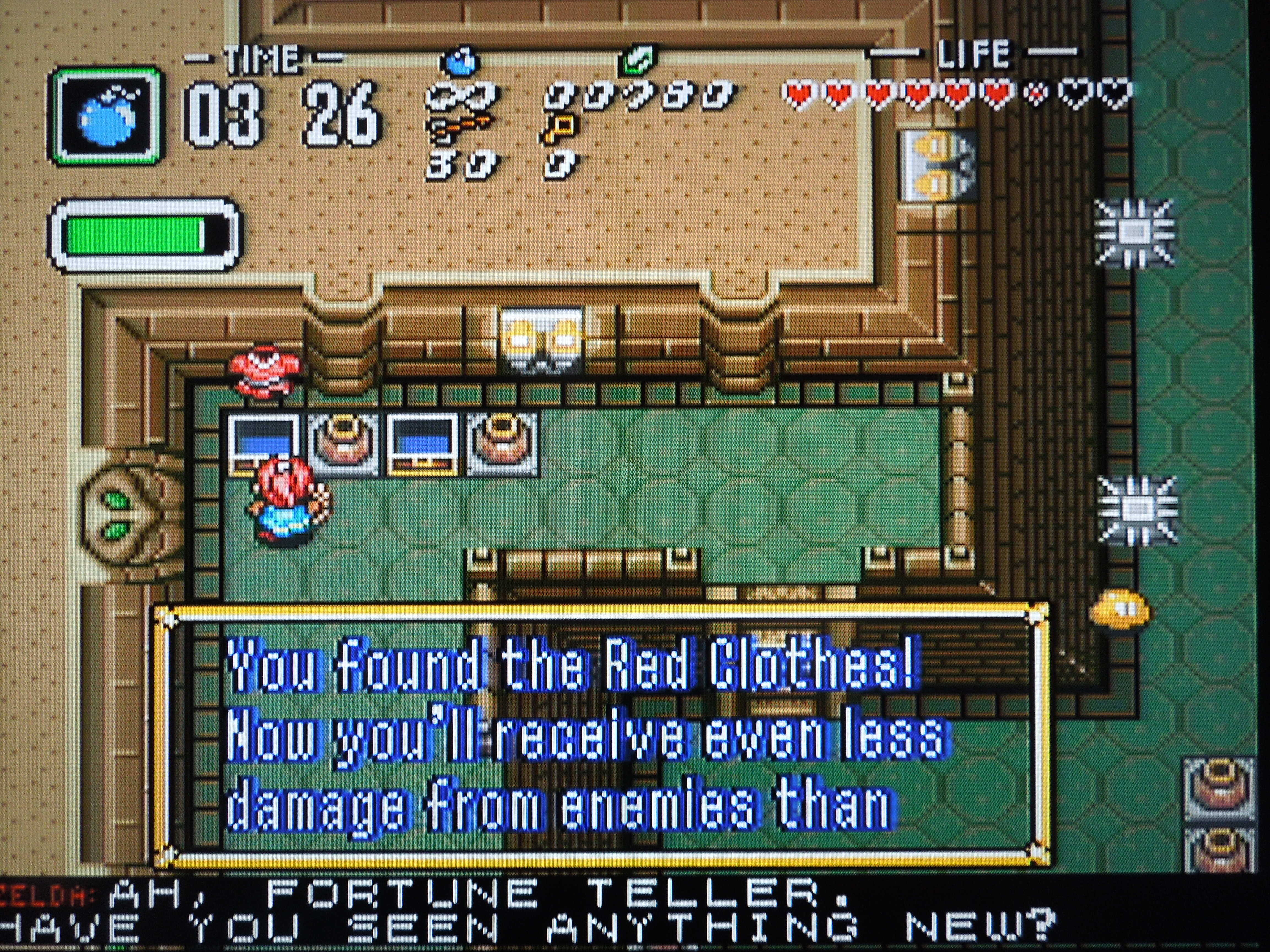
Don't leave Dungeon 6 without the Red Mail. Don’t leave Dungeon 6 without the Red Mail.

Saving: The game auto-saves to the exact minute you’re on.  I’ve found it’s best to push in and hold the Reset button before turning off the power to guarantee a save.

Dungeons 5 and 6: While these are more difficult than Dungeons 1, 2, 3, and 4 found in Chapter 1 and Chapter 2, they’re still not terribly difficult as far a Zelda-games go.  The bosses at the end are a piece of cake as well.  The real fun of the dungeons is trying to find all of the hidden treasure chests (opening chests adds to your high score).  Remember to use the map to locate weak walls that can be blown apart with bombs.  Also, be sure you don’t leave either dungeon without the Level 3 Sword or Level 3 Armor, respectively – they’re both held in smaller, normal-looking chests, not the big chests.

Seek out Heart Pieces as you progress through the game - how do you obtain this one? (the hookshot won't work) Seek out Heart Pieces as you progress through the game – how do you obtain this one? (the hookshot won’t work)

Extra time left?  If you accomplish all of your objectives and are still waiting for the clock to reach 3:56, remember that you can still access the areas of Hyrule that are from Chapter 1 and Chapter 2 (except for the first 4 dungeons – these are inaccessible).  The mini-games won’t be open anymore from Chapters 1 and 2, nor will the Rental Shops have any supplies, but you can still search for Heart Pieces and chests full of Rupees from those two Chapters.  There is still one part of the Overworld map that is shrouded with clouds and you cannot access due to barriers (black rocks) – this area is for Chapter 4.

Save the Priest and return him to the castle for bonus points towards your high score. Save the Priest and return him to the castle for bonus points towards your high score.

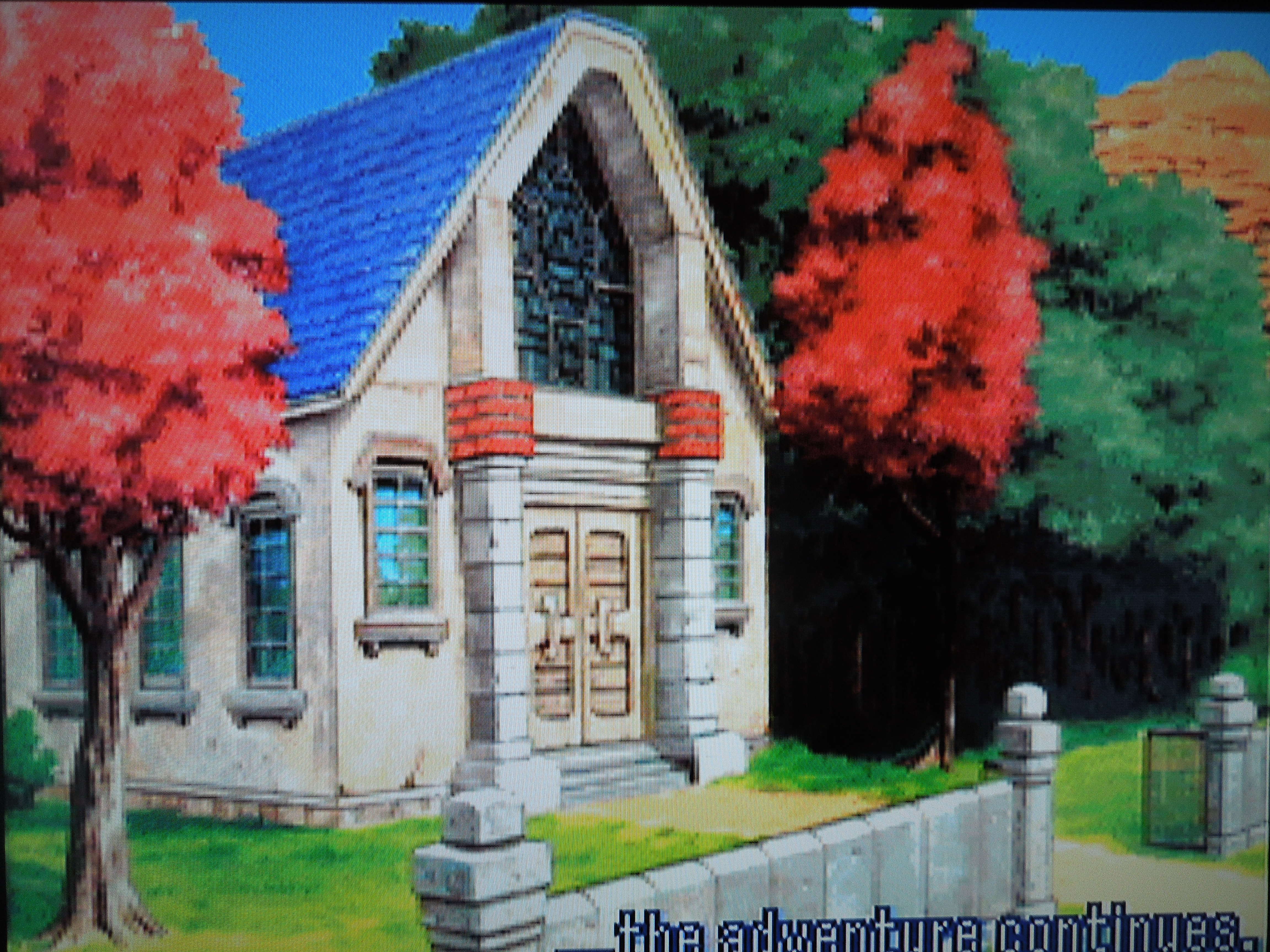
Cliffhanger Ending: The game ends (SPOILER) with Aginah finding the Book of Mudora in the basement of Link’s house (how convenient for him, all while you were out doing the real work!).  He discovers that the mystical Silver Arrows that can vanquish evil are located in Death Mountain, along with 1 of the remaining 2 Ancient Stone Tablet pieces – the other is near the Priest’s Church (Sanctuary).  Aginah, the Priest, Princess Zelda, and the Youth arrive at the Church at dusk to spend the night before beginning the final stage of their quest to unravel the mystery of the Ancient Stone Tablets and stop the Evil that has returned to Hyrule.

Chapter 3 ends with Aginah, Zelda, and the Youth on the cusp of solving the mystery of the Tablets. Chapter 3 ends with Aginah, Zelda, and the Youth on the cusp of solving the mystery of the Tablets.

So, where can I find this game?  SNES reproduction-makers can put Chapter 3 onto a cartridge for you, and some can even put all four chapters onto one cartridge.  You can also play the rom on a computer emulator.

Conclusion: Ancient Stone Tablets: Chapter 3 is a terrific game – it’s everything you want from a Zelda game (ok, it would be nice if it were a bit harder, and ok…it’s only 50 minutes long).  Much like with Chapters 1 and 2, Chapter 3 is an extremely interesting Zelda experience because of the nature of the game (being a Broadcast-Satellaview game).  Still, it is a legitimate Zelda title, and the quality of the series is evident here.

The Southern Gentleman’s Opinion and Letter Grade:  Chapter 3 is extremely easy to beat, but still definitely worth your time if you’re a Zelda fan. A

God Bless! Proverbs 3:6
DSCN7816

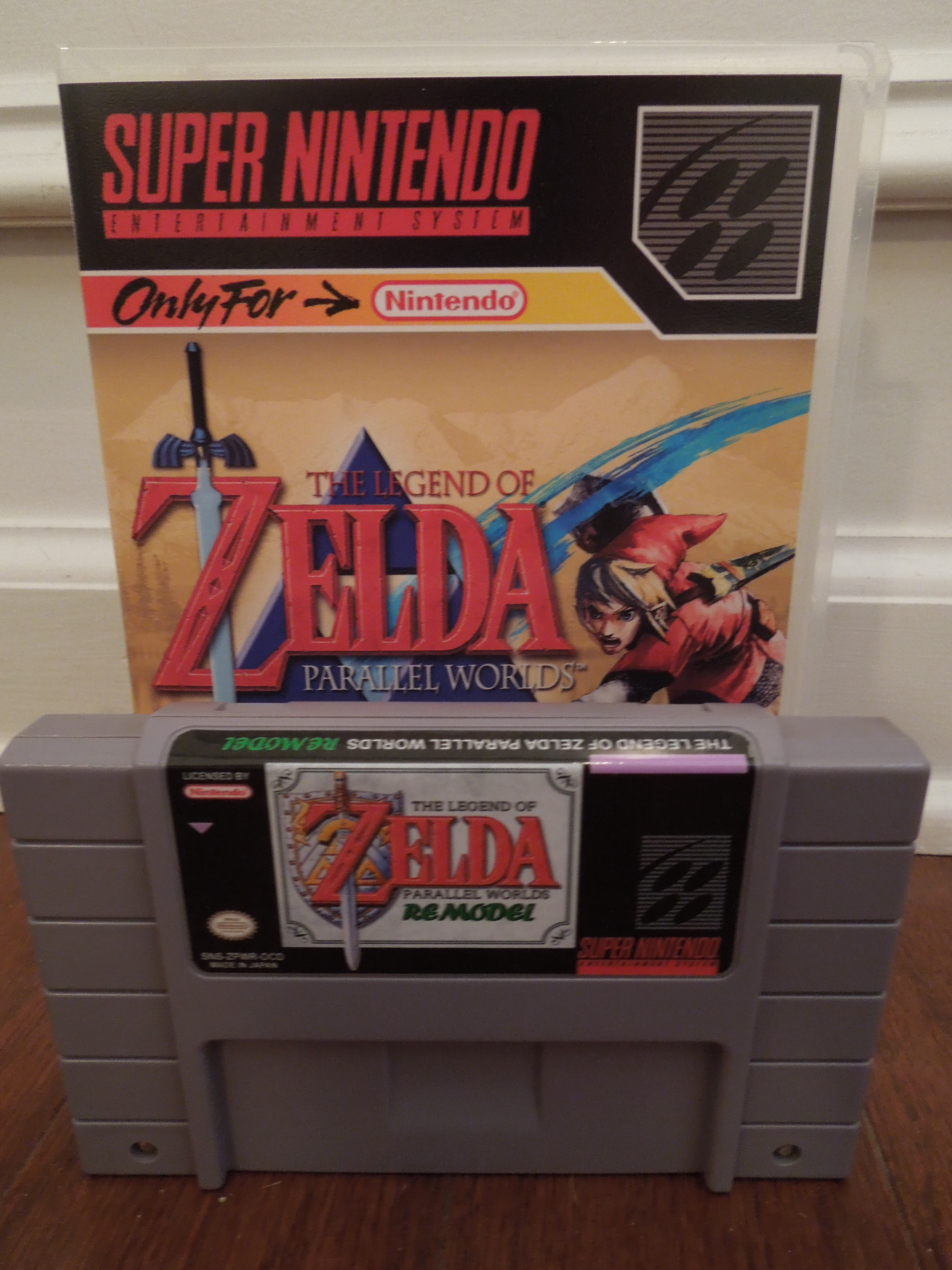
SNES – The Legend of Zelda: Parallel Worlds Remodel

The Legend of Zelda: Parallel Worlds Remodel for the SNES The Legend of Zelda: Parallel Worlds Remodel for the SNES

Note 1:  Like Zelda games?  Check out my reviews of BS Legend of Zelda and Ancient Stone Tablets!

Note 2:  This game was played on an original model Super Nintendo with S-video cables connected to a 32-inch HD tv.

Note 3: I originally reviewed this game as 1991SNESGuy on ocd repros before getting this blog started – this review is a bit more comprehensive.

'Remodel' is the second version of the game, which is supposed to be easier than the original 'Parallel Worlds.' ‘Remodel’ is the second version of the game, which is supposed to be easier than the original ‘Parallel Worlds.’

Quick History: The Legend of Zelda: Parallel Worlds Remodel is a fan-modded game.  The modders used the officially released Legend of Zelda: A Link to the Past as a template.  Initially, there was no ‘Remodel’ in the title, but because the original Parallel Worlds was considered too difficult, changes were made, and the game was made a bit ‘easier’ and added the word Remodel.  All of the modders who worked on this game clearly put a lot of time in to try to make this an interesting ‘Zelda-modded’ experience.

Story:  Your character (Link) and a friend are treasure hunters in Hyrule.  A mysterious ‘Parallel Tower’ suddenly appears, and word spreads that 7 maidens know the secret of how to access the tower and what its secrets are.  The king’s advisor, Draegor, kills the king and begins interrogating the maidens, “disposing” of them after he has the information he needs.  Now, only 1 maiden remains – Zelda.  Link and his friend plan to infiltrate the Hyrule Guard House and rescue Zelda as the game begins.

The game begins much like A Link to the Past - you must rescue Zelda. This time, however, she's being held in the Guard House. The game begins much like A Link to the Past – you must rescue Zelda. This time, however, she’s being held in the Guard House.

Music and Sound:  The same music and sound effects from the officially released A Link to the Past appears to be present – and they are excellent.  Some variations on the music are also present, and they sound good as well.

Gameplay & Graphics: New enemies have been added, which is awesome, the map of Hyrule has been reworked, including new dungeons and a different overworld.  The overworld looks great, including designs like ships and houses that weren’t in the original.  Link also looks different, arguably better, than he did in ALTTP.  Control and menus are great – they look like updated versions of what is found in A Link to the Past.

Improvements:  You have a Rupee (Money) counter that goes into the thousands, meaning you don’t have to top-out your money at 999.  There are enemies included (like the cannon-firing soldiers) that were originally intended to be put in A Link to the Past, but were left out – it’s neat to see them here.  The game displays the ‘area’ you’re in at all times, and that is a most welcome addition.

The Dark World this time is a frozen tundra - it looks fantastic. The Dark World this time is a frozen tundra – it looks fantastic.

Replayability & Appeal:  While I applaud the hard work the modders did to this game, which is impressive, I found the game generally too confusing and difficult (others may appreciate the difficulty more).  There were too many times I got confused about where to go next, and there were no clues in the game the way there were in official Zelda games.  I will say that with a fair amount of wandering, I was able (by luck sometimes) to stumble upon where to go next, and I did beat the game.  I was still addicted despite my frustration, although this was more from stubbornness to beat it more than because I was having fun.  Another thing that frustrated me was the sheer number of enemies in the game, far more than the original ALTTP – sometimes it even makes the action on screen slow down due to the number of sprites.  Also, there are numerous grammatical errors, which is to be expected, I guess.  The dungeons in the game were often far too challenging and disjointed, with a good deal of backtracking that really compounded the frustration level.

Beating this game will take a Herculean amount of patience. Beating this game will take a Herculean amount of patience.

Conclusion:  I can tell you that based on the videos I’ve seen of the original Parallel Worlds, this one is much easier, although still quite difficult.  Also, there is not an FAQ or comprehensive walkthrough anywhere online for this version, at least not one I could find.  There are plenty for the original Parallel Worlds, and sometimes that helps, but there are a lot of changes to dungeons and the overworld and such in this version, so looking at a walkthrough for the original version didn’t usually help.

So, where can I find this game?  Many SNES reproduction websites sell it, or you can play the rom on your computer emulator.

The Southern Gentleman’s Opinion and Letter Grade:  While I respect the modders who worked so hard on this, and there are some fun elements here, unless you are a huge Zelda fan, I would not recommend this game.  It’s a shame, because the game LOOKS fantastic.  But, in my opinion, official Zelda games like A Link to the Past, BS Legend of Zelda and Ancient Stone Tablets are the way to go, and the quality vs. the lack of quality is clear when you play these official versions compared to this particular modded version.  D-

God Bless! Proverbs 3:6
Game Boy – Nekketsu Koha Kunio-Kun: Bangai Ranto Hen Review

DSCN7723

Note 1:  Like Nekketsu games?  Check out all of my Nekketsu reviews (plus Super Dodge Ball!).  If you’re interested in other Game Boy reviews, check out my reviews of Fatal Fury 2 and I’m Kid Dracula!

Note 2:  This game was inserted into a Super Game Boy adapter and played on a Super Nintendo Entertainment System.  The SNES console was connected via S-Video cable to a 32-inch HD tv.

Bangai Ranto Hen was re-tooled and released in the U.S. as Double Dragon II. Bangai Ranto Hen was re-tooled and released in the U.S. as Double Dragon II.

Genre:  Beat ‘Em Up

Players:  1 or 2 Players (with 2 Game Boy handheld systems, 2 cartridges, and a link cable)

Quick History:  Nekketsu Koha Kunio-Kun: Bangai Ranto Hen – translated – Nekketsu Tough Guy Kunio: The Further Brawls was released for the Game Boy only in Japan in 1990.  In the U.S., the game was re-tooled (with different music and characters) as Double Dragon II.

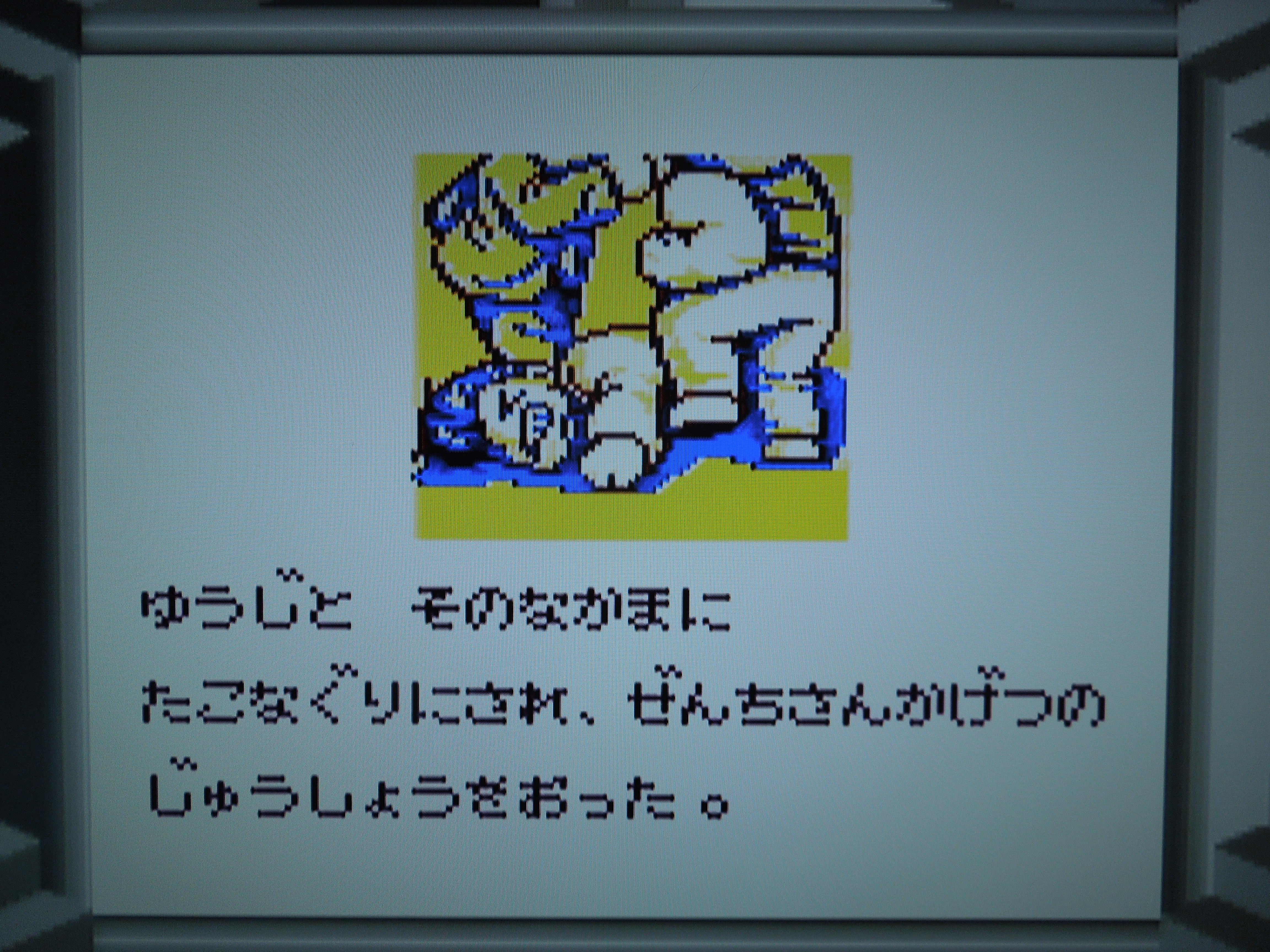
Story:  From everything I can gather, a rich man has moved to town, and he has a spoiled son.  The son, Yuji, falls in love with Miho, a girl in town.  Yuji tries to kidnap Miho, and a kid named Hiro defends her, and ends up taking a beating from Yuji and his thug friends that hospitalizes him.  Hiro was a good friend of Kunio, so Kunio along with his other friend Riki, takes to the streets to fight Yuji’s gang and ultimately track him down.

Kunio's buddy Hiro gets sent to the hospital, and Kunio seeks revenge. Kunio’s buddy Hiro gets sent to the hospital, and Kunio seeks revenge.

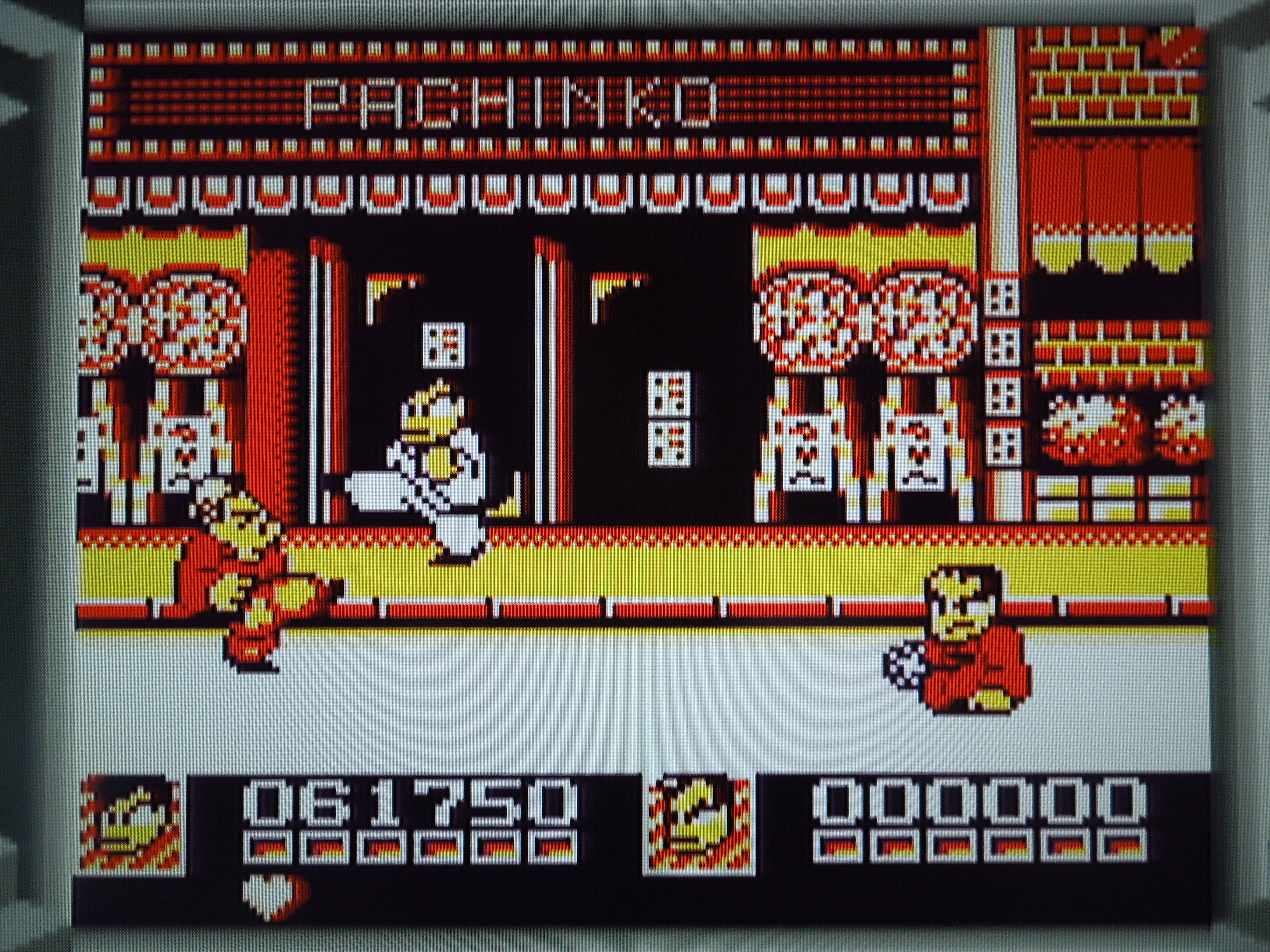
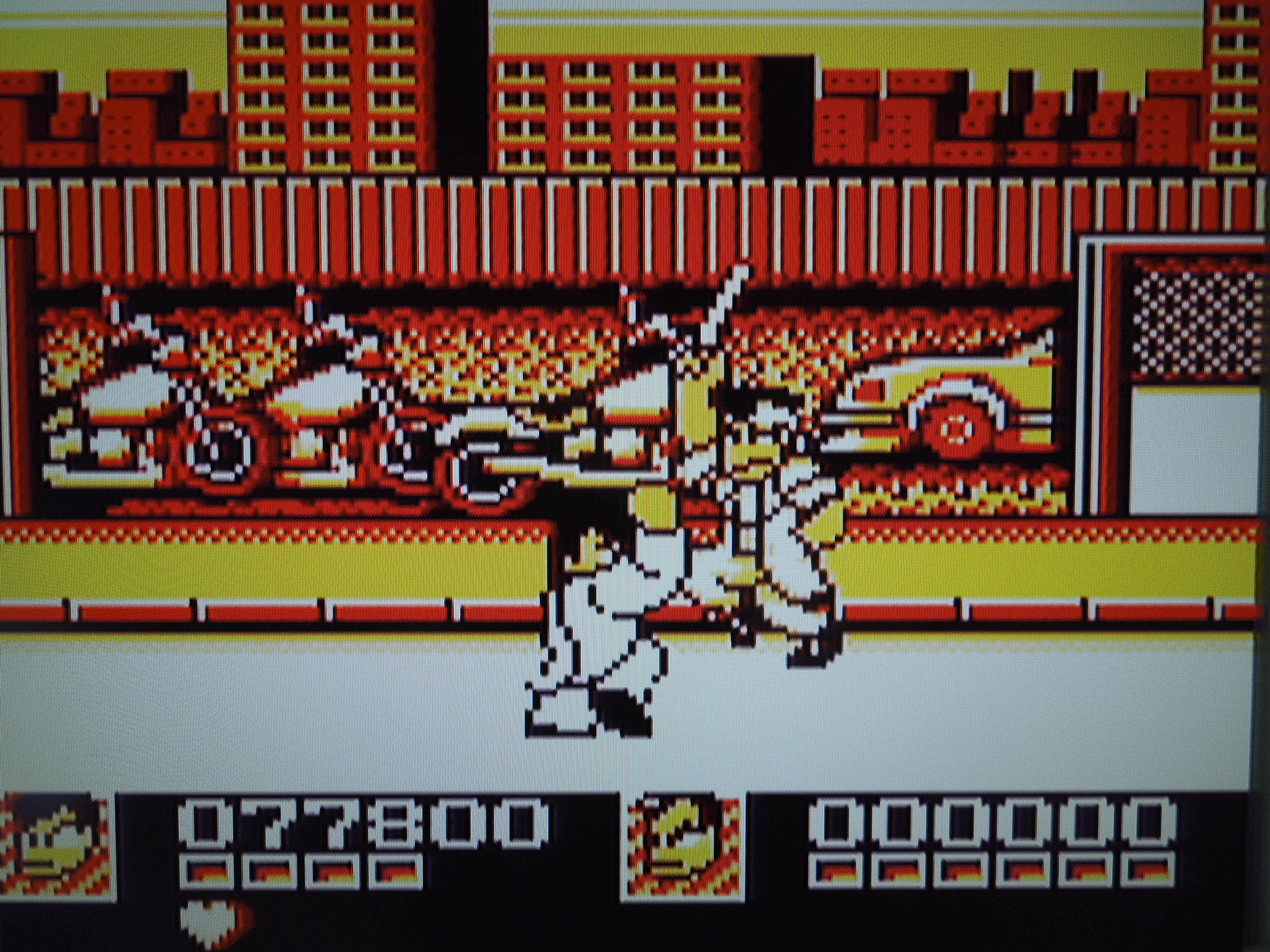
Gameplay:  Bangai Ranto Hen is a very simple Beat ‘Em Up.  Walk right, punch and kick a variety of bad guys with a boss at the end of a stage, repeat.  You have 3 lives, represented by hearts, and you cannot gain any extra lives in any way.  You have a health bar of 6 blocks, and as you get pummeled by bad guys, you lose blocks.  Every time you clear a round, your health bar replenishes itself, with the exception of the last level.  If you lose all of your lives, you can select Continue to go back to the beginning of the most recent stage you were on.  You have a score counter, but it doesn’t grant you extra lives when you ascertain high scores or anything like that.

Grabbing punks for a good rough-housing is good fun. Grabbing punks for a good rough-housing is good fun.

Difficulty:  There are 3 difficulties:  Easy, Medium, and Hard.  On Easy, you can only play through the first few stages before the game halts your progress.  Beating the game on Medium is not too tough, however.

Control:  You control Kunio (1P) or Riki (2P).  Very simple controls.  A punches.  B kicks.  While punching, pressing Toward + A grabs an opponent by the neck and pummels him with rapid punches.  Pressing Toward + B once you have been punching an opponent throws him.  When an opponent is down, pressing A or B executes a jumping stomp.  Pressing A + B makes your character crouch, then pressing A or B executes a jumping uppercut (like Ryu in Street Fighter II).  There is no other way to jump.  That’s it.  Simple, yes, but the game’s controls do work well.

You can execute throws by pressing Toward + B with a grabbed opponent. You can execute throws by pressing Toward + B with a grabbed opponent.

Music & Sound:  I’m actually rather impressed with the music.  Different tracks play on different stages, and they suitably convey a sense of ‘revenge.’  The punches, kicks, and throws all sound adequate.

Weapons?  Health Pick Ups?  1 UPs?  Nope – none of those are here.  Some bad guys carry chains, knives, or guns, but you can’t take them from them and use them like you could in a similar Kunio-kun game like River City Ransom. 

How does the game look on a Super Game Boy?  Quite good!  This game was not designed to take advantage of the Super Game Boy (like Nekketsu Volleyball), so you’ll want to pick out your own color palettes to make the game look as good as possible.  I found several good color combinations.  The only thing that was disappointing about playing on a Super Game Boy is that there is no way to play 2 Player Co-op.  Nekketsu Volleyball allowed for 2 players to play using 2 SNES controllers, but sadly, that option is not available here.  The only way to play 2 Player Co-op is the original way – 2 Game Boy handhelds, 2 cartridges, and a link cable.

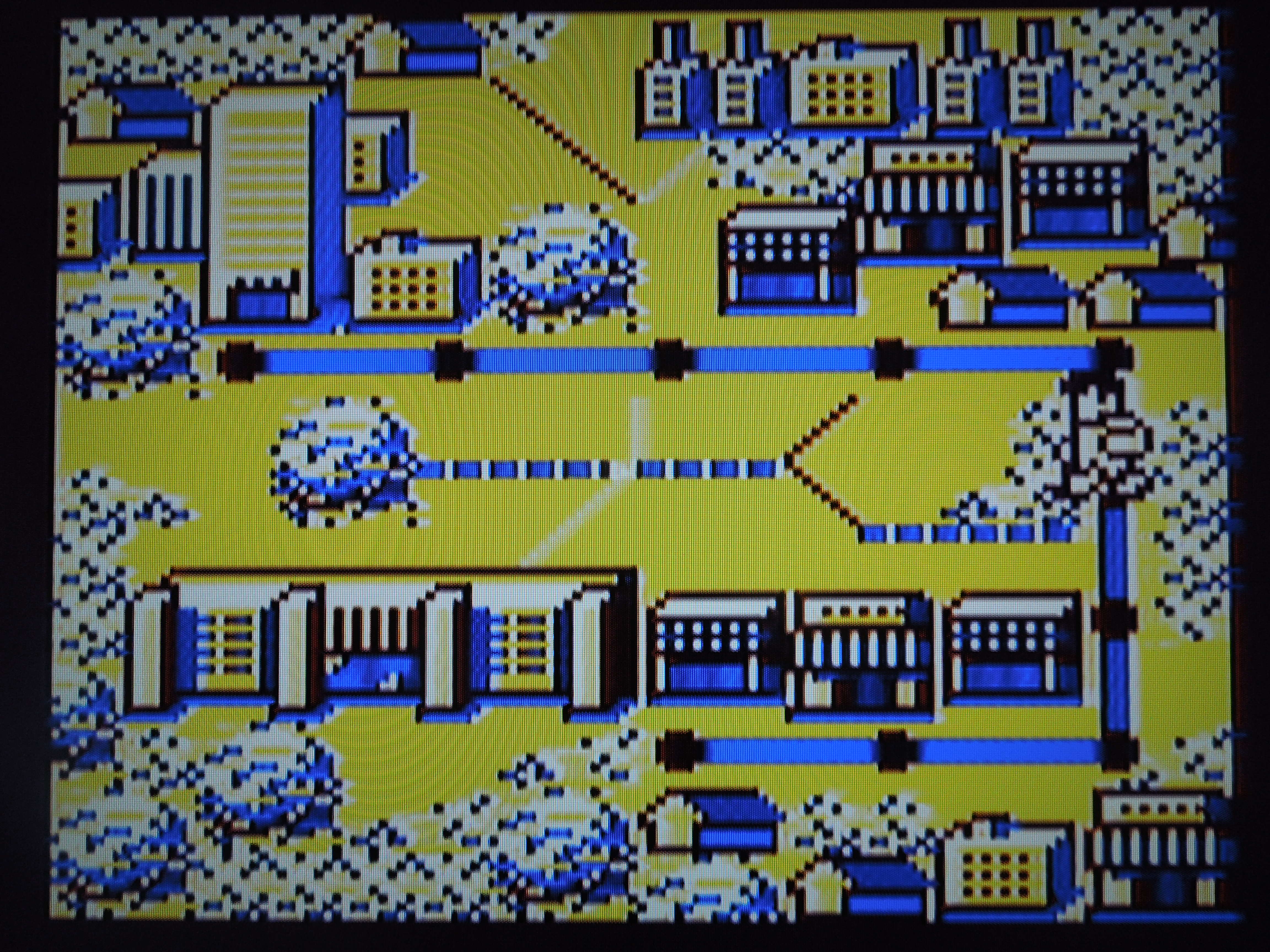
A map screen shows your progress between levels. A map screen shows your progress between levels.

Language barrier?  No, not really.  On the main screen, the ‘1 Player Start, 1 Player Continue’ is in English, but at the bottom of the screen, the difficulty levels are in Japanese, but it’s easy enough to figure out Easy (left), Medium (center), Hard (right).  The game’s story is in Japanese, but the cutscene pictures tell the story well even if you can’t read the language.  In some stages, store backgrounds are in English.

The bosses are the highlight of the game. The bosses are the highlight of the game.

Battery backup or password feature?  Neither.  The game is not long at all, and you can probably beat it all the way through in approximately 30 minutes.  The ‘1 Player Continue’ option simply becomes available if you lose all your lives.  If you power off your system, you’ll have to start back at the beginning.

So, where can I find this game?  Easy to find on eBay.  You can also play the rom on a computer emulator – I believe there’s even a translated version.

Most of the bosses aren't much tougher than the regular enemies. Most of the bosses aren’t much tougher than the regular enemies.

Conclusion:  Bangai Ranto Hen is an extraordinarily simple game.  Unlike other Nekketsu Beat ‘Em Ups, like River City Ransom, there’s no ‘experience system,’ no collecting money, no taking weapons from bad guys, no buying items in shops – just a straightforward Beat ‘Em Up.  This wouldn’t be so bad if there were more variety to the stages and fighting.  Many of the stages (there aren’t many) are identical repeats of previous stages.  There is one stage where you start on the end of a pier, and you can be thrown off by enemies for an instant death, so watch out (you can also throw them off).  The best part of the game are the bosses – a boxer, a martial artist with a kendo stick, a body builder (looks like an old school Arnold Schwarzenegger), a sumo wrestler, and finally, Yuji – they all look great.  The end of the game has you run the gauntlet of bosses you’ve already beaten before facing Yuji.  The biggest disappointment I had with this game was being unable to play co-op on a tv – this might have made the game a bit more fun – still the control is good, and so is the music.

The Southern Gentleman’s Opinion and Letter Grade:  Simple can be a great thing in video games – really great – but this game is just too bare bones for a recommendation unless you’re a huge Nekketsu fan.  C-

God Bless! Proverbs 3:6
NES – VS. Super Mario Bros.

VS. Super Mario Bros. for the NES VS. Super Mario Bros. for the NES

Note 1:  This game was played on an NES 101 model (toploader) that was modified to output in AV composite (red, yellow, white) just like the original NES.  It was connected to a 32-inch HD tv.

Note 2:  Like VS. NES games?  Check out my review of VS. Excitebike.  Like NES games in general?  Check out my reviews of Little League Baseball, Doki Doki Panic, I’m Kid Dracula, Mighty Final Fight, Nekketsu Ice Hockey, Nekketsu Riki Kunio, Nekketsu Soccer League, Nekketsu Street Basket, SEC Tecmo Bowl, Tecmo Bowl Japan, Splatterhouse, and TMNT Tournament Fighters!

VS. Super Mario Bros. was originally an arcade game. VS. Super Mario Bros. was originally an arcade game.

Genre:  Platformer

Players: 1 or 2, alternating

Quick History: Vs. Super Mario Bros. was released in arcades in 1986 – specifically the VS. UniSystem arcade cabinet.  The VS. UniSystem played arcade boards that were versions of NES games, although most of the games were different from their NES counterparts.  Somehow, NES reproduction makers have been able to put some of these old VS. arcade games onto NES cartridges for play on original Nintendos, and that is the case with VS. Super Mario BrosVS. Super Mario Bros. and the well-known Super Mario Bros. are not exactly the same, and this review will address some of the differences.

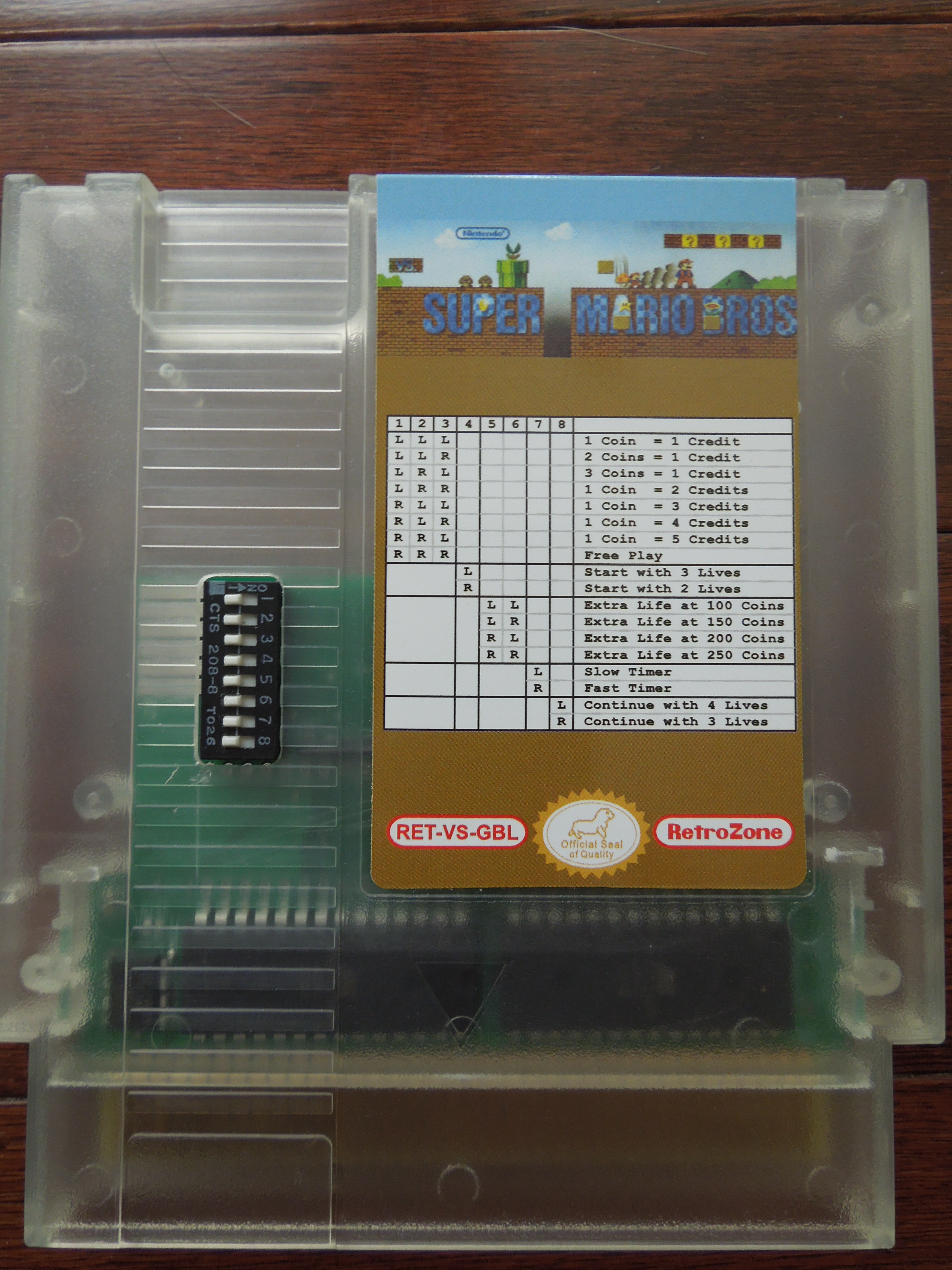
DIP switches:  Because VS. Super Mario Bros. is an arcade game, the cartridge was created with DIP switches on the front.  DIP switches are small white buttons that can be ‘set’ to certain positions to control things like the number of lives a player would receive for each ‘coin’ they inserted, how fast the stage timer would run in the game, how many coins the player had to collect to gain an extra life, etc.  There is also a switch to set the game to ‘Free Play,’ meaning you don’t have to ‘insert’ a coin in order to play.  In arcades, the owner was thus able to set his or her machines’ DIP switches to his or her own liking, and essentially ‘control’ how much money a machine would make.  It’s nice to see the DIP switches on this cartridge of VS. Super Mario Bros., as you can ‘control’ the settings yourself, and essentially give yourself the best chance to beat the game by setting the switches in your favor.

Add Credits by pressing Select & Start. Add Credits by pressing Select & Start.

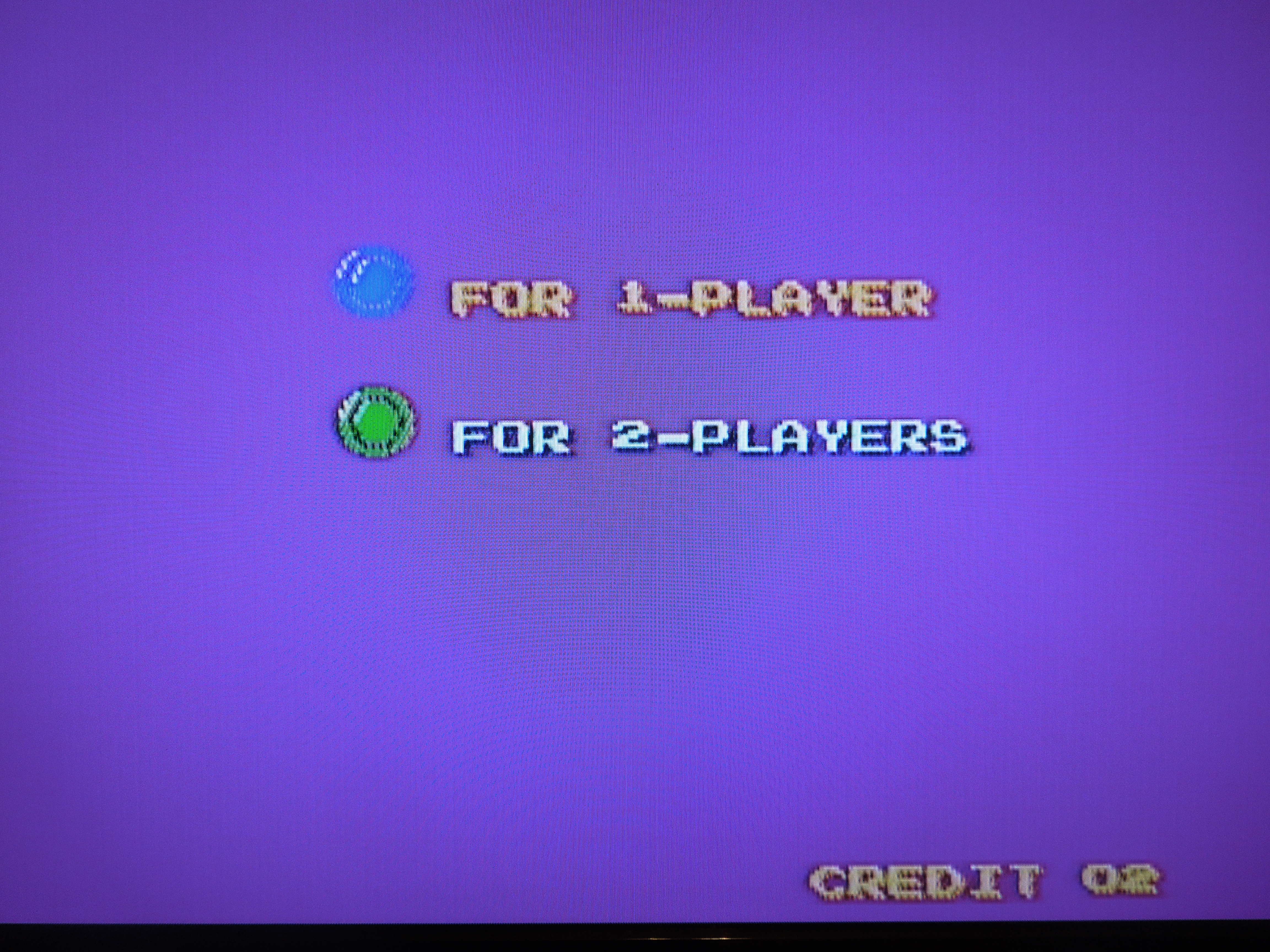
Control:  Unless the game is set to Free Play, pressing Select & Start together ‘inserts’ a coin.  You can insert as many coins as you want and build up your Credits.  You have to enter at least 2 coins to enable the alternating 2 player option.  During gameplay, holding B makes Mario or Luigi run fast, and pressing B when Mario has collected a Fire Flower causes him to throw a fireball.  Button A causes Mario or Luigi to jump.  You cannot pause this game.

Differences between VS. Super Mario Bros. and the regular NES Super Mario Bros.:

1. Less 1-Up mushrooms in VS.

2. Less power up mushrooms and Fire Flowers (or they’re found in more difficult to reach locations) in VS.

3. You cannot warp to World 8 in VS. – the furthest you can warp is World 6.

4. Many of the levels are the essentially the same in VS. as they are in the regular NES version, except that they have been made more difficult with smaller platforms to jump on or more holes to fall into.

5. Many of the later levels in the VS. actually come from the Japanese version of Super Mario Bros. 2.

6. In VS., there is a high score screen where you can enter your initials if you get a high enough score (sadly, the cartridge won’t save your score).

7.  The timer in each level runs quite fast, even if you have the DIP switch set to ‘slow’.

You can't warp any further than World 6 in this version. You can’t warp any further than World 6 in this version.

Difficulty: VS. Super Mario Bros. is quite difficult, as you can see from the list of differences.  The game, like the original, has 8 Worlds, each split into 4 sections.  (World 1-1, 1-2, 1-3, 1-4, and so on).  Although you can enter as many Credits as you want, or set the game to Free Play, you still have to practice if you want to beat the game.  The reason for this is, if you lose all of your lives (you can set the game to give you up to 4 lives per Credit) and elect to continue, you’ll start back at the beginning of the World you’re on.  So, for example, if you lose all of your lives on level 8-4, you’ll go all the way back to level 8-1 when you continue.

Trying to achieve a high score gives this game excellent replay value. Trying to achieve a high score gives this game excellent replay value.

So, where can I find this game?  I got a copy from Retrozone some time ago.  I’m not sure if it’s still available there, however.  I believe it is a more difficult game for NES reproduction makers to create because of the arcade nature of the game, but you can always email NES reproduction websites and ask if they are able to make it.  You can also play the game on a computer emulator.

Conclusion: Vs. Super Mario Bros. is different enough from the original to warrant a playthrough – but beware, it is TOUGH (for me, at least).  I found it more difficult than the Japanese only Super Mario Bros. 2, which is also a difficult game.  Not being able to warp to World 8 means you’ll have to master all of the levels in Worlds 6 and 7, some of which are incredibly difficult due to long jumps, numerous obstacles, and that quickly moving timer.  I really, really like the addition of the High Score screen.  Unfortunately, you cannot save your score, however – if the game had a battery for the purpose of saving your socre, it would be perfect.

The Southern Gentleman’s Opinion and Letter Grade:  VS. Super Mario Bros. is recommended if you’re looking for a supreme challenge far beyond that of the NES original.  A+

God Bless! Proverbs 3:6

PC Engine – Operation Wolf

Operation Wolf for the PC Engine Operation Wolf for the PC Engine

Note:  This game was played on a PC Engine home console.  The console was connected to 32-inch HD tv with AV cables (red, yellow, white).

Quick History:  Operation Wolf was released for the PC Engine home console exclusively in Japan in 1990.  The game is a port of the arcade game released in 1987.  There were several home console versions of Operation Wolf, including the NES.  The game was not released in the U.S. for the Turbografx 16 (the U.S. version of the PC Engine), and thus many U.S. gamers are unaware of any version other than the arcade or NES ones.

The PC Engine version of Operation Wolf trumps the NES version. The PC Engine version of Operation Wolf trumps the NES version.

Genre:  First person, on-rails shooter

Players:  1 or 2 players cooperative

Story:  You (or you and a partner) are Special Forces Operatives who are charged with rescuing POWs from concentration camps.  You’ll need to infiltrate jungles, villages, and military bases and shoot everything in sight to accomplish your objective.

Modes:  Operation Wolf is a very straight-forward game.  The opening screen has options for 1 Player, 2 Players, or Speed.  If you select Speed, you can change the speed at which your onscreen crosshair (the little X that shows where your gun is pointed) moves across the screen.  You can select from Slow, Normal, and Fast.  In my experience, Normal (the default selection) is perfect.

You can choose the order of the first 4 missions. You can choose the order of the first 4 missions.

Control:  Button II fires your machine gun.  Button I fires off your rocket launcher.  Run pauses the game.  The control pad moves your crosshair to every corner of the screen.

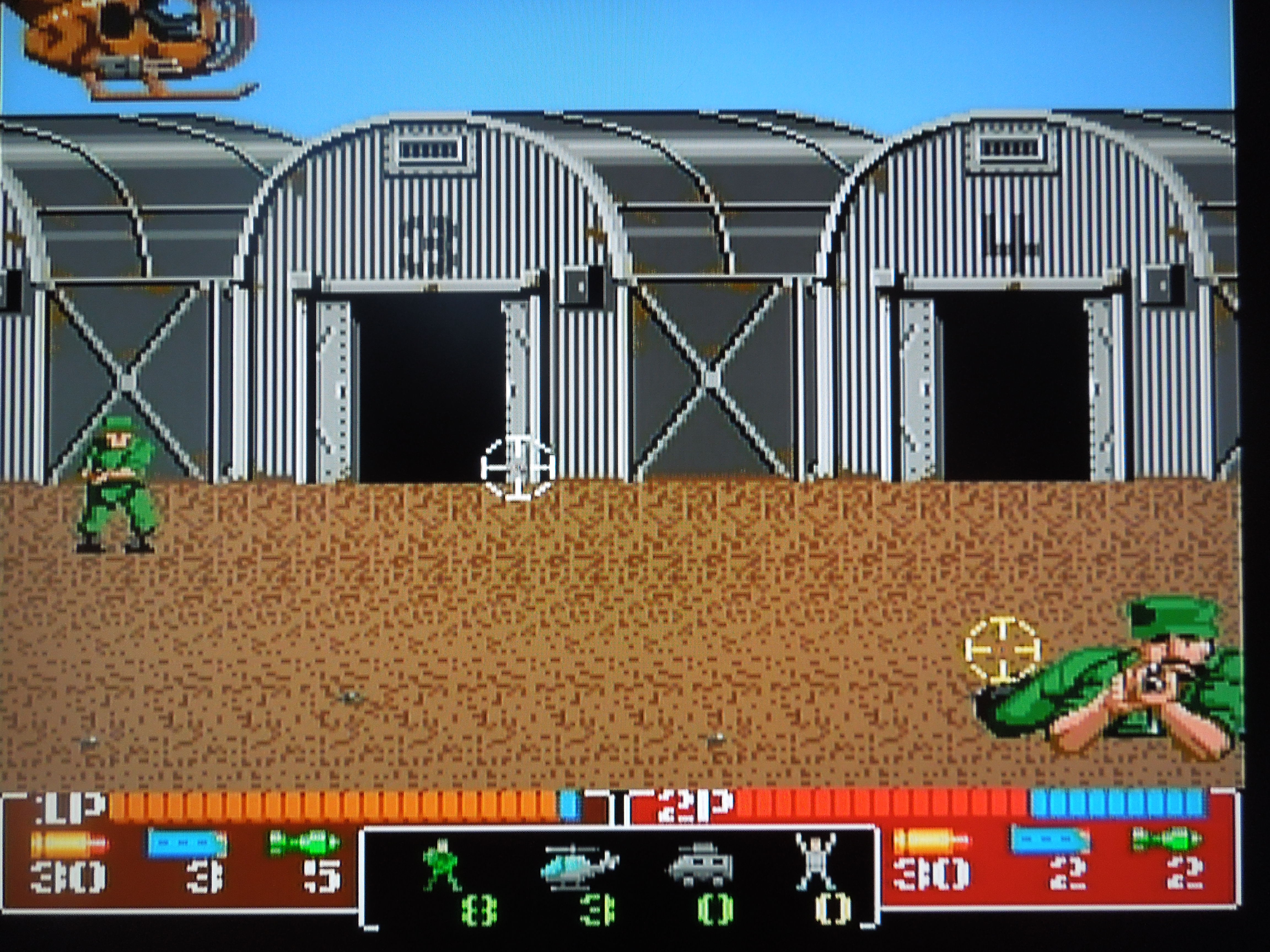
Gameplay:  You must shoot your way through 6 missions, all of which aren’t very long, but are filled with action.  To start the game, you can select among 4 missions.  After you beat each of these, 2 additional missions become available to you.  During each stage, your goal is to kill everything on screen while not dying yourself.  You have a long life bar at the bottom of the screen, and every time you get shot, it depletes.  Once it’s empty, the screen displays the words ‘You Dead’ and the mission is over.  Soldiers, paratroopers, knife-throwers, grenade lobbers, helicopters, armored cars, and armored boats will all be gunning for you.  You have a set amount of ammo for your machine gun and rockets for your rocket launcher, but you can pick up more in each stage.

You stats are displayed after you die or after you beat the game. You stats are displayed after you die or after you beat the game.

Items:  During each stage, you can collect different pickups to help you complete each mission.  You have to shoot them to acquire them.  Magazines increase the number of bullets you have.  Green rockets increase your rockets by 1.  ‘P’ drinks increase your health by several bars.  ‘FREE’ icons allow you to fire your machine gun for several seconds without losing any ammo.  Dynamite icons kill everything onscreen.  Occasionally, first aid kids will be parachuted down, and these refill your entire life bar.  Sometimes, vultures fly by or coconuts are seen hanging in trees.  Shooting these will release a magazine.

2 Player Co-op makes the game easier. 2 Player Co-op makes the game easier.

Innocents:  Prisoners-of-war, women, children, nurses, and even a bikini-clad blonde (seriously) will occasionally run by.  Don’t shoot them, or you’ll lose some of your health.

Continues:  If you lose all of your life during a stage (or both Players lose their life during co-op), you’ll have the option to continue only once.  You’ll restart from the beginning of the stage you were on, but your health and ammo will be refilled.   If you lose all of your life again, the game is over.

Language Barrier?  No and Yes.  No, not really.  The game title and mode selection are in English.  After you beat the game, or lose your life, you can view your stats (number of bullets fired, etc.), which are also in English.  The story, however, is in Japanese.  The stage names and onscreen text following completed missions are in Japanese, but it’s not hard to tell what’s going on due to the excellent art accompanying the text.

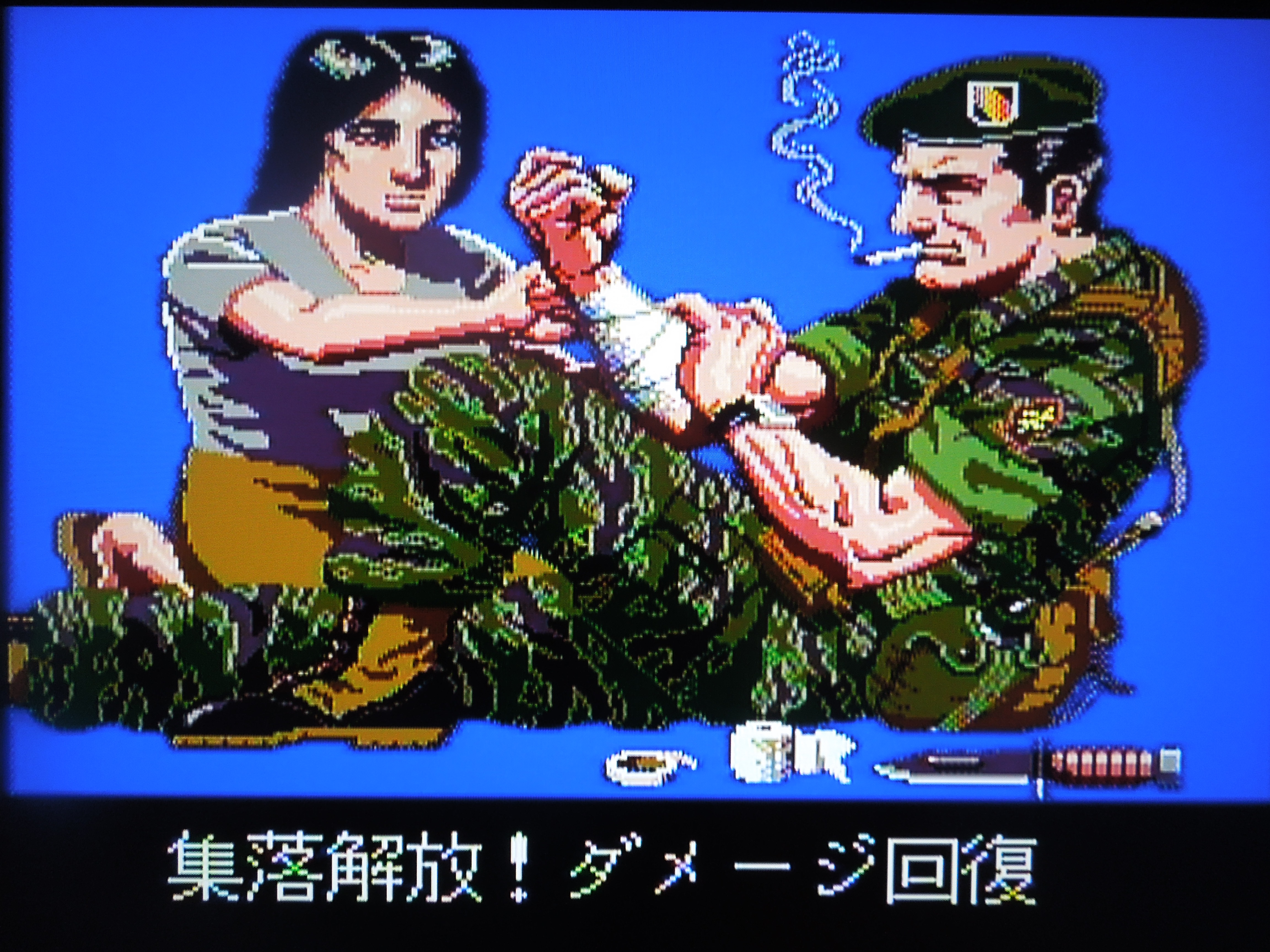
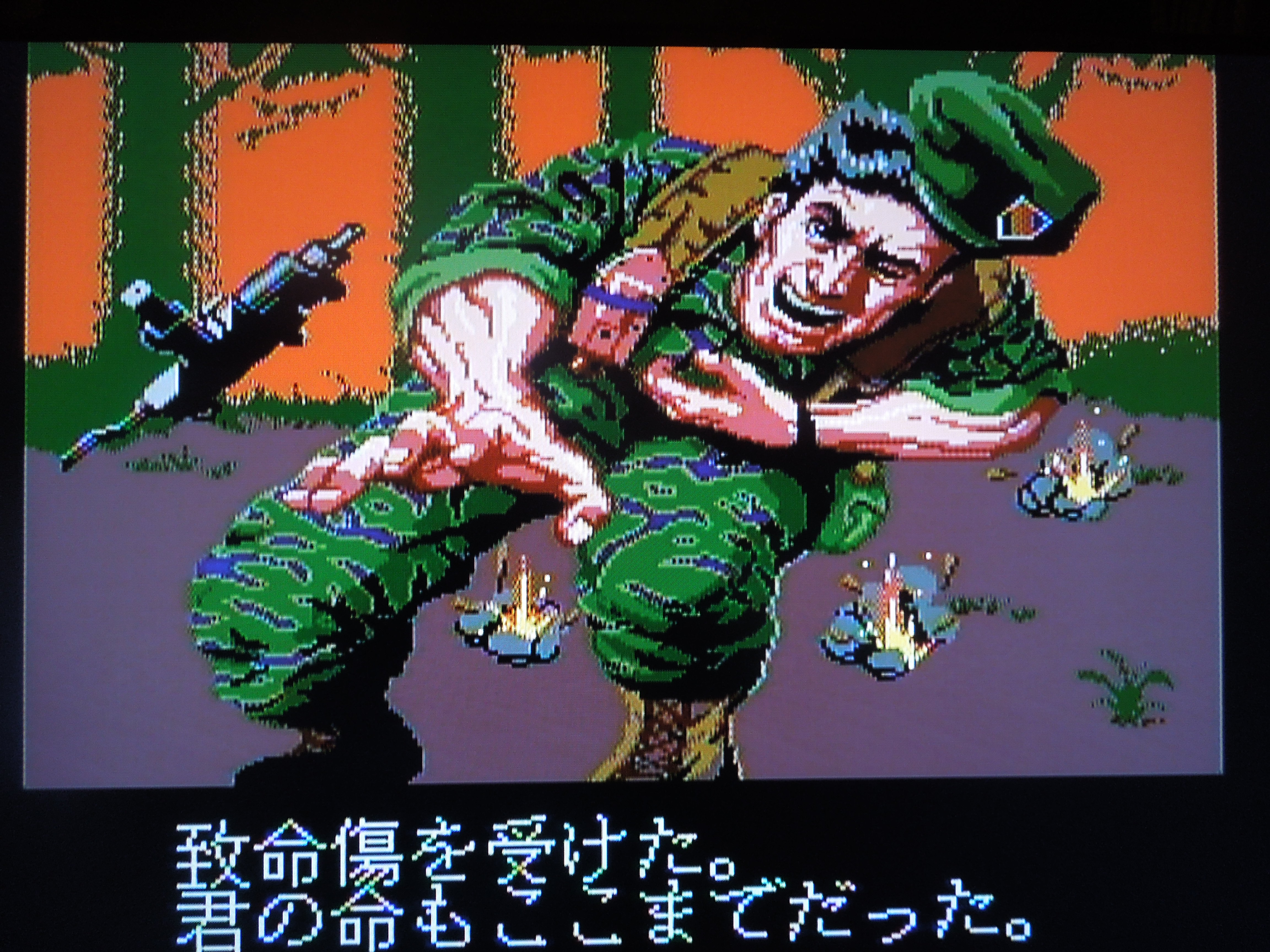
Cut-scenes advance the story between missions, although the text is in Japanese. Cut-scenes advance the story between missions, although the text is in Japanese.

So, where can I find this game?  It’s easy to find on sites like eBay, although you may have to order it from Japan.  You can also play the rom on a computer emulator.

Conclusion:  Operation Wolf for the PC Engine is a surprisingly excellent game.  The gunshots and explosions sound great, and the game looks fantastic – much better than the NES version, certainly.  The control is excellent, as the crosshair moves exactly where you want it to.  There is no option to attach a light gun like in the arcade original, but that doesn’t hurt the game.  Having built in turbo controls (like many PC Engine controllers do) really helps in games like this.  The challenge is spot on, too.  It will take you several playthroughs to decide which stages you should play first, second, etc. based on their difficulty.  Two player co-op makes the game somewhat easier, although players have to split the supplies they find, making the conservation of ammo and health pickups even more important.

The Southern Gentleman’s Opinion and Letter Grade:  Operation Wolf for the PC Engine is a gem of game.  Simple, addictive shooting action.  B+

God Bless! Proverbs 3:6

You have exactly 1 Continue, so honing your shooting skills is essential to beating the game. You have exactly 1 Continue, so honing your shooting skills is essential to beating the game.

Sega Mega Drive – Bare Knuckle III

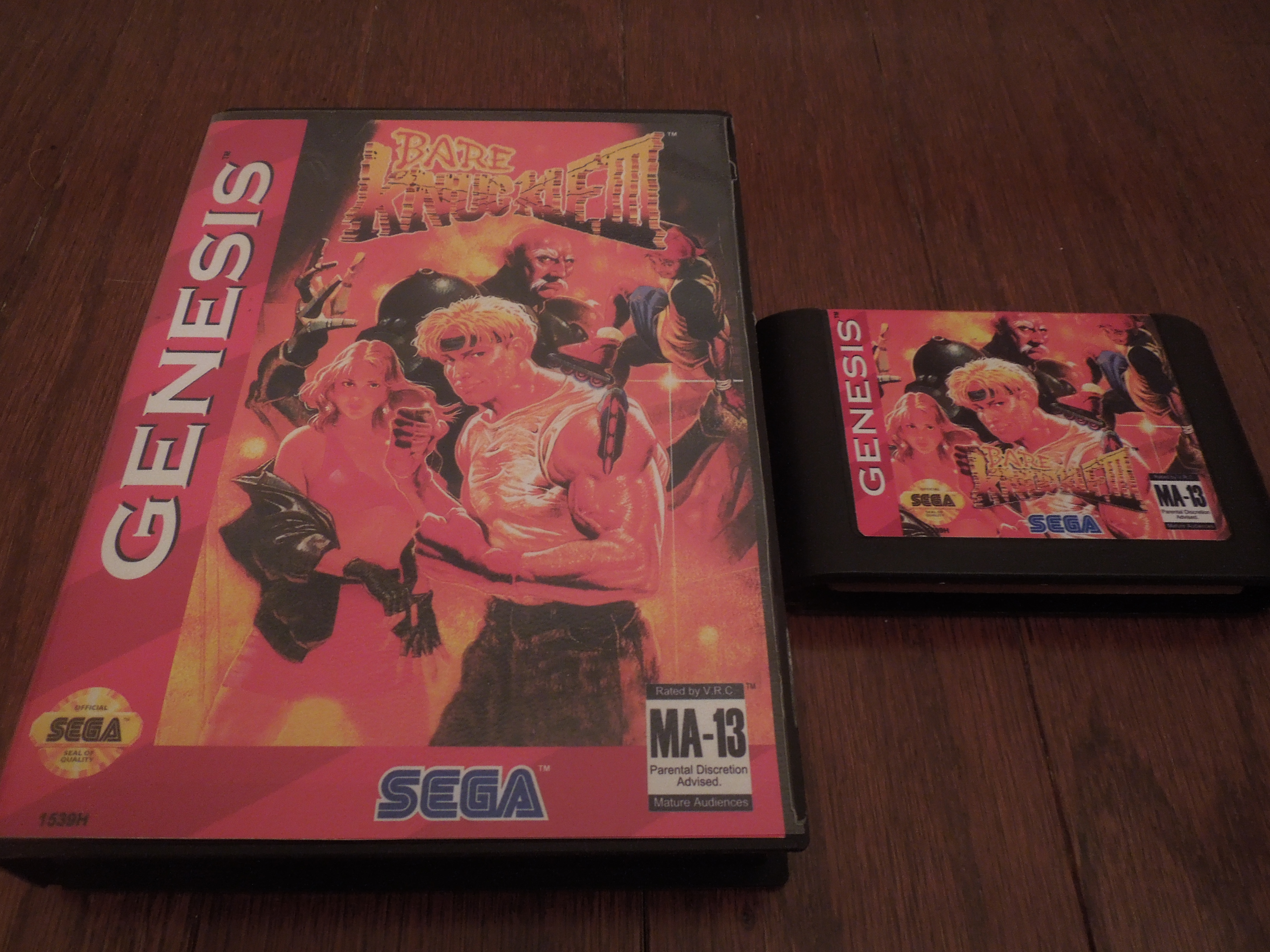
Bare Knuckle III for the Sega Genesis Bare Knuckle III for the Sega Genesis

Note 1:  Like Beat ‘Em Ups?  Check out my reviews of Crows: The Battle Action, D & D, Double Dragon II, Final Fight Guy, Final Fight II, Mighty Final Fight, Nekketsu Oyako, Sengoku 3, and Warriors of Fate!

Note 2:  This game was played on a Sega Genesis 3 game console.  The console was connected to a 32-inch HD tv with AV (red, yellow, white) cables.

Quick History:  Bare Knuckle III was released in Japan for the Sega Mega Drive home console in 1994.  In the United States, the game was released under the title Streets of Rage III for the Sega Genesis (the name of the Sega Mega Drive in the U.S.).  Although the he U.S. version’s gameplay was essentially the same, the game was significantly altered in terms of its story, the difficulty of the game, and the removal of a controversial character in the game.  Because of these changes, Bare Knuckle III and Streets of Rage III are two quite different experiences.  Today, the original Japanese game Bare Knuckle III has been translated into English, and it can be placed onto a Sega Genesis cartridge (which is slightly smaller in size than its Japanese counterpart for the Mega Drive) for play on a U.S. Sega Genesis console.  This review is for the translated Sega Genesis reproduction cartridge, Bare Knuckle III. 

Bare Knuckle III was formerly only available in Japan, but today, translated reproduction cartridges allow the game to be played on the U.S. Sega Genesis. Bare Knuckle III was formerly only available in Japan, but today, translated reproduction cartridges allow the game to be played on the U.S. Sega Genesis.

Genre:  Beat ‘Em Up

Players:  1 or 2 Players, Cooperative and Competitive

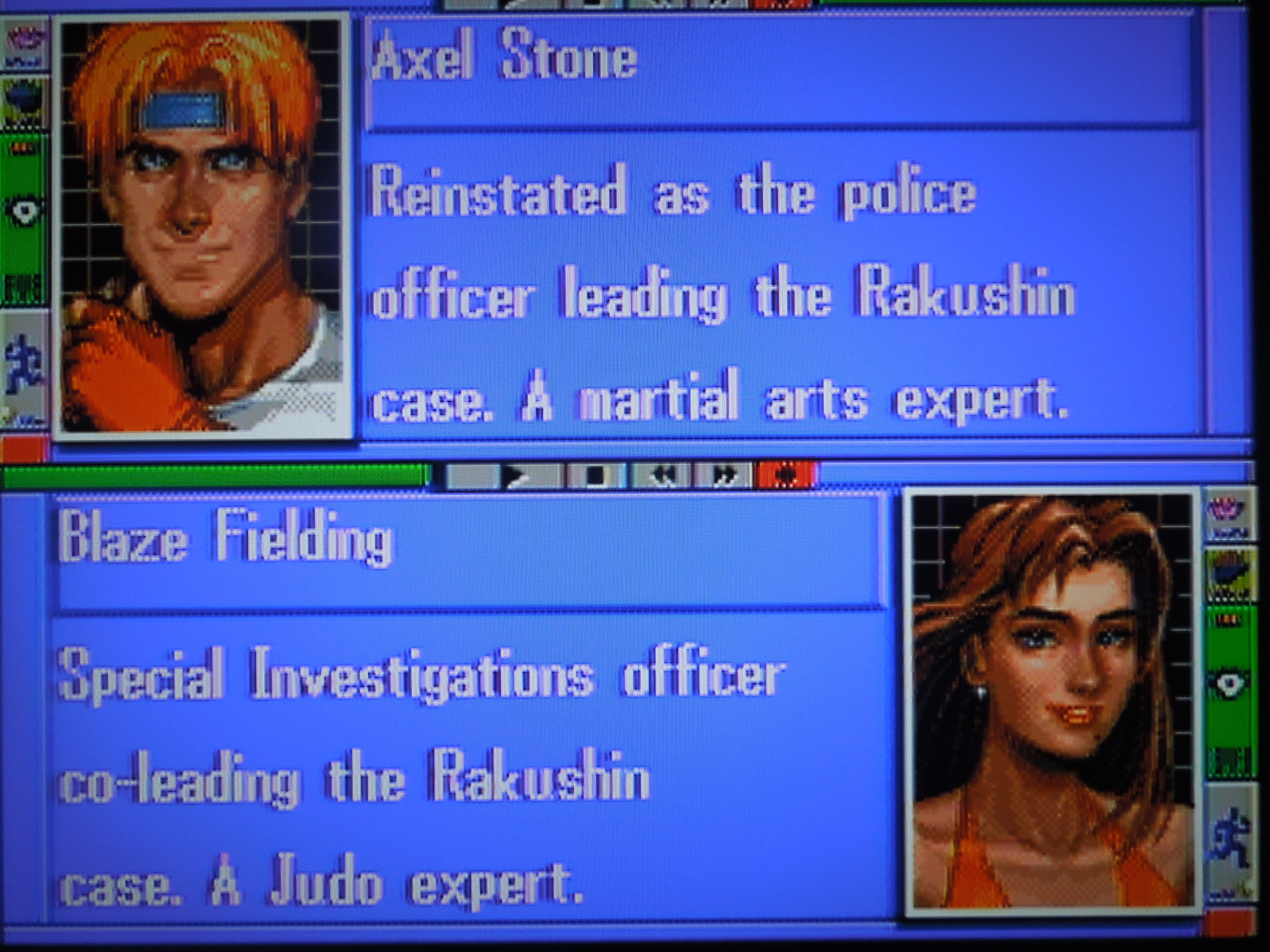
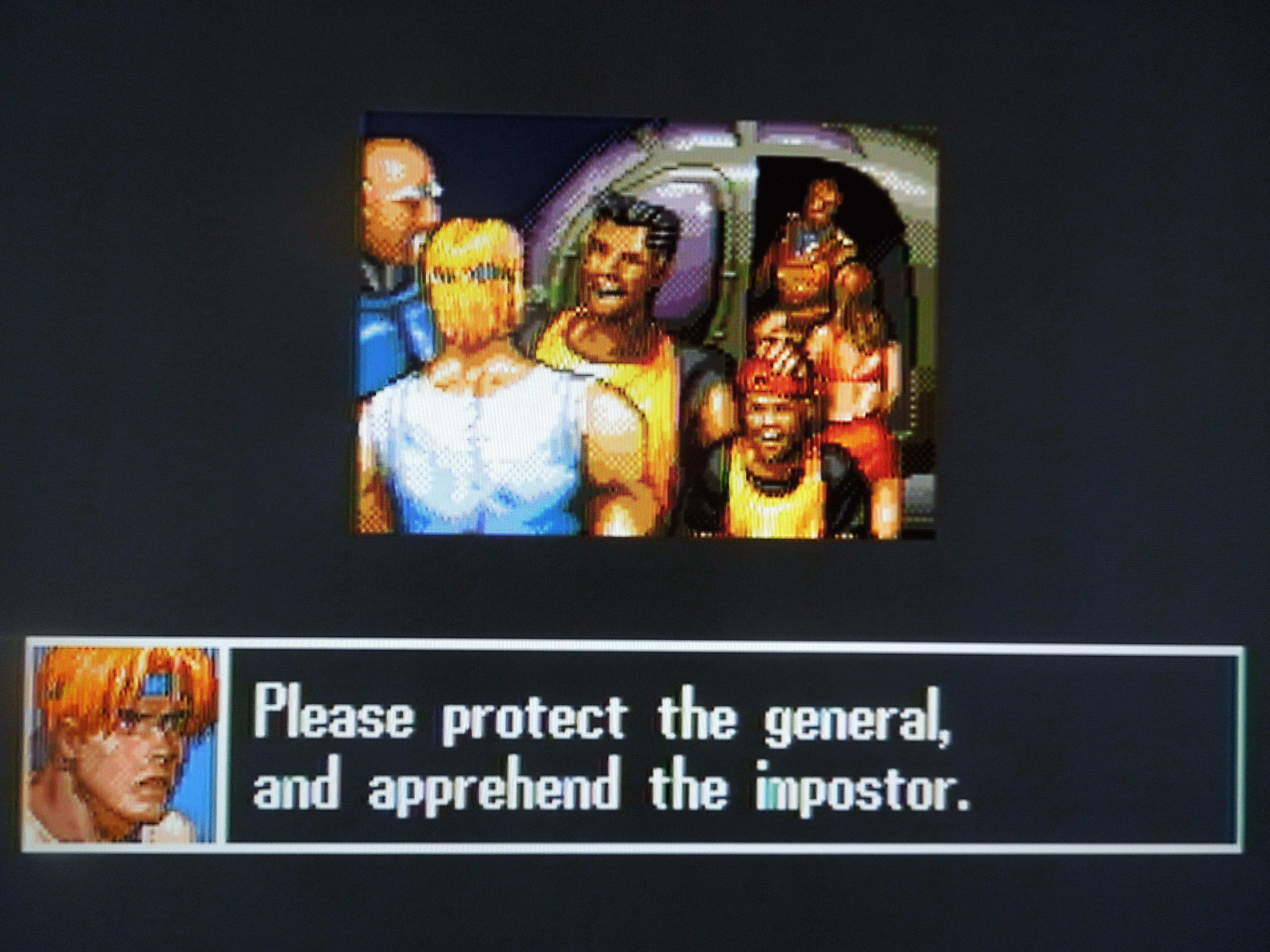
Story:  In Bare Knuckle III, Wood Oak City, the home of the game’s protagonists, has been hit by a nuclear bomb which contains a drug called Rakushin, killing tens of thousands of people and injuring even more.  Now, 2 police officers, Axel and Blaze, and their friends, Sammy and Dr. Zan, must track down the Syndicate, an organization that has stolen more Rakushin and intends to detonate another bomb with it.  Cut scenes and text dialogue play between each level that advance the story, and not only does this move the game beyond a simple Beat ‘Em Up, the story itself is a more ‘mature’ story than what is found in similar games.  Additionally, different endings can be achieved based on if you accomplish certain objectives in the game’s final 2 stages.

2 Cops and their friends must stop a catastrophic event from occurring again in their city. 2 Cops and their friends must stop a catastrophic event from occurring again in their city.

2 Player Battle: You can select from the game’s 4 characters (plus Victy, a boxing kangaroo, if you hold Up + B then press Start at the opening menu screen) for a head-to head matchup.  After selecting your fighters, you’ll duke It out in one of several selectable environments (all coming from the game’s Story Mode).  The game keeps track of who played as whom, and what the win/loss record of each player is.  Additionally, each player has unique quotes for winning and losing.  This is actually quite a fun mode, and a great way to practice with each character.

2 Player Battle Mode is well-executed here, with the game keeping track of win/loss records. 2 Player Battle Mode is well-executed here, with the game keeping track of win/loss records.

Control:  Although the back of the game box recommends a 6 button controller, I only used a 3 button one, and that works just fine.  You can alter the controls in the Option menu, and this is the setup I went with – A attack.  B jump.  C special.  Your chosen character can run by pressing Toward, Toward, and can attack on the run by pressing A.  Pressing Down, Down, or Up, Up causes your character to roll (evade) in the respective direction you pressed.  When in close to an enemy, pressing A grabs him or her, and pressing A again executes a throw.

Special Move and Stars:  You have a ‘Special’ bar beside your life bar that slowly fills up.  When it’s full, you can execute your Special Attack (C) without costing you any of your life bar.  Also, if you play the game long enough without losing a life, and you gain a set number of points, you gain Stars beneath your life bar.  Each Star you gain enables you to execute a stronger running attack move.  You can get up to 3 stars, but after you lose a life, any Stars you’ve gained will be subtracted by one.

Gaining 'Stars' by staying alive and earning points increases your character's power. Gaining ‘Stars’ by staying alive and earning points increases your character’s power.

Music and Sound:  Bare Knuckle III has a good variety of music for its 7 rounds, each which are significantly different from one another and suitably atmospheric.  The sounds effects (for a Genesis game) are good.  Punches, kicks, slams, Specials, explosions, and the screams of defeated enemies all sound pleasing.

Weapons, Food, Items:  Bats, knives, swords, and grenades can all be found or taken from enemies.  After a set number of hits, however, they’ll break.  Food can be found in the form of turkey and apples (you’ll find these often), and it will replenish your life bar.  Gold bars and bags of money can be picked up to wrack up your points total and get you to a ‘Star’ faster.  Additionally, occasionally, you’ll find 1Ups hidden in barrels.   You also gain 1Ups by gaining certain point totals.

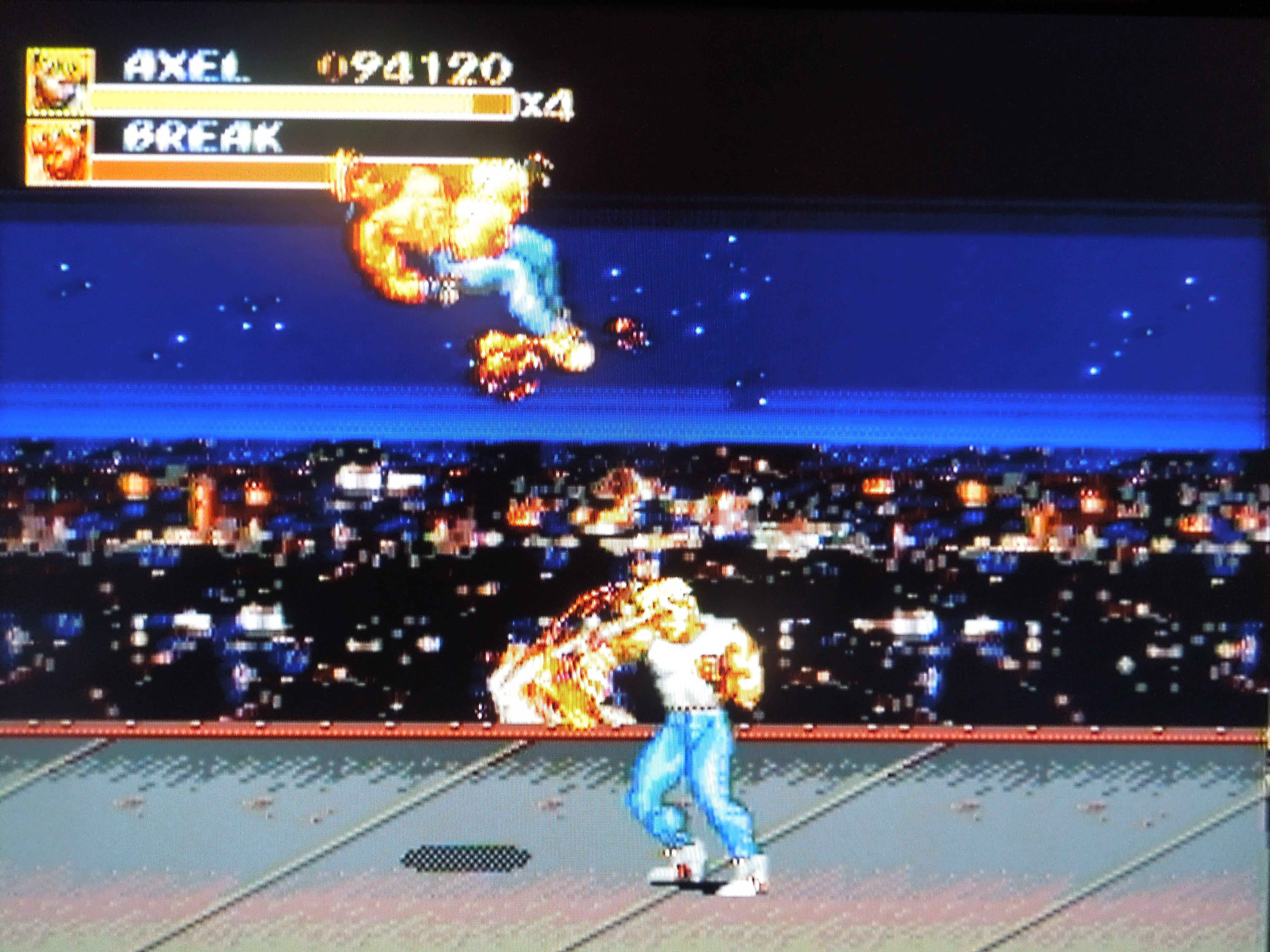
Axel vs his robot counterpart. Axel vs his robot counterpart.

Difficulty:  The game has four difficulty settings – Easy, Normal, Hard, and Very Hard.  You can beat the game all the way through on any difficulty setting, but greater percentages of your health are drained by enemy attacks on higher settings.  You shouldn’t have any difficulty at all beating the game on Easy, especially if you stay alive and get the Stars that make your running attack extremely powerful.

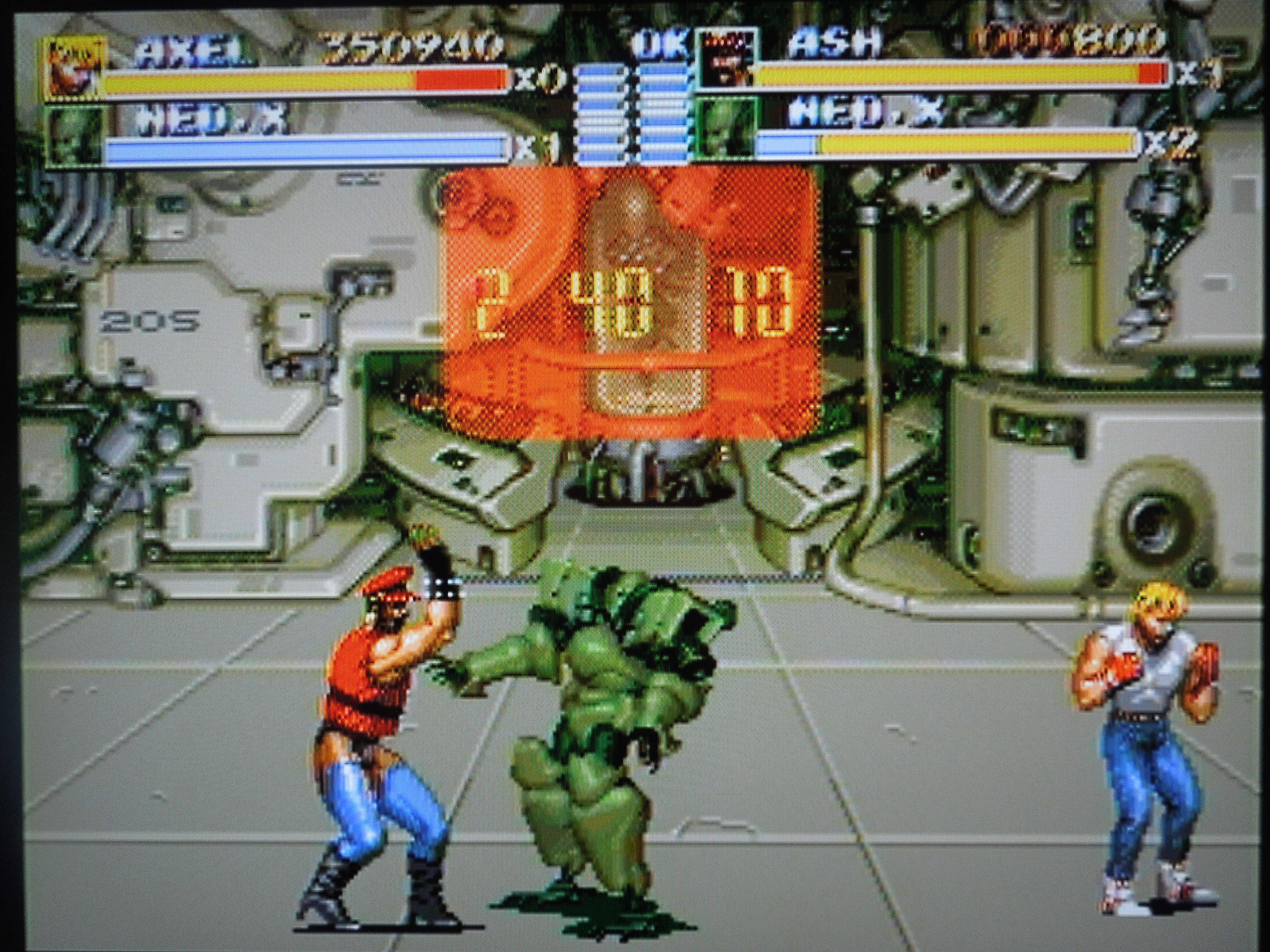
Hidden Characters:  Victy, a boxing kangaroo, can be used from the beginning of Story Mode by putting in the aforementioned code, or by NOT defeating him when you encounter him in the game.  To use Ash, the first boss, defeat him then hold button B until the start of the next stage.  To use Shiva, defeat him, then hold A until the start of the next stage.  For all 3 of these characters, you’ll have to lose all of your lives and elect to continue – then they will be selectable from the character list if you performed these actions.

This controversial boss, Ash, had to be removed when the game was released in the U.S. This controversial boss, Ash, had to be removed when the game was released in the U.S.

Bare Knuckle III (Japan) vs. Streets of Rage III (U.S.)  As I mentioned, there were many changes made to the U.S. version of the game, and not just the title.  The difficulty level in Bare Knuckle III is far easier than in Streets of Rage III – beating the game on Easy in BNIII is actually ‘easy,’ while the Easy in SoRIII is much more difficult.  The story in the U.S. version of the game removes completely the nuclear attack and references to the drug Rakushin, instead opting for a story involving robots being used to replace city officials.  Female enemies were also given less revealing outfits in the U.S. version.  Last, but most obviously, is the removal of the character Ash from the U.S. version.  Ash is clearly a gay-stereotyped character with effeminate mannerisms and moves.  He was given stockings and high heels, and when he dies, his death scream is the same as the death scream of female enemies.  As a playable character (using the aforementioned code), Ash is powerful, though, executing strong regular attacks.  He can’t pick up weapons or throw enemies however, with his face turning red and him giggling when attempting the latter move.  There is no doubt that had he been included in the U.S. version of the game, Sega would have been in trouble.  Note:  The Southern Gentleman does not support any form of racism, sexism, stereotyping, or discrimination whatsoever.

Whether or not you accomplish timed objectives in the game's final 2 stages impacts the ending you'll get. Whether or not you accomplish timed objectives in the game’s final 2 stages impacts the ending you’ll get.

So, where can I find this game?  You can find the untranslated Japanese original cartridge of Bare Knuckle III on eBay, as well as the U.S. version, Streets of Rage III.  Some online sites offer a translated reproduction cartridge like the one used for this review, you’ll just need to do an Internet search.  I believe the game has also been released on Sega compilation discs, and may also be available for download on some popular modern gaming services.  You can also play the rom on a computer emulator.

Cut scenes and dialogue between rounds create a great story. Cut scenes and dialogue between rounds create a great story.

Conclusion:  Bare Knuckle III is a terrific Beat ‘Em Up.  It is a rather long game, and it has more of an involved story that your standard Beat ‘Em Up.  Each character has his or her own strengths and weaknesses, adding diversity to the mix.  The controls are excellent, and the music and sound effects (on a system not known for it) are quite good.

The Southern Gentleman’s Opinion and Letter Grade:  Is Bare Knuckle III worth checking out if you’ve already played the U.S. version, Streets of Rage III?  Probably so, if you’re a Beat ‘Em Up fan.  B+

God Bless! Proverbs 3:6

NES – Nekketsu Kakutou Densetsu (Riki Kunio)

Riki Kunio for the NES Riki Kunio for the NES
Originally, released only for the Famicom, Riki Kunio has now been translated and can be played on your NES. Originally released only for the Famicom, Riki Kunio has now been translated and can be played on your NES.

Note:  This game was played on an NES 101 model (toploader) that was modified to output in AV composite (red, yellow, white) just like the original NES.  It was connected to a 32-inch HD tv.

Genre:  Fighting, 2 on 2

Quick History: Nekketsu Kakutou Densetsu, translated as Hot Blooded Fighting Legend, and commonly referred to as Riki Kunio, was released for the Famicom (Japanese NES) in 1992.  The game was never released outside of Japan, but today, the game has been translated and can be placed onto a NES cartridge for play on your Nintendo Entertainment System.  Because the game is one of the many games in the Kunio-kun game series, its title for these NES translated reproduction cartridges is often simply ‘Riki Kunio,’ after the two main characters in the Kunio-kun series.  This review is for the NES translated reproduction cartridge, Riki Kunio.

Players:  The game is for 1 or 2 players, either competitive or co-op.  Although the game actually has options for 3 or 4 players, this feature is inoperable, even with a NES Four-Score adapter and 4 controllers.  I believe the only way to play with up to 4 players would be if you had the original Japanese game, a Famicom console, and the appropriate adapters and controllers.  I’m unsure why this feature won’t work – perhaps the internal wiring of the Famicom and NES differ for more-than-2-player-gaming.

Password:  Riki Kunio has a password feature, but unfortunately, it too is inoperable.  It is a rather long password with unusual letters that would, in theory, save the ‘character’ you created or save your progress in Story Mode, but it won’t function at all in this NES reproduction cartridge.  I can only speculate that when the game was translated from Japanese to English, the translators didn’t focus on this feature of the game, so the ‘password’ you’re given at certain points in the game doesn’t correspond to what the original Japanese characters (letters) were in the original Famicom game.  Fortunately, not having a password in no way ruins the game experience.

The 'Double Tiger' challenge Kunio; he accepts. Game on! The ‘Double Tiger’ challenge Kunio; he accepts. Game on!

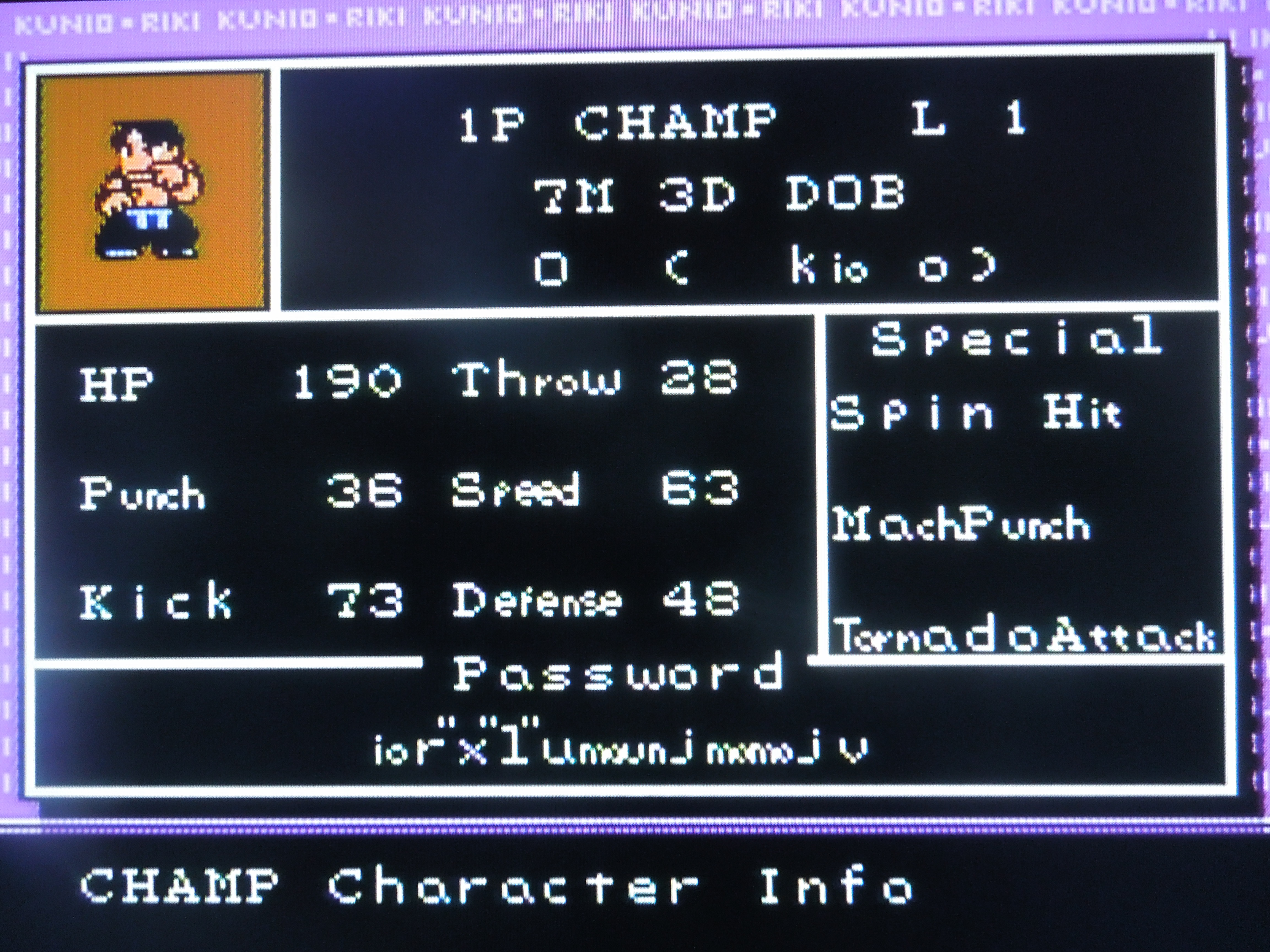
Story Mode:  In Story Mode, the ‘Double Tiger’ put a note in the locker of Kunio, challenging him to a fighting tournament.  However, you create your own fighter in this game, instead of automatically being assigned to play as Kunio.  First, you ‘build’ your own fighter by creating a name, giving a birthday, and even a blood type to him.  Based on what you select, you’ll be given one of four types of fighters – Fighter, Martial Artists, Kung Fu, or Judo Masters.  Each type has their own unique moves, and your created character will have his own unique stats – HP (Hit Points), Throw, Punch, Speed, Kick, Defense.  If you play 2 player co-op, player 2 can then create his character, but if you’re playing alone, you can select your partner from among the 4 types of fighters.  You can then select the ‘rules’ for your fighting matches, but honestly, I haven’t noticed any real differences in gameplay based on this option – I find selecting ‘No Rules’ to simply be a good default selection.  Now, you and your partner will enter a 2 on 2 fighting tournament that includes 7 other 2 man teams.  The game keeps up with your wins and losses, and after winning a set number of fights (I had to play 18 fights, having won 12) before finally getting to fight the Double Tiger.  After every match you win (and sometimes even when you lose) you and your partner will gain ‘levels’ (you start the game at Level 1).  With every level you gain, your stats go up and you get stronger.  You win matches when you and your partner defeat both of your opponents (drain their energy bars to beat them).  Both you and your partner have to be defeated before you lose the match.  Note:  You can strike your partner, so be careful.

Build your own fighter, who will have his own unique fighting style and statistics. Build your own fighter, who will have his own unique fighting style and statistics.

Rumble Mode: In Rumble Mode, 1 or 2 players can compete in a 4-man free-for-all fight (the other fighters will be CPU).  The last man standing wins.  You can select the arena you fight in from 7 selections, including a waterfall arena, a huge freezer, and a factory with electric walls.  Each arena has hazards, like spikes, electricity, disappearing bridges, and conveyer belts.

There are 4 types of fighters you can select as your partner (in 1 player Story) or as your opponents in Rumble Mode. There are 4 types of fighters you can select as your partner (in 1 player Story) or as your opponents in Rumble Mode.

Control: B kicks.  A punches.  A + B jumps.  Toward, Toward makes your character run.  Depending on which character you’ve ‘created’ – Fighter, Martial Artists, Kung Fu, or Judo Masters – your character will have different moves.  There’s a detailed FAQ of moves online, but here are some interesting points to this fighting game (that you can honestly execute by simply ‘button mashing’ often).  You can kick opponents while they’re down or mount them and punch them in the face (press A near them).  You can pick up a downed opponent and throw him with A.  You can execute wrestling moves like neckbreakers, backbreakers, power bombs, and pile drivers.  Also, you (and the CPU) can execute double-team moves, like turning into a fireball and attacking the opposition.

Food:  When a fighter is defeated, he turns into food, like a bowl of noodles, which can be eaten by any of the remaining fighters to replenish some of their health.

Music:  The music is quite catchy, and it changes based on the arena you’re in.  The punches, kicks, throws, and slams all sound terrific for an NES game, too.

So, where can I find this game?  You can find the original Japanese Famicom game on eBay, or you can request (or perhaps find a site selling it) the NES translated reproduction cartridge.  You can also play the rom on your computer.

Team Super Moves cause great damage. Team Super Moves cause great damage.

Conclusion:  Riki Kunio is unlike any NES game I’ve ever played. The moves and play-style remind me of games like the popular Beat ‘Em Up, Double Dragon, for the NES, but the fact that the game is a VS Figther, and a co-op VS Fighter makes this game special.  I’m not absolutely certain, but I don’t think there’s anything else like this on the NES.  The game control is great, and there is no slow-down at all.  The game does flicker when big moves occur, but this is nothing terrible, and is much worse in games like Super Dodge Ball, another Kunio-kun game.  With all 4 characters running around on screen, it can be easy to lose track of your character, however.  Fortunately, both you and your partner (in Story Mode) where one color (like purple or green) while your opponents wear a different color.  While the game seems to be a ‘button masher,’ there is some strategy in trying to evade the opposition or double-teaming an isolated opponent.  The challenge of the game is just about right, with the Double Tiger, the opponents in game’s final match, being tough, but not impossible.  The translation is not 100% perfect, but it’s mostly complete and easy to follow.

After playing approximately 16-20 matches (and winning more than you lose), you'll be ready for the Double Tiger. After playing approximately 16-20 matches (and winning more than you lose), you’ll be ready for the Double Tiger.

The Southern Gentleman’s Opinion and Letter Grade:  Riki Kunio is a great fighting game.  Anyone can pick up and play, and the co-op Story Mode is suberb, as is the ‘create a fighter’ option.  It’s unfortunate that you can’t play 3 or 4 players or use the password feature, but it’s no great loss.  Recommended.  B+

God Bless! Proverbs 3:6

Probably a 1 of a kind fighting game for the NES. Absolutely worth checking out. Probably a 1 of a kind fighting game for the NES. Absolutely worth checking out.

SNES – Saturday Night Slam Masters

Saturday Night Slam Masters for the SNES Saturday Night Slam Masters for the SNES

Note 1:  Like wrestling games?  Check out my reviews of WWF WrestleFest and 3 Count Bout!

Note 2:  This game was played on an original model Super Nintendo with S-video cables connected to a 32-inch HD tv.

Saturday Night Slam Masters, while often overlooked, is easy to find. Saturday Night Slam Masters, while often overlooked, is easy to find.

Players:  1-4 (multi-tap needed for more than 2 players)

Quick History:  Released for the Super Nintendo Entertainment System in 1994, Saturday Night Slam Masters is a home console port of an arcade game with the same name that was released in 1993.  Unlike other SNES wrestling games, like WWF Royal Rumble or WWF Raw, Saturday Night Slam Masters uses fictional wrestlers, although some of them do resemble popular wresters from the 1980s and 1990s.  Saturday Night Slam Masters, unlike other SNES wrestling titles, functions more as a hybrid of a wrestling + fighting game (like Street Fighter II).  Because of its lack of real-life wrestlers, Slam Masters was overlooked by many SNES owners.  Although the game is not terribly ‘obscure,’ it has perhaps been more simply ‘ignored’ by many SNES owners, which is a shame, because it’s a fun wrestling game (in my opinion, obviously).

Gameplay:  Slam Masters has two modes of play:  Single Match and Team Battle Royal.  In Single Match, you select 1 of 8 wrestlers and battle your way through 1-on-1 matches for a chance to fight the champion for the CWA Championship.  In Team Battle Royal, you and a partner (either human or CPU) battle other 2-man teams for the chance to be tag-team champions.  Note:  Although I use the term ‘tag-team,’ there is no ‘tagging’ in Slam Masters.  Both you and your partner are in the ring at the same time, fighting both members of the opposition – once either you and your partner have been pinned or submitted, or both members of the opposition have been pinned or submitted, the match ends.

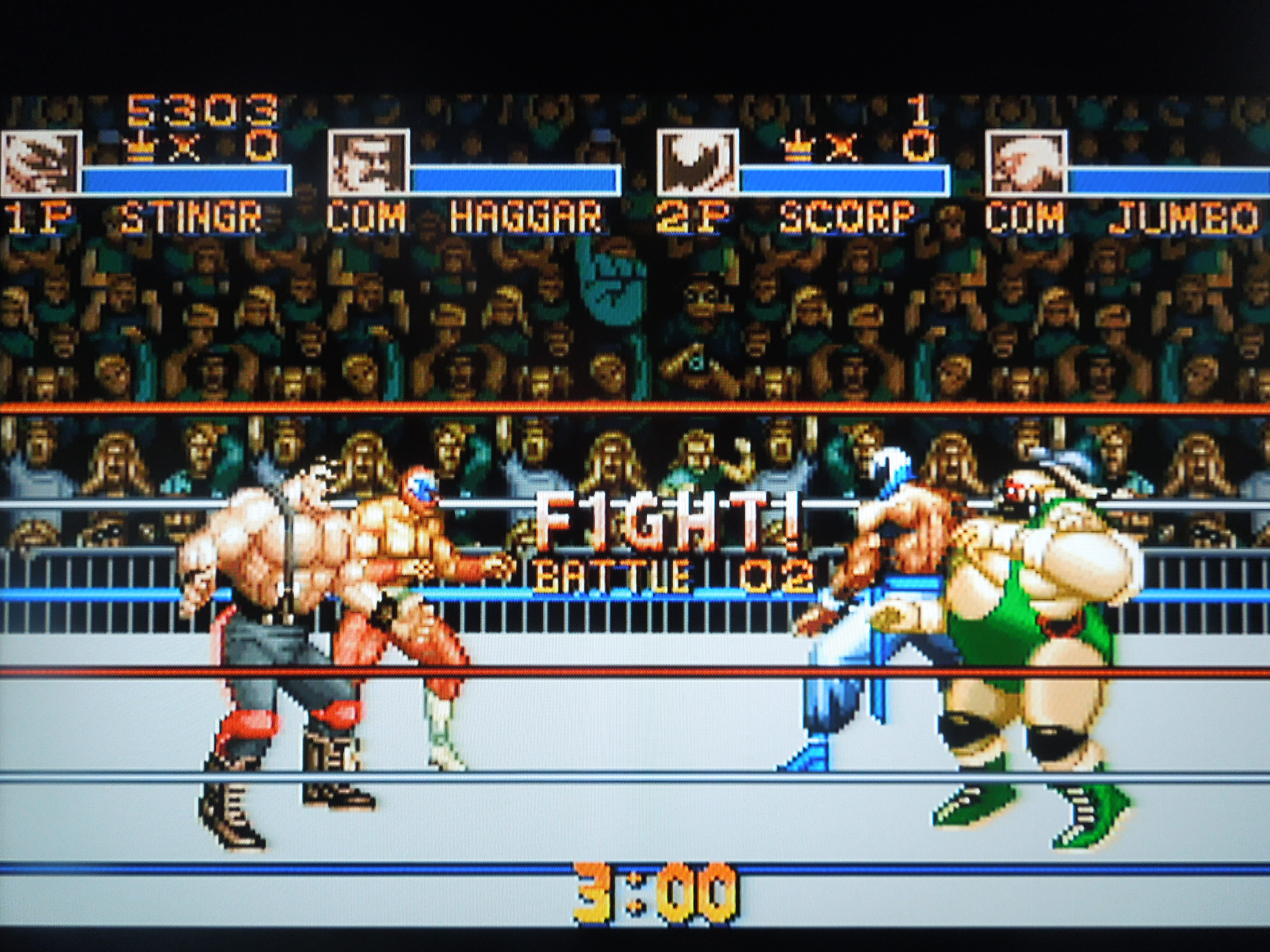
10 fictional wrestlers (8 in Single Match Mode) are available in Slam Masters. 10 fictional wrestlers (8 in Single Match Mode) are available in Slam Masters.

Control:  Being based on a 3-button arcade game, Slam Masters employs the same scheme.  Y attacks (punches or kicks), B jumps, and A pins your opponent.  Pressing Toward + Y grapples with your opponent.  In a grapple, Up or Down + Y executes a wrestling move, like a suplex, and Left or Right + Y whips (sends your opponent running into and bouncing off of the ropes).  Pressing Toward, Toward makes your wrestler run, then pressing Y makes him execute a running move, like a clothesline (you can also press B followed by Y for a jumping/running move).  Pressing Toward, Toward near a turn buckle causes him to climb it, then pressing B followed by Y executes a flying move, like a flying elbow.  While on the turnbuckle, repeatedly pressing A causes your wrestler to turn red with energy, and this makes you more likely to win grapples.   In Single Matches, you can climb out of the wrestling ring by pressing Toward, Toward, or Down, Down.  While outside the ring, you have until the ref counts to 20 to bash your opponent with a chair, bottle, or metal box (use Y to pick up and swing items).

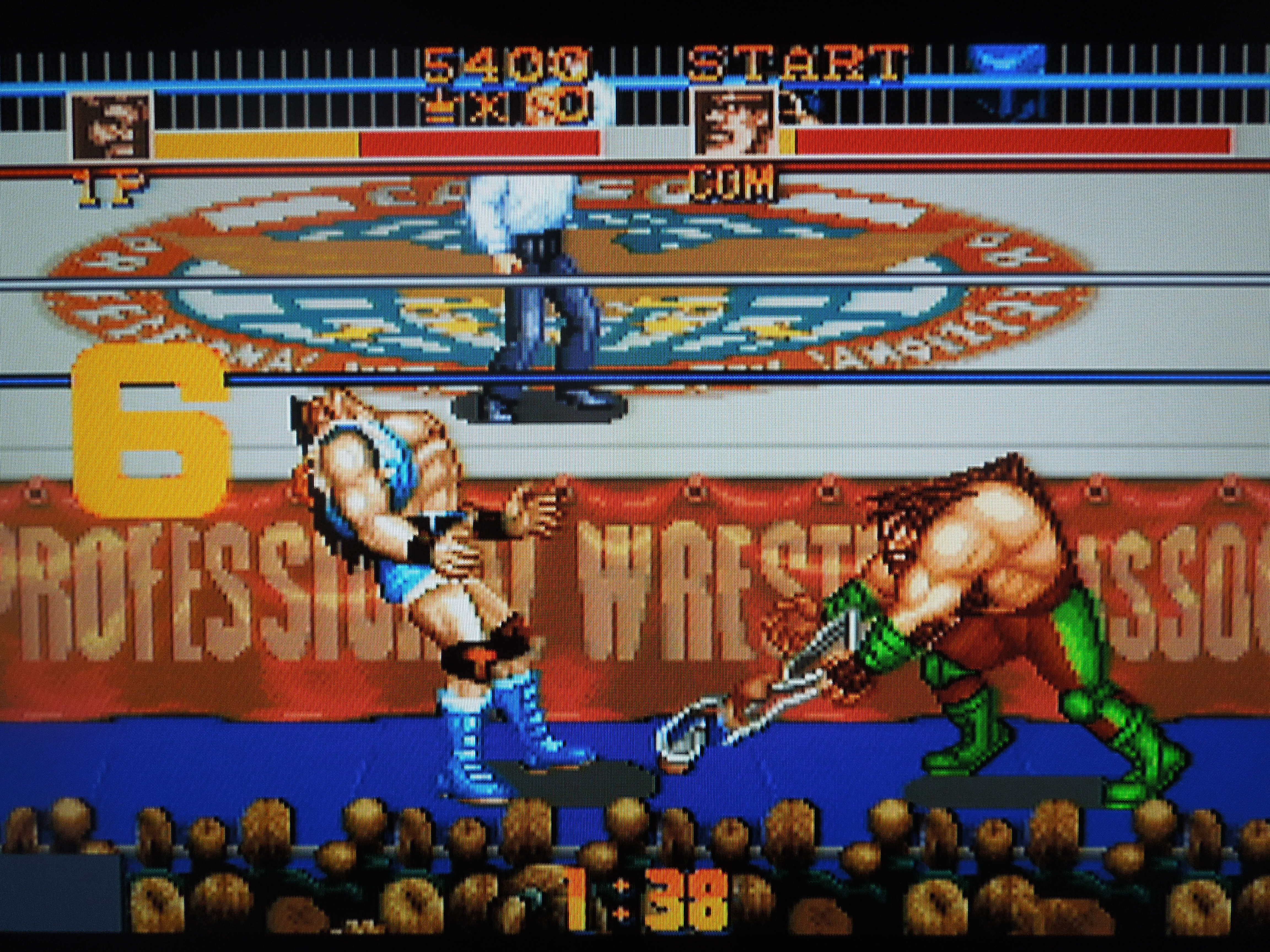
Use chairs and tables when fighting outside the ring. Use chairs and tables when fighting outside the ring.

Wrestlers:  Mike Haggar (from Final Fight), Scorpion, Jumbo, Biff Slamkovich, El Stingray, Titanic Tim (looks like T. Hawk from Super Street Fighter II), the Great Oni, Alexander the Grater, Gunlock and King Rasta make up the game’s wrestlers.  The wrestlers each hail from different countries, and each one has his own unique moves.  Some wresters (like El Stingray) are extremely quick, but not strong, while some (like Titanic Tim or Haggar) are slow, but have powerful moves.  Note:  Scorpion and Jumbo are only selectable in Team Battle Royal.

Music and Sound:  Average.  You wrestle in different international places (that all look alike), like London, New York, Hanover, or Moscow.  Each wrestler has his own musical theme, but none are too memorable.  The wrestling moves sound okay – when you power bomb your opponent, the sound effect is pleasing.  Basic strikes, like kicks and punches, are passable, but barely.  Overall, you won’t be displeased with the action sounds, just not impressed, either.

Win by either pin or submission. Win by either pin or submission.

Unlimited Continues:  Slam Masters, being based on an arcade game, functions like one – albeit one with unlimited Credits.  No matter how many matches you lose, you can always continue.

Difficulty:  In the Options menu, you can set the difficulty from 1 (easiest) to 8 (hardest).  Beating the game on 1 star is none too difficult, but bumping up the difficulty will cause an adequate challenge after the first few matches.

So, where can I find this game?  EBay, Amazon.  This one is easy to track down.  You can also play the rom an a computer emulator.

2 player wrestling co-op? It's well-executed here. 2 player wrestling co-op?  It’s well-executed here.

Conclusion:  Saturday Night Slam Masters is a fun, if extremely simple, wrestling game.  I love the simplicity, though.  The action is fast and furious, and the co-op Battle Royale mode is fantastic. It’s as good as any wrestling game on the SNES.

The Southern Gentleman’s Opinion and Letter Grade:  Recommended if you’re looking for a SNES wrestling game that isn’t based on the WWF, and honestly, is better than those offerings, anyway.  B

God Bless! Proverbs 3:6

Super Famicom – Final Fight 2

Final Fight 2 for the Super Famicom Final Fight 2 for the Super Famicom
Super Famicom games can be played on your SNES with a little work. Super Famicom games can be played on your SNES with a little work.

Note 1: Like Final Fight games?  Check out my reviews of Mighty Final Fight and Final Fight Guy.  Also, check out my other Beat ‘Em Up reviews for Warriors of Fate, Double Dragon II, D & D, Bare Knuckle 3, and Nekketsu Oyako!

Note 2: This game was played on a Super Nintendo Entertainment System. Although the game was released in Japan for the Super Famicom (Japanese SNES), it will play on the original model U.S. Super Nintendo IF you remove the two plastic tabs inside the SNES’ cartridge slot.  The game cannot be inserted with the tabs in place.  I removed the tabs in my SNES with a pair of needle-nosed pliers – it took about 10 minutes – now I can play all Super Famicom games from Japan!  The SNES was connected to a 32-inch tv via an S-Video cable.

Quick History:  Released in 1993, Final Fight 2 is the Beat ‘Em Up sequel to the popular arcade game, Final Fight (which was later ported to various home game consoles, like the SNES).  Unlike the first game, Final Fight 2 is not based on an arcade game.  Instead, it was released exclusively for the Super Nintendo (known as the Super Famicom in Japan).  Despite the game’s release in both regions – the U.S. and Japan – the game was ‘censored’ somewhat when released in the U.S., much like the original Final Fight.  This review is for the uncensored Japanese version of Final Fight 2. 

Story:  After the events of the original Final Fight, when Mayor Haggar, Guy, and Cody defeated the Mad Gear gang, the gang has resurfaced abroad.  The newly-reformed Mad Gear kidnap Guy’s finacee, Rena, and her father.  Now, Mayor Haggar, Maki (Rena’s sister), and Carlos (Haggar’s friend) hop a plane to Hong Kong to confront the gang members.  Cody and Guy are conspicuously absent in the game.

Fight through 6 international stages in order to rescue the kidnapped Rena. Fight through 6 international stages in order to rescue the kidnapped Rena.

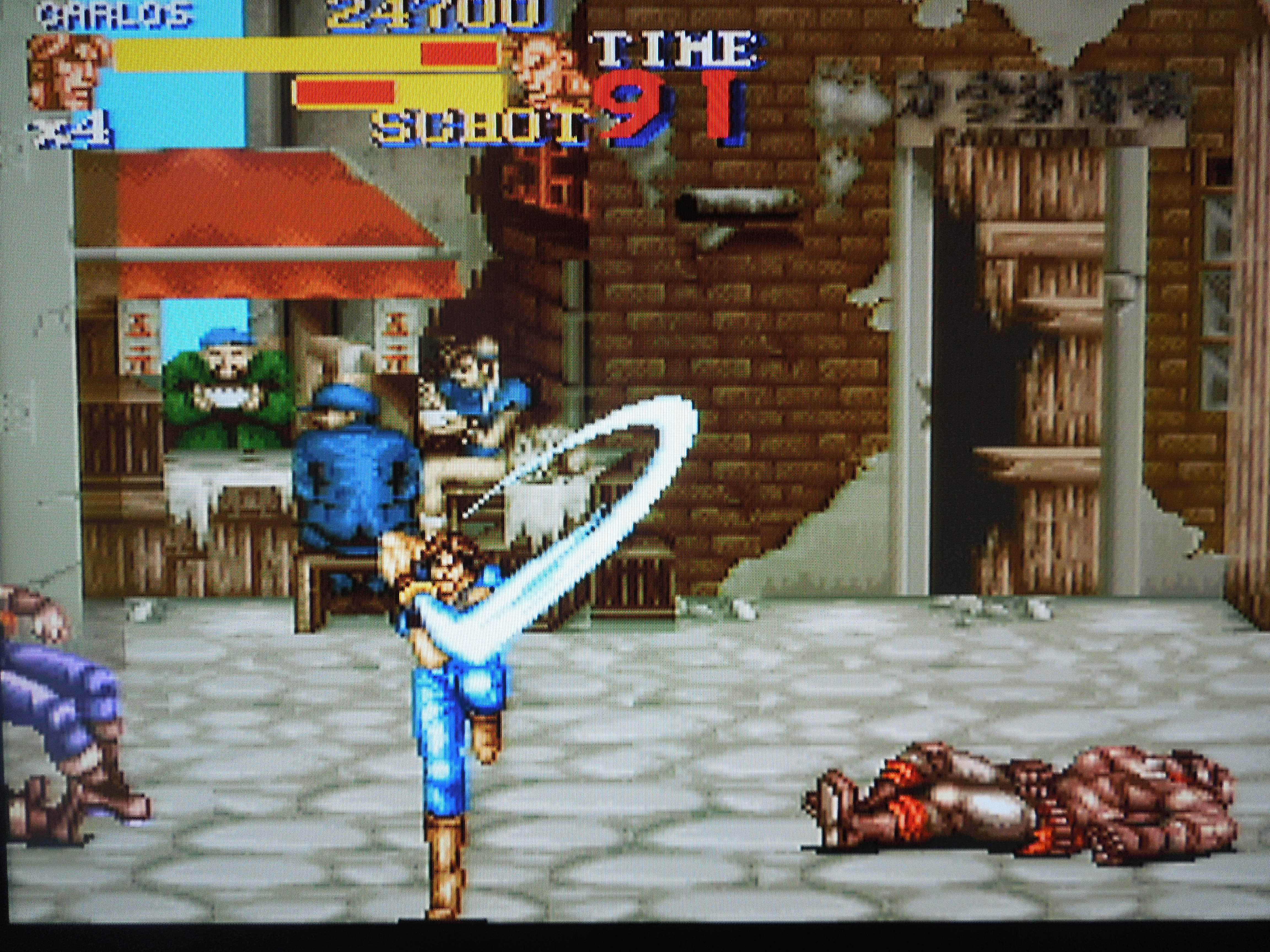
Control:  Y punches.  B jumps.  B + Y executes your special attack, which drains some of your energy if you connect.  You can change your special to a solitary button, like button A, in the Options menu.  Getting in close to an enemy causes you to grab him or her automatically.  With a grabbed enemy, pressing Y headbutts or knees him or her, depending on which character you’ve chosen.  With a grabbed enemy, pressing Y + left or right will throw him or her.  Additionally, using Haggar, if you press B to jump with a grabbed enemy followed by Y, you’ll execute a devastating spinning pile driver.  Also, Maki can jump off walls with a flying kick if you jump toward a wall a press Y.

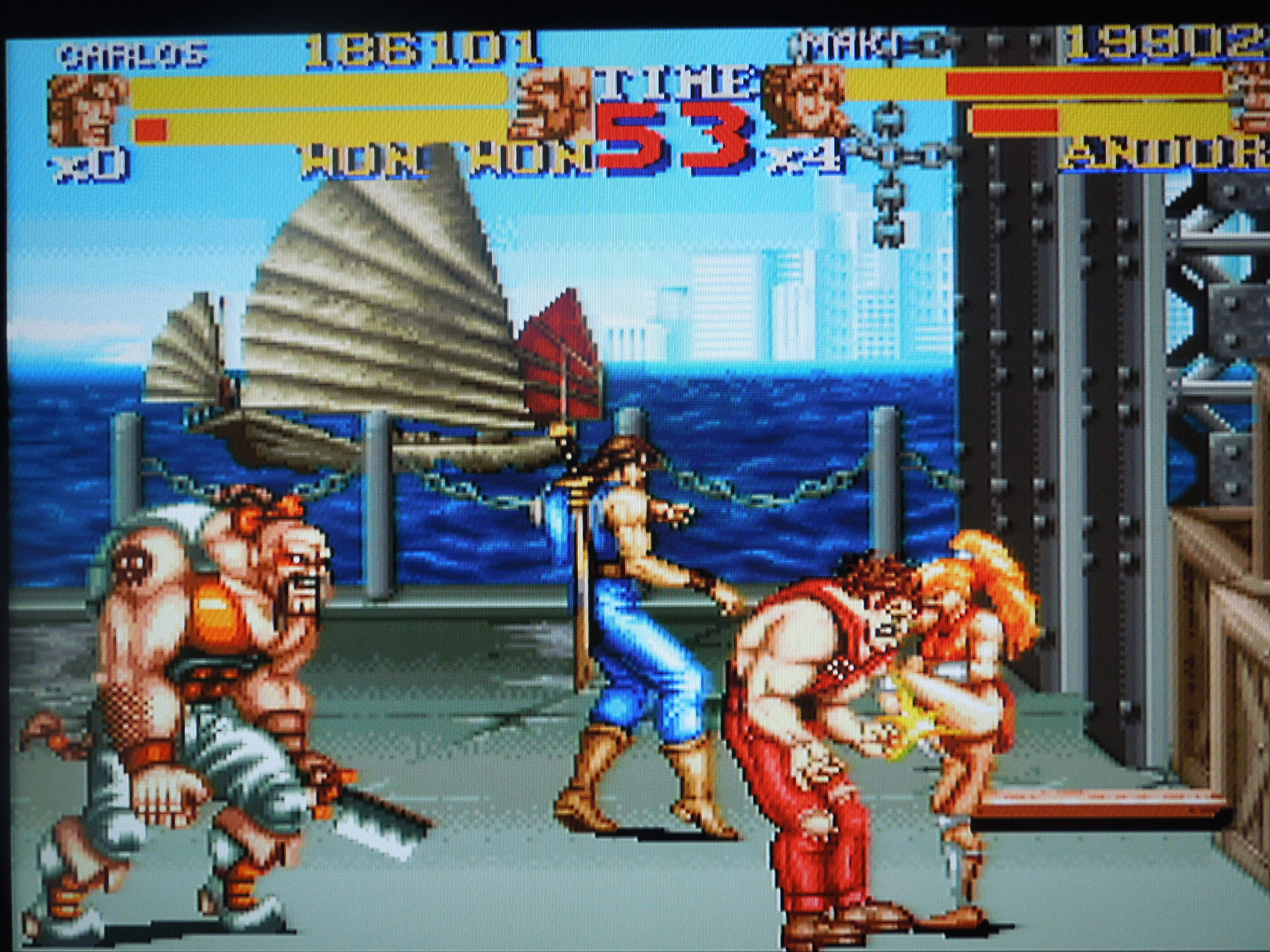
Characters:  Select Haggar, Carlos, or Maki to play through the game with.  You can change characters during gameplay if you lose all of your lives and continue.  Haggar is slower and stronger.  Carlos is more of the average character, with balanced speed and strength.  Maki is quicker, yet weaker.

Boss fights always involve other gang members getting involved. Boss fights always involve other gang members getting involved.

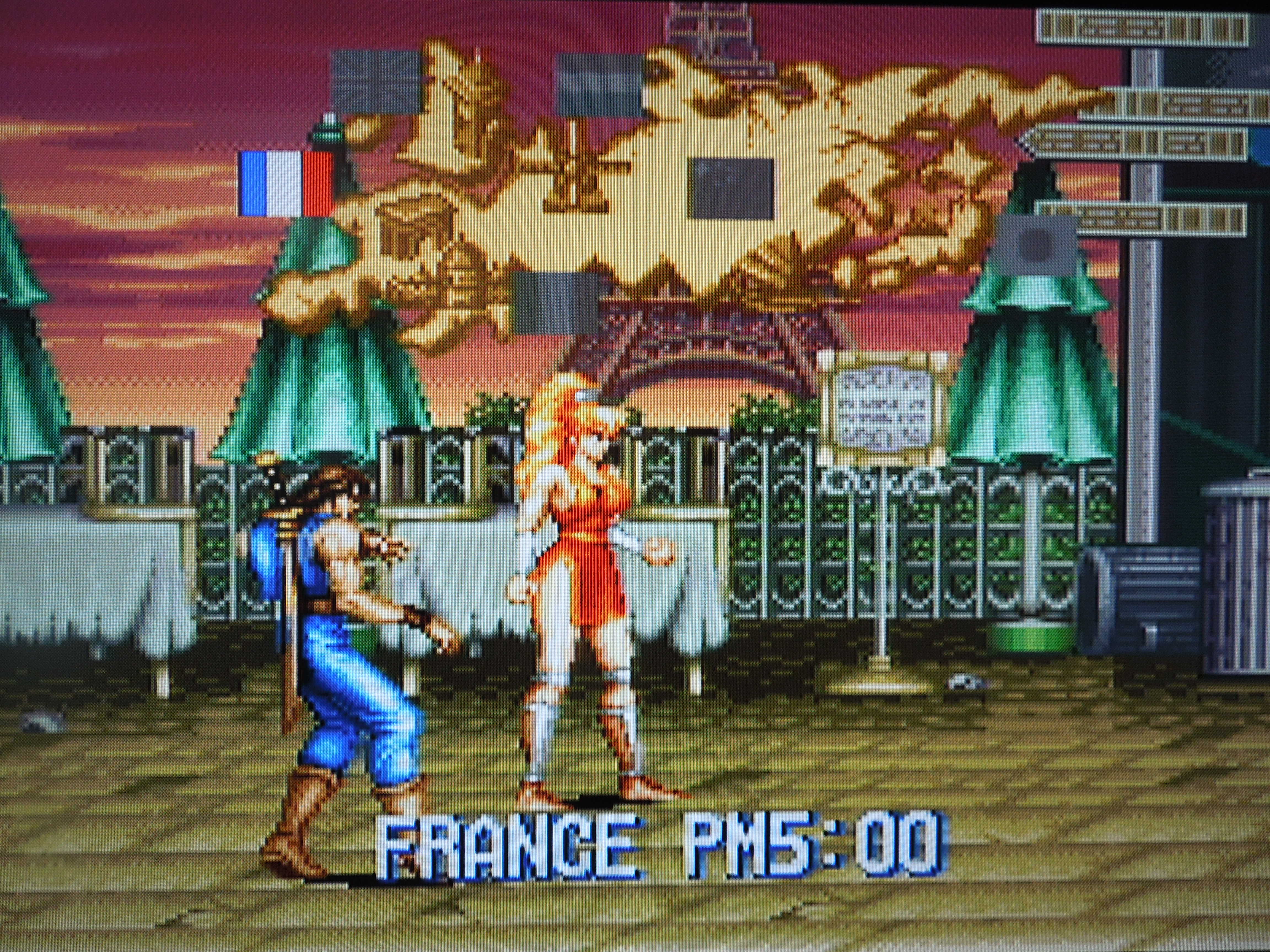
Gameplay:  After selecting your character, you must fight your way through 6 international stages in order to confront the new leader of the Mad Gear.  The stages are:  Hong Kong, France, Holland, England, Italy, and Japan.  You must fight wave after wave of gang members as you walk through each stage, culminating with a boss at the end.

Music and Sound:  Some familiar tunes from the original Final Fight can be heard, in addition to new tracks.  Overall, the music is decent and the sound effects are slightly above average, too.  Punches, kicks, and throws all sound satisfying.

Options:  In the Options menu, you can set the difficulty from Easy, Normal, Hard, and Expert.  You get a better ending by beating the game on the ‘Expert’ setting.

Differences in Japan version and U.S. version of Final Fight 2:  While some smaller graphical changes were made to the U.S. version, like the removal of the ‘peace’ logo in the France stage, here are the most notable differences.  (1) In the Japanese version, Won Won, the game’s first boss, fights with a meat cleaver in hand – he will use it to attack you, of course.  In the U.S. version, Won Won doesn’t have the meat cleaver, and he fights bare-handed.  (2)  In the Japanese version, there are 2 female gang members, Mary and Eliza.  In the U.S. version, however, these 2 females were removed and replaced with male gang members – Leon and Robert.

Female gang members, like the one seen here, were only found in the Japanese version of Final Fight 2. Female gang members, like the one seen here, were only found in the Japanese version of Final Fight 2.

Language Barrier?  Yes and No.  No, if you just want to enjoy playing an arcade-style Beat ‘Em Up.  The Options menu, character names, and stages are all in English.  The story, however, that plays during the game’s introduction and in-between stages, is in Japanese.

2 player co-op:  This is something that was missing from the SNES/Super Famicom version of the original Final Fight, but fortunately, is now in place.  2-player co-op requires both characters to share the limited number of continues, and the characters can strike one another as well, so you’ll have to be careful.

Extra Lives, Weapons and Health Pick-ups:  You gain extra lives at 100,000 points, and then again at every 200,000 points after that.  Also, you can replenish your energy by breaking open barrels and eating the food you find there.  You’ll also occasionally find knives, clubs, and 2 by 4’s to use on enemies.

So, where can I find this game?  I believe the U.S. version is downloadable on the Virtual Console service.  You can buy either the Super Nintendo or Super Famicom version on eBay, or you can play the rom on a computer emulator.

Occasional bonus stages allow you to wrack up points for extra lives. Occasional bonus stages allow you to wrack up points for extra lives.

Conclusion:  Final Fight 2 is amazingly similar to its predecessor, Final Fight.  The control scheme, which has not changed, is amazingly simple to master.  Having 3 selectable characters, each which handle a bit differently, is a nice option.  2 player co-op is excellent in Final Fight 2, although you’ll have to be careful to keep your distant from your partner.  Beating the game on Expert presents a tough challenge.

The Southern Gentleman’s  Opinion and Letter Grade:  Is Final Fight 2 better than Final Fight?  Debatable, and it really just depends on your preferences of characters, enemies, and setting, I suppose.  Not comparing it to anything else, Final Fight 2 is a simple, fun Beat ‘Em Up that isn’t anything special, but will provide you with some decent entertainment.  B 

God Bless! Proverbs 3:6

Game Boy – Fatal Fury 2

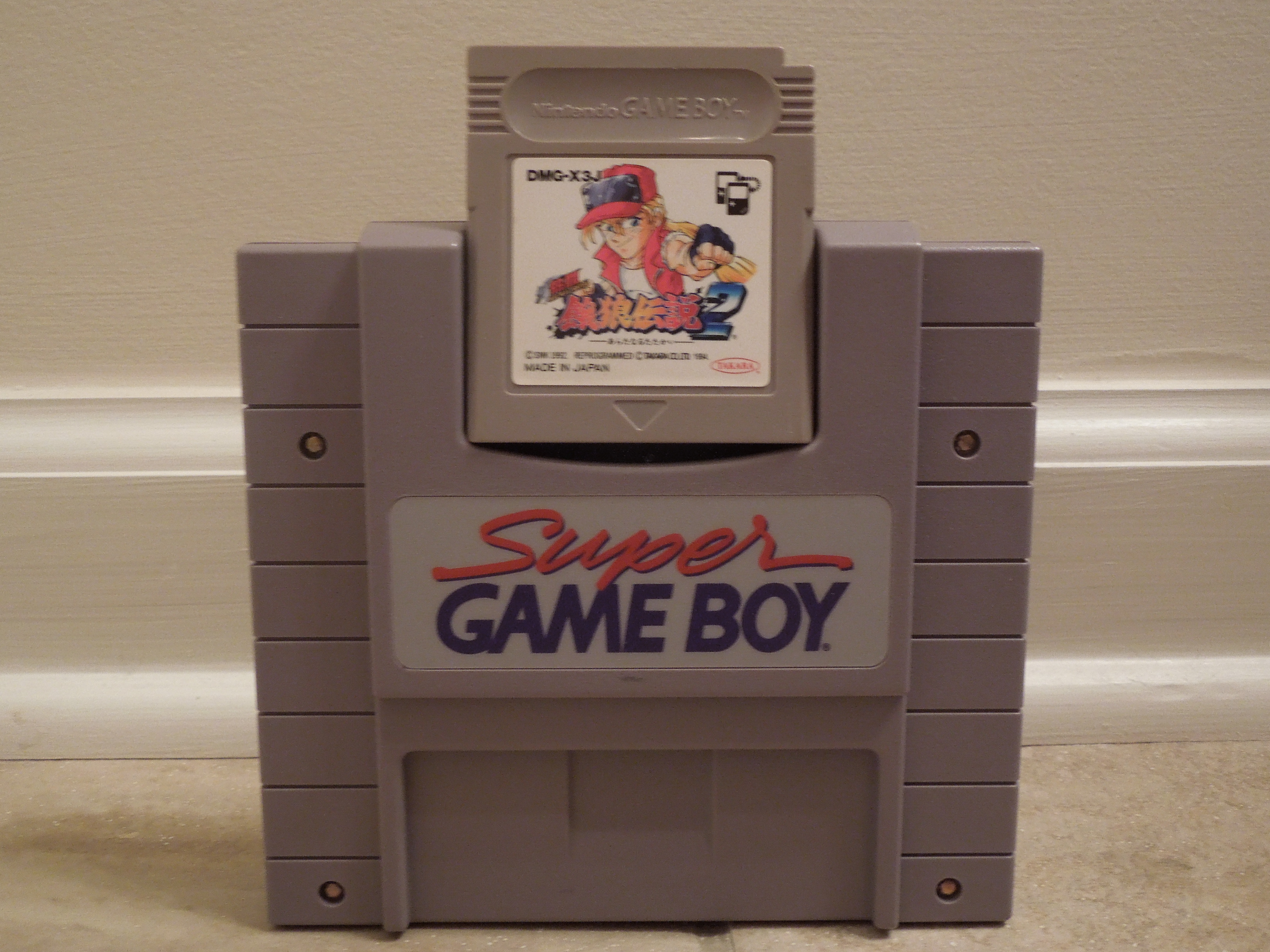
Fatal Fury 2 for the Game Boy Fatal Fury 2 for the Game Boy
Playing Fatal Fury 2 on a Super Game Boy has its advantages. Playing Fatal Fury 2 on a Super Game Boy has its advantages.

*Like Fatal Fury games?  Check out my review of Fatal Fury: First Contact as well!

Note: This game was played on a Super Game Boy that was inserted into a Super Nintendo Entertainment System.  The SNES was connected to a 32-inch HD tv with S-video cables.

Quick History:  Nettou Garou Densetsu 2 (translated: Dead Heat Fighters Legend of the Hungry Wolf 2), better known as Fatal Fury 2, was released for the Game Boy handheld system exclusively in Japan in 1994.  Fatal Fury 2 was originally released for the Neo Geo MVS (arcade) and AES (home console), as well as being ported to numerous other home consoles.  Fatal Fury 2 for the Game Boy used a ‘super-deformed’ art style, and it was also made to play with ‘bonuses’ on the Super Game Boy, a device that plugged into a SNES and allowed you to play Game Boy games on your tv, in color.  These ‘bonuses’ included a special Fatal Fury 2 game border, pre-set color palettes (although you can change the colors if you want), and the ability to play a 2 Player VS. match without having to have an extra Game Boy, game cartridge, or link cable – all that is needed is 2 SNES controllers.

Players:  1 Player or 2 Player VS

Story: After the game’s 3 protagonists, Terry Bogard, Andy Bogard, and Joe Higashi, defeated (and killed) the evil Geese Howard a year earlier in a Fighters’ Tournament, a new tournament is being held with some new fighters.

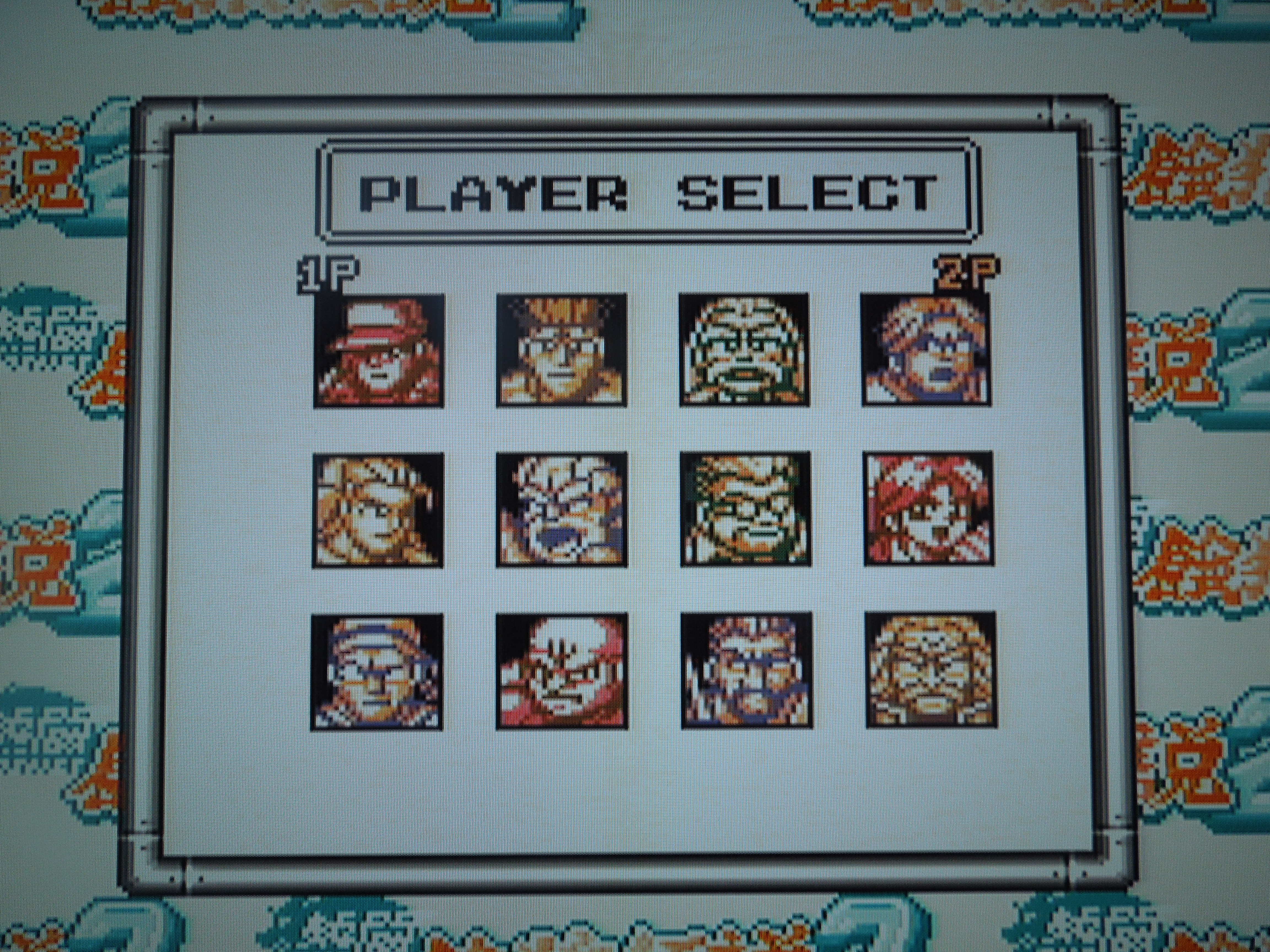
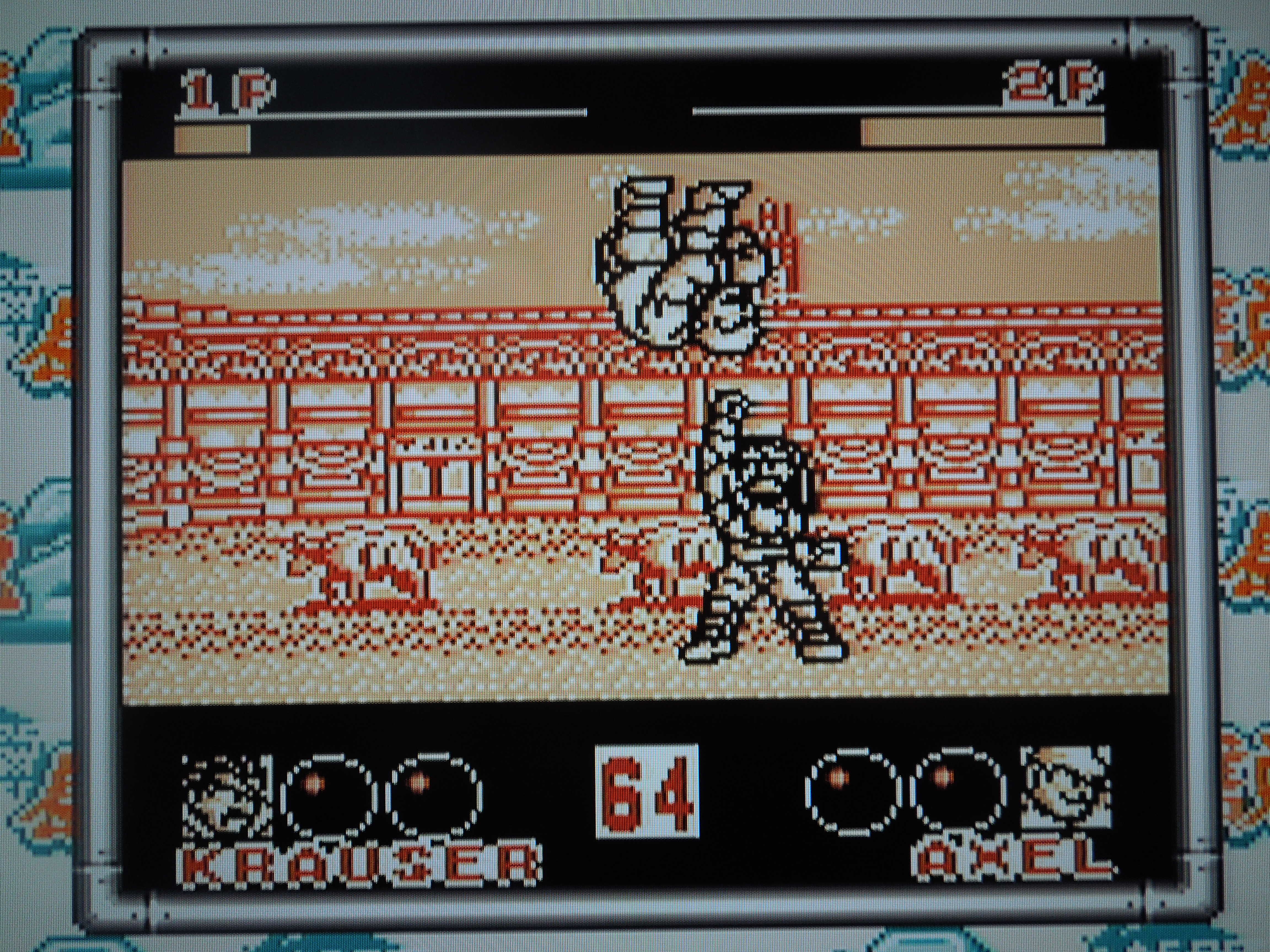
Gameplay and Characters:  Select your fighter among 12 characters:  Andy, Terry, Joe, Mai, Kim, Jubei, Bear, Cheng, Billy, Axel, Laurence, and Krauser (Note: press Select, Select, Select on the ‘Takara’ intro screen to ‘unlock’ the latter 4 ‘boss’ fighters).  Each fighter has his or her own unique fighting style and moves, as well as a distinct look and country of origin.  For example, Joe is a Thai kickboxer, Axel is a boxer, Jubei is an old martial arts master, etc.  After choosing your fighter, you will battle every other character in the game, including a mirror match vs your own character, in a ‘best of 3 rounds’ fight – beat them all, and you’ll beat the game.

Press Select, Select, Select on the 'Takara' intro screen to unlock the 3 'boss' fighters. Press Select, Select, Select on the ‘Takara’ intro screen to unlock the 4 ‘boss’ fighters.

Basic Control:  Start pauses the game during play.  Tapping A throws a weak kick; holding A throws a strong kick.  Tapping B throws a weak punch; holding B throws a strong punch.  Getting in close to your opponent and pressing B executes a throw.  Pressing A+B when you’re a little way away from your opponent taunts him or her.

Special Moves:  There is a great FAQ online (just put ‘Fatal Fury Game Boy FAQ’ into a search engine) that describes each fighters’ special moves, but here are a few moves for Billy Kane so you get an idea of how they work:  Rapid cane strike – Tap B repeatedly, Vertical Teleport Strike – Back, Down, Forward, A.  Fatal Fury Flaming Cane (only available when your health bar is flashing): Down, Forward, Forward, Down, Back, Up, A + B.  All of the moves are simple to pull off, and work well.  Even without knowing all of a character’s moves, you can usually figure them out (except for maybe the more complicated ‘Fatal Fury’ moves) by inputting basic ‘fighting game’ motions on your SNES controller (or Game Boy if you’re playing the cartridge on the original handheld).

Each fighter has his or her own desperation 'Fatal Fury' move when they're almost defeated. Each fighter has his or her own desperation ‘Fatal Fury’ move when they’re almost defeated.

Music and Sound:  Pretty good.  If you’re familiar with the Fatal Fury 2 theme, you’ll recognize it when you power on the game.  Different stages have different themes, and most sound quite good for a Game Boy game.  The sound effects are good as well, with punches and kicks sounding satisfying when landed on an opponent, and special moves have nice sounds as well.

Slow game play:  Fatal Fury 2 is a bit on the slow side.  Now, some characters are quicker than others, and some (like Bear) are extremely slow, but even if you select a quick character, the gameplay can still be slow.  Not terribly, pull-your-hair-out slow, mind you, just slower than say, the Neo Geo version.  Did it bother me, personally?  No, not at all, and that’s because it had no impact on the control of the game.

Each fighter has a unique fighting style. Each fighter has a unique fighting style.

Options:  When you start the game, you can set the difficulty from Easy, Normal, and Hard, and you can set the time limit on matches from 45, 60, and 90 seconds, or you can have no time limit.  As far as difficulty, the game is simple enough to beat on Easy, but later fights become adequately challenging on Normal and Hard.

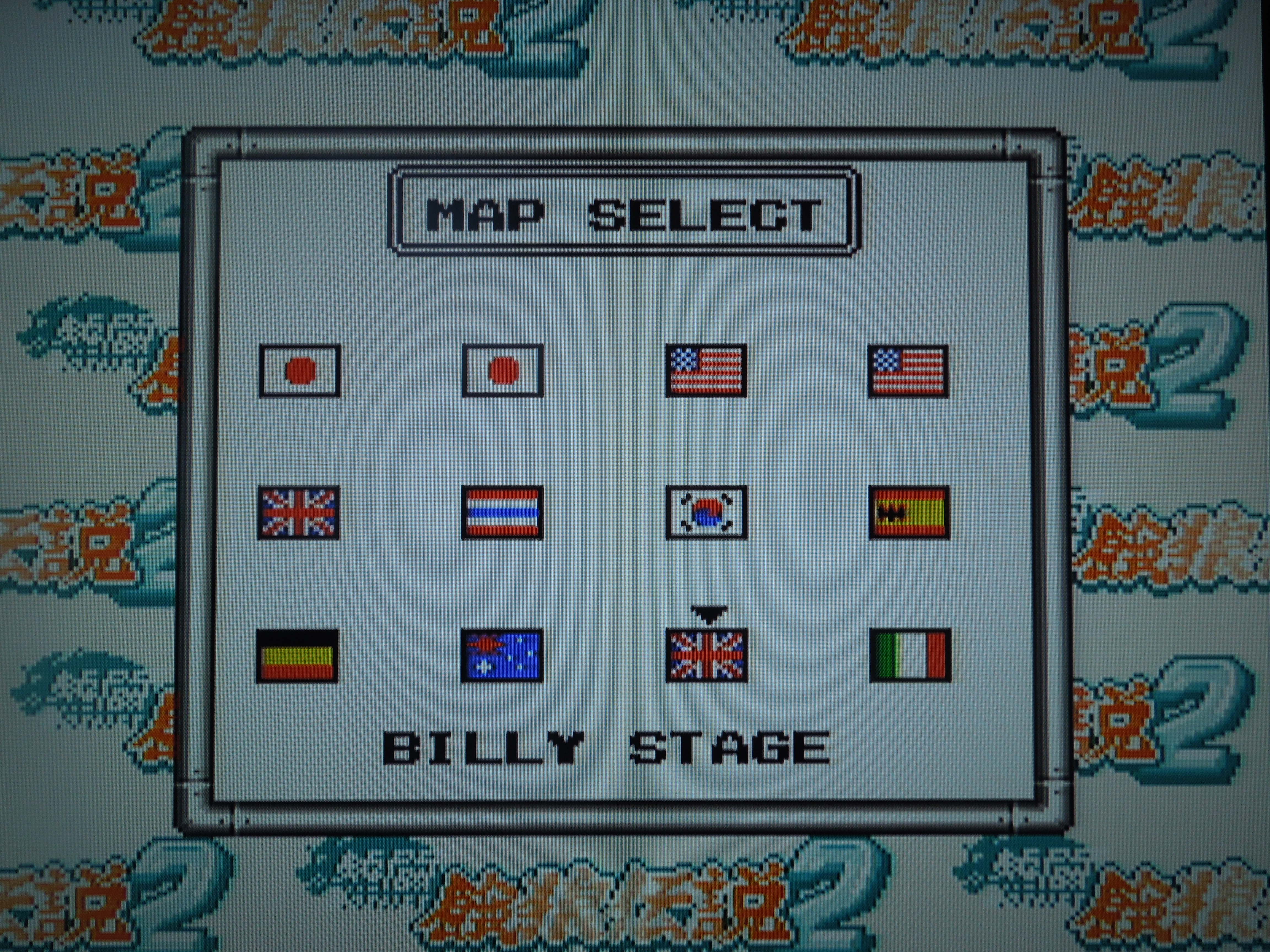
Select from each fighter's stage in 2 Player VS. Select from each fighter’s stage in 2
Player VS.

2 Player VS: When playing 2 player VS, you have the added bonus of getting to select which stage (12 total) you want to fight in, and the game actually keeps track of the win loss record of you and a friend, including which characters you were using.  Note:  Unlike in the Neo Geo versions, a 2nd player can not ‘interrupt’ the game to challenge player 1 – you’ll have to reset the game and select VS.

Language Barrier:  No and Yes.  No, if you just want to enjoy a decent Game Boy fighting game.  The main menu, including Story Mode, VS, and Options are all in English, which is great.  The character names and win/lose bubbles are in English also.  However, the ‘Story’ that plays during the game’s intro, the character ‘messages’ that are displayed during a fight or after a win or loss, and your character’s ending are in Japanese.  Actually check that – most character dialogue is in Japanese – Terry, for example yells ‘OK!’ after a win and Bear yells ‘Come on!’ during a fight (both in English), perhaps because both these characters are American.

So, where can I find this game?  It’s cheap on online sites like eBay, although you may have to order it from Japan.  Remember, you can play the game on an original Game Boy, Game Boy Color, most versions of the Game Boy Advance, and the Super Game Boy on a SNES.  You can also play the game on an emulator on your computer.

Conclusion:  So, why would I play this game on a Super Game Boy on my Super Nintendo when I could just buy the proper SNES version?  There’s no great answer for that question, but I can tell you that Fatal Fury 2 for the Game Boy is not a bad game by any stretch.  Sure, it’s slower than what most fighting game fans expect, but this doesn’t completely derail the game from being enjoyable.  I really like the ‘super-deformed’ characters, and the challenge on Normal is close to perfect.  Comparatively, is it better than Fatal Fury: First Contact for the Neo Geo Pocket Color?  No, definitely not, but it’s still fun.

The Southern Gentleman’s Opinion and Letter Grade:  Fatal Fury 2 for the Game Boy is a worthwhile obscure investment if you like portable fighters, if far from being a masterpiece.  C

God Bless! Proverbs 3:6
Fatal Fury 2 for the Game Boy is far from a terrible game. Fatal Fury 2 for the
Game Boy is far from a terrible game.