Neo Geo – Aggressors of Dark Kombat

Aggressors of Dark Kombat for the Neo Geo AES

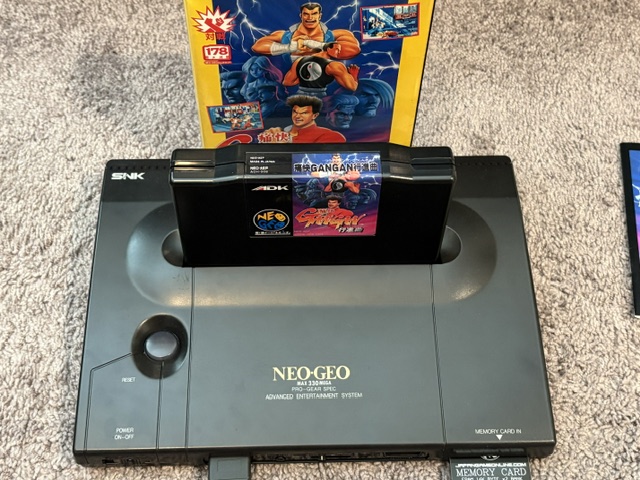
Note: This game was played on an original Neo Geo AES console. It was connected through component inputs that ran through an OSSC and converted the signal to HDMI.

Game: Aggressors of Dark Kombat (Tsuukai Gangan Koushinkyoku)

Brief History: Aggressors of Dark Kombat was released for the Neo Geo AES in August of 1994. It is, for all intents and purposes, a one-on-one fighter; however, it approaches this popular genre in a unique way, utilizing a multi-plane play area and a ‘wrestling’ style grapple system, as well as other less-common approaches.

Controls: ADK uses a three-button setup. A tapped for light punch, A held for strong punch. B tapped for light kick, B held for strong kick. C for jump, and you can perform an air attack by pressing A or B. A+B and towards a close opponent initiates a grapple; from there, pressing A or B plus a directional input executes a throw/wrestling move of some kind. Pressing C from a grapple causes your fighter to slip behind the opponent to execute a throw. The CPU can also ‘counter’ your grapple (and you theirs) by being first to hit the inputs after an initiated grapple. If your grapple is countered, immediately tap the A and B and C buttons to escape or re-counter. Occasionally, your opponent may stay down for a bit, and you can perform a ground attack by pressing A or B. Tapping back twice executes a quick backstep, and pressing up or down twice allows you to sidestep an attack. Holding back blocks when an opponent is attacking.

Leonhalt chokeslams Fuuma after initiating a grapple

Life Bar: There are no best-of-three ’rounds’ in ADK. Instead, you fight each opponent in a single round. However, both you and your opponent have four colored life bars that each must be depleted in order for one of you to be victorious. Life bars change from blue to green to yellow to red. Once red is gone, you’re history!

Fighters: Eight unique fighters comprise the roster for ADK. Interestingly, you can’t see the name of your fighter during character selection or during a match, as it’s simply not displayed. You can, however, see character names after a match and on the high score screen. Fighters range from the hulking Dolph Lungdren-look-alike Leonhalt and amateur wrestler Sheen, to the diminutive Japanese student Kisara and basketball-toting Bobby. Each fighter has his or her own strengths and weaknesses with regards to strength and speed.

Is this Street Slam? Nah, but ADK has both David and Goliath characters.

Special Moves: Each fighter has unique special moves that require specific inputs to execute. These are all easy to pull off and often result in multi-hit combos on your opponent. Even without a guide, most of these can be discovered by using common ‘fighting game’ motions with A or B button presses.

Finishing Moves: These are truly one of the game’s best features. Each fighter in ADK has an original finishing move that can only be used when certain criteria are in place. The criteria? Your opponent’s life bar must be in red AND your ‘Crazy’ meter must be full (it fills slowly as you land blows on your opponent). When it’s full, you’ll see ‘GANGAN’ blinking by your life bar, and if you execute your finishing move (unique inputs that are also simple to use), your opponent is toast – even if their red life bar was completely full! It’s important to note that finishing moves can be avoided by sidestepping the attack (because you have to be ‘aligned’ with your opponent), so remember this when the CPU tries it on you!
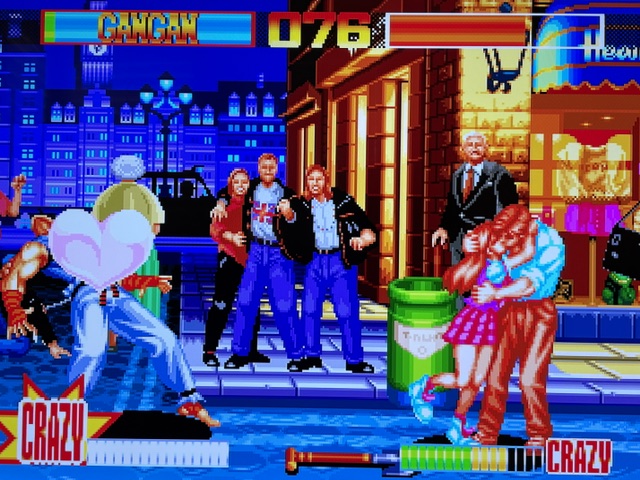
The ‘Finishing Moves’ in ADK are one-of-a-kind!

Weapons: Typically once or twice per match, an overexcited spectator will toss a weapon into the play field to add to the excitement, or a breakable object will reveal one. These include a Molotov cocktail, a shovel, and a sword. The sword and shovel do decent damage, but your character swings a bit slow. The Molotov cocktail, however, is thrown at the feet of your opponent where it then ignites the ground in flames, causing your opponent to catch fire and leaving him or her open for a quick attack.

Blood? If ADK is played on a U.S. or European Neo Geo AES, there is no blood. However, if played on a Japanese AES (or a Unibios is installed that allows you to change the console’s region), then some blood, although not copious amounts, is present once you get your opponent into this third (yellow) life bar.
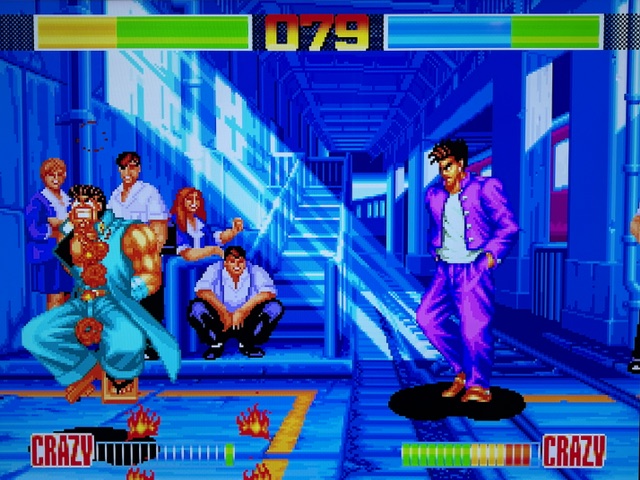
Weapons, like Molotov cocktails, are fair game in ADK.

Final Boss? There is no final boss in ADK. Instead, you fight against every other character plus a mirror match against your own character, and finally a ‘Final Battle’ against your ‘rival’ whom you’ve already bested once before.

Difficulty: You can choose among the four standard Neo Geo AES difficulties (Easy, Normal, MVS, Hard). The first opponent you face is typically very easy, and you can practice your special moves, grapple & slams, and finishing move here with little issue. The second opponent is slightly more challenging. By the time you get to the third opponent, however, the difficulty increases significantly, and you start to realize you have to learn how this game really works in order to win!

Certain throws are literally ‘bone-breaking!’

Keys to Winning in ADK: As with many Neo Geo fighting games, learning how the CPU works is part of learning how to win. When I first began this game, I thought ADK was similar to 3 Count Bout, a Neo Geo wrestling game (see my review) that is similar-ish in control to ADK, yet that game makes winning grapples practically impossible, and the result is a game that is not a lot of fun. In ADK, however it is VERY possible to win most grapples and matches, once you understand how the CPU works. I lost countless matches until I realized I should play DEFENSIVELY rather than OFFENSIVELY. If you try to take the fight to the CPU (starting with the third fight), it will simply block and combo and slam your behind into oblivion, and in short order. However, if you hold back often and let the CPU come to you, it will often try to combo you, which you’ll easily block, leaving your opponent open for a grapple & slam or your own combo! Learning exactly when to press the button for your slam after you initiate a grapple is critical so that you don’t get countered, but there’s an onscreen icon that appears in addition to an audio chime – once you have that down and win most grapples, you’ll be good to go (this was how I did it, at least!) Will you win every match this way? No, but you’ll win enough to make things fun!

There are wrestling-moves galore in ADK.

The Southern Gentleman’s Opinion and Letter Grade: A+ Aggressors of Dark Kombat, to me, feels more like a wrestling game than a one-on-one fighter, even if technically, that’s how it’s categorized. This is the ‘wrestling’ game that 3 Count Bout SHOULD have been. The characters are extremely charming and add excellent personality to the game as a whole. The controls and keys to victory, once learned, lead to an amazingly pleasurable play experience. Beyond that, the moves themselves, particularly the wrestling moves (power bombs, backbreakers, frankensteiners, pile drivers, choke slams, back drops, power slams, neck breakers, etc.) all have a tremendous impact and weight to them that is extremely satisfying. Finally, the finishing moves of each fighter puts the cherry on top, as some of them are downright a joy to behold. ADK is an absolute gem for the Neo Geo AES.

Aggressors of Dark Kombat power bombs its way to victory on the Neo Geo!

Super Famicom – SD F-1 Grand Prix

Note: This game was played on an Analogue Super NT. It was connected to a 55-inch HD-tv.

Game: SD F-1 Grand Prix (Super Deformed Formula-1 Grand Prix)

Players: Up to two, head-to-head competitive and/or against CPU racers

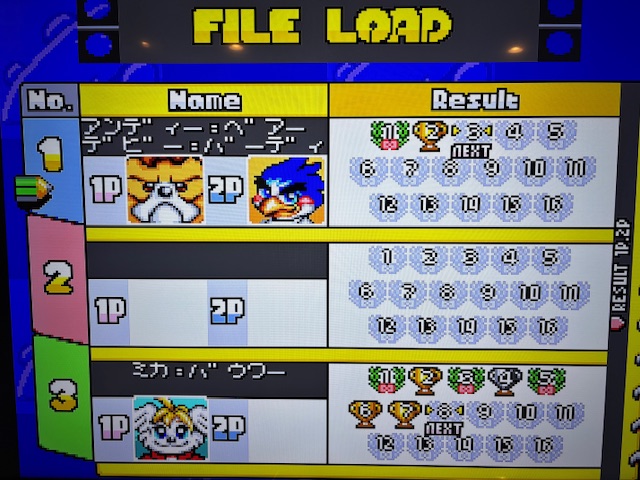
Language barrier? No. While track names and character names are in Japanese, as are the voices of the race commentators, much of the game is in English, including (partially) the Options and the Save/Load screens. This is one of the easiest ‘Japan only’ games to play for English-only readers and speakers.

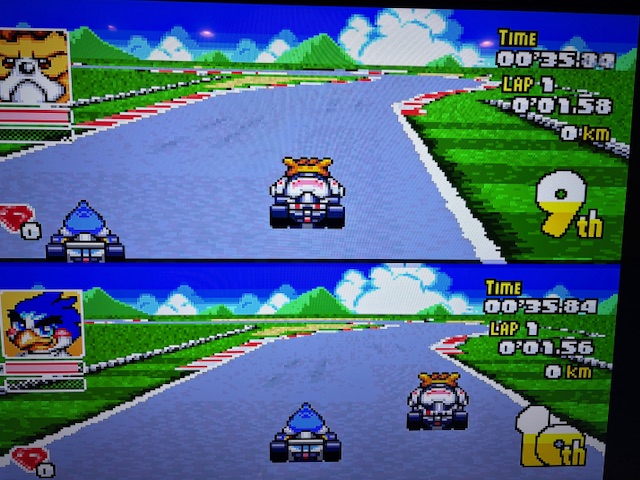
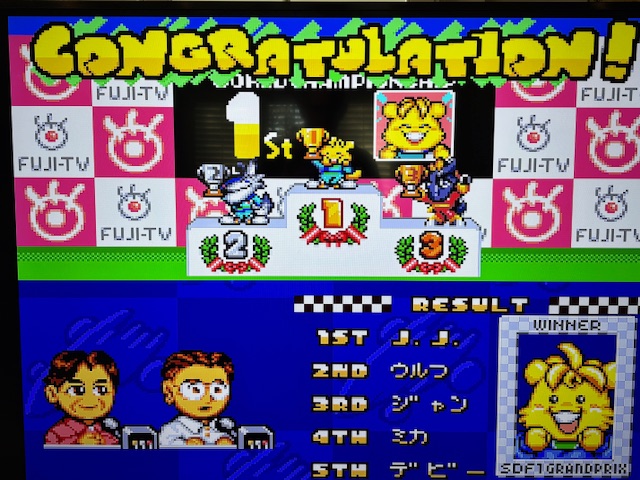
Quick History: SD F-1 Grand Prix was released for the Super Famicom in October of 1995. It was only released in Japan. There were multiple games in the ‘F-1 Grand Prix’ series, but this one was more of a spinoff, with cartoon animal mascot racers drawn in the ‘super-deformed’ style and were meant to represent the real-life human counterparts from the more ‘serious’ Grand Prix games. The game is quite similar in looks, and in some ways, gameplay, to the popular Super Mario Kart that was released three years earlier in both the U.S., Europe, and Japan.

Controls: B gives you cart gas. Y is brake. R uses an item once you acquire one. A activates a boost once your boost gauge is completely full by picking up boost tokens that are scattered throughout each course.

Options: A handy ‘Easy, Normal, Hard’ difficulty option is here, as well as the option to change the button layout and listen to the music tracks. Unfortunately, there’s not an option to turn off the Japanese race broadcasters, although their commentary, even if you don’t understand what they’re saying, can be quite amusing simply based on their inflection and enthusiasm.

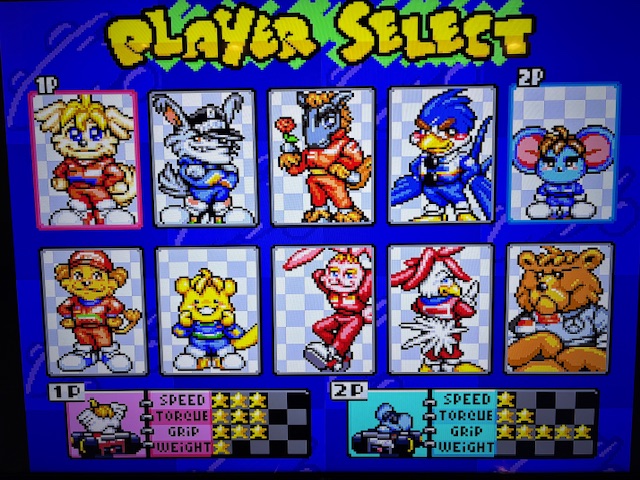
Carts & Drivers: There are ten drivers to choose among, and each one has a rating among four categories: Speed, Torque (Acceleration), Grip, and Weight.

Items: In Crash Mode (Cup Mode), you can ride over and pick up items like bombs, rockets, and oil barrels to take out the opposition! There’s even a Star that makes you quick and invincible for a short while.

Pit Stop: Your cart has a life bar, and running into walls, getting hit by opponents’ weapons, etc., depletes this. You can, however, replenish the bar by driving through the ‘pit stop’ after each lap. This is a flashing set of bars akin to what you might see in F-Zero, if you’re familiar with that SNES classic.

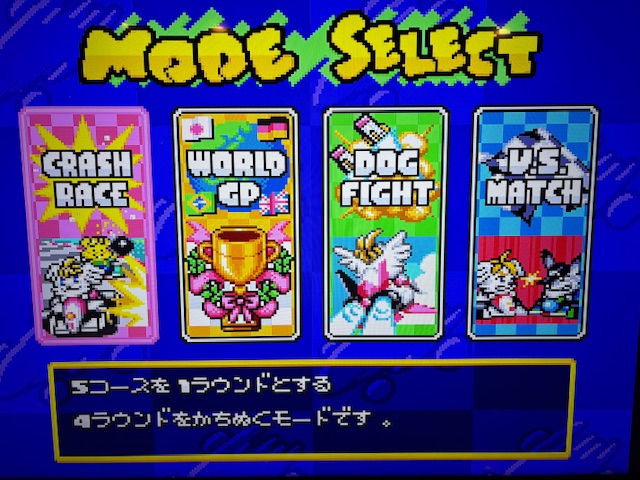
Game Modes: SD F-1 Grand Prix has multiple modes:

World GP – For one or two players. You’ll race through 16 courses from around the world. Before each race, you’ll run a two-lap ‘qualifying’ round to determine your starting position in the upcoming race. You’ll then complete 5 laps on each course. The higher your finishing position, the more points you receive, which are tallied throughout the season (you can save your data after each course). Finish in 1st (most accumulated points) after all 16 courses, and you’ll unlock four additional tracks. *Items are not available during World GP, although you do still have use of your boost gauge.

Crash Race – For one or two players. Although the name might not fit, this is your standard ‘Cup Mode,’ and the most similar to what you’re probably used to in cart racers. All weapons/items/boosts are available here, and you’ll choose from one of four rounds (cups): America, Europe, Asia, or Africa. Each round consists of four courses where your finish order determines your total points. Win the gold in each round (you can save after a completed round), and you’ll unlock two additional rounds (World Round and Paradise Round). In this mode, additionally, you can purchase upgrades for your cart after each race! These upgrades can boost your speed, weight, and handling. Your finishing position not only gives you points toward winning a cup, but also cash to spend in the shop. You can also pick up cash to spend by collecting red diamonds during a race, done so by simply hitting another racer with an item during the match.

DogFight – 2 Player only. Battle Mode. While having a permanent boost, you must hit your opponent with items until his or her red energy bar drains. Fast and fun!

VS. Match – 2 Player only. Pick your racers and a track, and have at it! There’s also a variation on this called ‘Relay,’ where each player chooses two drivers and you have to ‘tag’ your partner by driving through him after a completed lap.

Time Attack – Race for your best time on a single track. Your times are saved.

The Southern Gentleman’s Opinion and Letter Grade: (A) I’ll never forget picking up Super Mario Kart from Toys ‘R Us back in 1992 and immediately loving it. I’ve enjoyed cart racers ever since, but I always wished there would have been a proper SNES sequel to that original game. SD F-1 Grand Prix is that sequel, or as close as it gets. It’s a phenomenal cart racer that improves, in my opinion, upon that classic SNES game in many ways. Is it exactly the same? No. Is everything an improvement? No, there’s no proper music during races, just sound effects and the broadcasters. There’s no power sliding, making turning and cutting corners more important than ever. But the modes that are available are tremendous, and unlockable tracks and characters only add to the total package, all of which LOOKS terrific as well.

God Bless! Proverbs 3:6

Go for the Gold!

SNES – BS Super Mario USA: Week 4

Note: This reproduction cartridge was played in an Analogue Super NT console that was connected to a 65-inch HD-tv.

Quick History: BS Super Mario USA: Week 4 was originally a downloadable/broadcast game released only in Japan in 1996. It is effectively an official sequel to Super Mario Bros. 2. It was available for the Broadcast Satellaview, an attachment that plugged into the owner’s Super Famicom system. There were four ‘parts/episodes/weeks’ to the BS Super Mario USA game, with one being released over four consecutive weeks. This review is specifically for the fourth episode.

Mods to original broadcast game: This reproduction cartridge of BS Super Mario USA: Week 4 has been modded from its original broadcast version. The music from Super Mario Bros. 2 (USA) that was used in the release of Super Mario All-Stars has been added, as well as some English-translated text on a few screens. Originally, there were Japanese voice actors who voiced the different characters in the game, and these are not present on this cartridge.

Story: The evil Wart has returned to the land of Subcon, and one of his minions, Mouser, has stolen the numerous golden Mario statues that were a tribute to the plumber who liberated the land on his first visit. This time, Mario and his companions must track down all the missing statues and take out Wart and his minions once and for all.

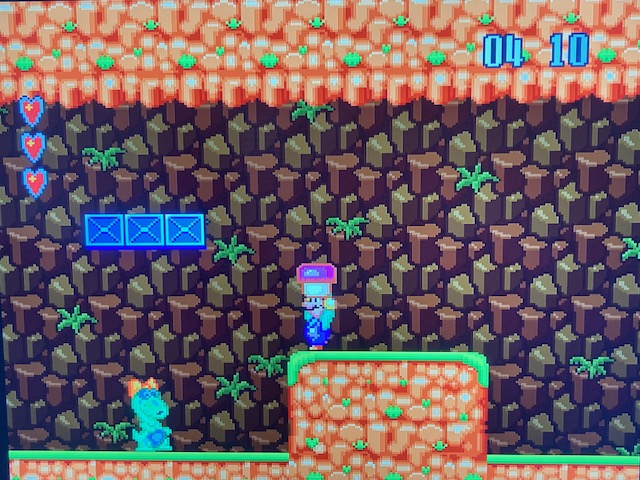
Check the result’s screen often to see what goals you still need to accomplish.

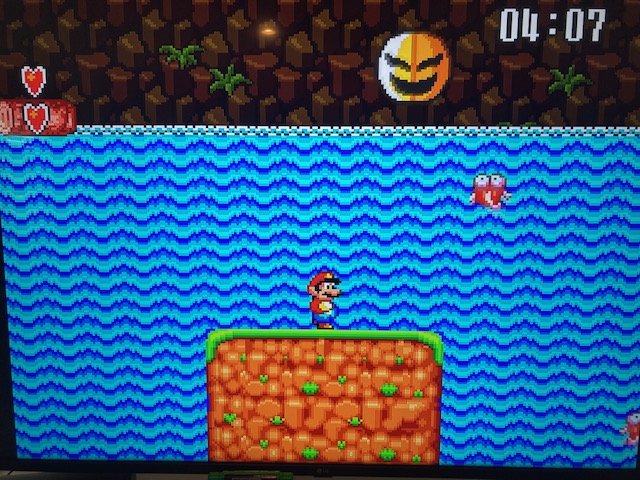
Clock and Timed Events: Originally, BS Super Mario USA was meant to be played in a 50-minute window of time, and that remains the case on this reproduction cartridge. A running clock (that you cannot stop by pausing) is onscreen at all times; it begins at 4:06 and ends at 4:56. When you reach 4:56, the game’s ending will play and all of your points will be tallied for your final score. As you play, different ‘events’ will occur at specific minutes. At some minutes, a giant bomb might be flung onto the screen for you to dodge, or you may get a temporary increase in your jumping ability; there are many of these events, and they add elements of originality and surprise to the game. Additionally, your character will change among Mario, Luigi, Princess Toadstool, and Toad at specific minutes – you cannot select who to play as like in the original game.

Gameplay Objectives: In BS Super Mario USA: Week 4, your goal is to recover all 10 of the missing golden Mario statues, collect all of the mushroom powerups, collect as many coins as you can*, and defeat the two Birdos, Clawgrip, and finally, Wart himself. The more of these goals you accomplish, the higher your score will be at the end of the game. Different point totals are awarded for completing the game’s objectives, making this very much a ‘high score’ game. *Coins are used to play a mini game near the end of your session (when the clock hits 4:50) which can add points to your total.

Levels: There are only three levels in BS Super Mario USA: Week 4 5-1, 5-2, and 5-3. These are the same levels as they appeared in Super Mario Bros. 2, albeit with the addition of the golden Mario statues. After completing a level by beating a boss, you can return to it at anytime, or exit it mid-level. This effectively means you don’t have to find every statue or mushroom on your first visit, as you can return as much as you like.

Finding Wart: To find and fight Wart, you must grab a potion and drop it near a tall jar. When the magic door appears, enter it, then jump on the tall jar and press down; you’ll be taken straight to Wart’s lair. Note that Wart is the one boss where losing the fight means you’ll have to replay the stage and go back through the process of getting to him again – with the other bosses, you’re allowed to lose and start back in their immediate area. If you beat Wart, the game is not immediately over as in the original version of the game – you have to wait until the clock hits 4:56 for it to end. Once beaten, if time remains, you’ll simply re-select one of the three levels to accumulate more coins or complete anything else you need to.

Differences between Week 4 and the other 3 weeks: Each of the four versions of the game contain three different levels each. Week 1 = World 1, Week 2 = World 2, Week 3 = World 4, and Week 4 = World 5. Worlds 3, 6, and 7 were never used.

The Southern Gentleman’s Opinion and Letter Grade: A BS Super Mario USA: Week 4 is a phenomenal and abbreviated romp through a portion of the world of Subcon. Great for a short playthrough of the original, larger game. There’s enough here to distinguish it from the game it’s based on, Super Mario 2 (which itself was based on the Japanese game Doki Doki Panic). The constantly switching characters, the random timed events, and the objectives to locate items in a specific allotment of time all combine well to make this a unique (and official) Super Mario experience, while still remaining familiar, comfortable, and as fun as the original game on which it’s based.

God Bless! Proverbs 3:6