Turbografx-16 – Neutopia II

Neutopia II for the Turbografx 16

Note: This game is a Turbografx 16 reproduction of Neutopia II.  It was played on a Turbografx 16 console that has been modded to output in component video. The console was connected to a 32-inch tv, outputting at 240p. Connected to the console is a Turbobooster Plus, which enables game saving without the use of passwords.  The Turbobooster Plus is a reliable way to save game data, I believe because it does not use a save ‘battery’ that might die over time.  Instead, I believe it uses some kind of memory chip that is ‘charged’ every time the system is turned on.  In a few of the game manuals I have for other games (ones that also are capable of saving), you are encouraged to turn the system on at least every two weeks so as not to lose any data you’ve saved.  My unit has worked great and I’ve had no problems saving.

Story: Your father, the legendary hero Jazeta (play Neutopia to experience his story) has gone missing. It’s up to you to discover what’s happened to him and discover why evil seems to be returning to the land of Neutopia.
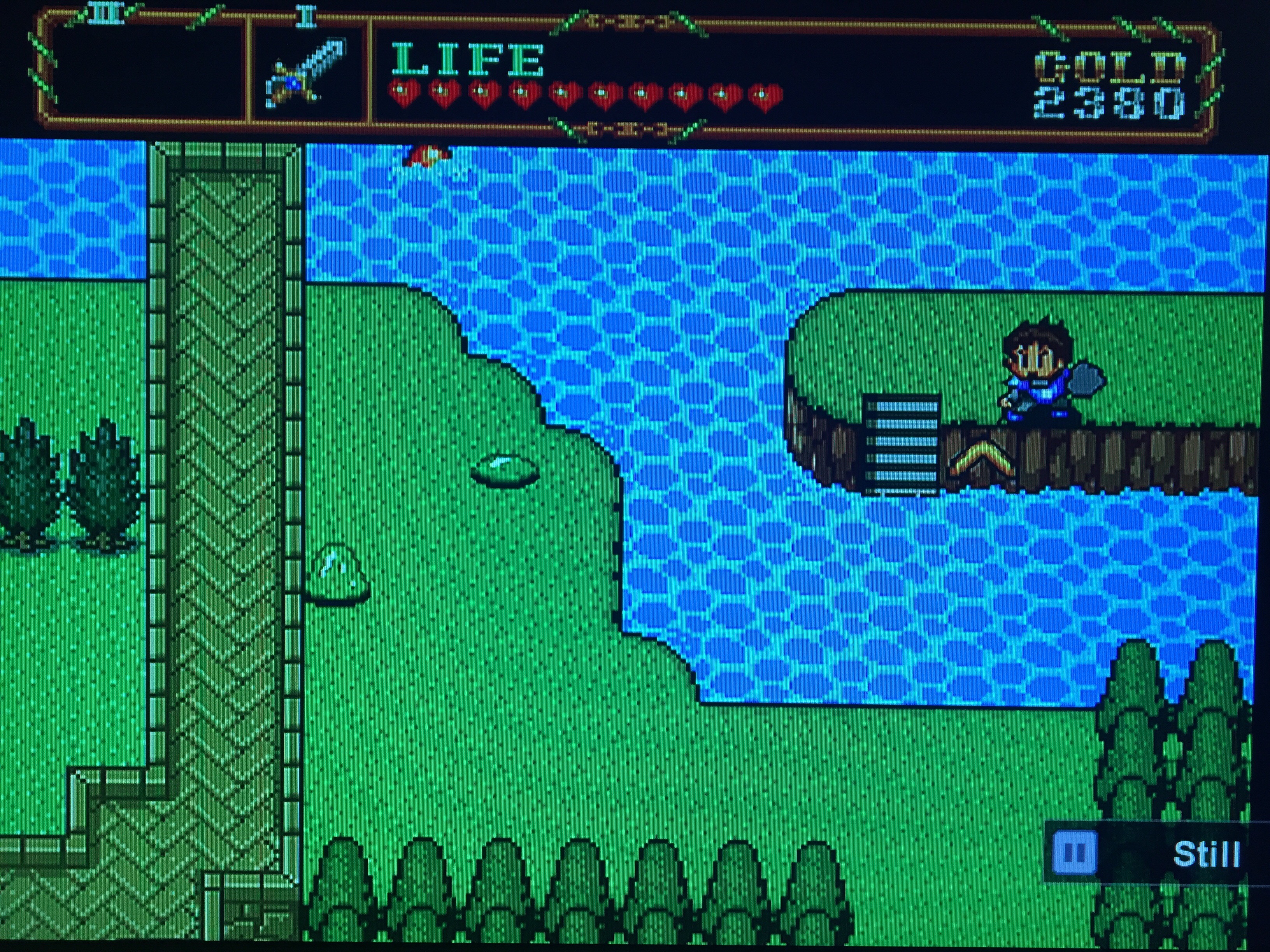

Gameplay:  Explore a huge over world filled with towns, fields, icy mountain ranges, and even an underwater kingdom.  Uncover Neutopia’s 8 labyrinths to find weapons, armor, and other helpful items to help you destroy the encroaching evil forces and follow the clues as to your father, Jazeta’s, fate.
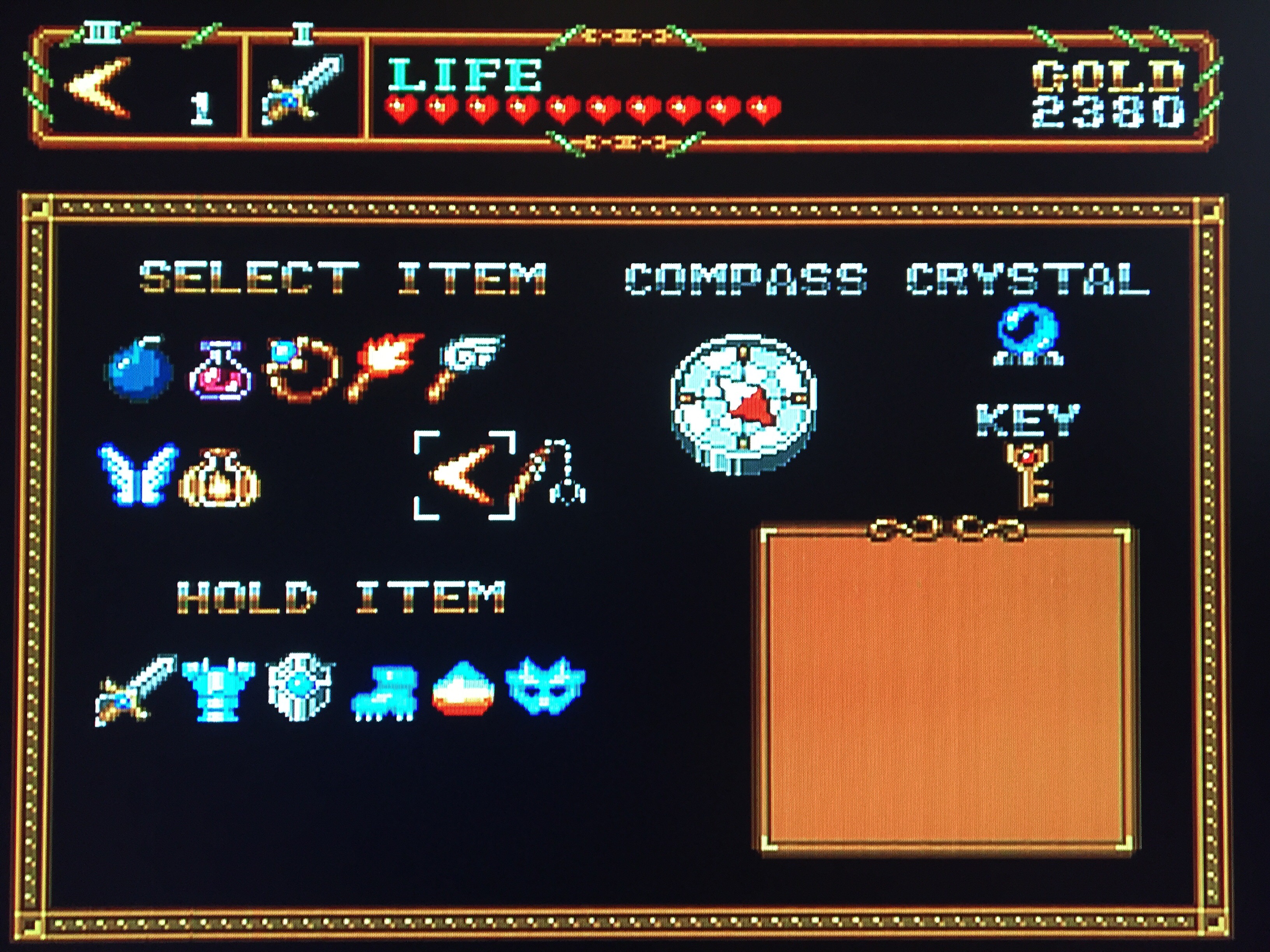
Control: Button I controls the sword (which you’ll upgrade multiple times by finding better swords in labyrinths). Button II uses any one of the ‘select’ items you collect – moonbeam moss illuminates dark caves, the medicine restores your hearts, the flail hits enemies surrounding you at the expense of 10 gold per use, etc.
Gold and Stores: You’ll collect silver coins (10), gold coins (50), or money bags (100) by defeating enemies. Use these to (mostly) buy medicine, bombs, or a boomerang (it will be lost if you don’t catch it while using it). Enemies drop gold often, so stockpiling money is not too difficult, particularly in the cave leading to labyrinth 3 – the enemy rocks are loaded with gold. Beware: Dying reduces your gold by HALF.  When in doubt (or low health), use the Wings of Return item to make it back to the ‘save’ lady – if for no other reason than to keep your gold. 
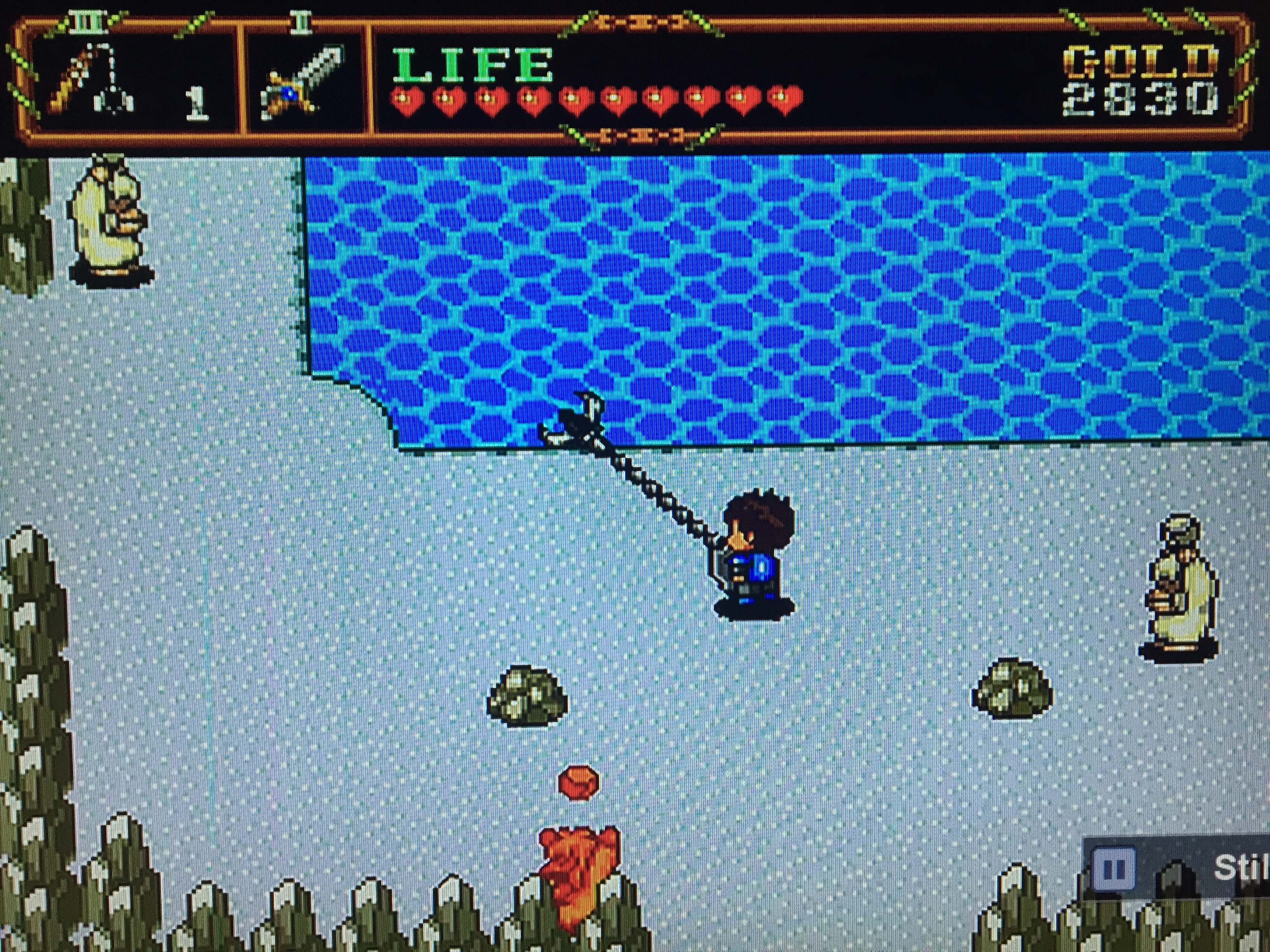

Progression: Neutopia II does a great job of directing you where to go next. The citizens of Neutopia, either in the towns or hidden in caves in the over world, will often tell you exactly where you should be headed. If you do get lost, it’s usually not for long. You’ll advance your strength and defense by acquiring new armor, swords, and shields.  Your arsenal of weapons will expand as you acquire the boomerang, wands with elemental powers, and the flail.  After beating the labyrinth bosses (which can be challenging – always carry 2 medicines), you’ll gain a unit of health (heart) to extend your life bar.  You’ll also encounter elders in the wild who will increase your life bar as well, or monks who will increase your bomb-carrying capacity.

Labyrinths: The 8 labyrinths get increasingly complex. The first two are quite simple, but starting with the 3rd one, they often require you to play them a bit, collect a few items (the crystal ball map and ‘boss’ key, for example), then leave and buy more medicine and save your game before continuing. The labyrinths aren’t impossible at all, they simply take patience and a large supply of bombs to uncover secret rooms hidden behind walls.  The crystal ball maps you’ll always find help every labyrinth become solvable.


Saving: To save your progress, visit the pink-robed woman who lives in every town or resides under a rock near the entrance of each labyrinth. She’ll give you a password or offer to have you save in the file cabinet, which is only possible if you have the Turbobooster-Plus or Turbografx 16 CD attachment hooked onto your console. The file cabinet is awesome because the password is quite long, yet all you’ll need to do is select your save file. However, you should NOT let the long password deter you from playing the game. The first time I played through Neutopia II a few years ago, I used a password all the way.  It takes about a minute to write it down in a notebook, and a minute to input it when you’re ready to begin playing again.  No big deal, and a password in a notebook can never be frustratingly deleted like an electronic save file (although this shouldn’t happen on your Turbobooster Plus unless you don’t turn on the system for more than a couple of weeks).

Differences from the first Neutopia:

Improvements:

1. Your character can be moved diagonally, unlike the first game.

2. Your sword can be swung in an arc instead of only straight ahead.

3. Gold is easier to accumulate as more enemies drop it, plus there’s the addition of the 100-coin bag.

4. Citizens offer more useful advice on where to go next, although neither game is really confusing in that regard.

5. More attack weapons than original game.

6. You find health pickups (hearts – which replenish one unit of life) far more often than you found health pickups (cherries – which replenish one unit of life) in the first Neutopia.  

Steps backward from the first game:

1. Fire wand, Lightning wand, and Wind wand sometimes pull enemies towards you when used, causing them to hit you. This doesn’t always happen, but is frustrating when it does.

*I WAS FLAT WRONG ABOUT WHAT WAS WRITTEN ABOVE, AND SO WERE OTHERS WHO HAVE CITED THE ABOVE ISSUE IN THEIR REVIEWS OF NEUTOPIA II.  What I finally discovered was that with items like the Elemental Wands and Boomerang, was that if you simply continued facing toward an enemy while attacking, or if you advanced directly toward them, they would never be pulled towards you.  However, if, after engaging an enemy with one of those weapons, you turned in any other direction, they would be pulled directly toward you.  Almost, (and this is a stupid example, I know), imagine that you threw a lasso around something, then turned and hitched the rope over your shoulder and jerked the object toward you – that’s kind of what happens in Neutopia II.  So, while this is a weird design for the game (and I, in no way, see how pulling an enemy toward yourself is beneficial), it does mean that you can effectively use those weapons as long as you know the rule.  Having played through the game knowing the rule finally, I never pull enemies toward my character anymore, usually because I remain stationary, or occasionally advance toward an enemy.  The important thing to remember is, once you’ve fired off the weapon, don’t move in any other direction other than toward the enemy, unless you want them jerked right toward your character.  

2. You cannot cancel talking to citizens once you’ve engaged them. In the first game, you could press Button II to cancel.  Now, you have no choice but to hear every word they have to say.

3. Labyrinths are more complex this time, but that could be seen as a positive or negative, of course.

4. Neutopia II has a longer password save feature than the original does; however, if you have a TurboBooster-Plus or CD attachment, this doesn’t make any difference since you can use the File Cabinet.

5. Your character moves much slower to start the game in Neutopia II than he did in Neutopia.  However, you’ll acquire the falcon shoes after the 3rd labyrinth, making your movement much quicker.

6. You find the ‘Wings of Return’ item far less often in Neutopia II than you did in Neutopia.  While you’ll still not have a major problem locating one, in the first game, it seemed like every other enemy you killed would drop a pair, ensuring that you always had a way to escape a labyrinth if you needed to.  In Neutopia II, you might just find yourself out of medicine, needing to escape a labryinth, but unable to obtain a Wings of Return item from a slain enemy in order to do so.

7. *This one is a bit of a rant – skip to my final review if you’d like.  The medicine ‘problem’ still hasn’t been fixed.  In both the first game and Neutopia II, you can hold up to two medicine bottles at one time.  Each one will completely re-fill your health meter.  You can buy medicine from vendors in town.  Also, in every labyrinth (usually behind a hidden, bomb-able wall), and sometimes in rooms you’ll enter in the over world, you’ll also find a chest that contains 1 dose of medicine.  Now, one would think, if you tried to open a chest that contained 1 bottle of medicine, and you already had the maximum allotment of two doses in your inventory, you might get a message like “You don’t have room for it!” like in other games of this ilk.  Then, if your health meter was low, you could use one of your own doses, then collect the one from the chest.  Or, you could return and collect it later, after you’d used one of your two doses.  But NO, not in Neutopia II (or Neutopia).  Even if you are already carrying two bottles and you open a chest with medicine in it, you’ll hold it up, receive the message, “You got the medicine!” and you won’t actually get anything except an empty chest!  It’s REALLY frustrating to be in a labyrinth and come across a hidden room with a chest in it – you only have 1/4 of your energy bar – not enough to use one of your precious two doses of medicine yet.  So you open the chest, thinking it will be the crystal ball or new sword – and you get a medicine!  Except now, instead of being able to re-fill your hearts and THEN collecting it, it’s gone forever and your energy is still low.  I HATED this from the first game, and wish they would have fixed it in Neutopia II.  Alas, this is one of the game’s few flaws, in my opinion.  This design flaw makes you approach the game a bit differently – my strategy now is to (when in doubt), just use a medicine bottle if my health is at half or less when I find a hidden chest in a dungeon BEFORE I open it, just in case it happens to contain a dose of medicine I’d like to NOT lose.

The Southern Gentleman’s Opinion and Letter Grade:  A  Neutopia II is a fantastic adventure RPG. It, like the original Neutopia, feels like a mixture of the original NES Zelda and A Link to the Past on the SNES. I haven’t reviewed the first Neutopia, but the two games are strikingly similar – I would recommend playing the original first, which is a bit easier. But Neutopia II is a fantastic Zelda-style game, certainly better (in my opinion, as always) than the NES Zelda it models itself after, and it even comes close to the stratosphere of classics like A Link to the Past. 

God Bless! Proverbs 3:6
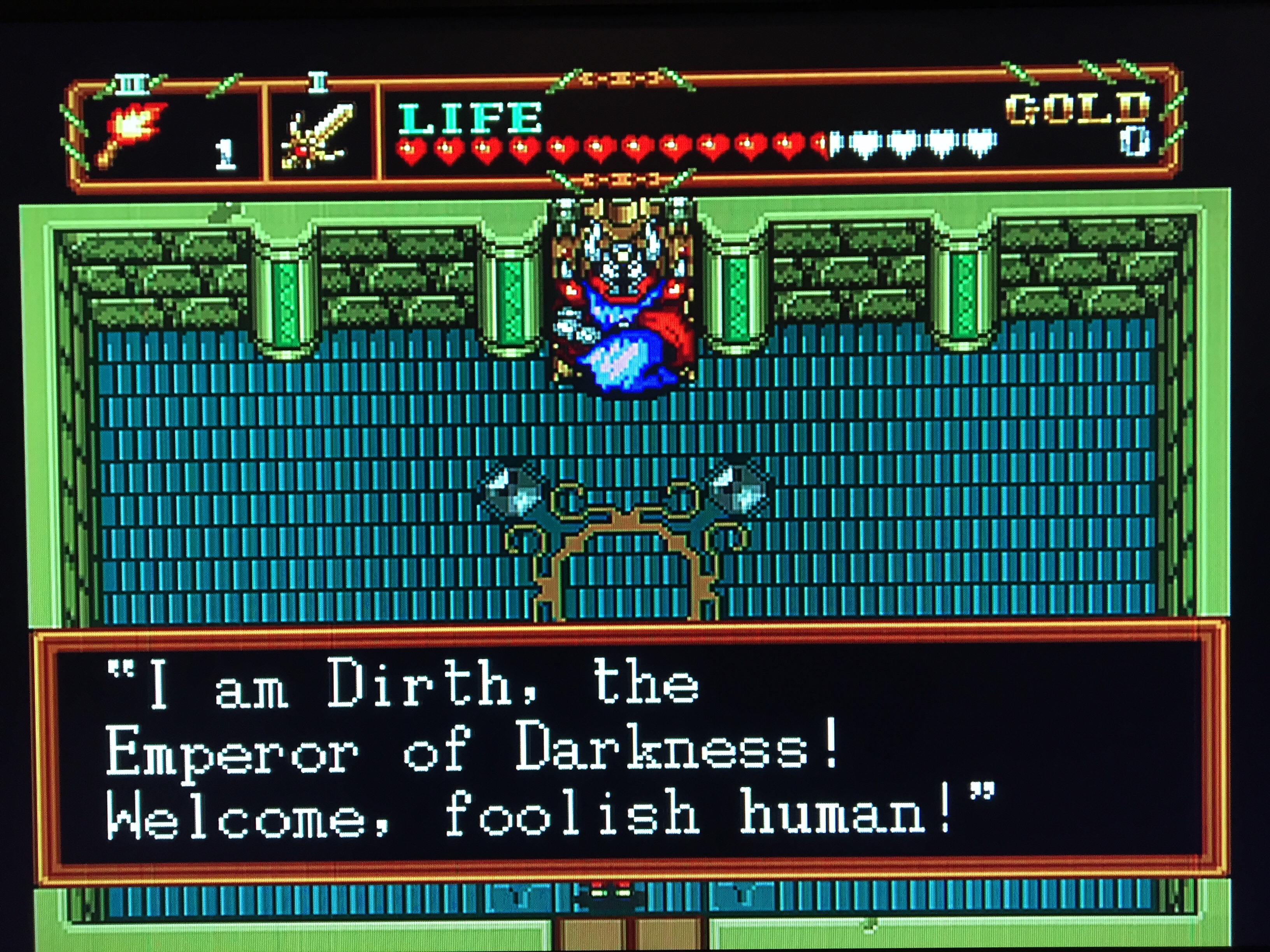

Bonus – Dirth Strategy: 

Step 1: The final boss of the game, Dirth, is quite challenging. Many of the bosses are, but Dirth is certainly the most difficult, if you don’t game plan. My advice is to beat the entire labyrinth leading all the way to him – collect the key and crystal ball and bomb all the walls that create a path to him. Then use the Wings of Return to see the save lady. Go buy two medicines (if you don’t already have them).  Now save your game, so if you die, you can return via save file or password to the save lady, and you won’t have to buy medicine or figure out the labyrinth’s secrets again.


Step 2: Memorize the exact labyrinth path to Dirth. This won’t be hard, particularly if, like me, it takes multiple times before you beat him, forcing you to re-start at the save lady. (From the save lady to Dirth takes about 10 minutes if you know the way). It’s important to reach him with close-to full health, in addition to your two medicines.  Use the Fire wand or flail on the enemies – the flying squirrels and green caterpillars in particular cause significant damage, so keep them away.  This isn’t tough with practice.


Step 3: Only the Sun Sword can hurt Dirth. Also, MAKE SURE you’ve acquired the gold armor and gold shield like the old man tells you just before the Dirth battle, which you should have acquired in previous labyrinths.  Without these, it will take more hits to kill Dirth, which you don’t want.  I forgot the gold shield in the Twin Towers, and was hitting Dirth 30+times without him dying, so I went back for it, and upon fighting him again, found it took fewer hits to beat him (not sure why a shield matters when you’re hitting him with a sword, but okay). *As a side note, re-entering previous labyrinths, after you’ve already started another labyrinth, RE-SETS them, so pick up everything the first time around to avoid a headache.  The Dirth battle is fast and frantic. Use the Run button to take a pause if it gets too hectic.  Dirth splits into two – a fake and the real Dirth – stand in the MIDDLE of the screen and pick one when he appears.  Run towards it, swing ONCE and RUN AWAY, NO MATTER WHAT.  If you hit him, great – if it was the fake Dirth, no sweat. Keep going with THIS STRATEGY.  If Dirth hits you with his spinning tornadoes, or you accidentally touch him, don’t panic and try to go beserk on him because he WILL win. Beating him takes PATIENCE.  Expect to get hit (but very seldom with practice), and follow this strategy, and even if it takes 10 tries, you WILL become a master of this battle and beat him with a medicine to spare. Good luck – you didn’t come this far to give up.
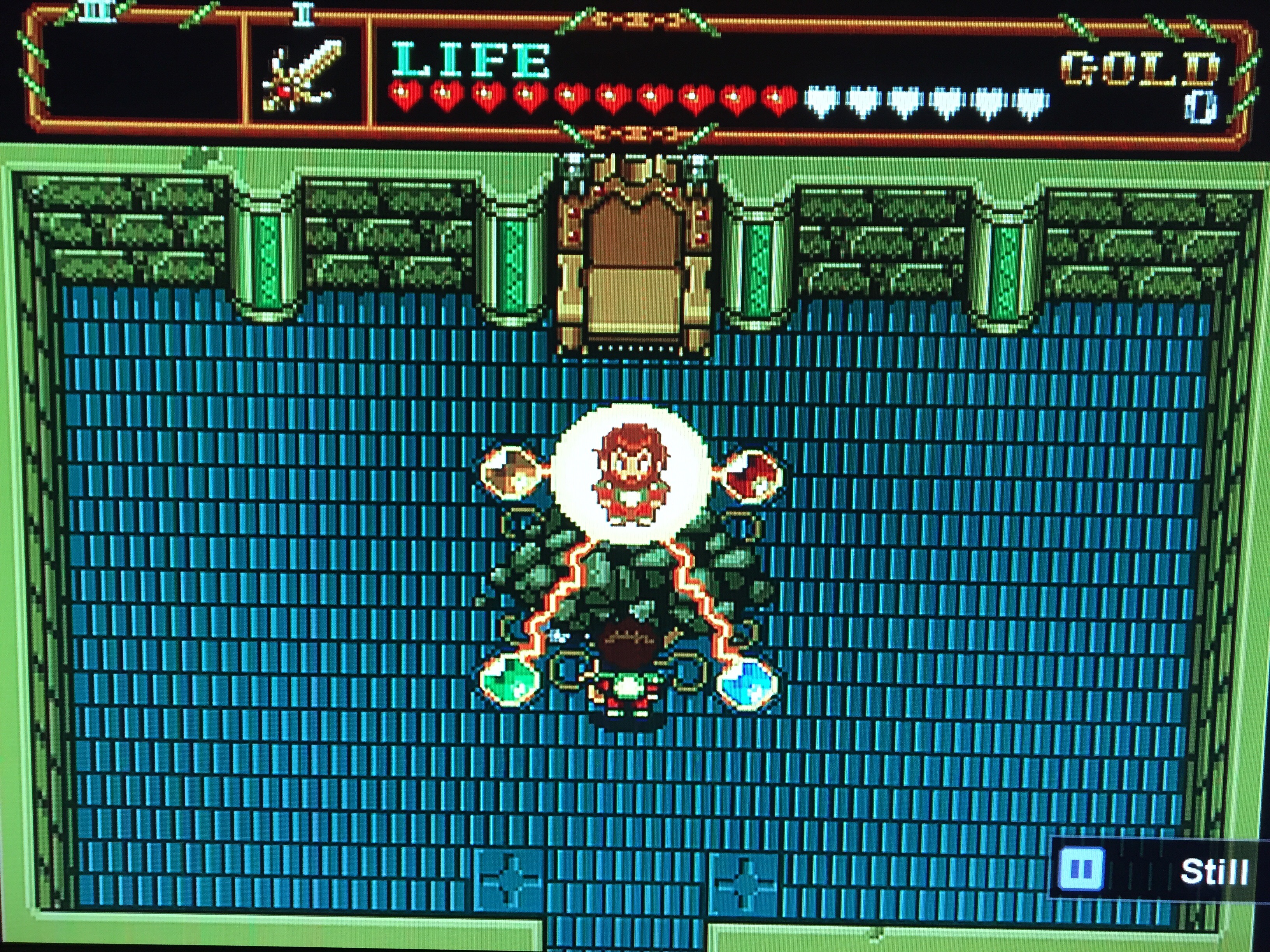
Final Note: Enter the name ‘KOALA’ to play as a weird-looking character with a big head!  He’ll also start with TWO doses of medicine in his inventory!  Just don’t open the left chest in the room in the picture – it contains a medicine that you should come back and collect later instead of paying a vendor for one.
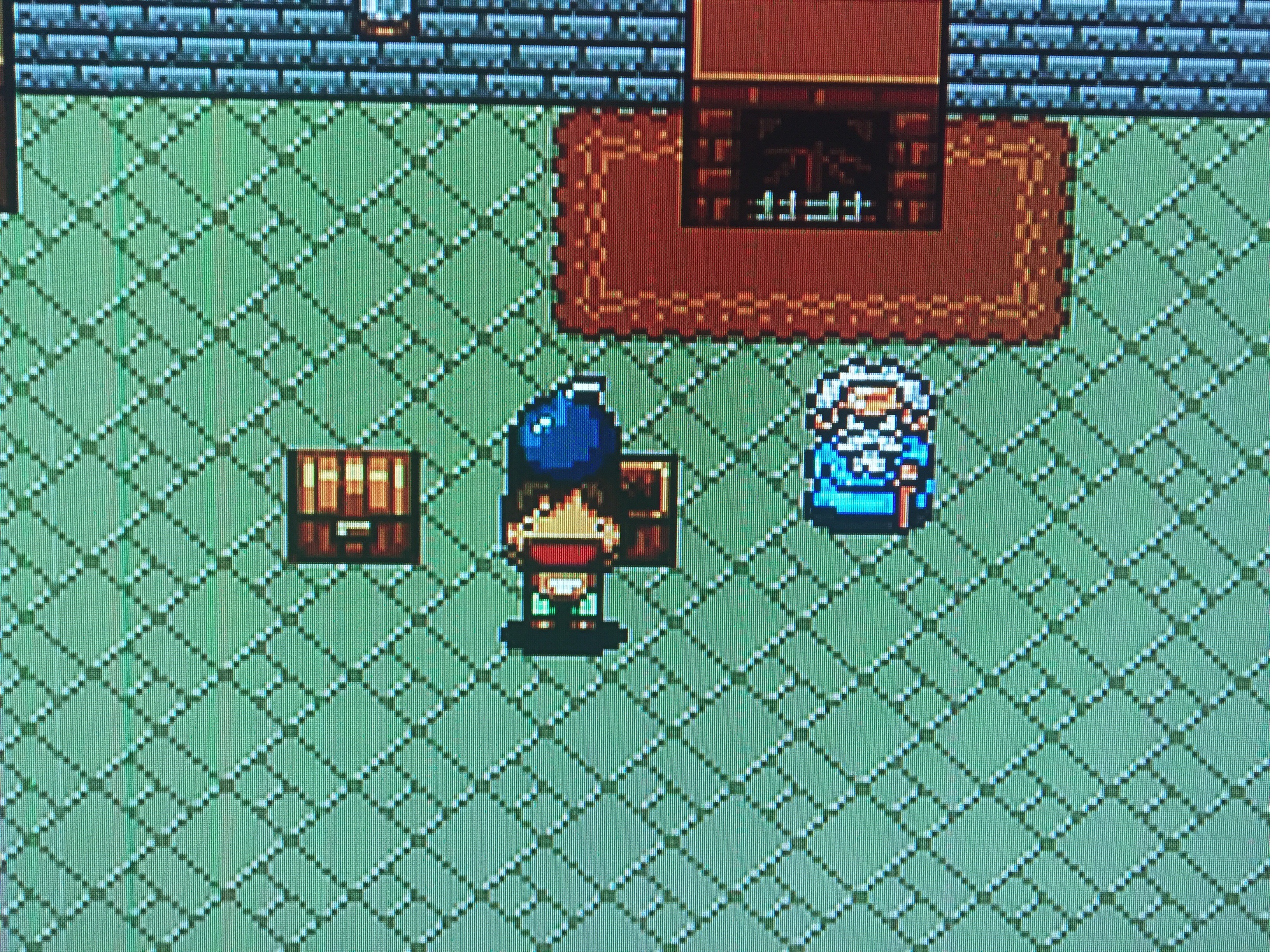
KOALA looks quite different than the regular hero.
Alas, the Neutopia Trilogy would never come to fruition.

Turbografx-16 – Die Hard

Check out my review of Die Hard on youtube! Just type ‘ORO video games’ into the search engine to pull up my channel!


Note: Die Hard was played on a 19 inch tv. The console is a PC Engine (Japan version of TG16) that is modded to allow Turbografx 16 games, and although Die Hard was only released in Japan, I requested that a reproduction maker make a TG16 version using a terrific English translation. This console was also modded for RGB and is outputting it through a SCART cable directly onto a tv I was fortunate to find that has a SCART input.  It looks awesome.

Note 2: I won’t be comparing this to any other Die Hard games because I’ve never played any. I’ve seen the movie on which the game was based, but I’m not familiar with it enough to know all the minute details of what the game gets right. There are probably longer, better reviews on the Internet.


Genre: Overhead Shooter

Players: 1

Stages: 10, timed between 3 and 10 minutes.

Continues:  4 per stage.  No password feature or cheat code for level select. Hold button 1 on the title screen before pressing Run to gain unlimited continues.

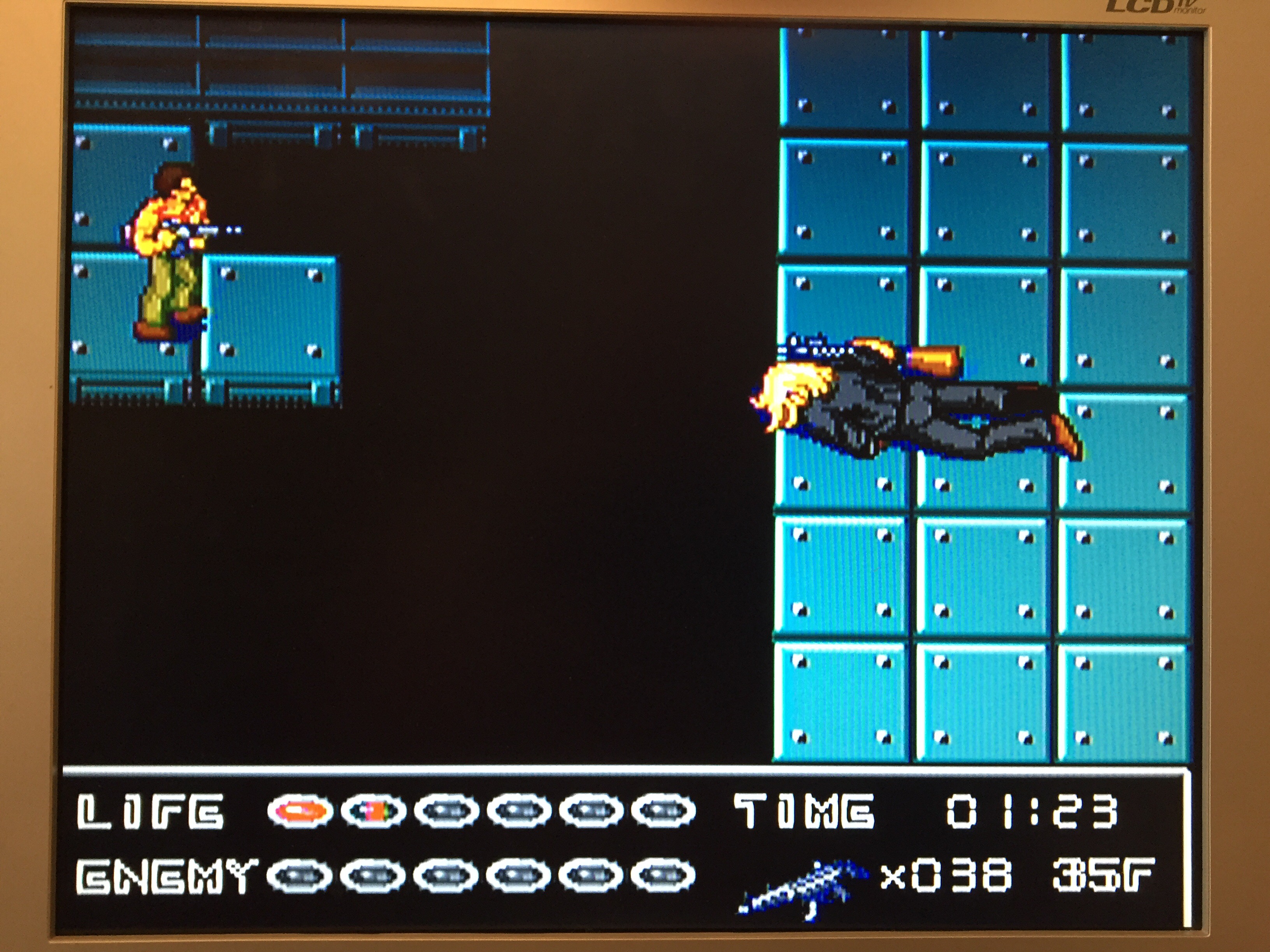
Story:  John McClane must ascend the Nakatomi Plaza Tower, shooting terrorists along the way in order to thwart the plans of the evil Hans Gruber.  Oddly, you don’t encounter Gruber in the game (although he appears in a pre-game cutscene), and your final battle is with a helicopter.


Cutscenes: They play between some stages and attempt to use scenes from the movie. They add to the story and are pretty good, actually!


Guns:  Four guns are available: (1) a weak, single shot rifle, (2) a machine gun that fires rapidly in a straight line, (3) a rocket launcher with short range that has a bigger killing radius, and (4) a long-reaching flamethrower.  None of the guns are that great – a spread gun would have been most welcome.  All have limited ammunition, and if you run out you’ll have to use your fists.  Fortunately, gun pickups are plentiful and are dropped often by bad guys.


Other pickups: Other pickups include body armor, which doubles your life bar, beer, which gives you 3 health meters back, and a first aid kit, which completely restores your health bar.

Bosses: You’ll fight a small handful of bosses from the movie every few stages.  They will take a few tries to learn how to kill, but after that, they’re a piece of cake.

Blood:  McClane bleeds when his life bar is low, which is a nice touch.  Sadly, the enemies don’t when you blow them away.


Translation: This English translation is terrific!  It has some cursing, but it’s the same way McClane talks in the movie.

Difficulty:  Minimal. Stage 3 is an annoying maze (see below for tips), and Stage 7 has some semi-difficult jumps that result in your instant death if you don’t make them.  Most of the stages are short, however, and the slightly longer ones have checkpoints you’ll start at if you die.  Using the unlimited continue code is highly recommended for beating the game.  There are definitely some stages that will take multiple tries to beat.

Stage 3 Help: Take the left door, then the next-to-last door. Take the right door, then the next-to-last door. Take the right door, then the last door. Stage complete.

Stage 4 Help:  There’s body armor hidden to the left of the door to the boss. Walk around the left-hand wall to find it. This makes the boss fight much easier.

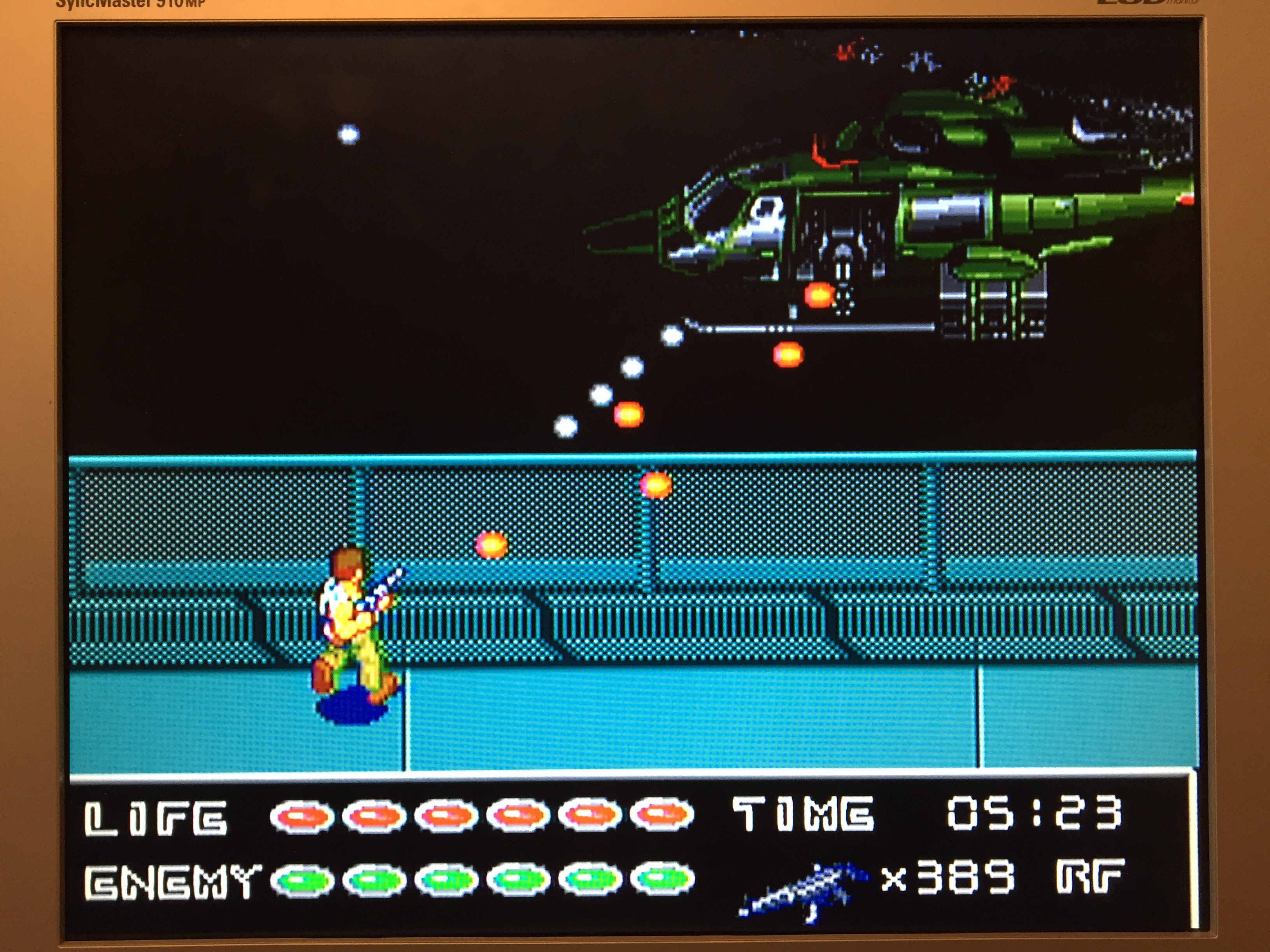
Stage 10 Help:  The last fight against the helicopter may seem tough, but is actually quite easy if you know what to do.  Stand on the far right and fire the machine gun. Jump or move out of the way of the normal bullets, and jump CONSTANTLY when the homing missiles come at you. As long as you’re in the air, the missiles won’t hit you near as often, and you can shoot them down without fear of getting hit. Yes, the helicopter takes awhile to bring down, but it drops approximately 3 beer bottles periodically and a first aid kit near the end.  It also drops multiple machine guns, a couple of rocket launchers, and a flamethrower.  Even with all this fire power, you may still run out of ammo near the end.  I literally had to jump and PUNCH the helicopter for the last few hits to make it explode – surely one of gamings all time great moments.


The Southern Gentleman’s Opinion and Letter Grade:  C.  Die Hard is a nice shooter with big sprites and is based on a great movie.  The challenge is minimal, which is either positive or negative in the eye of the beholder.  The music is bland, as is the general gameplay, although the control of McClane is excellent.  Other overhead shooters have done it much better (True Lies for the SNES, the overhead levels of Super C for the NES). The cutscenes and English translation are brilliant, which help the game overall. 

God Bless! Proverbs 3:6

SNES – Crystal Beans

Quick History: Crystal Beans is the “sequel” to Dungeon Explorer for the Turbografx 16, and a re-make/overhaul of its sequel (for the Turbografx CD), Dungeon Explorer II.  The game was only released in Japan, but today, like many RPGs, it’s been (expertly, grammatically speaking) translated into English and can be played on the Super Nintendo.


Players: 1-3

Story & Characters: Select one of 8 characters – Wizard, Witch, Warrior, Bowman, etc. and traverse the land seeking to kill 15 demons and restore peace to the land (in a nutshell). The game is a “real time” RPG, so no menu-based fighting.  Each character, while possessing different stats (strength, speed, etc), fires a straight forward attack, has a whirling defense move to repel enemy projectiles, and a magic attack that can be activated upon finding enough Black Magic (skull) items.

Gameplay: Select a different “area” on the map to visit to explore a new dungeon or visit a new town (straightforward “linear” gameplay).  Visiting new towns and speaking to residents opens up new dungeons, and exploring dungeons and subsequently beating the dungeon boss opens up new towns.


Leveling up: Level up by beating the dungeon bosses.  Each boss drops a gem that brings you up 1 level and additionally boosts your stats in one area based on the color you selected (blue=strength for example – you can see the color coordinated stats on the ‘status’ screen to balance your character as you play through the game).


Saving? You save your ‘character’ in this game by writing down the password and entering it when you resume play.  You’ll pick up at the last dungeon or town you were in at the level your character was on when you resume play.  *You’ll note there is a ‘Save’ option.  For the reproduction cartridge I played with, there was no battery, and this ‘Save’ option was a bit perplexing…stick with the password save if you’re using a reproduction cartridge.  I’m not sure if the original game utilized battery backup for the ‘Save’ option or not, or if it was simply used to to save the password for continuing after Game Overs.

Continues:  You get 5 total, and they’re shared in multiplayer.  Lose them all, and it’s back to the beginning of the dungeon or a checkpoint in the larger dungeons.


Conclusion: Crytal Beans is one of the simplest RPGs I’ve played.  The story is simple, the gameplay is simple, the dungeons are simple – everything is simple (bosses provide a decent challenge).  This is no Legend of Zelda or Secret of Mana or Chrono Trigger.  However, it’s fun to be able to pick up Crystal Beans and beat it in only a few hours.

The Southern Gentleman’s Opinion & Letter Grade: C.  Add a plus with 2 or 3 players. 

God Bless! Proverbs 3:6

FM Towns Marty – Muscle Bomber: The Body Explosion


IMG_0978

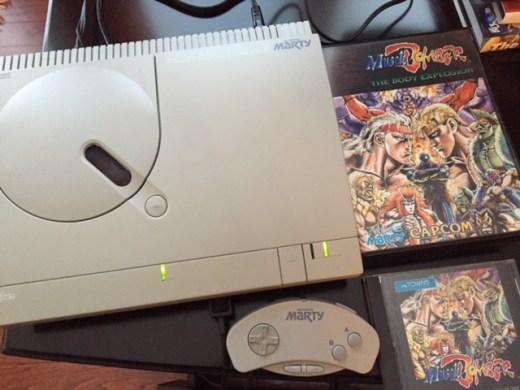
FM Towns Marty console and Muscle Bomber: The Body Explosion

Note: This game was played on a 25 inch-HD tv.  The console was connected to the tv using S-video cables.

Note 2: This will not be an in-depth review by any account, just a brief overview and short review of this obscure game.  I’ve been too busy to do many reviews lately, so this is the best I can do at the moment!

Quick History: Muscle Bomber: The Body Explosion was released for the FM Towns computer and FM Towns Marty game console in 1993.  It is a port of the Japanese arcade game of the same name.  The game was also released for the Super Nintendo and Sega Genesis under the name Saturday Night Slam Masters (see my SNES review).

Players: 2 players VS option, or 1 player single match campaign for World Championship.

IMG_0990

Modes: Muscle Bomber has only one mode of play, unlike other versions of the game.  In this FM Towns Marty version, there is no Team Battle Royal Mode where you could play co-op versus 2-computer controlled characters or other human players.  There is only the Single Match mode, where you must battle through the roster of wrestlers twice – once to win the Championship, and once to defend your title.

Gameplay Options: In the Options menu, you can change the screen resolution, which as far as I can tell, changes the size of the game on the screen mainly, change the difficulty among 7 settings, and change the controller configuration, among a few other small things.  The FM Towns Marty controller is a very basic controller with only 5 buttons – Run (Start), Select, B, A, and an unlabeled shoulder button that I believe is used to change the screen resolution in-game on some FM Towns Marty games.

IMG_0977

Wrestlers: There are 8 selectable wrestlers in Muscle Bomber.  Aleksey Zalazof, Luck Colt, Mysterious Budo, Titan the Great, El Stinger, “Macho” Mike Haggar (from Final Fight), Sheep the Royal, and Gomes.  There are 2 unselectable boss characters whom you must square off against named Kimala and The Astro.  Each wrestler has their own specific look and movelist, although Zalazof and Colt are quite similar.

Control: B punches or kicks, depending on your wrestler.  A jumps (which you can follow up with an attack by pressing B).  Select “Falls” (Pins).  Moving in close to your opponent and pressing Toward + B grapples, then pressing B + Left or Right whips (sends running) your opponent across the ring, where they will bounce off the ropes and come back towards you for an attack.  In a grapple, Up or Down + B executes a wrestling move, like a body slam, pile driver, backbreaker, etc., depending on your wrestler.  Most wrestlers also have a submission hold that can be executed from the grapple position.  If you lock it on while your opponent has no energy left, they’ll give up and you can win that way.  All wrestlers also have a special “finisher” they can execute by pressing a particular controller directional combination and button combination while in a grapple (simple – for example, rotate the directional pad in a 360 motion and press A + B to execute Haggar’s spinning pile driver) or a unique standing attack by pressing B repeatedly or pressing B + A. Simple, and easy to master.  You can climb on the turnbuckles by tapping toward them twice, and jump off for a flying attack.

Match Length: Each match in Muscle Bomber lasts exactly 3 minutes, and it goes fast.  If time runs out with no winner, whoever has the most energy wins.  However, if both wrestlers have the exact same amount of energy (for example, if both have depleted energy bars but no one has made a pin or submission) and time runs out, the word “Draw” will appear on the screen.  However, the game will then declare “Tie Break!” and you’ll be granted 1 additional minute to see if someone can win it.  I’m not sure what happens if no one is able to win in that final minute.  I would imagine a proper draw and you’re forced to start the match over.

Outside the Ring:  You can roll out of the ring to fight, but in this version, there are no chairs, tables, or any other weapons to pick up and attack your opponent with.  It’s still satisfying to pile drive them on those blue mats though, and you can still whip them into the steel railing for damage.  If you don’t answer a 20 count and return to the ring, you’ll lose that way (or win that way if you can slam your opponent down with around 18 seconds then jump back in the ring).

Difficulty: There are 7 difficulty levels in this FM Towns Marty version, but so far I’ve only played the game on Very Easy.  After the first 3 matches, the game did get a bit more difficult, and I kept losing to Zalazof after getting Tombstoned! If the computer hits a finisher on you, it depletes a lot of your energy, and sometimes this will happen repeatedly! If the computer character turns red, stay away!  This means they are more likely to win a grapple.  If you turn red, grab them quick!  Learning your characters finisher, which you can execute well before your opponent’s life is almost gone, is paramount to winning matches.  Even still, I had no trouble fighting through the game despite losing a few matches here and there.  I was very satisfied with a competent but not ridiculous computer AI (and this was on Very Easy, mind you).

Music: The CD music is AWESOME!!!  Beautiful tracks (well, a couple are forgettable) accompany the wrestler whom you’re facing.

IMG_0986

Loading: There are load times when playing this on the FM Towns Marty.  Most noticeably, after selecting your fighters you’re shown a cut scene (skippable by pressing Run) of the two combatants approaching the ring.  After this, before the match begins, there can be up to a 20 second black screen while the game loads your fight – sometimes a little shorter, like around 7-10 seconds.  I personally don’t mind this, as it’s just one of the nuances of playing retro games, particularly CD games, and I do like that I don’t have to look at the words NOW LOADING at all, as the programmers didn’t put it in – just a black screen until your fight begins.  Aside from this, there is no significant loading, and the matches play perfectly.

The Crowd:  In the SNES version, and the Arcade, and I believe the Genesis version, the crowd has some animation and moves a bit.  In this FM Towns Marty version, they’re static.  Meh, I never notice as I’m busy trying to whip my opponent.  Camera flashes occur from the crowd, especially when you hit a slam.

Language Barrier? No, not at all.  The demo shows a character ‘card’ with the wrestlers’ names in English, but a description of them in Japanese, and the quotes that accompany the pictures of the wrestlers after a match are in Japanese, but all of their names are in English, the Options (Set Up) screen is in English, and the wrestling ring has English on it, so you’re good to go.

IMG_0985

The Southern Gentleman’s Opinion and Letter Grade: B.  Compared to the other versions, sure, it’s not as “complete” without the Team Battle Royal.  However, the CD music is awesome, the game controls great (and simply), the difficulty is just right, and it’s really, really fun!  The characters are huge and have a lot of personality, which I particularly love.  A must have for the obscure FM Towns Marty!  

God Bless! Proverbs 3:6


Neo Geo – Zupapa!

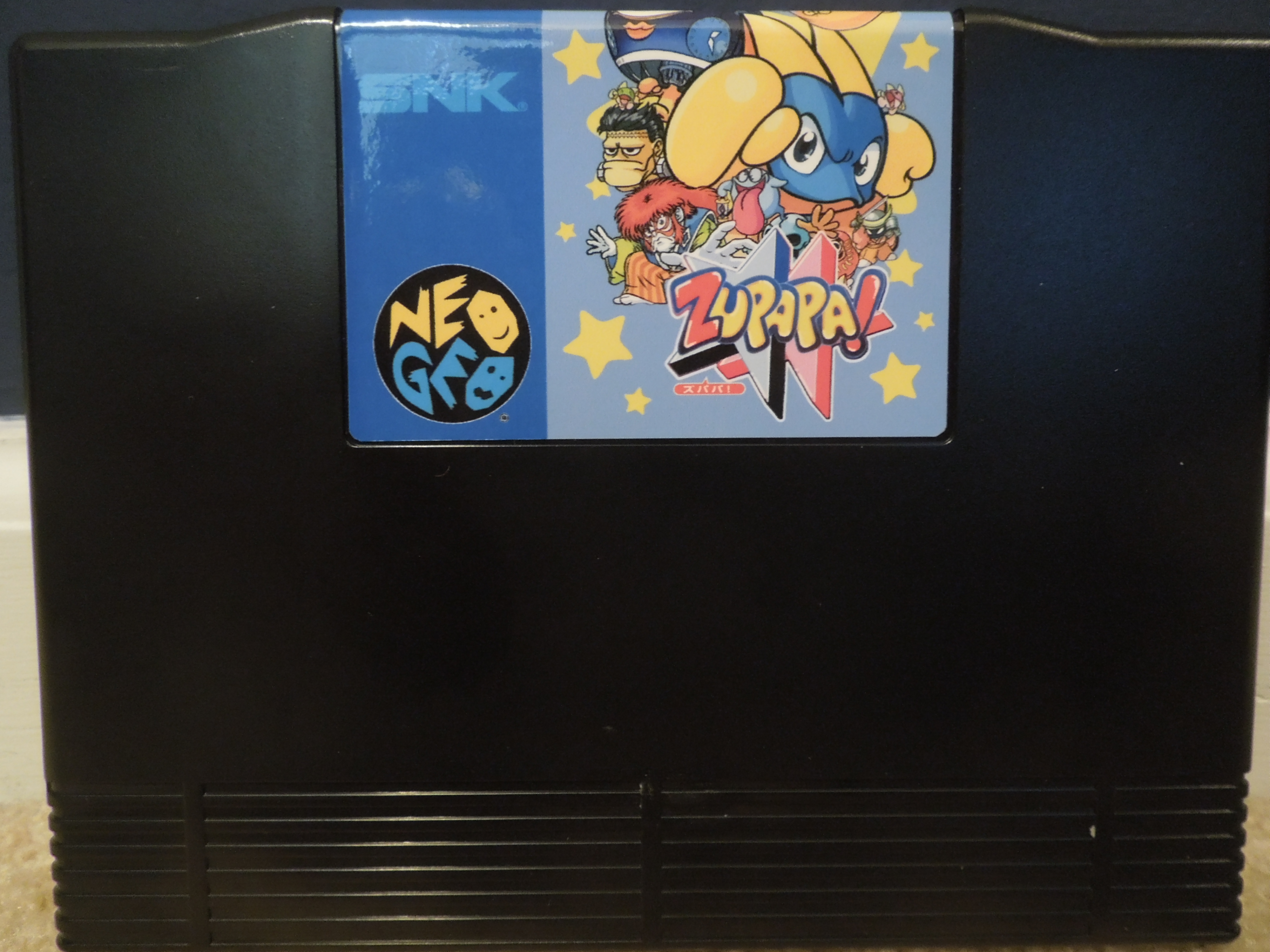
Zupapa! for the Neo Geo AES. Zupapa! for the Neo Geo AES. 

Note 1: Like Neo Geo games?  Check out many of my other reviews!

Note 2: This game was played on a Neo Geo AES home console that has been modified to output in component video (green, blue, red). The Neo Geo AES was connected to a 32-inch HD tv.

Note 3: This review will be quite short, but I’ll try to include as much as I can!

Quick History: Zupapa! was released for the Neo Geo MVS (arcade cabinet) in 2001.  Evidently, however (from what I’ve been able to find online), the game was actually developed in 1994, but was shelved for 7 years before being released by SNK.  The game never received an official AES release, but conversions of the game, like this one, exist for the home console Neo Geo.  This review is for the AES version.

An AES conversion of Zupapa! An AES conversion of Zupapa!

Players: 1 or 2, co-op (or competitive if you’re competing for the high score)

Memory Card Support?  Yes.  You can save your game by letting the timer run to zero after losing all 3 of your lives.

Credits: 4 Credits only on an AES – no unlimited credits here.

Lives: 3 lives per credit – 1 hit kills you.

Difficulty Level:  The game is defaulted to Level 4 (MVS).  The game does not allow you to change the difficulty.  The only way to make the game easier or more difficult is to access the UniBios menu, if you have it installed on your AES.

Story:  Absolutely no story is presented in the game, but based on the ending of the game, I can only surmise that you, a male Zupapa if you’re Player 1 (blue) and a female Zupapa if you’re player 2 (pink), and your Zooks (kids), have to take down a wanna-be Zupapa and all of his minions across 9 worlds.  Doing so will allow you and your kids to live happily ever after on your own Zupapa planet.  Oh, a Zupapa looks kind of like a platypus wearing a mask and boxing gloves.

Worlds:  There are 9 Worlds for you to complete, each comprised of 5 levels.  You can choose the first World you start on, and after that the game moves in a clockwise circle through the next 5 Worlds.  After completing those, the final 3 Worlds become available to you.  There are no names for each World, but each has it’s own theme, enemies, and boss (in the final level of each World) and here’s what I would call them: Horror World, Toybox World, Prehistoric World, Circus World, Ancient Japan World, Animal World, Space World, Medieval World, and Devil World.

There are 9 unique Worlds to conquer in Zupapa! (3 others appear after the first 6). There are 9 unique Worlds to conquer in Zupapa! (3 others appear after the first 6).

Gameplay:  In Zupapa!, each level is comprised of a single screen that you must ‘clear’ of all enemies before you can advance to the next one.  There is a time limit (not viewable, but notable by a ringing alarm clock creature and then a demon killing you if you don’t heed the clock), but most levels you’ll clear of enemies quickly.  Your Zupapa character can punch enemies with button A, making them vulnerable to be killed by simply touching them.  Additionally, you can collect your randomly scattered Zooks from around the screen and hurl them at the enemies, which likewise incapacitates them for a kill.  The key to clearing a level quickly, however, is gathering as many Zooks as possible (4 total) and hurling them ALL at an enemy.  If you touch an enemy with Zooks holding it down, a circle of stars will envelope a portion of the screen, killing any enemies it touches!  The size and reach of the circle of stars is dependent on how many Zooks you threw at the enemy.  So basically, hurling all 4 onto an enemy = the most additional kills by your circle of stars.  Bosses cannot be punched, but instead require you to either hurl Zooks at them repeatedly (slower method) or use the circle of stars method (faster method).

Use the 'circle of stars' killing method to rack up big points! Use the ‘circle of stars’ killing method to rack up big points!

Items: During levels, a “P” or an “S” icon will randomly be dropped into the screen.  The “P” increases the power and range of your regular punch, and it allows your to throw any of your gathered Zooks at an enemy in a single throw, instead of one at a time (time saver).  The “S” icon is a speed-up icon, allowing you to move almost twice as fast as normal.  You can also gather random icons that allow you to add to your high score by simply jumping or punching!  Other items include fruit icons that add to your high score as well.

High Score: Zupapa! is an addictive ‘high score’ game.  You’ll get a ton of fruit (points) for killing bosses, but you can also get additional fruit by using the circle of stars method of killing enemies.  Different fruit offer different values.  For example, the cherry gives you 2,000 points.  The orange gives you 3,000.  If you kill 2 enemies with your circle of stars, you’re guaranteed to get a cherry and an orange.  If you hit 3 enemies, you’ll get a cherry, an orange, and whatever the next highest fruit is (grape for 4,000 points, I think).  I enjoy playing and keeping up with my high score based on only 1 credit.  I’m currently at around 700,000 points while getting through 2 Worlds before I get taken out.

Each World has it's own unique 'theme,' like the Toybox World with a giant teddy bear as the boss. Each World has it’s own unique ‘theme,’ like the Toybox World with a giant teddy bear as the boss.

Player 2 AES bug? When playing the game in co-op, there was a problem.  I’m not sure if it’s just my copy of the game, or if this would happen anytime Zupapa! was converted or played in AES mode.  If I was playing a 1-player game, and a second player wanted to join in (using controller 2, port 2), they couldn’t.  Their side of the screen (top right) alternates between ‘Game Over’ and ‘Push Start,’ but pushing Start does not allow them to join (nor does Select, in case you were wondering).  So I reset the game, and used controller 2 (in port 2) to Start the game – no problem there, and everything worked just fine.  However, after losing all 3 lives, and the ‘Continue?’ message and countdown appearing, I could not continue no matter what I pressed even though I still had Credits left!  This is not a problem playing a 1-player game, as continuing is as easy as pressing Start (as long as you have the Credits for a continue).  Using my UniBios menu, I switched the game to MVS (arcade mode), and the problem did not exist – I could enter Credits with Select and press Start to continue with both Player 1 and Player 2.  So, I can only gather that this is an AES programming bug.

Comparison to Nightmare in the Dark: If you read my review of that game, you’ll notice the two games are structurally similar.  There is actually a great comparison review on a website I found called neogeokult.com that is far better than what I’m typing here.  Personally, I still prefer Nightmare, but it’s close.  Zupapa! does contain more levels than the former, and it has the added bonus of being able to choose where you start, which is quite nice.  Zupapa! also plays faster than Nightmare, with less time being given to complete each stage.  Zupapa! is definitely more difficult than Nightmare, if only because of it’s length.  It doesn’t take too much time to beat Nightmare on the 4 given Credits, but it would take much longer to master Zupapa! with only 4.

The final boss is not what he appears to be - and he has diabolical plans for the Zupapa! The final boss is not what he appears to be – and he has diabolical plans for the Zupapa!

The Southern Gentleman’s Opinion and Letter Grade: Zupapa! is an absolutely fantastic game.  Colorful graphics, unique enemies, awesome backgrounds (that change based on each level to reflect the theme of each World!), huge, unique bosses, some catchy music, and an adequate challenge.  The 1 Credit high score challenge is enough to make the replay-ability high for this game, but so is the challenge of trying to beat it on the 4 given Credits.  The final stages can be very, very difficult.  A+

God Bless! Proverbs 3:6

Famicom – Esper Dream 2

Esper Dream 2 for the Famicom Esper Dream 2 for the Famicom

Note 1:  This game was played on a NES 101 (Top Loader) console with RF output.  Because it is a Famicom (Japanese NES) game, I used a HoneyBee adapter that allows you to play Famicom games on the NES.

Note 2:  Because this game is an action/adventure RPG that includes a lot of text, I found a translation rom and had a patch inserted so the game’s text would be English.  I would have simply had an NES reproduction cartridge made, but that presented the maker with some difficulties because the original game included some uncommon (additional) sound chips that may not have functioned properly in an NES cartridge.

This copy of Esper Dream 2 had an English translation patch added, and was played on an NES Top Loader through a HoneyBee adapter. This copy of Esper Dream 2 had an English translation patch added, and it was played on an NES Top Loader through a HoneyBee adapter.

Quick History:  Esper Dream 2 was released by Konami in Japan in 1992.  It is the sequel to Esper Dream, a Famicom Disk System exclusive game, released in 1987.  As far as the title goes, an “Esper,” according to Urban Dictionary, is “a human being born capable of using telepathy and other paranormal mental abilities.”

Story:  You begin Esper Dream 2 by naming your main character, a boy with bright teal hair.  You have up to 4 letters for the name, and the name appears on a ‘library card.’  After naming the boy, the game begins in the Toaru Library, where you go to do some leisure reading.  While reading, however, a fairy (aptly named ‘Fairy’) appears and asks you to retrieve the rings of the ‘Book Worlds’ – 5 different worlds reached by standing on the star in front of each numbered book case in the Library.  The 5 rings were stolen by monsters, but a greater plot is hinted at and unveiled as the story progresses.  Fairy gives you a ‘Normal Suit’ and a ‘Fairy Bow’ to start the game, and off you go to BookCase 1!

It's up to you to recover the 5 Rings and save the Book Worlds! It’s up to you to recover the 5 Rings and save the Book Worlds!

Control:  The A button, in fighting situations, fires your bow or gun, of which you have unlimited fire.  The B button, in fighting situations, uses your ESP powers (spells), and drains your meter based on the level of the spell.  The Select button cycles through your ESP powers (spells), and the Start button pulls up the main menu where you can equip weapons and armor, use items like Herbs to heal, talk to the Fairy for advice on what to do next, look at your ESP spells, and even change the speed at which your character moves.

The Start menu gives you a variety of options. The Start menu gives you a variety of options.

BookCase Worlds:  Each World begins in a Town (except for BookCase 2, which begins on a Space Train), where you’ll get some basic info from the locals about monsters nearby causing trouble.  In each World, you’ll shop, fight monsters, and go on linear fetch quests to progress the story towards finding the monster who has stolen the ring in each world.

Helpers:  Soon after you arrive in each World and snoop around a bit, you’ll be joined by someone from the town, whose main benefit is to assist you in battle. You encounter enemies by making contact with small, moving footprints in each world – when you touch them, the game switches to a ‘battle screen,’ where you can choose to fight the enemy or simply walk off the screen or use Teleport to escape. Your computer partner will follow directly behind your character when not in battle. When in battle, unlike you, your partner cannot be harmed whatsoever by enemies, and his or her attacks are actually quite handy in battle. You’ll have no control over them during battle, however, as they are completely AI controlled.  Two of the helpers are human – Lisa and The (train) Conducter, Aram, and two are quite bizarre – a talking Screw and a talking Star!

You'll have a helper in each world to accompany you and help you in battle. You’ll have a helper in each world to accompany you and help you in battle.

Experience Points:  With each individual monster that you kill, you’ll build experience.  After you gain enough points, you’ll ‘Level Up,’ and your Life Bar (H.P.) and Magic Bar (E.P.) will extend.  Additionally, your Attack and Defense stats will increase marginally.  Most battles are quick, and leveling up happens often.  Once you get to Level 33, however, you’ll be maxed out at 1,340 E.P. and 9,999 H.P.

Music:  The music in Esper Dream 2 is excellent.  Each BookCase World has a different song, and they are extremely well composed.  The game uses the Konami VRC6 chip, which was supposed to add an extra music channel for better music than other games.  Honestly, I’m not a technical expert when it comes to games (I just enjoy playing), and I have no idea if that ‘extra channel’ of music is working the way I have the game hooked up (to a HoneyBee adapter plugged into an NES 101), or if you need to play the game on a Famicom in order to get the extra music, but what I do hear is outstanding.

You'll find (or buy) all kinds of weapons, armor, healing items, and other objects throughout your quest. You’ll find (or buy) all kinds of weapons, armor, healing items, and other objects throughout your quest.

Only 4 Levels?  Yes.  BookCase 3 is simply one room with a couple of characters in it from the original Esper Dream that was released for the Famicom Disk System.  Prior to entering, a strange character (who is actually the protagonist from the original game) will appear in front of the bookcase and give you the ring and armor from that world.  He claims to have ‘done all the work for you.’  While this is neat if you have played the first game and are familiar with these characters, I wish it would have been a proper world, as the entire game plays on the short side.  Technically, you do have to actually battle through 5 Worlds even without a World 3, because after completing World 5, a staircase opens up in the Library that you have to enter.  It’s not a proper ‘World,’ but it does contain previous bosses and of course the final boss.

BookCase World 3 is nothing more than a single screen with characters from the first game (and some great music). BookCase World 3 is nothing more than a single screen with characters from the first game (and some great music).

Difficulty:  The difficulty of the game usually hinges on the boss fights.  While the first couple of Worlds and boss fights are easy, the latter few are certainly tough – you need to be properly leveled up and sometimes have to try a variety of attacks before beating bosses.  Additionally, you’ll mostly breeze right through World 1 and World 2, but for World 4 and World 5, you’ll have a lot of exploring and backtracking to do, and you may get lost a few times before you figure things out.

Saving:  The game saves your progress.  You can use the Teleport spell at any time to return to the Library, where you record your progress in the open book.  The game has two save slots, by the way.

The boss fights, particularly the last one, are awesome, but they may take a few tries if you're not prepared. The boss fights, particularly the last one, are awesome, but they may take a few tries if you’re not prepared.

Conclusion:  Esper Dream 2 is an outstanding NES/Famicom game.  I like that it’s of the action/adventure variety, rather than a turn-based RPG like many other NES games of this ilk.  The story, with the ‘Book Worlds’ and ‘ESP’ themes, is quite different from anything I’ve played before on the NES.  A minor gripe I have with the game is the underdevelopment of the characters and explanation of just what is going on at all times.  The translation itself is wonderful – not a grammatical error to be found – and I always knew where I was supposed to go – but the story never really explained WHY all this was happening clearly, and certain characters’ motivations were a bit of an unsolved mystery.  Still, I was captivated throughout, and the 4 BookCase Worlds were each unique and fun to explore.

The Southern Gentleman’s Opinion and Letter Grade:  A  It’s a shame this never had a U.S. release, because this is one terrific game.  I wouldn’t recommend playing it without the English translation, though.

God Bless! Proverbs 3:6

Tips to being successful in Esper Dream 2

  1.  Level Up, Level Up, Level Up – It’s easy to do, and you’ll be glad you had a longer health bar and more ESP Power later on – trust me.
  2. STAY STOCKED UP ON HEALTH ITEMS AT ALL TIMES – Herbs (200 Health Restored), Angel Wings (200 EP Retored), then the additional items that restore 400 Health or 400 EP then later All Health Restored (Strength Origin) or All EP Restored.  You’ll be glad you did in BookCase Worlds 4 and 5, particularly for the bosses.
  3. LEARN THE ESP (by leveling up) spells and USE them.


Neo Geo – Waku Waku 7


Waku Waku 7 for the Neo Geo AES Waku Waku 7 for the Neo Geo AES

Note 1:  Like Neo Geo games?  Check out some of my other reviews!

Note 2: This game was played on a Neo Geo AES home console that has been modified to output in component video (green, blue, red). The Neo Geo AES was connected to a 32-inch HD tv.

Note 3:  I am generally not a big fan of 1-on-1 fighting games; they’ve never really peaked my interest as much as Run ‘n Gun games or Beat ‘Em Ups, and that’s why I don’t have many that are reviewed on my website (see Fatal Fury and TMNT Tournament Fighters) Therefore, I apologize if this review is rather bare-bones in terms of depth.  It is written from the perspective of someone who doesn’t have much experience with these types of games; if you want a more in-depth look at the game, I’m sure there are other reviews online.

Quick History:  Waku Waku 7 was released by Sunsoft for the Neo Geo MVS arcade cabinet in 1996.  It is the sequel, of sorts, to a previous Neo fighter called Galaxy Fight.  It was never released for the Neo Geo AES home console in the United States, but today many MVS games have been converted to AES format for play on the home console.  The copy of Waku Waku 7 used for this review is an AES conversion.  The game was also ported, in Japan only, to the Sega Saturn.  That version, so I’ve read, is known for having somewhat overly pixelated backgrounds but amazing artwork ‘bonuses’ included.

Waku Waku 7 was never officially released for the AES in the U.S. Waku Waku 7 was never officially released for the AES in the U.S.

Genre:  1-on-1 Fighting

Players: 1 or 2, competitive

Memory Card Support?  Yes.  After you use your 4 alloted Credits, or after you choose not to continue, you’ll have the option to Save your game, allowing you to return to the stage you were last on.

Options:  Before selecting your fighter, you can set the difficulty from Easy, Normal, MVS, or Hard, and you can select English, Spanish, or Japanese as your primary language.  You can also select whether you would like to have your character (and opponent) ‘auto’ charge before attempting Specials or ‘manually’ charge before attempting Specials.

Story:  7 different fighters are searching for the legendary 7 Waku Waku balls.  Should someone collect all 7 balls, he or she will have his or her most heartfelt wish granted.

7 unique characters are available (9 in 2P VS). 7 unique characters are available (9 in 2P VS).

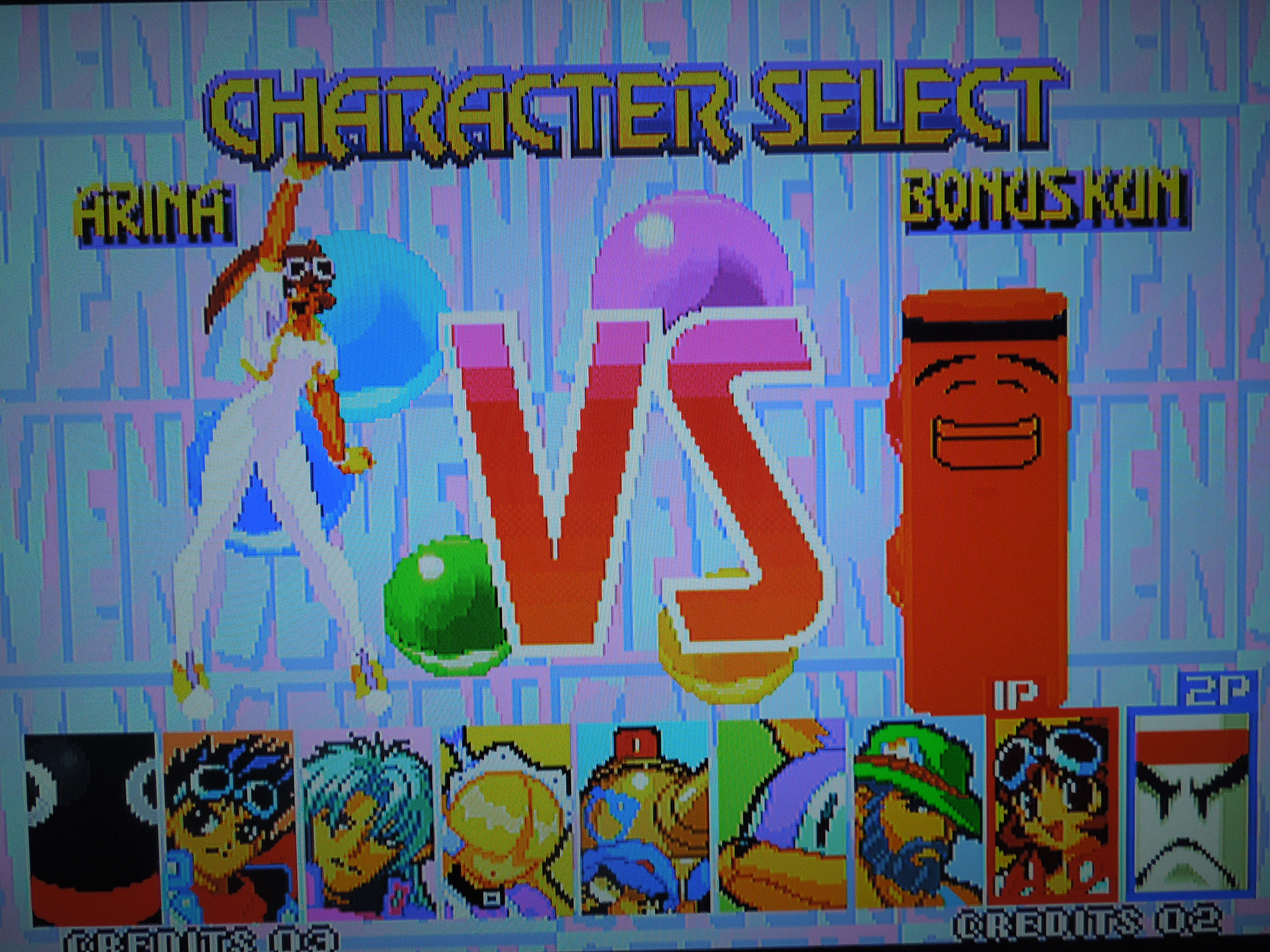
Characters:  Fernandez, Rai, Slash, Tesse, Politank-Z, Mauru, Dandy-J, Arina, and BonusKun – what struck me as incredible upon first playing this game was the overall bizarre nature of some of the 7 selectable characters (9 are selectable in 2P VS).  The fighters all have an extremely bright, anime-style look to them, and it works incredibly well.  Among the more ‘strange-looking’ characters are a punching-bag character (BonusKun), a giant rabbity-thing (Mauru), and a giant black ball/bat thing that reminded me of the Chomp character from Super Mario.  When you select your character, one great feature of this game is that it shows you the movelist of your fighter, including Specials.

Backgrounds:  The backgrounds of each character’s stage change from day to dusk to night throughout the 3 rounds, which is a nice touch.

Control: The control in this game, as far as executing Specials and Super Moves, is excellent.  I had no problem throwing projectiles, dragon-punches, and other moves.  The fluidity of the controls is spot on with the smoothness of the animation on screen, I might add.

Special moves are simple to execute and amazing to watch. Special moves are simple to execute and amazing to watch.

Music:  Fantastic.  Really, really amazing.  Of all the Neo Geo games I’ve played, this one has the best music by great lengths.  Each fighter’s stage has its own unique track, and many are upbeat to accompany the fast-paced, frantic nature of the fighting taking place.  An exception is the music in Tesse’s stage, which takes place in front of a giant manor; that track has a more slow-paced, somewhat-creepy vibe.  Arina’s stage is the best – an entire ‘super happy’ song is sung (in Japanese) throughout your 3 rounds; it’s really addictive, and stands out as the best single piece of music I’ve heard in any Neo Geo game.

Battles start in the day and transition to night between rounds. Battles start in the day and transition to night between rounds.

Moves: Each character has a wide-variety of moves at his or her disposal.  Mastering the ‘Doki Doki’ and ‘Harahara’ super moves is both easy and fun-to-watch; the moves of some of the characters in the game look as bizarre as the characters themselves!  Each character has a ‘charge bar’ at the bottom of the screen that slowly fills up as you fight (or you can select to ‘auto’ charge it from the Options).  You’ll have no trouble putting together combos quickly and mastering a character, which is one thing I really enjoy about this particular fighter.

Bizarre characters execute beyond-bizarre moves in Waku Waku 7. Bizarre characters execute beyond-bizarre moves in Waku Waku 7.

Difficulty:  The 4 selectable difficulty Options is great.  Unlike other Neo Geo fighters I’ve played, I really liked that on this one, ‘Easy’ was just that – quite easy.  I beat the game on my first try without losing a credit without even really knowing what I was doing.  ‘Normal’ presented a decent step up, though.  I made it through a couple of fights before getting owned by the little-person in a ‘police-tank’ (Politank-Z, another bizarre fighter).  Learning a character’s movelist becomes a must if you want to continue on fighting in anything tougher than ‘Easy.’

Each character has his or her own ending, and not all of them are 'happy.' Each character has his or her own ending, and not all of them are ‘happy.’

Conclusion:  Waku Waku 7 is one of the best Neo Geo games I’ve ever played, and I’m admittedly not a fan of this genre of video games (1-on-1 fighters).  This one, however, has the perfect combination of things I personally like:  outstanding animation, wonderful music, easy-to-learn controls, a difficulty I can work with, and not-too-many selectable fighters!  It’s kind of nice only having 7 to choose from and not an overwhelming number of selections – It forces you to learn one or two characters that you prefer instead of asking ‘Who haven’t I tried yet?’ again and again.  It is obvious that the people at Sunsoft went more for quality over quantity here with regards to the number of characters.

The Southern Gentleman’s Opinion and Letter Grade:  Maybe the best-kept secret on the Neo Geo.  A++

God Bless! Proverbs 3:6


Neo Geo – Ghost Lop

Ghost Lop for the Neo Geo AES Ghost Lop for the Neo Geo AES

Note 1:  Like Neo Geo games?  Check out some of my other reviews!

Note 2:  This game was played on a Neo Geo AES home console that has been modified to output in component video (green, blue, red).  The Neo Geo AES was connected to a 32-inch HD tv.

Ghost Lop never received an official release. Ghost Lop never received an official release.

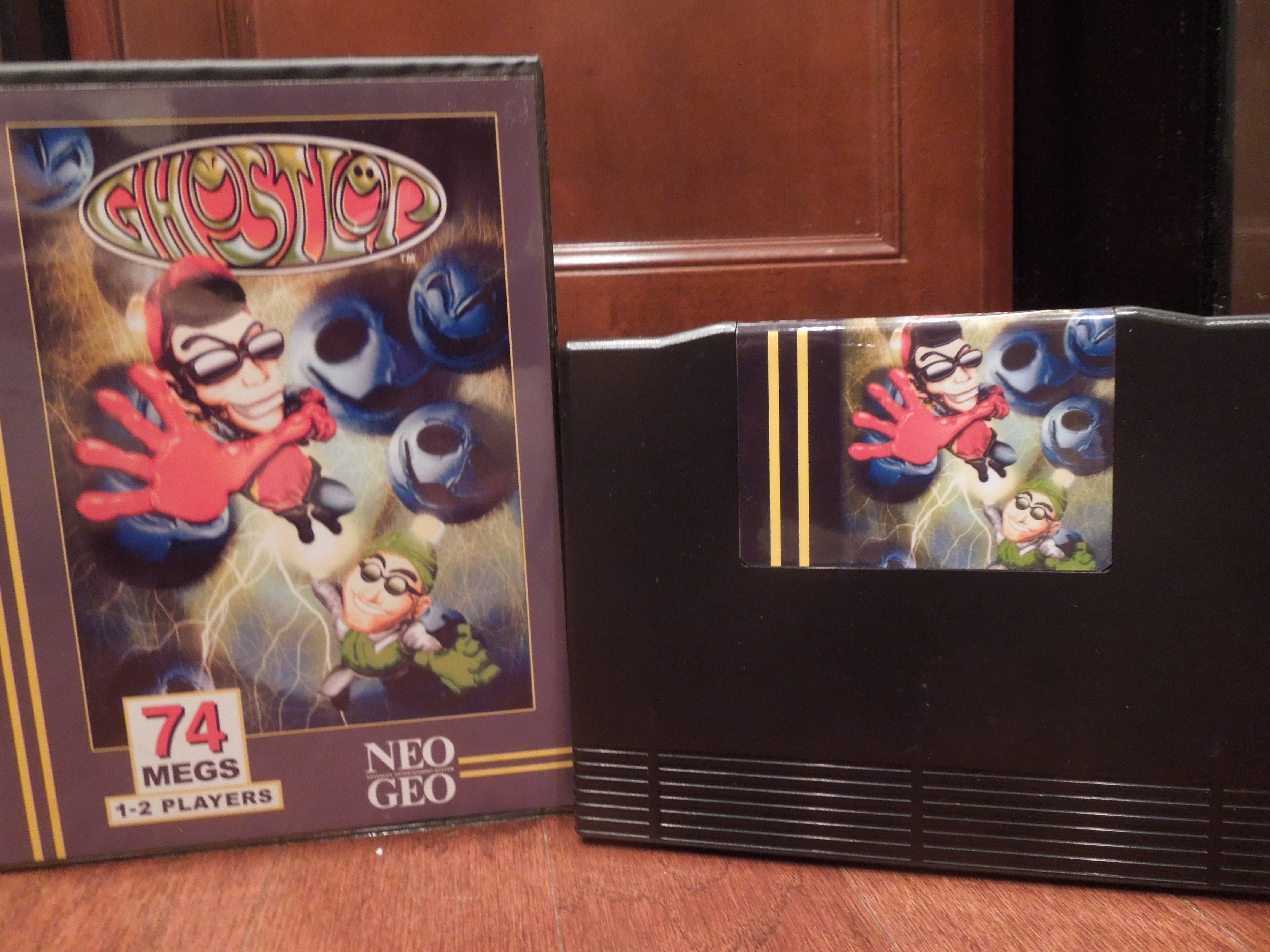
Quick History:  Ghost Lop was developed by Data East, yet was never officially released for the Neo Geo, neither the AES home console nor the MVS arcade cabinet cartridge.  There were, however, arcade prototype cartridges issued, and the game was actually a ‘complete’ game.  Because Ghost Lop was never officially released, and there were only ‘prototype’ cartridges, its history is quite complex, and if you’d like to read more about it, I advise Googling ‘The Real Story of Ghostlop by Billy Pitt.”  I tried posting a link but for some reason it won’t activate through my website.  The cartridge used for this review is an AES conversion cartridge using new eproms.

Genre: Puzzle-ish (but with a ‘branching’ story)

Players: 1 or 2, competitive

8 opponents await you in Ghost Lop. 8 opponents await you in Ghost Lop.

Memory Card Support?  Yes.  After you use your 4 Credits, or after you choose not to continue, you’ll have the option to Save your game, allowing you to return to the stage you were last on.

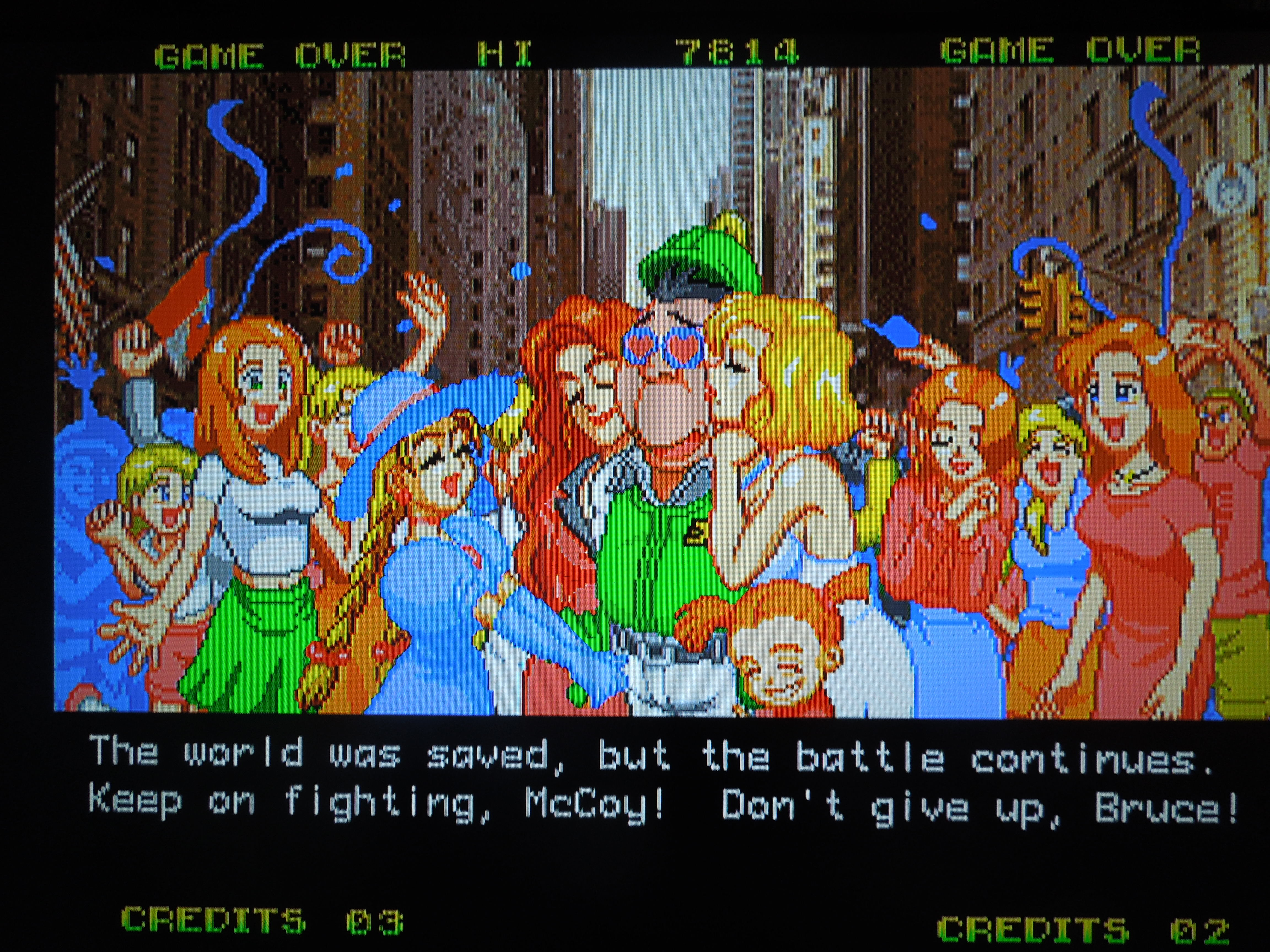
Story: Taken directly from the intro: “Bruce is a ghost hunter.  He works at a company that specializes in hunting and evicting ghosts.  He and his partner, McCoy, work hard every day under the supervision of Rachael, the demanding president.”  I noticed (lookswise) parallels between the game  characters and characters from the popular GhostBusters films.  Bruce has the look of Peter Venkman (tall and thin, brown hair), McCoy of Ray Stantz (a bit portly), and Rachael of Janine Meltinz (with the red hair, although in the game she’s the boss, not the secretary).

Options: You can adjust the difficulty from 1-8, and you can turn the timer (which runs from 99 seconds down to zero) on or off.

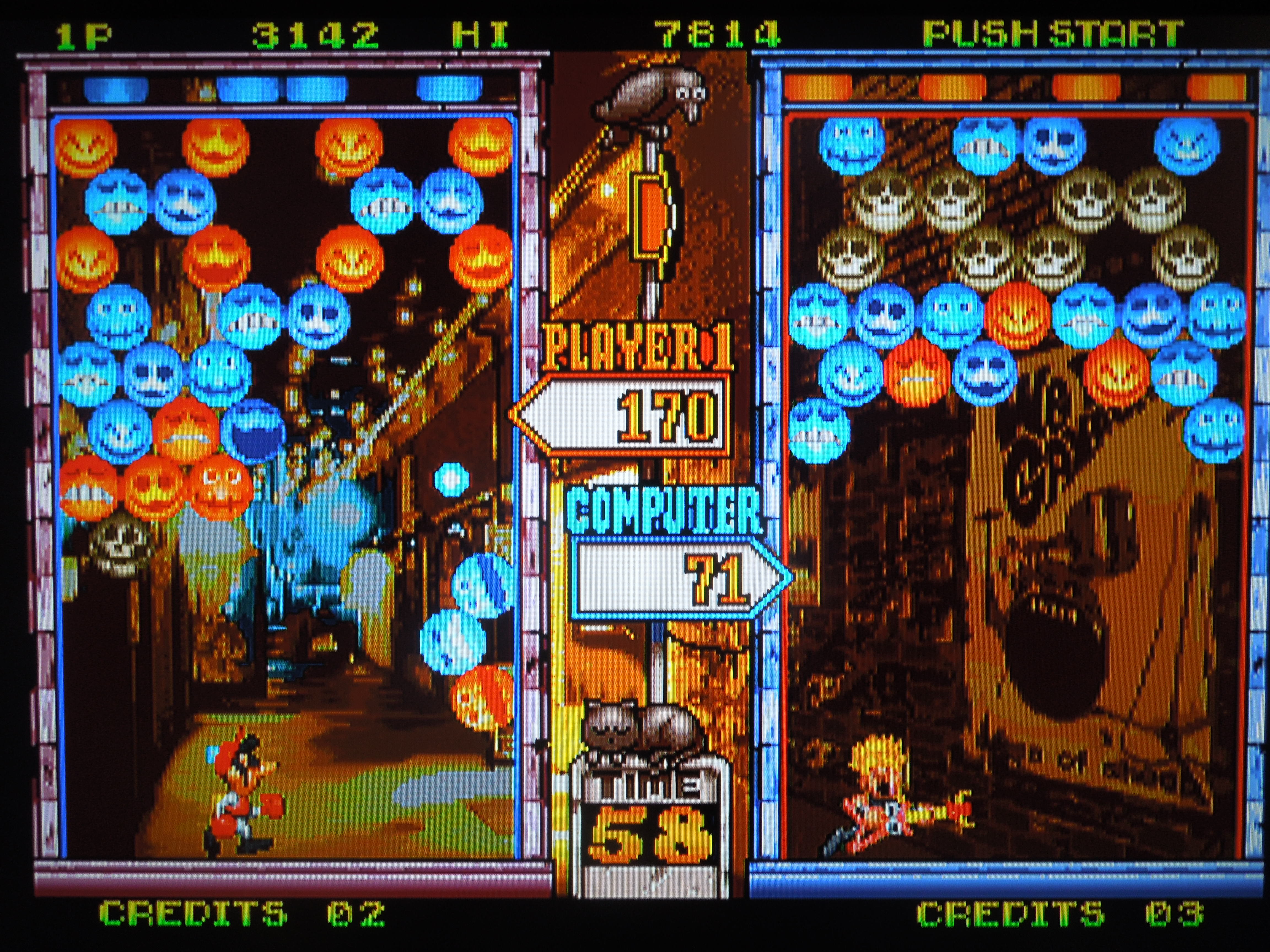
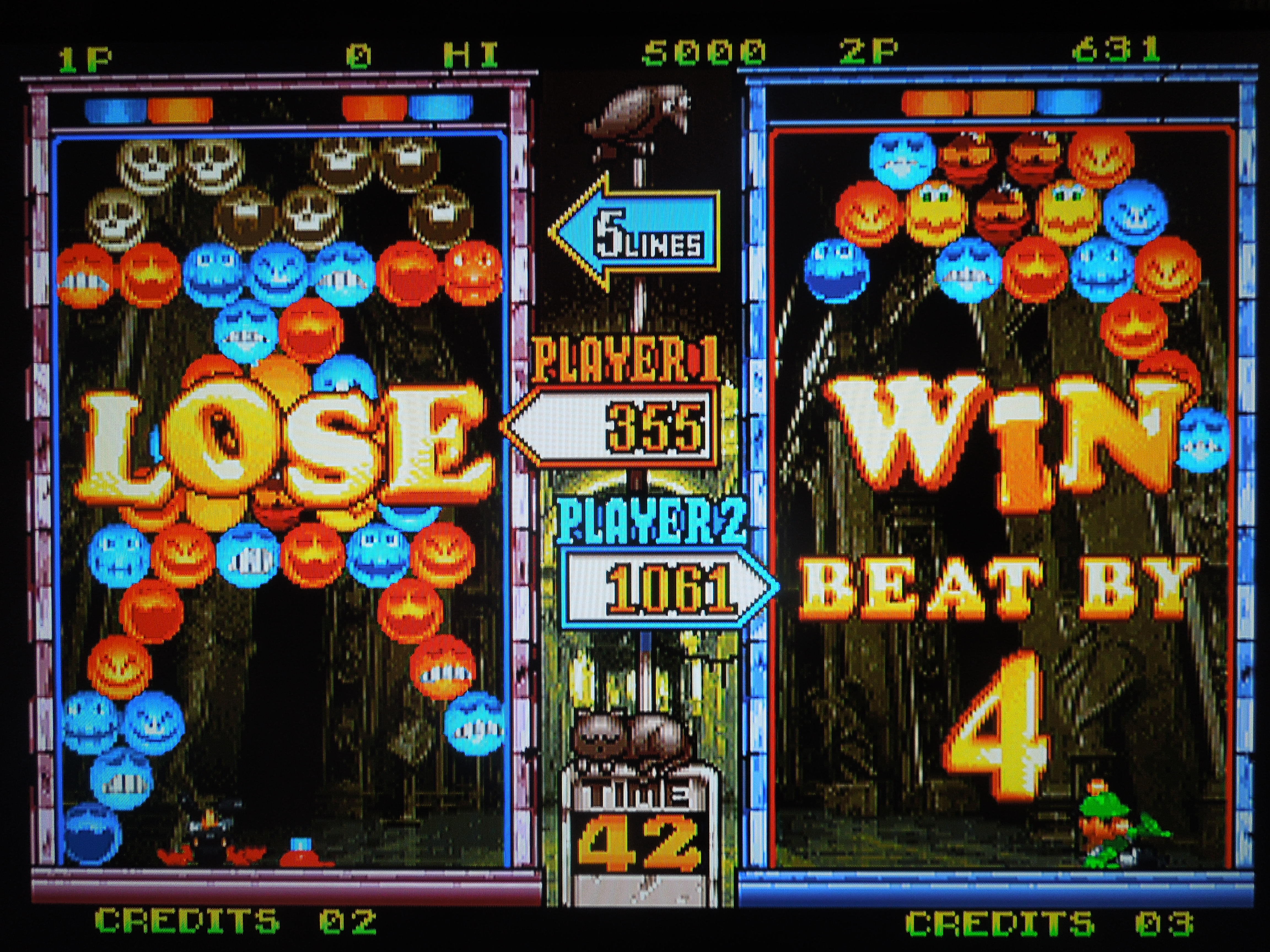
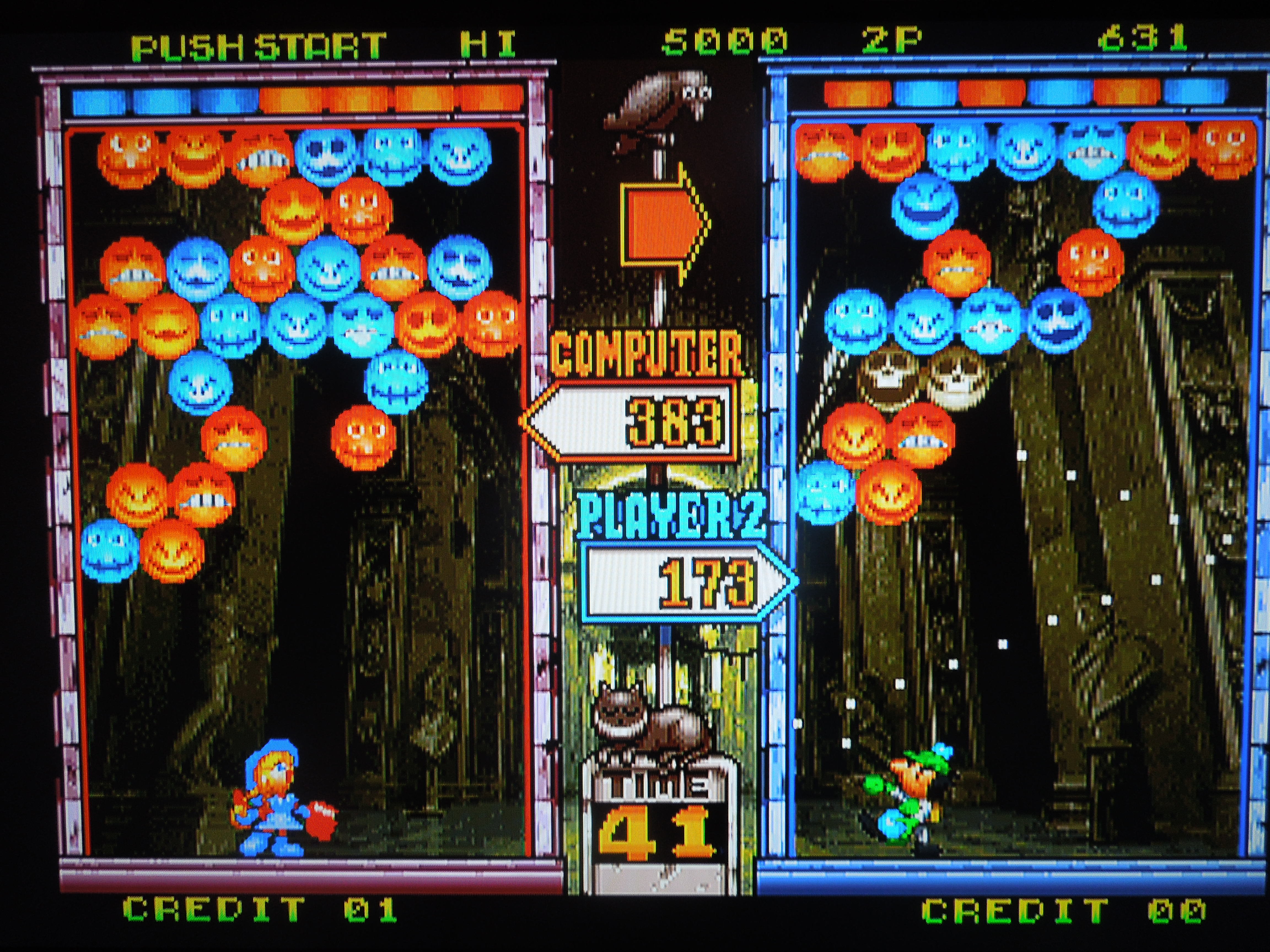
Gameplay: In Ghost Lop, you control either Bruce (if your controller is plugged into port 1) or McCoy (if your controller is plugged into port 2) and must engage in 8 ‘battles’ with other characters/monsters to beat the game.  Your goal, during each competitive battle, is to destroy more Red and Blue Ghosts than your opponent.  By destroying the Red and Blue Ghosts, you get particular point totals, and when the clock hits zero, whoever has the most points, wins.  If the clock has been turned off, then the first to 5,000 points wins.  Rounds can end early if the Red or Blue ghosts fill up you or your opponent’s half of the screen (overwhelm you).  Each battle is a Best of 3 Rounds fight.

Destroy more Ghosts than your opponent in order to win a Best of 3 Rounds battle. Destroy more Ghosts than your opponent in order to win a Best of 3 Rounds battle.

Control:  So, how do you fight the Red and Blue Ghosts in order to beat your opponents?  Button A throws a red ball that destroys Red Ghosts.  Button B throws a blue ball that destroys Blue Ghosts.  By holding the joystick right or left, you can move your character left or right, and once stationary, you can throw either colored ball (you can also change the color of your ball anytime during its flight by pressing the button for the other color) at the Ghosts.  While standing still, you can angle the ball to take out as many Ghosts as you can with a single throw – anytime your ball connects with a Ghost of the same color, that Ghost will disappear, as well as any beside it that are of the same color.  You have to catch the ball when it bounces back your way, however – if you miss and it hits the ground, then an entire line of ghosts will advance.  You can bank the ball off the walls to squeeze it into tight places and take out dozens of ghosts with a single throw – the more ghosts you destroy per throw, the higher your points go.  Additionally, for every ‘large amount’ of Ghosts you destroy on your half the screen, a line of Grey Skulls will appear on your opponent’s screen, making it harder for him or her to attack his or her own Ghosts.  *Note your opponent will do the same to you.  Select pauses the game.

Your score and rank are given after each opponent you beat. Your score and rank are given after each opponent you beat.

Other Ghosts:  In addition to Red and Blue Ghosts, there are 3 additional Ghosts that can appear on your screen.  Grey Skulls can be destroyed by striking them twice with either a blue or a red ball.  Dark Red Ghosts can be destroyed by striking them with either colored ball, and doing so causes them to explode and destroy any surrounding Ghosts.  Lastly, Yellow Ghosts can be struck with either a red or a blue ball, and this will destroy every Ghost on screen.

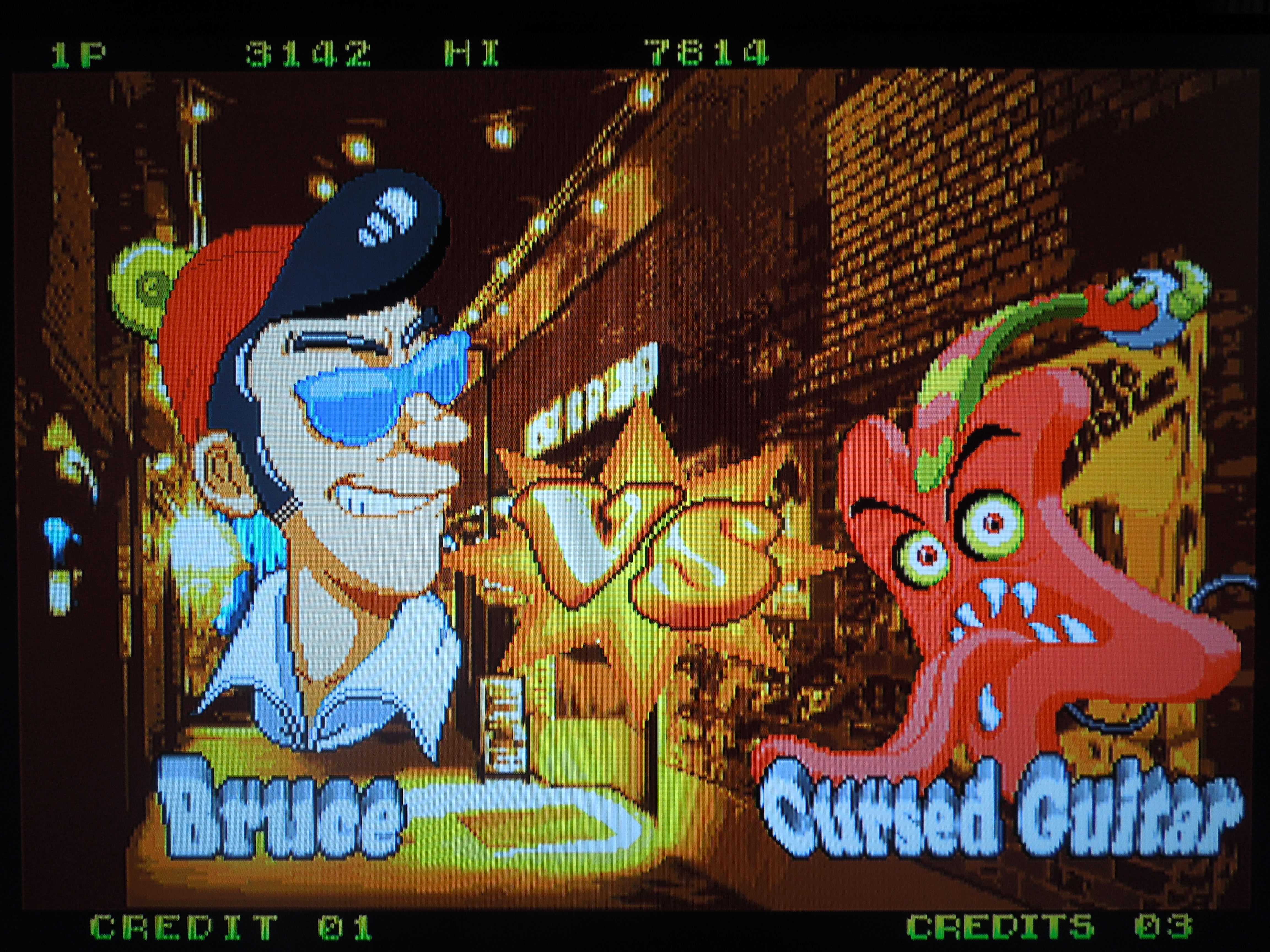
Choices/Branching Paths: After your first two opponents have been beaten, you’ll begin having choices about what to do next.  For example, Rachael (your boss) will tell you to go to Randy’s room to deal with the Ghost Under the Bed or to Jennifer’s House to fight the PolterGeist.  Later, LuLu the Exorcist will offer you a job – accept it and you’ll fight the Cursed Guitar; deny her and you’ll fight the Amusement Park Horse.  To some degree, the choices you make impact the next set of choices you’ll get, leading to multiple branching paths each time you play the game.  Regardless of your path, you’ll always have to face 8 opponents, ending with the Great King of Terror.

The people of the city are in need of your ghost hunting expertise. The people of the city are in need of your ghost hunting expertise.

Music and Sound Effects: There are different songs for each opponent you face, and each character/monster has his or her own speech/sound effects, adding variety to the game.  The Red and Blue Ghosts cackle when you make a mistake, adding a creepy humor.  Additionally, each opponent has a different background screen that is appropriate for where your fight takes place.

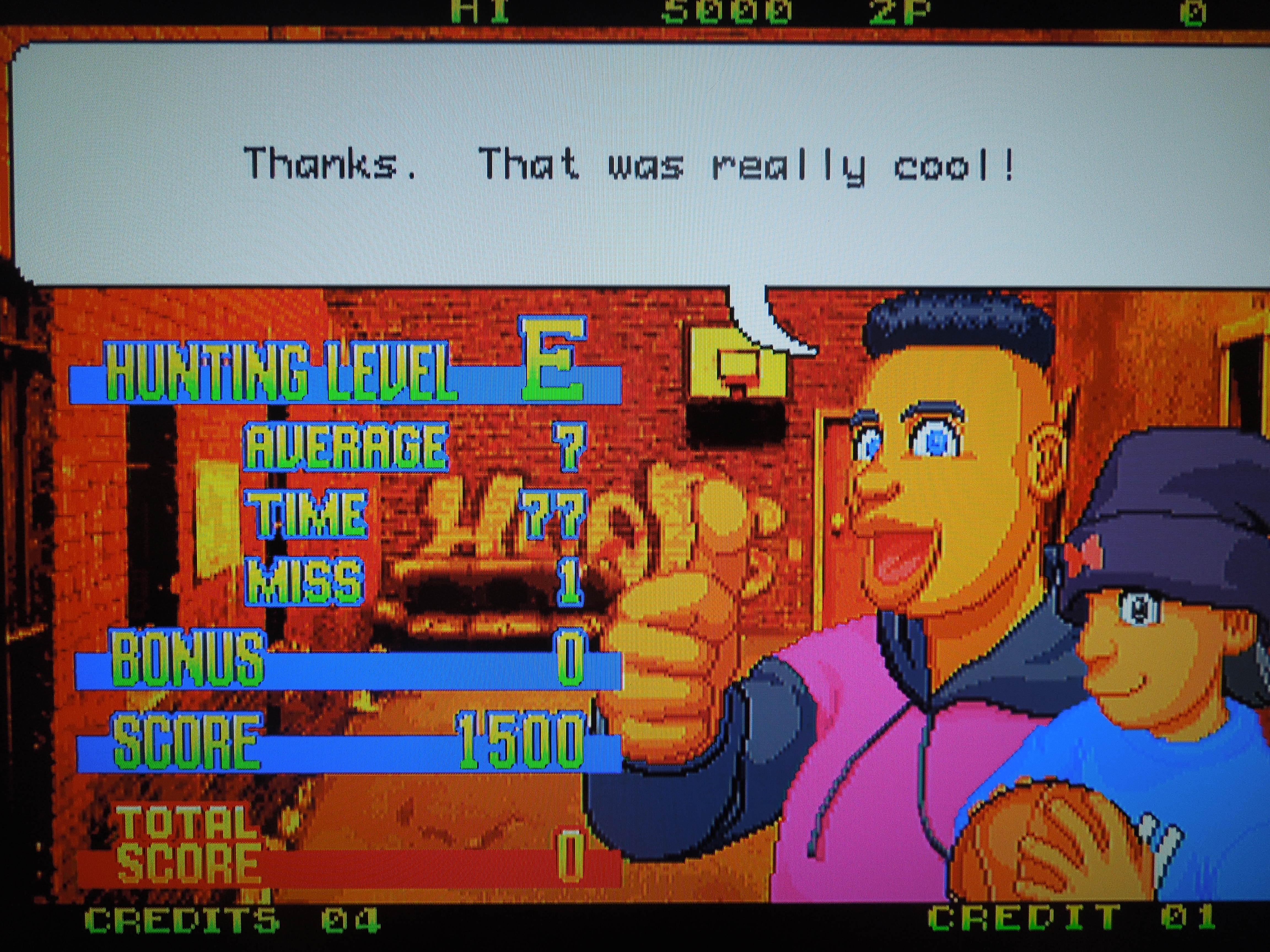
High Score: Your score is given after each opponent you beat in the Best of 3 Rounds battles.  Based on how quickly you dispatched your Red and Blue Ghosts (and therefore your opponent), you’ll get a particular ‘Hunting Level’ (Rank) from A-F, and points for Average (?), Miss (how many times you didn’t catch your ball, I suppose), and Time.  Your score resets after every Credit you use.

Multiple Endings: I’ve discovered at least 2 different endings, although I believe there may be more.  The two different ones I got seem to have been based on the choices I made during the game, and since there are multiple choices you make that could be different, I would guess there are more than two endings.  In one ending my character got a brand new sports card as a reward for his hard work, and in another all of the female characters from the game were fawning over my character for his bravery.

Endings vary based on what choices you make during the game. Endings vary based on what choices you make during the game.

2 Player VS: When you compete against another human player, one of you controls Bruce and the other, McCoy.  The game keeps track of how many consecutive wins one of you may obtain.

2 Player VS. is great fun. 2 Player VS. is great fun.

Conclusion: Ghost Lop is a terrific game.  It will take a while to figure out how to best dispatch of your Ghosts efficiently, but once you do, the game becomes maddingly addictive.  It’s also great that you can adjust the difficulty level from 1-8 and adjust the clock on or off.  I will say that even on Level 1 (Easiest), the game’s second opponent, Friday the Ghost Dog at the Pet Cemetery, is the hardest opponent in the game – get by him, and you’ll be good to go.  The addition of choices and branching paths means you can’t see or fight all of the game’s opponents on your first or even second playthrough, adding replayability.  Multiple endings is always great too, of course.

The Southern Gentleman’s Opinion and Letter Grade: Interesting, challenging (but not too much) puzzle game with a Ghostbuster-themed story and great control? Winner.  A

God Bless! Proverbs 3:6

Neo Geo – Shock Troopers

Note 1:  Like Neo Geo games?  Check out some of my other reviews!

Note 2:  This game was played on a Neo Geo AES home console that has been modified to output in component video (green, blue, red).  The Neo Geo AES was connected to a 32-inch HD tv.

Quick History: Shock Troopers was released for the Neo Geo MVS (arcade cabinet) in 1997.  The game never received a release for the Neo Geo AES, the home console version of the arcade cabinet (there was no difference in the actual games, only the size of the cartridges).  Today, however, Shock Troopers is one of the more popular MVS candidates to receive a conversion – taking the arcade boards from an MVS cartridge and placing them into an AES cartridge.  The Shock Troopers used in this review is an AES conversion.

Shock Troopers is an AES conversion. Shock Troopers is an AES conversion.

Different versions of the same game? Two different versions of Shock Troopers exist, and from the little I’ve been able to read about the subject, they are known as Versions A and B.  Version A does not start your character(s) with a full life bar (although the life bar takes longer to deplete than in Version B), has a Star Rating System that awards extra health at the beginning of each stage and impacts how quickly your character can move for a particular stage, and it requires all 3 characters in Team Mode to share the same life bar.  Version B starts your character with a full life bar (although the life bar depletes more rapidly than the ‘mostly’ full life bar in Version A), the Star Rating System is not present (so you’ll never be able to gain bonus health at the start of levels, although your character does still seem to retain the ability to move somewhat faster, inexplicably), and all 3 characters in Team Mode have separate life bars.  The version used for this review is Version B.  Having played Version A of Shock Troopers on my Neo Geo X handheld, I very much prefer Version B.  Version B feels easier to me because of the separate life bars of each of your characters in Team Mode – this gives more of a reason to switch characters as you find health pickups – you are able to stay alive longer by giving food only to your soldier who needs it.

Cutscenes tell the story between stages. Cutscenes tell the story between stages.

Players: 1 or 2, co-op

Memory Card Support?  No.  Shock Troopers is one of the few Neo Geo games that does not use the memory card in any capacity.  Therefore, beating the game requires a straight playthrough.

Credits:  You are given exactly 4 Credits to beat the game.

Difficulty selection?  Choose between Easy, Normal, Hard, and MVS (arcade difficulty between Normal and Hard)

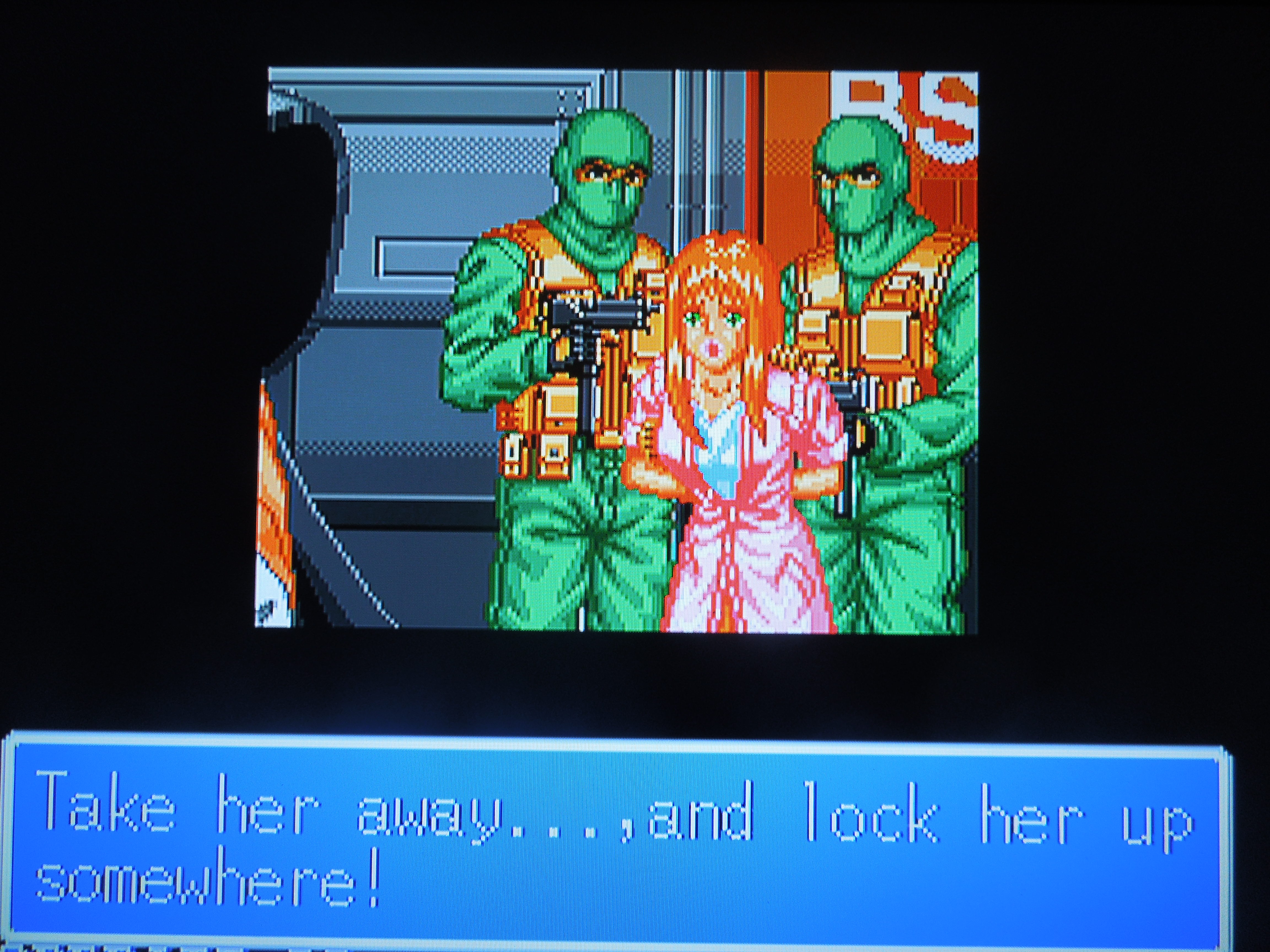
Story: A terrorist group known as the Bloody Scorpion Group (BSG) have kidnapped a scientist, Dr. George, who has discovered how to create a ‘personality-altering’ drug, a301, that the terrorist group’s leader believes can help him create super-soldiers.  Additionally, the Terrorist Leader has kidnapped Dr. George’s granddaughter, Cecilia, and is threatening to kill her if the good Dr. George doesn’t cooperate and start producing large amounts of a301 to help the Terrorist Leader achieve his goal of world domination.  Cecilia’s boyfriend, Jackal, and the other Shock Troopers are sent in on a mission called ‘Operation Delta Storm’ to eradicate the Bloody Scorpion Group, kill the Terrorist Leader, and rescue Dr. George and Cecilia.

The Bloody Scorpion Group must be eradicated. The Bloody Scorpion Group must be eradicated.

Characters: Choose between 8 characters of varying strength, defense and speed – 5 males and 3 females:  Jackal, Milky, Loki, Rio, Southern Cross, Marie Bee, Maru, and Big Mama.  Big Mama and Southern Cross move slowly but can take more damage before dying; Milky and Marie Bee move very quickly but are killed more easily; some of the other characters have a balance of speed, defense, and regular fire power.  Additionally, each character has a different ‘special’ attack (grenade, rocket launcher, etc.) in limited supply and of varying strength.

Each character handles a bit differently with regards to speed, power, and defense. Each character handles a bit differently with regards to speed, power, and defense.

Modes: There are 2 ways to play Shock Troopers.  ‘Lonely Wolf’ allows you to select 1 of the 8 characters and battle your way through the 7 stages of the game.  For each of your 4 Credits in Lonely Wolf, you’ll get three lives for your chosen character.  The other option is ‘Team Mode,’ where you’ll select 3 of the 8 characters, and can switch among the 3 at any time.  For each Credit in Team Mode, all 3 characters must die before it’s Game Over and you have to continue.  Another difference between the two modes is in Lonely Wolf you receive a larger stock of your ‘special’ weapon for each life of your character.  Rio, for example, in Lonely Wolf, will have 15 exploding arrows for each of his 3 lives on 1 Credit; however, when Rio is selected as part of a 3-person group in Team Mode, he will only have 10 exploding arrows (his team members also have a reduced number of specials).  This discrepancy brings balance between the two modes, making it a matter of strategy which one you choose – more firepower or the chance to sustain the lives of my characters longer by switching among them?

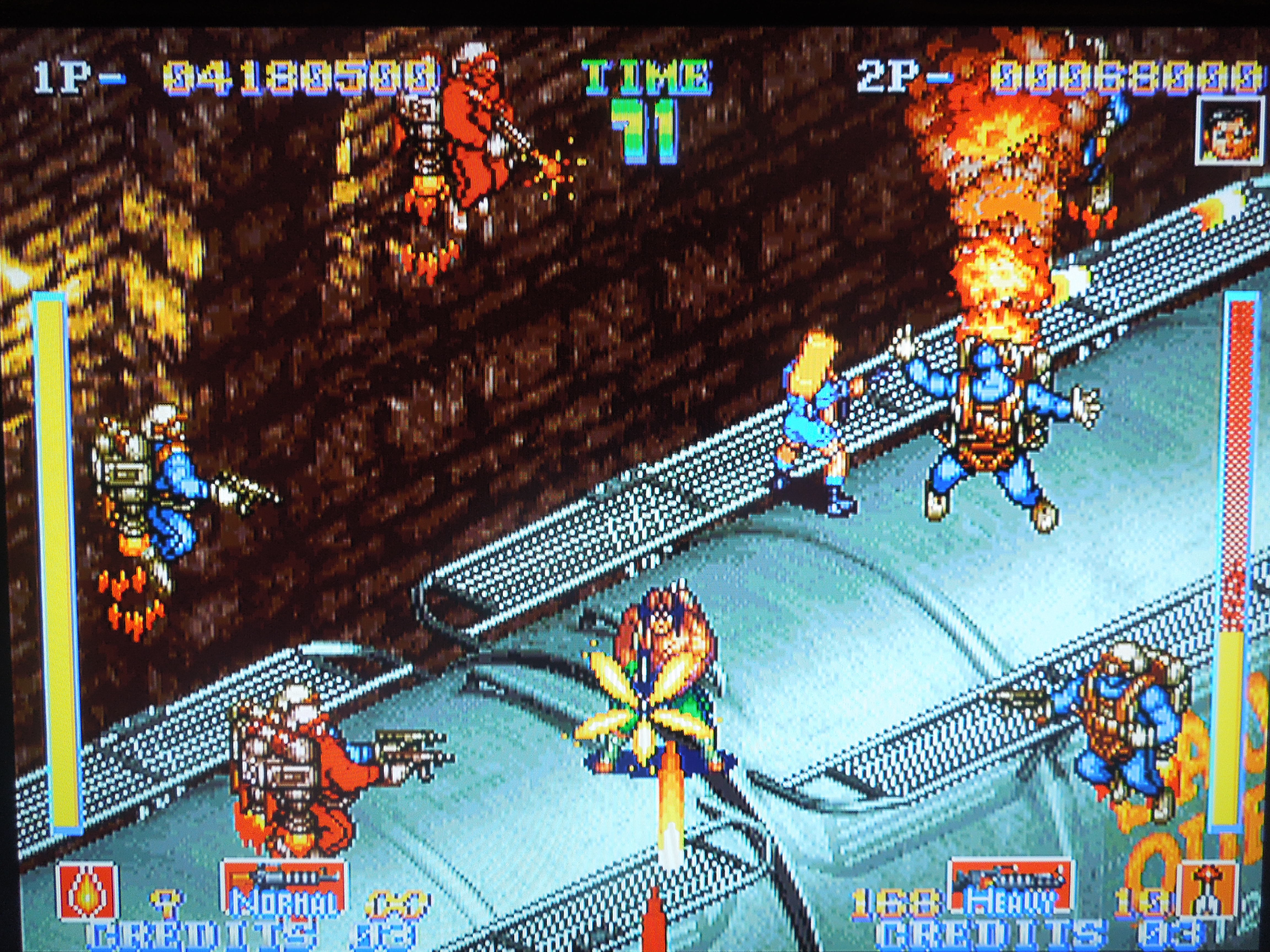
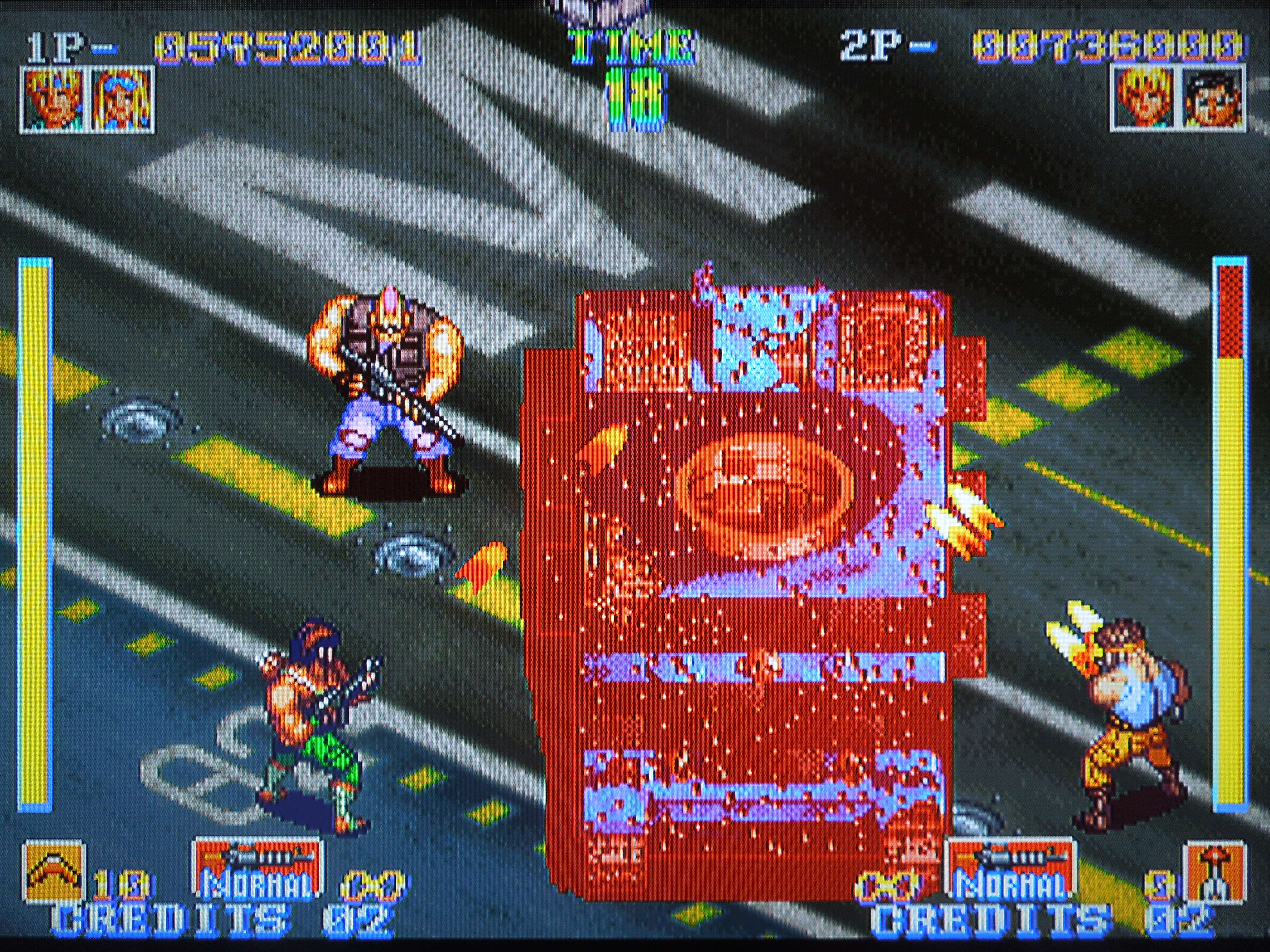
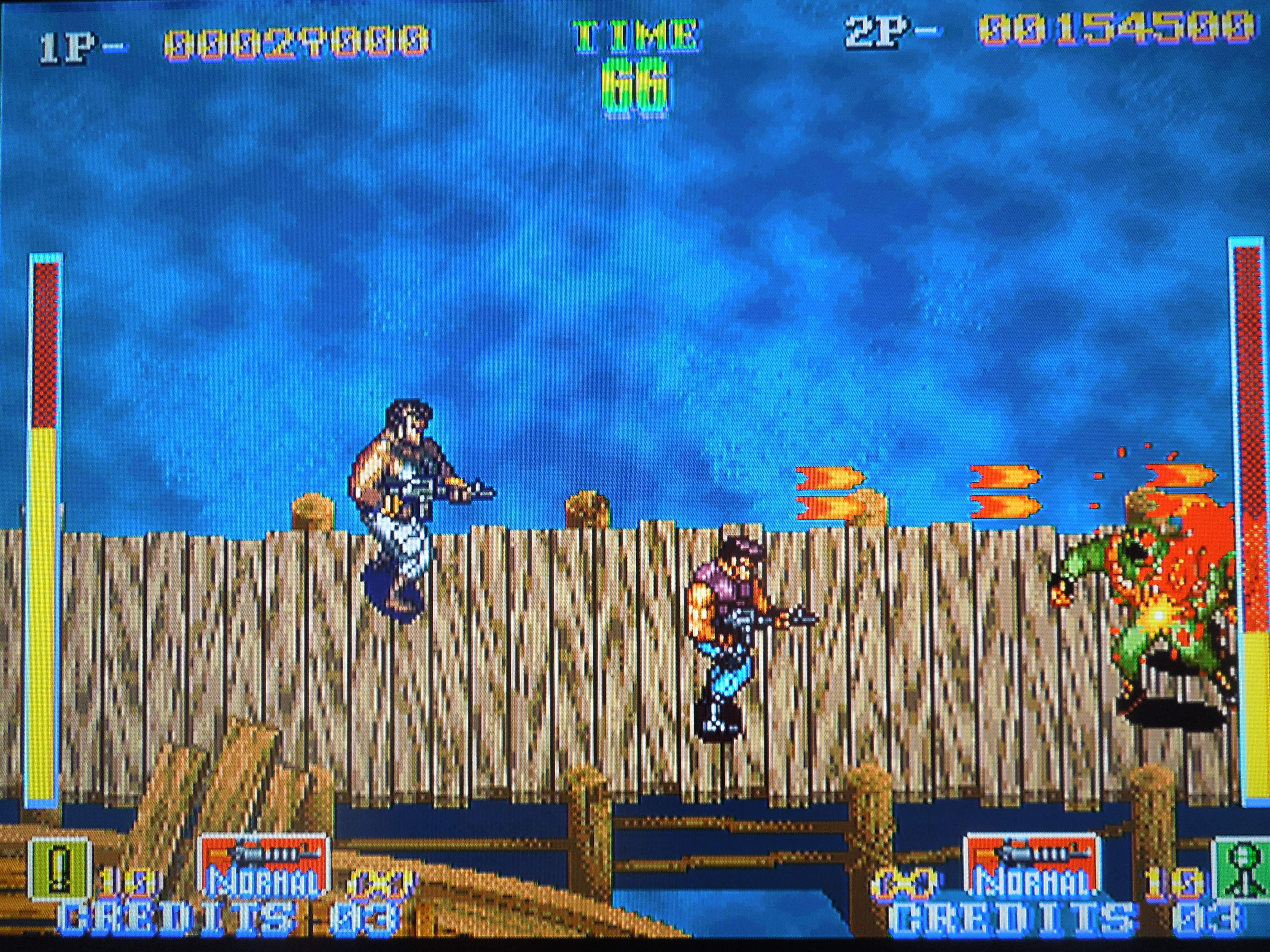
Gameplay: Shock Troopers is a top-down ‘Run and Gun’ shooterButton A shoots.  Holding it down allows you to maintain a constant stream of bullets.  You can shoot in 8 directions, and while pointing your character in a specific direction and holding A, you still have the ability to move around while firing, which is a great control scheme.  Button B ‘rolls’ your character, and this allows you a temporary period of invincibility as you dodge bullets; rolling is absolutely crucial to mastering the game.  Button C unleashes your special attack (grenades, rocket launcher, etc.).  Button D (in Team Mode) switches among your 3 characters.

Bosses often require a ton of firepower to bring down. Bosses often require a ton of firepower to bring down.

Stage Choices:  At the beginning of the game, you can choose amongst 3 different ‘paths’ to get you to the Terrorist Leader of the Bloody Scorpion Group: Mountain, Jungle, or Valley path.  After Stage 3 of each path, you’ll have the option to change routes and select one of the other two paths.  No matter which path you choose, or regardless of if you stick to it or not, you’ll always play a total of 7 Stages.  It’s great to have the selection, and it adds replay value to the game.

Pick-Ups: As you gun down the soldiers and vehicles of the BSG, you’ll pick up various weapon items that strengthen your normal gun’s firepower.  My favorite is the interestingly named ‘3-way’ that is basically a spread gun.  You’ll only have a limited stock of each weapon pickup, but you’ll constantly find more scattered across each stage.  You’ll also find special pick-ups labeled ‘Bomb’ that increase the number of specials you can use.  Occasionally, blowing up buildings or shooting crates reveal steaks or bananas or other foods that increase your health bar by varying amounts.  Another way to keep your character(s)’ health up is to go for a ‘melee’ kill on the soldiers you encounter – if you kill them at close range (your character will automatically pull a knife or use his or her fist) instead of using your gun, they’ll often drop a ‘Life Up’ icon that increases your health bar a bit.  They may also (and more frequently) drop a Blue Diamond bonus points pick-up when killed this way.  Sometimes they’ll even drop a Red Diamond that kills everything on the screen or a Yellow Diamond that makes you temporarily invincible.

DSCN9217

Stage Layouts and Bosses: Most stages have you walking through them blasting everything in site, but variations on stage layouts include: a scene riding motorcycles (while shooting bad guys), a scene climbing a sheer rock face (without a rope?!! oh, and while shooting bad guys) and hitching a ride on a train (while shooting bad guys), among many others.  At the end of every stage is a Boss.  Typically the boss is huge and mechanical, like a Helicopter or a massive Tank.  Sometimes, however, the boss is a regular human (albeit who takes a ton of shots to kill), or you’ll have to fight the human boss after you destroy the mechanical boss.  Stage 7 and the final fight against the Terrorist Leader is a strictly human-on-human boss fight.

DSCN9205

Japanese voices? When you beat a stage, your character(s) typically does a pose and says something in Japanese (this seems to be regardless of the regional ‘setting’ of your Neo Geo).  Oh, and while I’m at it, there is no blood on the European Console mode, but there is a ton of it on the USA and Japanese Neo Geo consoles.  All text is in English (albeit with spelling errors occasionally, as is typical with Neo Geo games).

DSCN9228

High Score?  If you’re going for a high score in this game, then going for the melee kills on soldiers is the way to go, as collecting the Blue Diamonds they drop when killed that way will boost your score quickly.  I enjoy playing the game while allowing myself only 1 Credit on the MVS difficulty and recording my high score (the old notebook method since you can’t actually save your score).  You can, of course, also try to set a high score by allowing yourself use of all 4 Credits because your score rolls over (doesn’t reset to zero) if you choose to continue.  My current high score is just over 5 million points using Rio in Lonely Wolf Mode, MVS Difficulty, 1 Credit only.

Different character endings? While the core ending is the same, using different characters allows you to see a specific ‘What are they doing now that they’ve saved the world?’ screen for the character(s) you used.

Other platforms? That I know of, Shock Troopers was released for the Neo Geo X, Wii Virtual Console, and on a compilation disc for multiple systems in the past few years.

Each character has a unique Each character has a unique “Where are they now?” ending.

Conclusion: Shock Troopers is absolutely one of the best games I’ve played on the Neo Geo.  The control, the character selection, the alternate paths, the sound and music (which are both excellent), the hilarious cutscenes that advance the story between stages), the co-op mode – all combine for a terrific Run and Gun with loads of replayability.  Negative aspects?  I suppose the lack of memory card support hurts the game somewhat, although a straight playthrough can be done in around half an hour, give or take.  As with many Neo Geo AES games I enjoy the 4 Credit limit, as this forces you to learn how to master the game if you want to make it to the end.

The Southern Gentleman’s Opinion and Letter Grade: Outstanding, A++

God Bless! Proverbs 3:6


Neo Geo – Baseball Stars 2

Baseball Stars 2 for the Neo Geo AES Baseball Stars 2 for the Neo Geo AES


Note 1:  Like Neo Geo games?  Check out some of my other reviews!

Note 2:  This game was played on a Neo Geo AES home console that has been modified to output in component video (green, blue, red).  The Neo Geo AES was connected to a 32-inch HD tv.

Players: 1 or 2 Players

Memory Card Support?  Yes.  In Pennant Race Mode, the game auto-saves your progress after every half-inning if you have a memory card inserted.

Extra Innings and 10-run rule?  Yes – I’ve gotten as high as 19 innings before a tie was broken, and if you get ahead (or behind) by 10 runs, the game ends, even if you’re in the 2nd inning!

Very Quick History: Baseball Stars 2 was released for the Neo Geo AES home console and MVS (arcade cabinet) in 1992.  It is the sequel to 1990’s Baseball Stars Professional.

Modes:  Baseball Stars 2 has two modes of play:  Pennant Race (1 Player) and VS. (2 Players).  In VS., each player selects a different team from among 12 total teams and go head-to-head in a 1-off game to determine a winner.  While the VS. mode is great fun for 2 Players, the Pennant Race is where the game truly shines.

While not everyone is familiar with the Neo Geo, Baseball Stars 2 was a more common game for the system. While not everyone is familiar with the Neo Geo, Baseball Stars 2 was a more common game for the system.

Pennant Race:  First of all, you need a memory card to really enjoy the Pennant Race (Season Mode).  To begin, you select between 2 Leagues (Divisions), the Fighting League and the Exciting League.  Each team is comprised of 6 teams, and each team has its own particular strengths.  Here is a list of the teams below, along with their strengths:

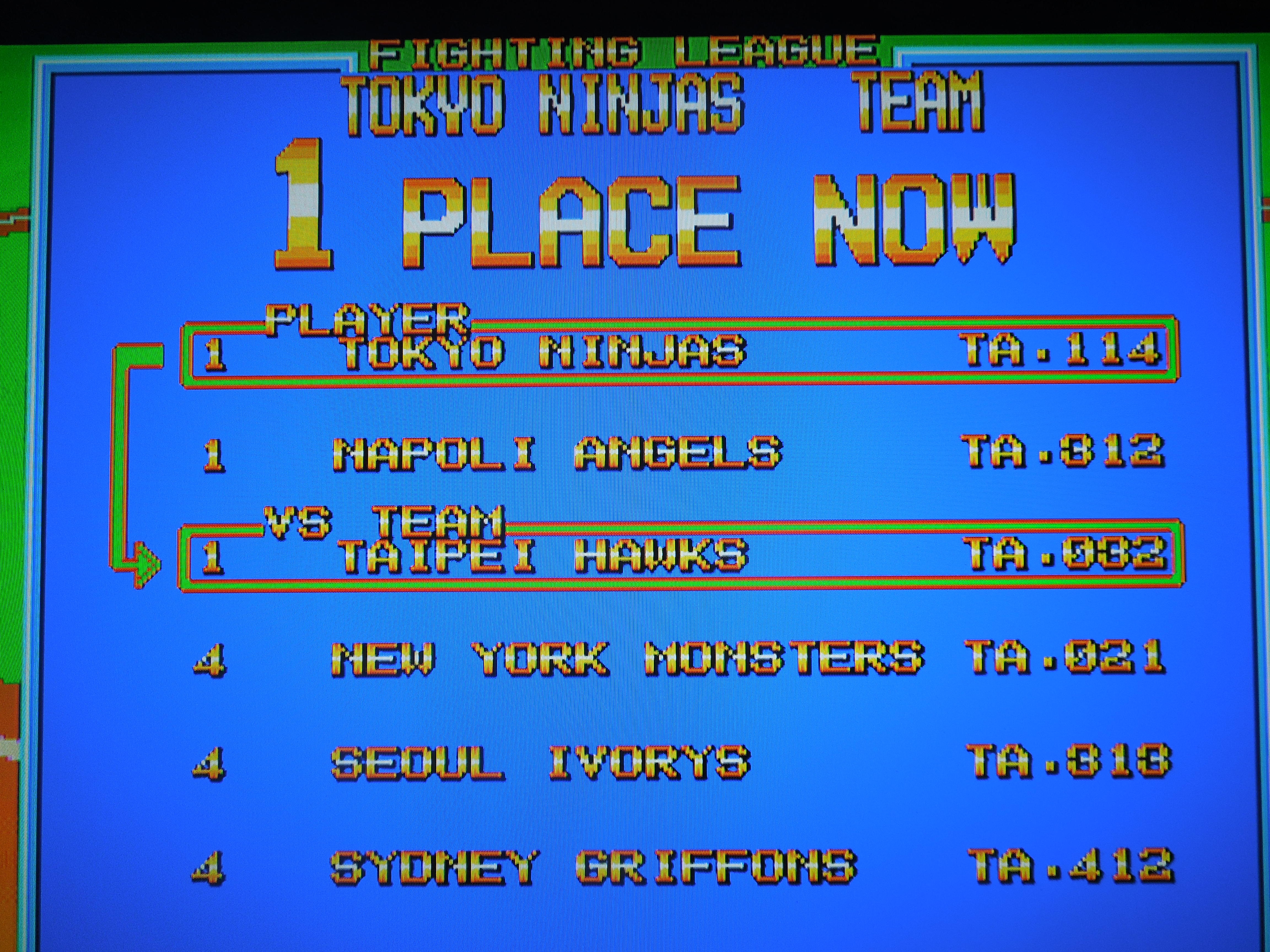
Fighting League: New York Monsters (batting), Toyko Ninjas (fast runners), Napoli Angels (balanced), Taipei Hawks (pitching), Seoul Ivorys (unexpected), Sydney Griffins (defense)

Exciting League: USA Bisons (batting), Japan Samurais (fast runners) Italian Waves (balanced), Taiwan Dragons (pitching), Korean RedVipers (unexpected), Aussie Thunders(defense)

Each team has different strengths. Each team has different strengths.

Choosing the Fighting League is labeled as ‘Easy’ and choosing the Exciting League is labeled as ‘Hard.’  This is because the fielding of the Fighting League teams is ‘automatic,’ and the fielding of the Exciting League teams is ‘manual.’  Essentially, what this means is, for example, when a pop fly or ground ball is hit by the computer in your fielder’s vicinity, if you are using a Fighting League team, the fielder will automatically be put in position (without you having to do anything) to catch or stop the ball.  However, if you have an Exciting League team, you’ll have to make sure you move the player into position yourself to catch or stop the ball.  Having played with teams in both Leagues equally, however, I would say there is not much of a difference between the fielding of ‘automatic’ and ‘manual.’  Even in automatic, you’ll still sometimes need to put your player in position to stop or catch a ball, and in manual, sometimes you’ll still automatically be placed in position to stop a ball.  The bottom line is, don’t be daunted by the ‘Manual’ Exciting League, it’s not much different from the Fighting League.

League (Division) Standings are displayed after every game in the Pennant Race. League (Division) Standings are displayed after every game in the Pennant Race.

After you pick a League, you select which team you want to play as from that League, then play a 15-game season against the other teams from your League (you’ll play each team 5 times).  After each game, win or lose, you’ll be shown the League (Division) Standings, and you can see what place you’re in.  The object of the Season, of course, is to place first in your League (have the best record) at the end of the 15-game season.  If you finish 1st, you’ll move on to a 16th game, the World Championship Game, against the League (Division) winner of the other League.  Win it, and you’ll be World Champion and have beaten the game!  Recently, I played through the game with the Italian Waves; I went 11-4 in the regular season, won my Division, and played the USA Bisons in the Championship game, and narrowly escaped with an 12-11 victory.

Every team has a bopper or two...or five. Every team has a bopper or two…or five.

The importance of winning your 15 regular season games: If you win a regular season game, the ‘Owner’ of your team will bestow upon you 10 ‘Power Bats’ – large baseball bats that you can assign at any time to your batters that are frequently used (but not guaranteed) for bashing homeruns.  If you don’t win a regular season game, however, you get NO Power Bats, and winning can be much tougher.

Power Bats can be used at opportune times to give you the advantage. Power Bats can be used at opportune times to give you the advantage.

Pitchers: You have 4 pitchers at your disposal for each game, and you can take out a tired one and put in a fresh one at any time.  Pitchers’ strength and stamina lasts for an average of 2-3 innings, and it is very important that you save a fresh pitcher for the bottom of the 9th inning so the computer can’t rally (*you always bat first and the computer always bats second, in every single game and the Championship game).

Help from the Owner:  After season games, and sometimes even during games, the owner will assign a special batter or pitcher to your team to help you win – the pitcher might have a better-than-average stamina or the batter might be capable of hitting homeruns easily.

Excellent graphics and gameplay are obvious in Baseball Stars 2. Excellent graphics and gameplay are obvious in Baseball Stars 2.

Conclusion: Baseball Stars 2 is a wonderful baseball game – the Pennant Race/Season mode is really, really fun.  The graphics of the game are spectacular.  The ball players are larger-than-life and colorful, and of particular note are the ‘close-ups’ that occur on close plays.  For example, when there is a close play at first, the game will show a cut-away of the player narrowly being ‘safe’ or ‘out’ at the bag; if you have to make a diving catch, a graphic of a player diving will be displayed, or if you hit a particular batter with the ball, he will rush the mound and punch your pitcher in the jaw, complete with an action graphic.  Zoom-in effects sometimes happen with foul balls, where the ball will come spinning back towards your tv screen, and this is one of my small personal favorite aspects of the game.  There are numerous voice-overs for the game, and they all add to the excitement: “It’s outta here – a HOME-RUUUUUN!”  “The Italian Waves scored this inning!” “He needs relief!”  The music is upbeat and catchy.  The difficulty of the computer can vary from Normal to Very Hard, but learning how to manage your pitching rotation, knowing when to use Power Bats, and learning the nuances of fielding (after a few practice games) can increase your chances of winning.
The Southern Gentleman’s Opinion and Letter Grade:  A must-have for any Neo Geo AES owner, A+

God Bless! Proverbs 3:6