I’m Kid Dracula for the NES I’m Kid Dracula was originally only available for the Famicom in Japan.
Note 1: Want more Kid Dracula? Check out my review of the Game Boy sequel, Kid Dracula!
Note 2: This game was played on an NES 101 model (toploader) that was modified to output in AV composite (red, yellow, white) just like the original NES. It was connected to a 32-inch HD tv.
Quick History: Akumajō Special: Boku Dracula-kun (translated: Demon Castle Special: I’m Kid Dracula) was released for the Famicom (Japanese NES) in 1990. The game was never released in the U.S., despite the fact that the game’s sequel for the Game Boy, Kid Dracula, did receive a U.S. release (see my review https://obscurevideogames.com/category/game-boy/ ). However, the game has since been translated into English, and today, NES reproduction cartridges are available online. This review is for the NES translated-reproduction cartridge of I’m Kid Dracula. I’m Kid Dracula is a platformer game similar to the Mega Man series. It is a game in the Castlevania series, although it is also a parody of those games.
Story: In Transylvania, Kid Dracula’s coffin is struck by lightning, awakening him, and the demon Galamoth challenges him for rule of the land. Kid Dracula must travel through 9 unique stages, defeating monsters and overcoming obstacles, until he confronts Galamoth.
Gameplay: You’ll travel through 9 stages, each which have their own unique layouts, enemies, and bosses: Transylvania Castle, Cloud World, Underwater World, Ice World, New York City, Egypt, Outer Space, Sky Ship, and Galamoth’s Lair. Each stage requires you to fight or avoid enemies, navigate obstacles and terrain, and fight an end boss. There are checkpoints you reach throughout the levels, so if you die (and still have remaining lives), you can re-start from that point. You’ll start with 3 lives, but you can gain extra lives by playing mini-games between each level. In order to play the mini-games, you must gather coins from enemies you defeat in individual levels to ‘pay’ for the mini-games. You’ll start the game with 3 hearts, and therefore can only take 3 hits before you die. However, you can find 2 additional heart containers to extend your total to 5.
Heart Containers can be found throughout the game’s 9 levels.
Spells: After the first 6 levels, Kid Dracula will learn a new spell. He starts off with the ‘Normal’ Fireball Spell, but subsequently gains a Homing Missile Spell, a Bomb Spell, a Flight Spell (turns you into a bat), a Freeze Spell, and a Hanging Spell (you can walk on the ceiling). To change spells, you simply scroll through them by pressing Select. To use them, you hold B until Kid Dracula starts flashing, then release.
Music & Sound: Catchy music, although it does get repetitive. The sound effects are not bad, but there aren’t a lot of them.
Each stage has its own unique boss.
Difficulty: I’m Kid Dracula can be a quite difficult. The first level is easy enough, but after that, some of the levels will take repeated tries before you beat them. Fortunately, there are check points, but because most of the levels are so long, even reaching them can be tough. A good strategy is to stock up on coins in the first couple of levels in order to win extra lives in the mini-games. As long as you don’t have to continue, you’ll retain any extra heart containers you find, and this makes the game considerably easier.
Password: If you choose not to continue after losing all your lives, you’ll get a password to get you back to the level you left off on. Every time you continue, you’ll be back to only having 3 lives and 3 hearts.
So, where can I find this game? You can find the original Famicom cartridge on EBay, although it’s in Japanese. NES reproductions are sold online. You can play the rom on your computer.
You’ll acquire new spells after each level.
Conclusion: I’m Kid Dracula is a great platforming game. While some levels can be maddeningly difficult, finally beating them after repeated tries is rewarding. The game looks amazing – one of the better looking NES games. Each stage looks completely different, and every stage has its own unique boss and enemies – no ‘palette-swapped’ repeat enemies and bosses here. Both Kid Dracula and all the enemies are drawn in the ‘super-deformed’ art style, and each one has their own personality.
The Southern Gentleman’s Opinion and Letter Grade: Recommended if you enjoy challenging platformers. A
*Check out my youtube video about this game: My channel is ORO Video Games (just type it in the search engine). I’ve reviewed this game and several others. Thanks & God Bless!
TMNT Tournament Fighters for the NES
Note 1: Like fighting games? Check out my reviews of Fatal Fury: First Contact, Fatal Fury 2, Nekketsu Riki Kunio, Saturday Slam Masters, 3 Count Bout, and WWF WrestleFest!
Note 2: This game was played on an NES 101 model (toploader) that was modified to output in AV composite (red, yellow, white) just like the original NES. It was connected to a 32-inch HD tv.
Quick History: Teenage Mutant Ninja Turtles Tournament Fighters was released for the NES in North America and Europe in 1994, but surprisingly, the game was not released in Japan. It was released at the very end of the NES’ life cycle, as less and less games were being made for the system. By 1994, the NES’ successor, the Super Nintendo, was firmly established as the dominant home console (as well as competitor Sega Genesis), and TMNT Tournament Fighters was over-looked by most gamers (or they never knew it existed in the first place), even TMNT fans. Interestingly, both the Super Nintendo and Sega Genesis released a version of TMNT Tournament Fighters as well, but those games (while different from one another) were unlike the NES release. While many gamers are familiar with the first 3 NES Turtle games (TMNT, TMNT 2: The Arcade Game, TMNT 3: The Manhattan Project), this 4th game, TMNT Tournament Fighters, received a lower-production run than the ultra-successful original 3 Turtles games for the NES.
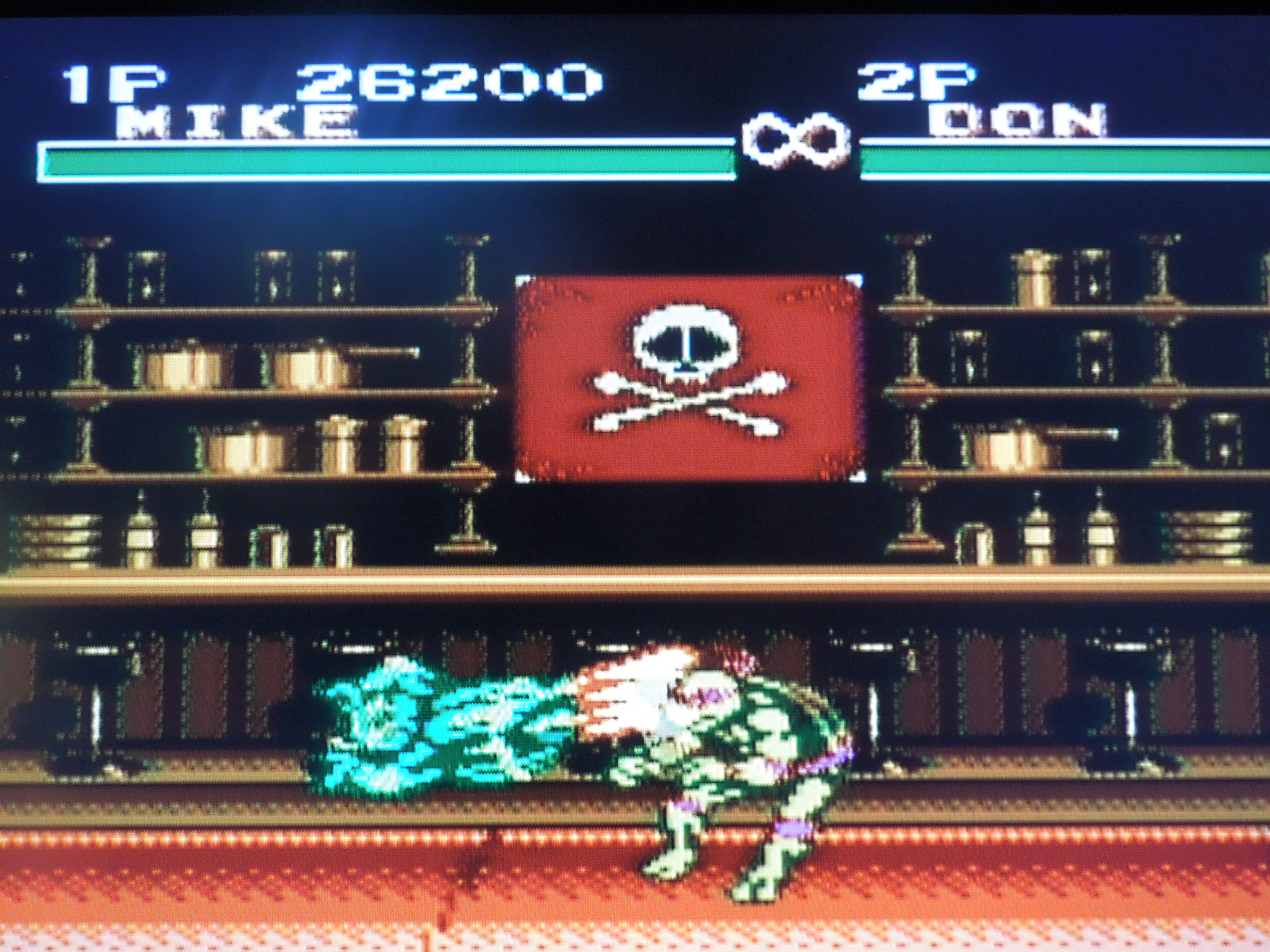
Tournament Fighters is one of the few one-on-one fighting games for the NES.
Gameplay: TMNT Tournament Fighters is a one-on-one fighting game, similar to well-known games of that genre like Street Fighter II or Mortal Kombat. Either against the CPU or against another human player, you select from among 7 characters and fight in a ‘best of 3 rounds’ match against the game’s other characters.
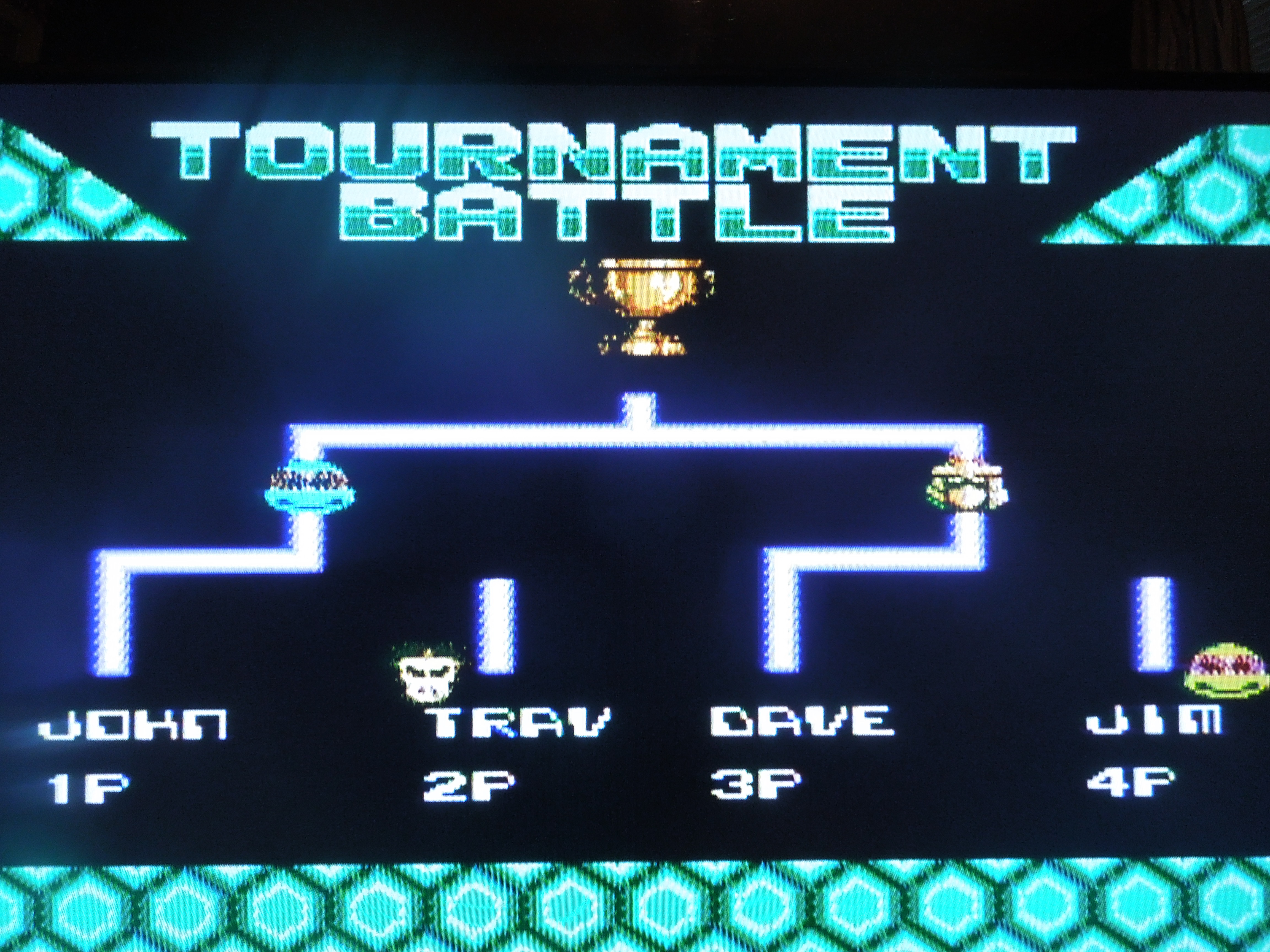
Modes: Many options are available in TMNT Tournament Fighters. A ‘Story’ mode is available, where the Turtles are challenged by their arch-enemy, Shredder to “meet in the streets to find out who is the best.” This mode simply has you choose 1 of the 4 Turtles and battle through the other characters in the game (including a ‘mirror’ match vs your own character). Additionally, for 1 player, you can select a quick match vs the computer, or for 2 players, vs each other. Another nice addition is the ‘Tournament,’ where any combination of human characters or CPU characters participate in a Knockout-Tournament to decide a champion.
Tournament Mode allows 4 players to compete.
Characters: Leonardo, Donatello, Michelangelo, Raphael, Shredder, Casey Jones, and Hot Head are the game’s 7 selectable characters. The 4 Turtles are all palette-swapped versions of each other with slightly different colors; however, each one has their own unique special move(s) and particular animations. The Turtles all fight bare-handed. In 2 player VS, both human players could select the same characters, with the exception of Hot Head vs Hot Head. In Issue 54 of Nintendo Power, where this game was introduced, this line was given to explain why you couldn’t do this: “You can’t fight as Hot Head vs. Hot Head because the dragon spirit won’t allow such a battle to take place.” That always struck me as odd, even back in 1994. However, there is a way to achieve Hot Head vs Hot Head. If you select VS. CPU, pick Casey Jones or Shredder as your player and Hot Head as your CPU opponent, then win or lose your match, once you select ‘Re-match,’ you’ll be able to highlight Hot Head with both the ‘1 player’ and ‘CPU’ cursor to create the ‘forbidden’ match. It’s only then that you see why the developers didn’t want you to play this way – because Hot Head is so big, when you have two of him on screen at the same time, the game flickers a lot, and it doesn’t look good at all. However, you can still play the match with no problem despite this.
Hot Head vs Hot Head matches are a flickery mess.
Options: The Options menu allows you to alter your Continues (for Story Mode), change the difficulty level, and change the game speed (from Normal to Turbo). All of these are welcome additions to the game. Personally, I feel the Turbo option is the best way to play, as Normal just feels a bit too slow. The game is simple enough to beat on Easy (although Shredder, your opponent in the game’s final match, is still tough), but the game amps up considerably beyond Easy mode.
Control: There aren’t a lot of great reviews for TMNT Tournament Fighters online, and the few I have found often site things like ‘unresponsive’ control for the game’s special moves. This couldn’t be further from wrong. The game controls extremely well, and pulling off the one or two special moves each character has works every time, as long as you’re inputting the control motions correctly. I have noticed that original source material, like the issue of Nintendo Power that originally reviewed the game, incorrectly listed how to utilize certain special moves – it’s entirely possible that the game’s instruction manual did this to, although I don’t own once to know for sure. There is an FAQ available online that mostly lists the moves correctly, with the exception of Casey Jones’ hockey stick attack (Hold Down/Away, then press Up + B). Since each character has only 1 or 2 special moves, they’re easy to memorize, and using them in-game is a key to winning.
Special moves are a cinch to pull off, although each character only has one or two.
Music & Sound: Meh. Nothing great here. The music is absolutely nothing special, and the sound effects could have been better. The punches and throws and special moves all have their own noises, but the NES, especially in 1994, could have done better than what’s here.
So, where can I find this game? EBay. The game has not been released for any modern-gaming download services like Nintendo’s eShop. You can also play the rom on your computer.
Conclusion: TMNT Tournament Fighters for the NES is an average game. It controls well, looks OK, and is one of the few one-on-one fighting games available for the system. The multitude of gameplay modes, as well as a decent Options menu, help the game. Beyond that, it’s just not a very ‘involved’ fighting game like Street Fighter 2, Mortal Kombat, or even the Super Nintendo version of TMNT Tournament Fighters. While there is some small bit of fighting strategy to beating the game’s opponents, you’ll often have to rely on just hitting your same special move over and over to get the win.
The Southern Gentleman’s Opinion and Letter Grade: Recommended only if you’re a huge TMNT fan and looking to complete your collection of Turtles’ games for the NES. Otherwise, you mightlook for the excellent SNES version of Tournament Fighters, which is easier to locate and more in line with what fighting-game fans are likely to expect from their games. C+
God Bless! Proverbs 3:6
This is the only NES Turtles game where you can play as Shredder.
Note 1: Like soccer games? Check out my reviews of Nekketsu High School Soccer and Nekketsu Soccer Hen!
Note 2: This game was played on an NES 101 model (toploader) that was modified to output in AV composite (red, yellow, white) just like the original NES. It was connected to a 32-inch HD tv.
Nekketsu Soccer League translated reproduction cartridge and the bootleg version, Goal III
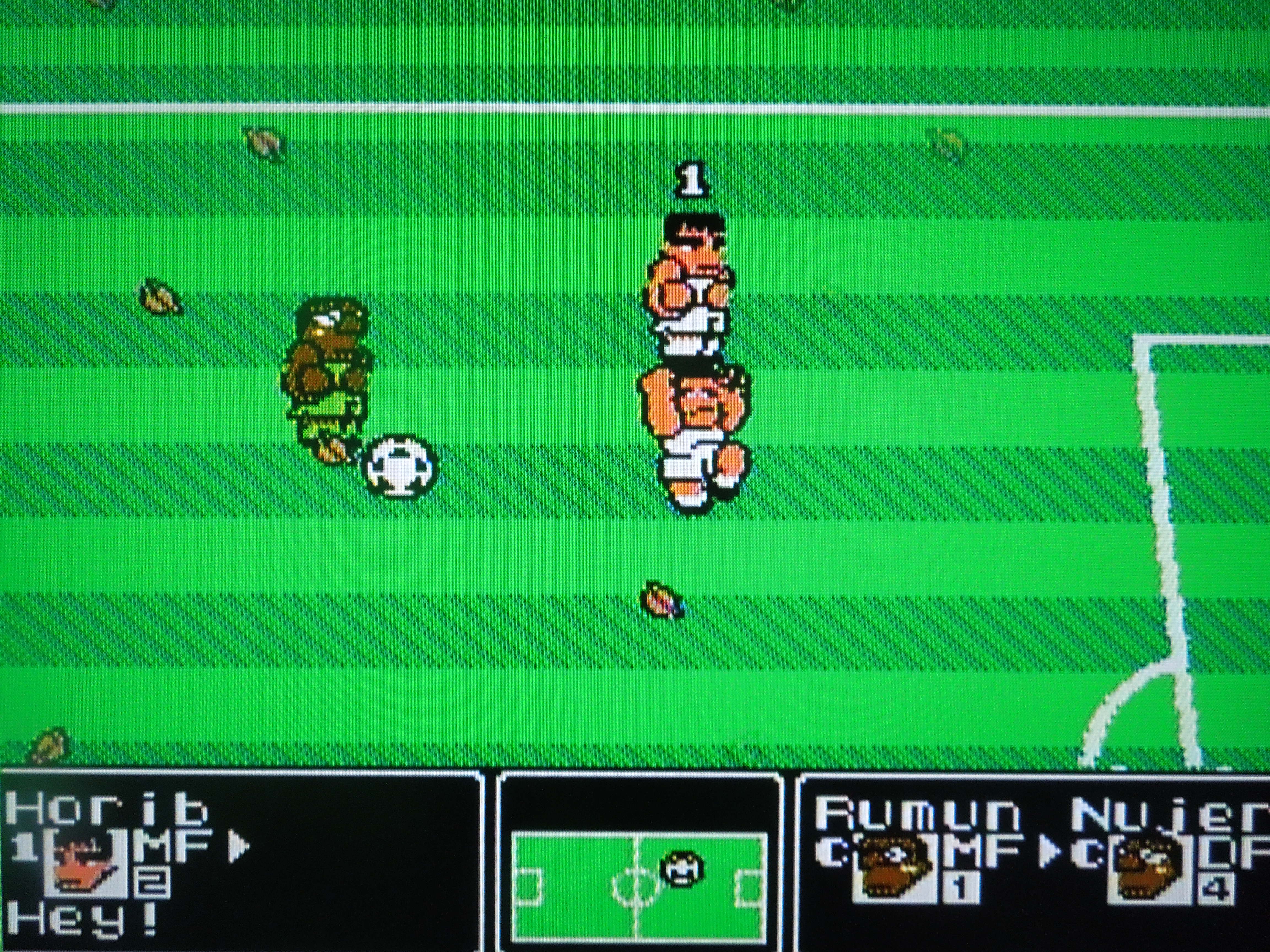
Quick History: Kunio-kun no Nekketsu Soccer League, released only in Japan for the Famicom in 1993, is the sequel to Nekketsu Koko Dodgeball Bu: Soccer Hen. Soccer Hen was released for the Famicom, PC Engine (see my review), Mega Drive (see my review), and NES (the game was renamed Nintendo World Cup and some things were changed). Nekketsu Soccer League, unlike Soccer Hen, was not released on multiple systems – only the Famicom (Japanese NES). There was a Famicom bootleg copy of Nekketsu Soccer League known as Goal III released as well, although it still contains the Japanese language. Several years ago, Nekketsu Soccer League was translated by fans, and today, it can be placed on cartridges for play on the original NES console. This review is for the NES reproduction/translation cartridge of Nekketsu Soccer League.
Story: Kunio and his soccer team are encouraged by Misako (their female manager) to participate in the Technos World Cup. In order to do so, they must first travel to multiple international locales and beat other teams to qualify for the Technos World Cup Tournament.
Control: You only ‘control’ one player on your team, but you can ‘tell’ your teammates what to do. A passes (or tells your teammate to pass). B shoots (or tells your teammate to shoot). A+B jumps with the ball. Pressing B in the air executes a Super Shot. On defense, A slide tackles (or tells your teammates to slide tackle). B shoulder tackles (or tells your teammates to slide tackle). Additionally, you can jump on top of your teammates shoulders, or even on top of the ball.
Modes: 3 modes are available in Nekketsu Soccer League: Nekketsu League (Season), Match (VS), and Penalty.
1 Player or 2 Player Co-op are available in Season Mode (Nekketsu League)
-Season (Nekketsu League): For 1 player or 2 player co-op. In 2 player co-op, player 1 is a mid-fielder, and player 2 is the goalie. Both players can run all over the field at any time, however. As Nekketsu (Japan), you choose among 12 opponents to face. You must win approximately 25 matches (earn 70 ‘points’ – more on this in a bit) before qualifying for the Technos World Cup Tournament, so obvisously you can choose to play teams more than once. A password system saves your progress throughout the Season – you get an updated password after each match.
– Match: For 2 players only. Each player selects from 6 teams and compete in a match. The 6 available teams are Nekketsu (Japan), Italy, Germany, Argentina, Brazil, and Cameroon. All of the teams have their own unique 6 players, with their own speed/power/defensive stats, as well as their own unique Super Shots. Players can select to be the same team. *Note: This mode has an option for 3 or 4 players, but that mode, unfortunately, will not work on an NES console, even with a multi-tap. 3 or 4 player mode would only work on an actual Japanese Famicom with the proper peripherals.
-PK: For 1 player or 2 players: Select from among 6 teams and compete in a ‘best of 5’ PK battle. Each team will have 5 penalty kick opportunities, and the teams alternate. You control the kicker on offense, and the goalie on defense. Each PK attempt has a time limit of 7 seconds. If the score is tied after all 5 kickers for each team have kicked, additional kick opportunities will be available until there’s a winner.
More About Nekketsu League (Season Mode): There are 12 teams you can choose to play against in Season Mode. Depending on who you beat, you earn ‘points’ for the win. You cannot play and beat any 1 team more than 3 times. You need 70 points before you can enter the Technos World Cup Tournament. You get an updated password after each win, and this password keeps track of your wins and points.
Asia League (Korea, Thailand, Mongolia) – 2 points per win
Africa League (Cameroon, Guinea, Senegal) 3 points per win
South America League (Argentina, Brazil, Mexico) 3 points per win
Europe League (England, Italy, Germany) 3 points per win
After beating the Season Mode, you’ll qualify for the Technos Cup Tournament.
Technos World Cup Tournament: Once you have at least 70 points, you can choose to participate in the Tournament if you choose. The Tournament is for 6 teams, but you are seeded # 6, and must actually play 4 matches. If you lose even one game, it’s Game Over, as you do not receive a password between matches in the Tournament like you do in regular-Season mode. The Tournament teams can be tough, so hopefully all the practice during your Season got you ready. You do get a ‘Runner-Up’ trophy and ending if you reach the Title Game and lose, at least.
Gameplay: During the Season and Tournament, you can only play as Japan. The games are 6 on 6 soccer. Each game is divided into 2 minute halves. If the game is tied at the end, the game will go to a Penalty Kick Shootout to determine a winner. Before each match and at half time, you can change up the on-field formation of your team, select your 6 starters from your team’s 12 players, and give directions to your computer-controlled teammates (like ‘Always Shoot/Always Pass). You can also have a ‘meeting’ (optional) with your teammates where you can talk to them or give them items that may boost or drain their statistics.
Before games, you can change up player positions and formations.
Players: Kunio, Yoritsune, Saji, Horibata, Iwakabe, Genei, Ugajin, Onitake, Kumon, Kaizuki, Tsunewo, and Carlos make up your Nekketsu Japan team. Before each match, you can select who you want your starters to be, as well as which player you will control. All 12 players perform differently. Some are slower and stronger, some are quicker and weaker, and some are balanced (you can view their stats in the ‘meeting’ option). Each has their own Super Shot. When you’re selecting who to put in what position, if a player is ‘smiling,’ it means he’s fit for that position; if a player is frowning, it means he’s not a good choice for that position. Note: In 2 player VS mode, the Nekketsu team only has Kunio, Yoritsune, Saji, Horibata, Iwakabe, and Genei available.
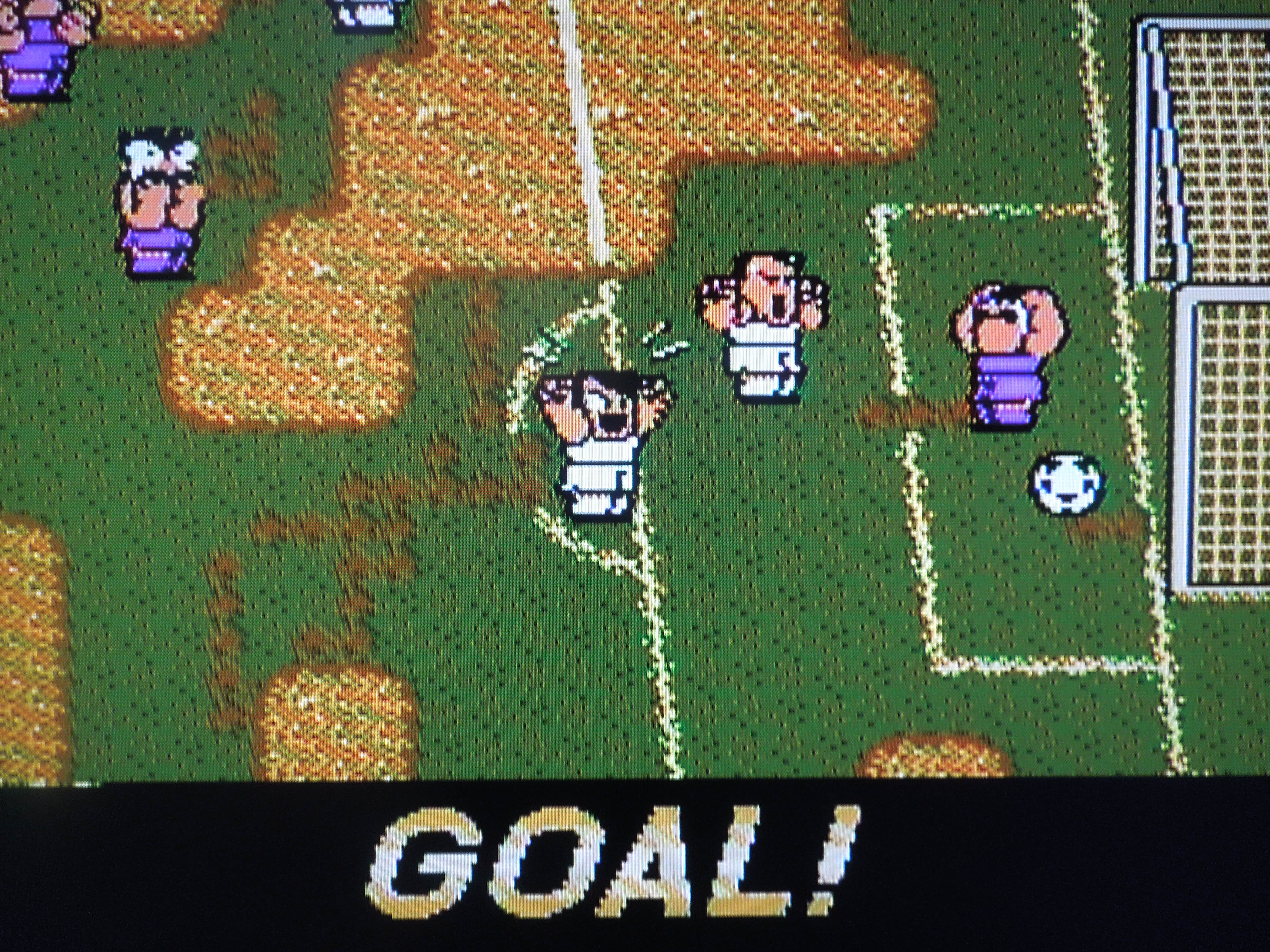
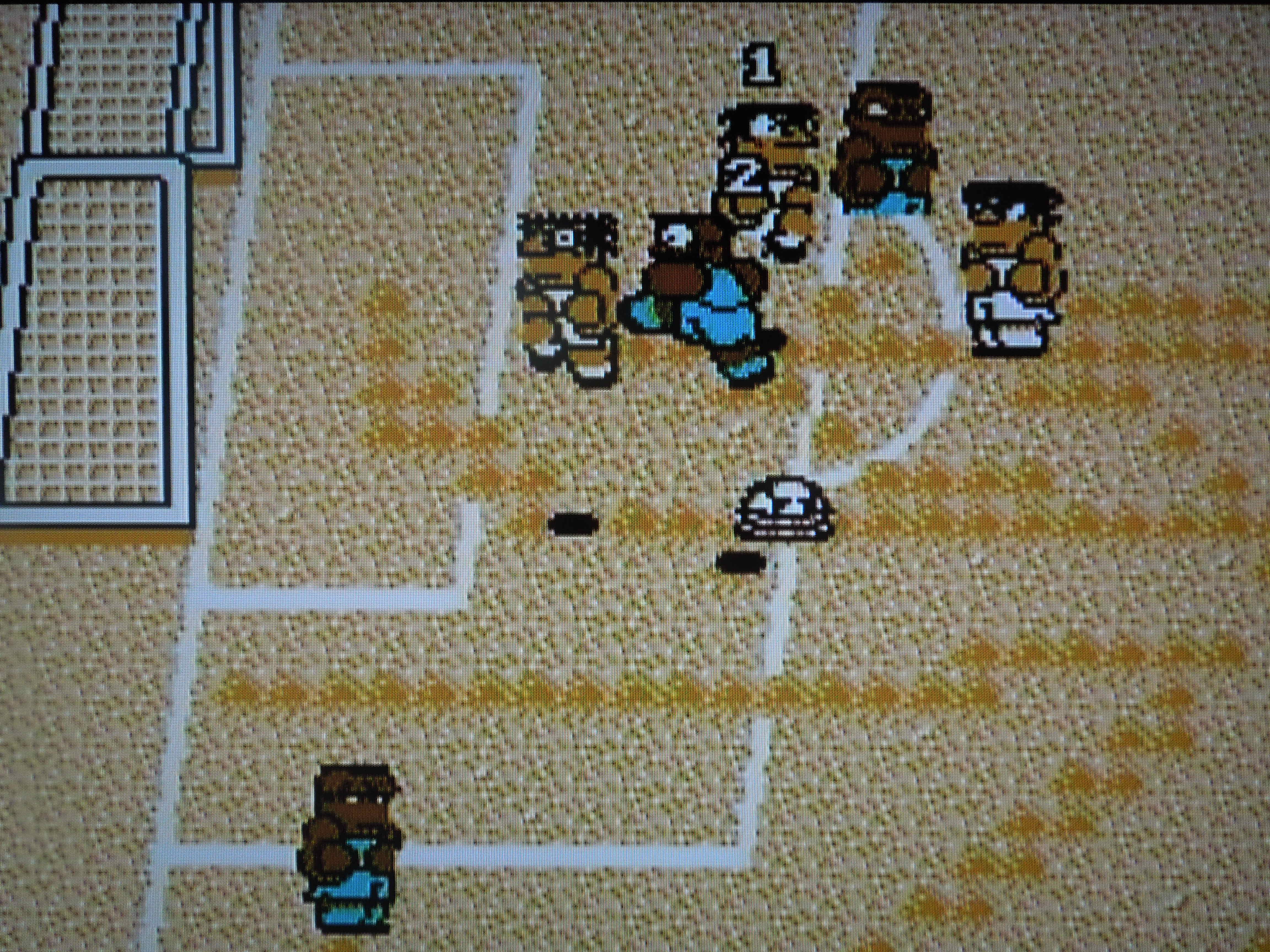
Fields and Weather: Depending on which team you’re playing, you’ll play on grass fields, sand fields, or even in the mud. Wind, rain, tornandos, and even lightning can occur during matches, and all of these can have an effect on the outcome of the game.
Weather and field conditions can impact the outcome of matches.
Music & Sound: Great. Before each match, you can choose from among 7 different themes to play during matches. They range from fun, easy going tunes to intense, ‘final match’ themes. Sound effects are well done as well. Roughing up opposing players and executing Super Shots have notable effects.
So, where can I find this game? You can find the original Famicom cartridge on eBay, but you’ll need a Famicom console or a ‘Famicom to NES’ converter to play on an NES. Many online sites now offer the translated version on an NES cartridge. You can play the rom on a computer emulator.
Conclusion: Nekketsu Soccer League is a terrific soccer game. It offers more variety than its predecessor, Soccer Hen, with the best addition being the PK Overtime. The weather affecting the game is a nice touch, but it does cause some slow-down, and this game plays a bit slower than Soccer Hen. The controls are very easy to learn, and having 3 levels of difficulty to choose among is a welcome addition. It would have been great if you could select any of the game’s 12 teams to play through the season mode with instead of just the Japan team, and it’s unfortunate that even in 2 player VS, you can still only select 6 of the 12 teams. The two-player co-op is fun, but having Player 2 unchangeably relegated to the Goalie position was a mistake – fortunately, Player 2 can still run all over the field and isn’t stuck waiting for the action (like in Nekketsu Ice Challenge – see my review). This game has much replay value due to its Season setup (and the fact that it’s really fun), and winning the Technos World Cup will take some skill.
The Southern Gentleman’s Opinion and Letter Grade: It’s honestly a tough call as to whether or not this game is better than it’s predecessor, Soccer Hen. It’s certainly just as good, and quite a different experience from that game. Having an English translated version of this originally Japan-only game is amazing, of course. B+
Note 1: Like wrestling games? Check out my reviews of Saturday Night Slam Masters and WWF WrestleFest!
Note 2: This game was played on a Neo Geo AES home console that has been modified to output in component video (red, green, blue). It was connected to a 32-inch HD tv.
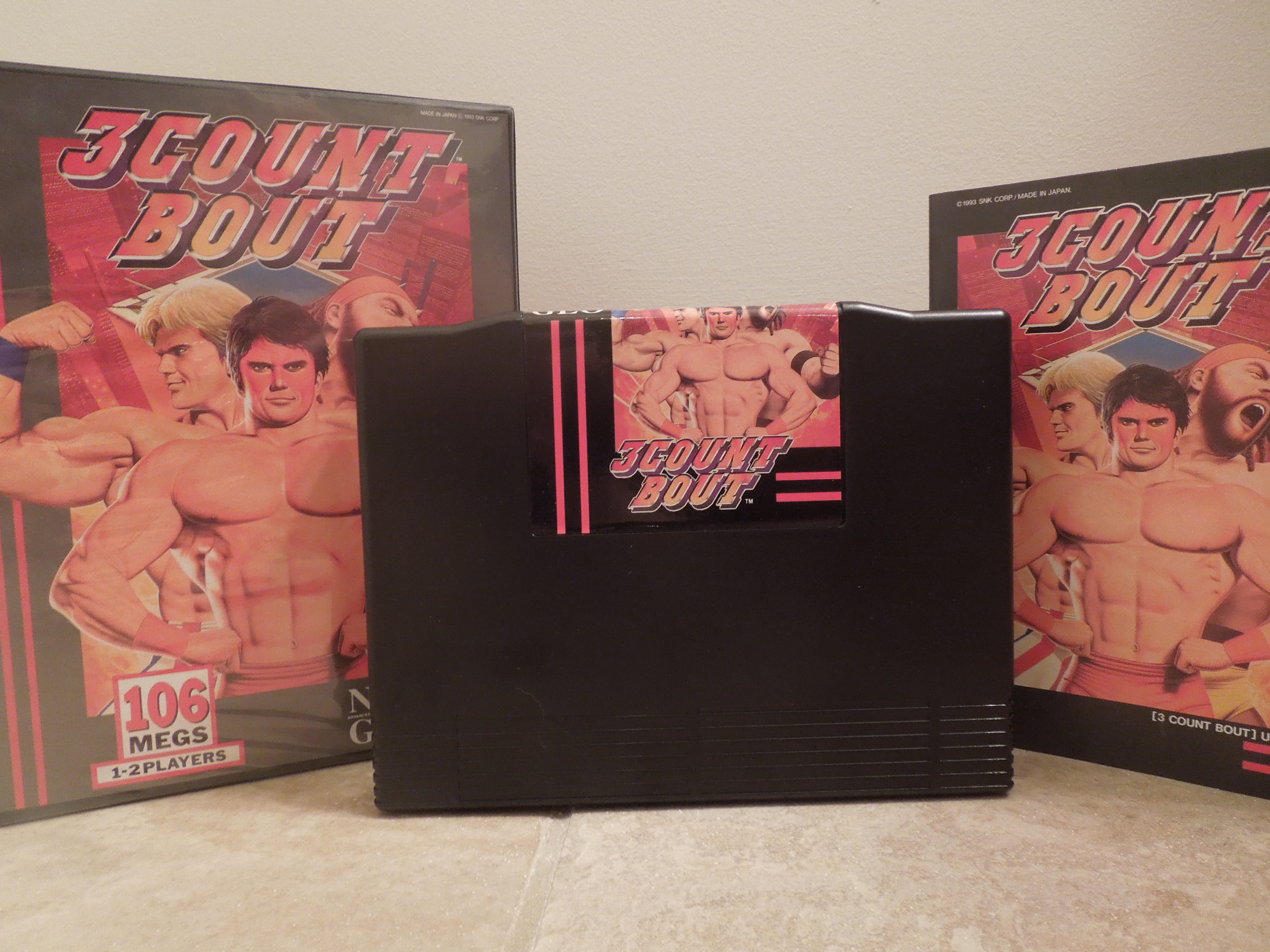
3 Count Bout is known as Fire Suplex in Japan.
Quick History: 3 Count Bout (known as Fire Suplex in Japan)was released for the Neo Geo AES home console in 1993. While the game itself was a common enough release for the AES as well as the Neo Geo MVS (arcade cabinet), many wrestling-game fans are unfamiliar with it.
Modes: 3 Count Bout has 3 modes of play: 1 Player vs CPU in Singles Matches, 2 Players vs CPU in Tag Matches (co-op), or 2 Player VS (competitive singles match).
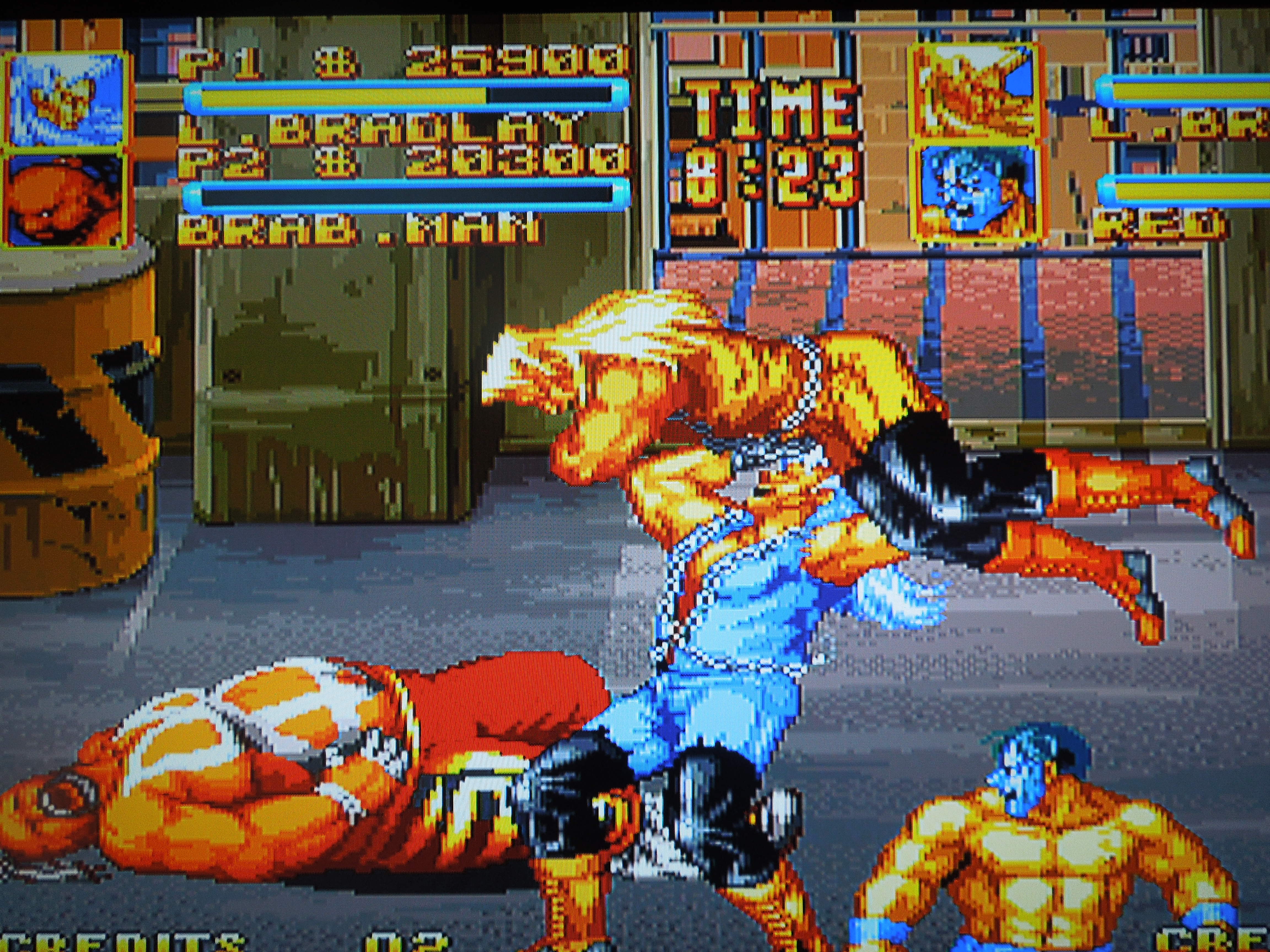
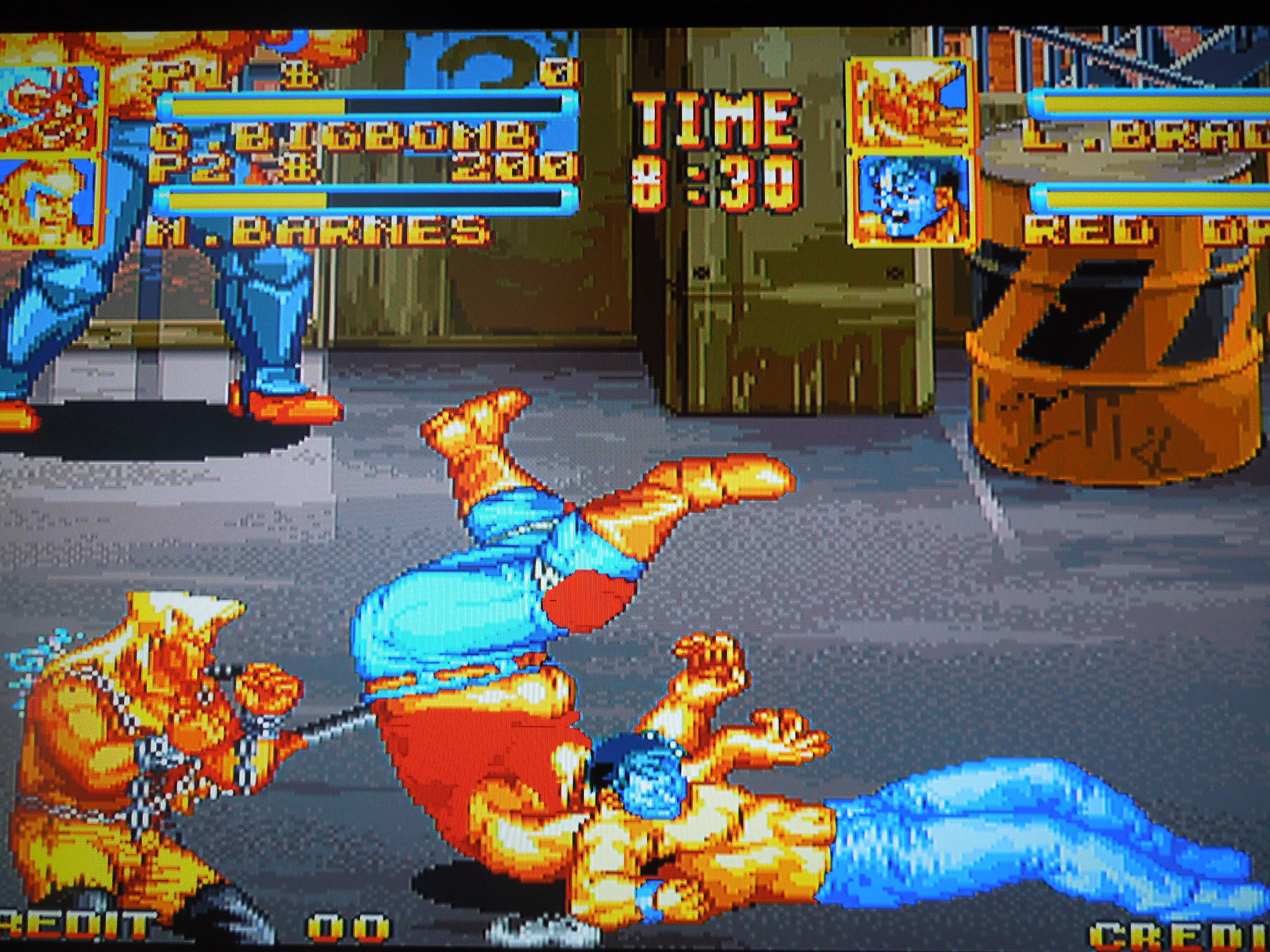
1 Player mode: You select from among 10 fictional wrestlers and wrestle/fight in 10 matches. Matches take place in 1 of 4 environments: the SWF wrestling ring, a ring with electrified ropes that shock players when touched, an alleyway with weapons, or a warehouse with weapons. In the ‘ring’ matches, you have to deplete your opponent’s life bar until you can pin them (D button) or make them submit from a hold (B button while opponent is lying down). In the warehouse and alleyway matches, you have to deplete your opponent’s life bar until he can no longer answer a 10 count after being knocked down.
2 Player co-op: You each select a wrestler (you can both pick the same guy) and compete in 5 tag-team matches. Like the 1 player mode, you’ll wrestle in 4 different environments. In the ‘ring’ matches, D tags your partner when in your corner. While on the ring apron waiting for a tag-in, tapping A will regain power, adding some strategy to the game. If the CPU attempts to put you in a submission hold or pin you near your corner, you partner can get in the ring to break up the hold or pin. Likewise, if you go for a pin or submission near the CPU’s corner, the CPU’s partner will get in and break things up. If you throw the CPU player out of the ring on your side, your partner can get out and you can both beat up on him (just make sure the legal man is back in the ring by the 20 count). If you, however, get thrown out of the ring on the CPU side, he and his partner will double-team you, so try to get back in the ring quickly. In the warehouse and alleyway matches, you still have to ‘tag’ each other in and out – the non-legal man waits at the top of the screen. To win this match, you have to knock out both of your opponents. To lose, both you and your partner have to be knocked out.
Whether in 1 Player or 2 Player co-op, once you get to Red Dragon, the game becomes extremely difficult.
2 Player VS: You each select a wrestler (you both can pick the same guy) and compete in a 1 on 1 match. You can select from the game’s 4 environments. This a great VS mode, where both human players have equal chances to win grapples. On an interesting side note, in the 2 Street Fight matches (alleyway and warehouse) if players knock each other down at the same time with no energy left and neither can answer the 10 count, instead of a double-disqualification, Player 1 wins!
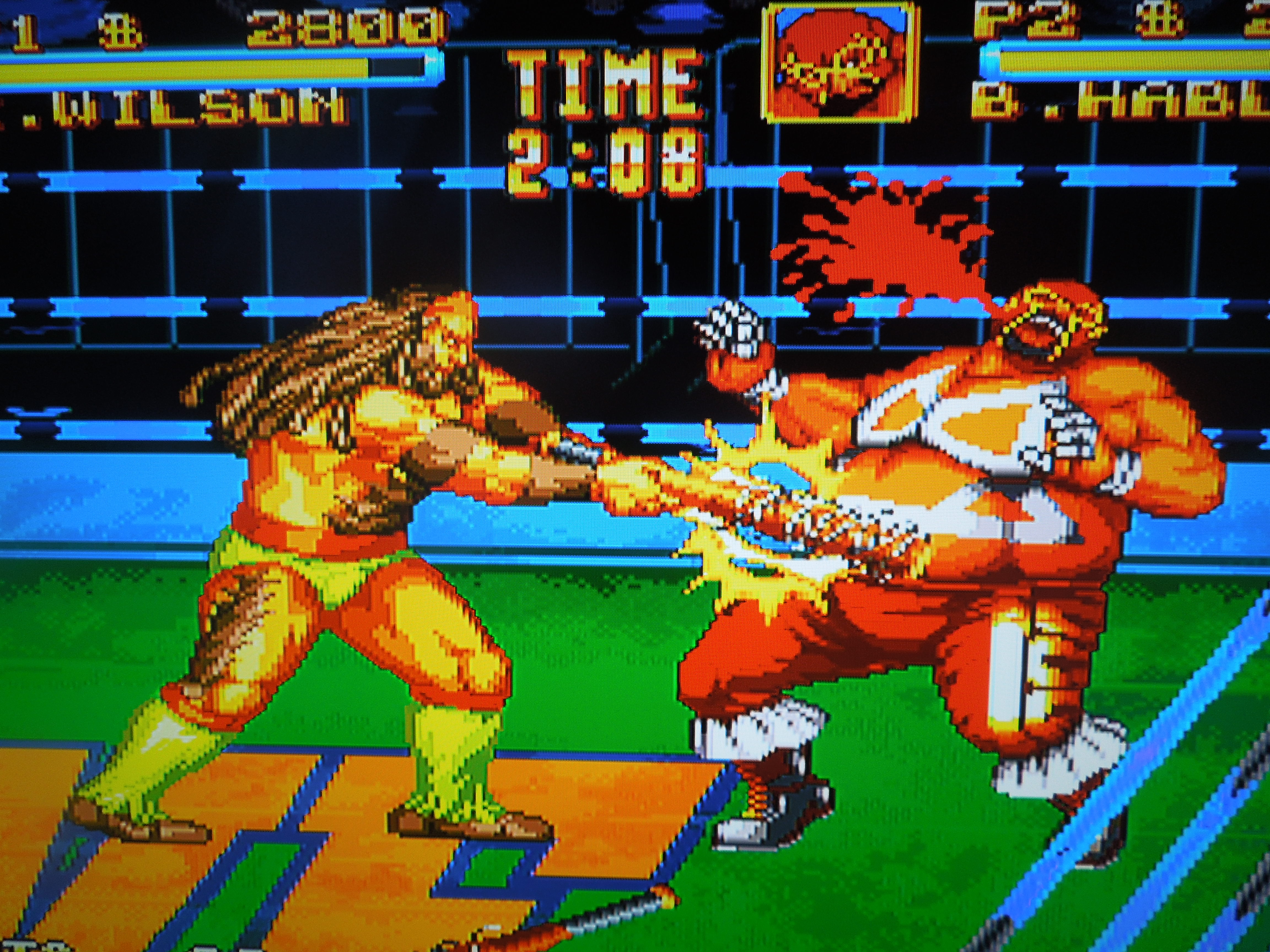
Basic Control: A punches. Pressing A rapidly and holding forward causes a character-specific move, like a bite or blowing mist in your opponent’s eyes. B kicks. C jumps. D pins an opponent when he is down or tags your partner in 2 player co-op. Pressing A+B executes a dash/escape move. Quickly pressing Away, Toward A executes a useful dash attack. Pressing B by a downed opponent puts them in a submission hold – pressing C drops a knee or elbow on them. When in close to an opponent, you’ll automatically lock up in a grapple – tap A rapidly to win the grapple, then any combination of joystick directions + A or B to execute different wrestling moves (hitting A + B when you’ve won a grapple on a weakened opponent executes a finishing move). You can also climb the top two turnbuckles and jump off at opponents by pressing A.
Music & Sound: The music is average, nothing terribly memorable. It changes for some of the matches. The sound effects are decent. A nice touch is the many-voiceovers for the wrestlers, and before each match (entirely skippable by pressing A), a ring announcer introduces each wrestler – no during match commentary, sadly, except when you win – “3 count fall!!!”
Having a co-op Tag-Team Mode is something the game does right.
Characters: 3 Count Bout has 10 selectable characters. All are fictional, but they are huge and all look great. Terry Rogers, Red Dragon, Leo Bradlay, Roy Wilson, Master Barnes, Blubber Man, Blues Hablam, Gochack Bigbomb, and Big Bomberder (all spellings are from the game). Blubber Man and Blues Hablam look exactly alike, except the latter wears a mask – their moves are the same. Gochack Bigbomb and Big Bomberder look exactly alike, except the former wears a mask – their moves are exactly alike. Each wrestler (apart from the two pairs I just mentioned) has their own unique move set, speed, and strength.
Difficulty: Here’s where everything takes a downturn. You have 4 selectable difficulties: Easy, Normal, MVS (arcade difficulty), and Hard. Select Easy, because it’s the only chance you have. The problem is, once you get to the 3rd match vs. Red Dragon (or 2nd match in co-op vs. Leo Bradlay and Red Dragon), the CPU’s ability to win grapples amps up to approximately 85%, and to make things worse, the CPU attacks RELENTLESSLY. While punching the CPU before locking up in a grapple increases your chances of winning the grapple and pulling off a move, even this can be tough. Your best bet is to go for jumping attacks, off the turnbuckle attacks, and utilizing your wreslters Away, Toward, A dash attack. Tagging in c0-op is a must, as you can regain some energy on the outside, but winning tag matches (after the easy first one) is just as difficult as singles matches, as the CPU’s constant attacking makes it tough for you to even get to your partner. Can the game be beaten? Yes, I have done it multiple times, but only with TREMENDOUS patience and cheap, repetitive tactics. If you can beat all 10 opponents in single player using the game’s unchangeable allotment of 4 credits (meaning you can’t continue more than 4 times following losses), consider yourself the master or 3 Count Bout. Fortunately, if you have a Neo Geo Memory card, you can save the game after you use all of your Credits, then continue from there.
There are tons of amazing wrestling moves to utilize, if you can manage to win grapples.
So, where can I find this game? It is easy enough to find an AES cartridge or MVS arcade cartridge on eBay. Also, the game is one of the 20 included games on the Neo Geo X handheld. You can play the rom on a computer emulator.
Conclusion: First, what this game does right – it doesn’t matter that 3 Count Bout doesn’t have real wrestlers – that’s perfectly fine. The 10 included wrestlers all look great, and take up a large amount of the screen. The street fights and electrified-ropes match are particularly great ideas, and it’s really fun bashing your opponent with a baseball bat wrapped in barbed-wire or body-slamming him into the ropes and watching him get shocked. Co-op was a great move, although more intuitive co-op where your partner has more chances to get involved or tag-team moves could be used would have improved this aspect. But the difficulty is too much. You’ll have a great time in the first two matches in 1 Player Mode where you can actually win grapples, or in the first tag match in 2 Player co-op. But once you get to Red Dragon (and everyone else after him), the game goes from being a fun wrestling/fighting game to a game of “How many cheap, quick moves can I try to use on this guy before he utterly destroys me?” It’s unfortunate, because if only the difficulty wasn’t so ridiculous, this would be a wonderful wrestling game. You will lose a ton of matches, get angry, and wonder why this game was programmed this way if you play 3 Count Bout, make absolutely no mistake.
The Southern Gentleman’s Opinion and Letter Grade: Comparatively, 3 Count Bout can’t hold a candle to fellow arcade wrestling game, WWF WrestlFest. If you’re a Neo Geo fan and want a wrestling game, maybe you might consider this, but beware. C-
Note 1: Like baseball games? Check out my review of Bad News Baseball!
Note 2: This game was played on an NES 101 model (toploader) that was modified to output in AV composite (red, yellow, white) just like the original NES. It was connected to a 32-inch HD tv.
Little League Baseball was overshadowed by SNK’s other game, Baseball Stars.
Quick Hisory: Little League Baseball: Championship Series was released for the NES in 1990. The game was developed by SNK, the same developer that would release the more well-known and popular NES games Baseball Stars and Baseball Stars 2. Perhaps because of the title, NES baseball aficionados have not always given this game a fair chance compared to the numerous other baseball games released for the NES.
Gameplay: In Little League Baseball, there are two modes of play: Championship Series and Exhibition Mode. In Exhibition, you play a single game against the computer or against a friend in 2 player VS. In Championship Series, you take your chosen team through an International Tournament to become World Champion. A long, but easy to record password system saves your progress in the tournament.
Teams: Korea, Japan, Chinese Taipei, California, Arizona, Texas, Fl0rida, Hawaii, Puerto Rico, Italy, Spain, New York, Pennsylvania, Illinois, Canada, and Mexico are the 16 selectable teams. At the beginning of the game, you can selelct ‘Power Analysis’ to see where each teams strengths and weaknesses lie: batting, running, pitching, and defense make up each teams’ statistics. For example, some teams are terrific batters and runners but weak in pitching and defense; some teams are balanced in all areas.
Players: A neat feature of LLB are the sizes of the players. Players range from either short, tall, or fat, and each one has a ‘Skill Level’ from 1 (bad) to 5 (great). Skill level 5 players are likely to get a hit or knock one out of the park, while Skill level 1 players have a lower percentage chance of getting on base. This simplified statisitic is a welcome addition, but unfortunately, when you want to replace your pitcher or put in a pinch hitter, which you can do, you CANNOT see the stats of the player you’re putting in until they’re in the game. For example, if you want to replace your Skill level 2 batter because you think he’ll probably get out, and decide to put in a pinch hitter, the pinch hitter might also be Skill level 2, but you won’t be able to tell until after you’ve already put him in the game! This hurts the strategy of the game.
Control: The control in LLB is great. Controlling your pitches, batting, running bases, stealing – it’s all easily executed. A nice feature also is the ability to dive for balls when playing defense by pressing B + Left or Right. Occasionally, you’ll have difficulty fielding a ball despite the fact that you appear to be right on top of the ball, but this doesn’t happen often.
You can view each team’s strengths and weaknesses in the ‘Power Analysis.’
Computer: The CPU in LLB is TOUGH. Some teams are scoring machines, and too often they’ll bunt, and your pitcher will be too slow to get to the ball to even get the runner out at 1st, causing an unfair advantage for the human player. My advice is to pick a team that is strong in hitting in order to keep up if the game becomes a shootout.
Little League Baseball Rules: Each game is only 6 innings long (unless extra innings are required due to a tie), and a neat addition is made to the start of the game: Two players grab the bat and go hand-over-hand to the base of the bat – whoever’s hand ends up at the base of the bat gets to go on offense first.
Begin the game by trying to win the right to bat first.
Music & Sound: The music in LLB is quite good – very much in line with the sport, and different songs play in different games. The sound effects are average. One thing that is sorely lacking are the voiceover samples found in other games for things like “Strike!” “Ball!” “Out!” or “Safe!” None of those here – instead, you get a sound effect that just isn’t as effective.
So, where can I find this game? It’s easy enough to find on eBay, or you play the rom on your computer.
Conclusion: Little League Baseball: Championship Series is a great looking NES baseball games – it can stand the test of time much better than some other NES baseball games. The control is good, and the selection of teams (at 16) is excellent, especially considering the differences in each team. The challenge is a little more than some gamers will like, but the game is certainly not unbeatable. The password system works great. Single games are (obviously) shorter than other NES baseball games because of the 6 inning rule, making this game have a different ‘feel.’ Not being able to see your pinch hitters’ and relief pitchers’ stats before choosing them is a major drawback to video-game baseball strategy, however.
The Southern Gentleman’s Opinion and Letter Grade: Little League Baseball does a lot right – it’s simplified baseball, and there aren’t a lot of screens to navigate in order to get to the game. If you’re looking for a somewhat different baseball experience for the NES, this is it. B-
God Bless! Proverbs 3:6
You’ll only play 6 innings (unless tied) per Little League rules.
Tecmo Bowl Japan for the Famicom Like using Chicago’s Dennis Gentry on kickoff returns? Well forget it, because in TB Japan, he’s been replaced by the slower Mark Green.
Note 1: Like football games? Check out my reviews of Football Frenzy, SEC Tecmo Bowl, Tecmo Super Bowl College, and Tecmo Bowl Arcade!
Note 2: This game was played on an NES 101 model (toploader) that was modified to output in AV composite (red, yellow, white) just like the original NES. It was connected to a 32-inch HD tv. Because Famicom (Japanese NES) games won’t play on NES consoles directly, I made a converter out of an old copy of the NES game Gyromite that allows Famicom games to be played on the NES.
Quick History: Wait, how is this obscure? Everybody knows Tecmo Bowl?!! Probably not this version. Tecmo Bowl USA, which is revered nationionwide, was released early in 1989 to the delight of football fans. Almost 2 years later, at the end of 1990, an ‘updated’ version was released only in Japan for the Famicom. Not much was changed – the same 12 teams that are in the U.S. version appear in the Japanese version. Each team still has the exact same playbook in both versions. What changed were some of the players on the team. For example, in real life, Mark Green didn’t play for Chicago in 1988 when Tecmo Bowl USA was being created – therefore, he’s not in the game. However, in the 1989 draft, Green went to Chicago. Therefore, in Tecmo Bowl Japan, Green is now on the team as a kick returner, taking the job of Dennis Gentry. It wasn’t just a name-switch for many players either – some teams got weaker or stronger based on the changes that were made.
About Tecmo Bowl Japan: I’m not going to spend a lot of time on control, gameplay, etc, because Tecmo Bowl is one of the most well-known games of all time. If you don’t know about it, there are dozens of websites on the Internet dedicated to it. This review will focus on how Tecmo Bowl Japan is different from Tecmo Bowl USA.
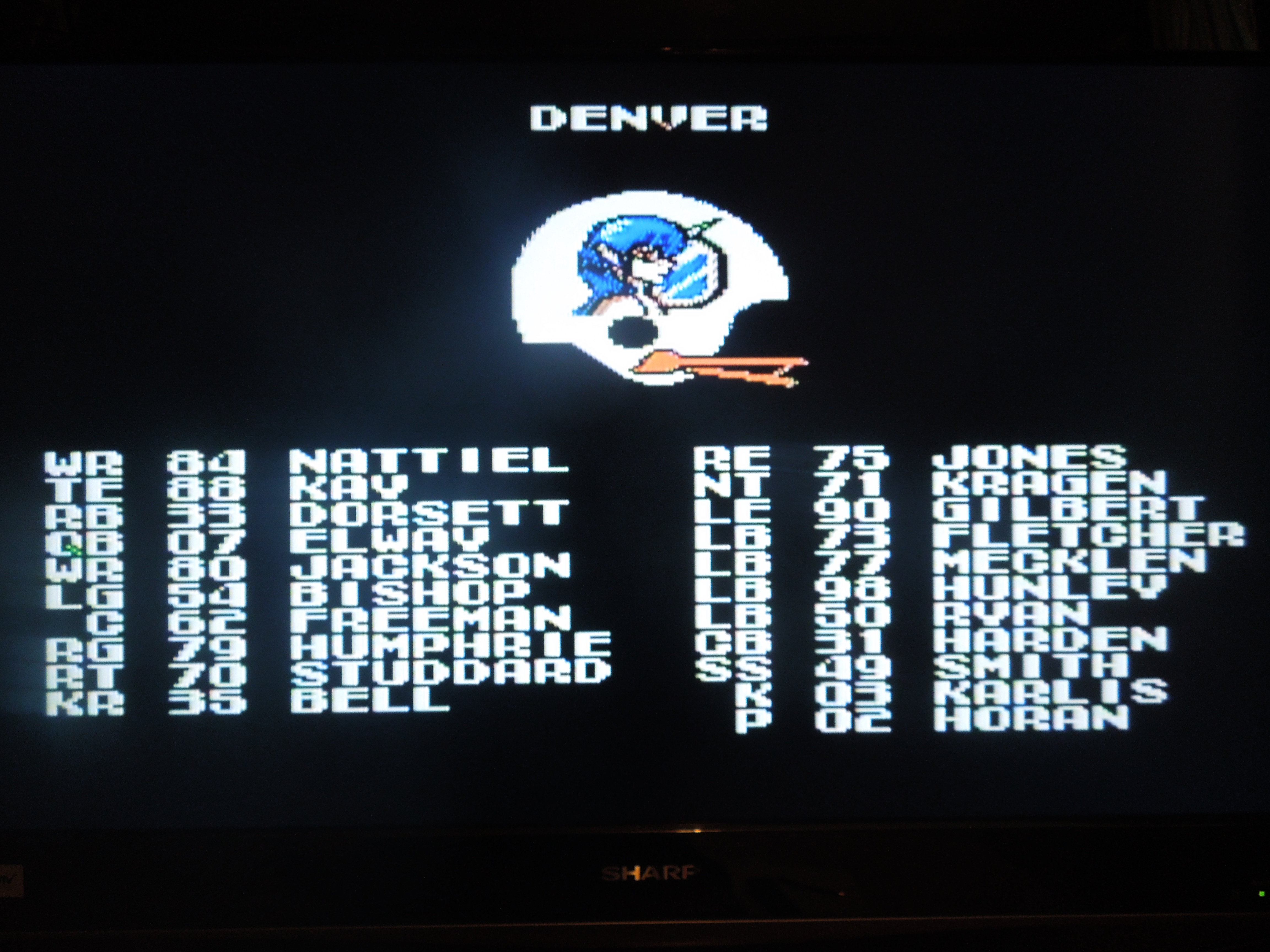
Denver’s USA roster, circa 1988. Denver’s Japan roster, circa 1990. Speedy John Taylor replaces slow Mike Wilson for San Francisco in TB Japan.
Small difference: When you boot up Tecmo Bowl USA, you’ll see ‘1988.’ When you boot up Tecmo Bowl Japan, you’ll see ‘1990.’ If you don’t press Start and let the screen scroll through the teams, you’ll see that every roster has changes made from the USA version to the Japan version – some teams had more changes than others.
3 main differences in the Japan version:
1. On Chicago, Mark Green replaces Dennis Gentry as a kickoff returner – this stinks. If you like playing as Chicago, Gentry’s return game was unbeatable – he was so fast that scoring touchdowns on kickoffs was quite easy. Mark Green has only average speed, so even crossing the 50 isn’t a given. Luckily, Gentry is still on the team as a wide receiver.
2. On San Francisco, John Taylor replaces Mike Wilson at receiver – this is awesome. Mike Wilson was extremely slow and usually got tackled quickly after catching the ball. Taylor, however, is extremely quick, and is an amazing compliment to fellow wide receiver Jerry Rice, who is still extremely fast. With these two speedy receivers, San Francisco is almost perfect.
3. On Los Angeles, BO JACKSON IS EVEN FASTER IN THE JAPAN VERSION THAN HE WAS IN THE USA VERSION!!! I read this somewhere years ago, and always wanted to find out if it was true. I played both games and selected Bo’s 1 and only running play multiple times in both the Japan and USA versions. He is definitely faster – you’ll really notice if you play both games back to back. In the USA version, it was a good bet you could take it to the house as long as the computer didn’t pick your play, and you might have to dodge some defenders towards the end of your run. But in the Japan version, his acceleration and top speed are so ridiculous that you’ll rarely have to dodge any defenders – 3 yards and a cloud of dust.
As if Bo Jackson’s Tecmo Bowl Legacy needed any improvement, he’s even faster in TB Japan.
Other player changes? Oh, I’m sure. The 3 listed here are just some of the glaring ones I’ve noticed. Don’t worry, Lawrence Taylor is still a powerhouse on defense.
Language Barrier? No – everything is in English. No Japanese whatsoever.
So, where can I find this game? EBay. If you don’t want to bother with the original Famicom cartridge/converter like I did, you can find the rom online and plenty of NES reproduction websites on the Internet. You can also play the rom on a computer.
Conclusion: Tecmo Bowl Japan is basically the same game as Tecmo Bowl USA – you’d really have to be a real nerd (like me) to notice the differences. It would have been great if the Japanese version would have changed some teams or the playbooks, but all that’s different are some players with better or worse stats than their predecessors. Interesting though, and a lot of people love Tecmo Bowl, but have never heard of this version.
The Southern Gentleman’s Opinion and Letter Grade: Only recommended if you’re really, really interested in Tecmo Bowl or destroying your friends with an even more invincible Bo Jackson. B
God Bless! Proverbs 3:6
ADDITION FROM THE COMMENTS SECTION ABOUT MORE PLAYER DIFFERENCES:
Really liked your write-up about the 1990 Japan version of Tecmo Bowl. I picked up that version along with a famicom to NES adapter about 10 years ago, and my friends and I played it a ton.
Actually it had a lot of other really impactful changes with player personnel…and more often than not it was for the worse. No Eric Dickerson on the Japan Colts is a big one. Standout LB’s Carl Banks, Wilber Marshall, Fredd Young, and Duane Bickett are merely shadows of their USA versions. Seattle did get a fast Rufus Porter at bottom LB position, and San Fran got Charles Haley at LB as well. Those guys are great. Overall it really changed the DNA of most teams. Chicago, Miami, and Denver were really the only teams that stayed nearly intact in terms of overall ability. Dallas, Washington, Indy were far worse, while San Fran version rose up further in our rankings.
Big Time kick returner Gerald McNeil of the Browns was replaced by slow Mike Oliphant, but the Browns got much faster at WR and also got a faster Clay Matthews at LB…so it became a push of sorts. However Japan Tecmo overall had a larger assortment of big time KR’s than the USA version though, so it evened out.
We play our own 12 game seasons in 2 player mode, and alternate with the USA and Japan versions, so it really gives us a nice variance. Recently got a rom made that combined the 2 versions, so we can have a Japan 49ers vs USA Giants game for instance. That’s really cool, because for years and years before that, we could only theorize what might happen when such match-ups were to occur…now we can play them out.
Keep up the good work!
-Brad B
Tecmobowl-vs-RBI.com
Note 1: Like baseball games? Check out my review of Little League Baseball!
Note 2: This game was played on an NES 101 model (toploader) that was modified to output in AV composite (red, yellow, white) just like the original NES. It was connected to a 32-inch HD tv.
Quick History: Bad News Baseball was released in 1990 for the Nintendo Entertainment System. The game was released by Tecmo, the Japanese video game corporation that produced the well-known football game, Tecmo Bowl. While some NES sports-game enthusiasts are familiar with Bad News Baseball, many ‘general population’ gamers are unaware of the game. NES baseball games like RBI Baseball, Major League Baseball, or Baseball Stars 2 were the popular favorites during the NES’ heyday, while unfortunately, amazing baseball games like Bad News Baseball were often overlooked.
Play an 11 game Season in Bad News Baseball – win them all and you’ll be World Champion.
Modes: Bad News Baseball has several modes:
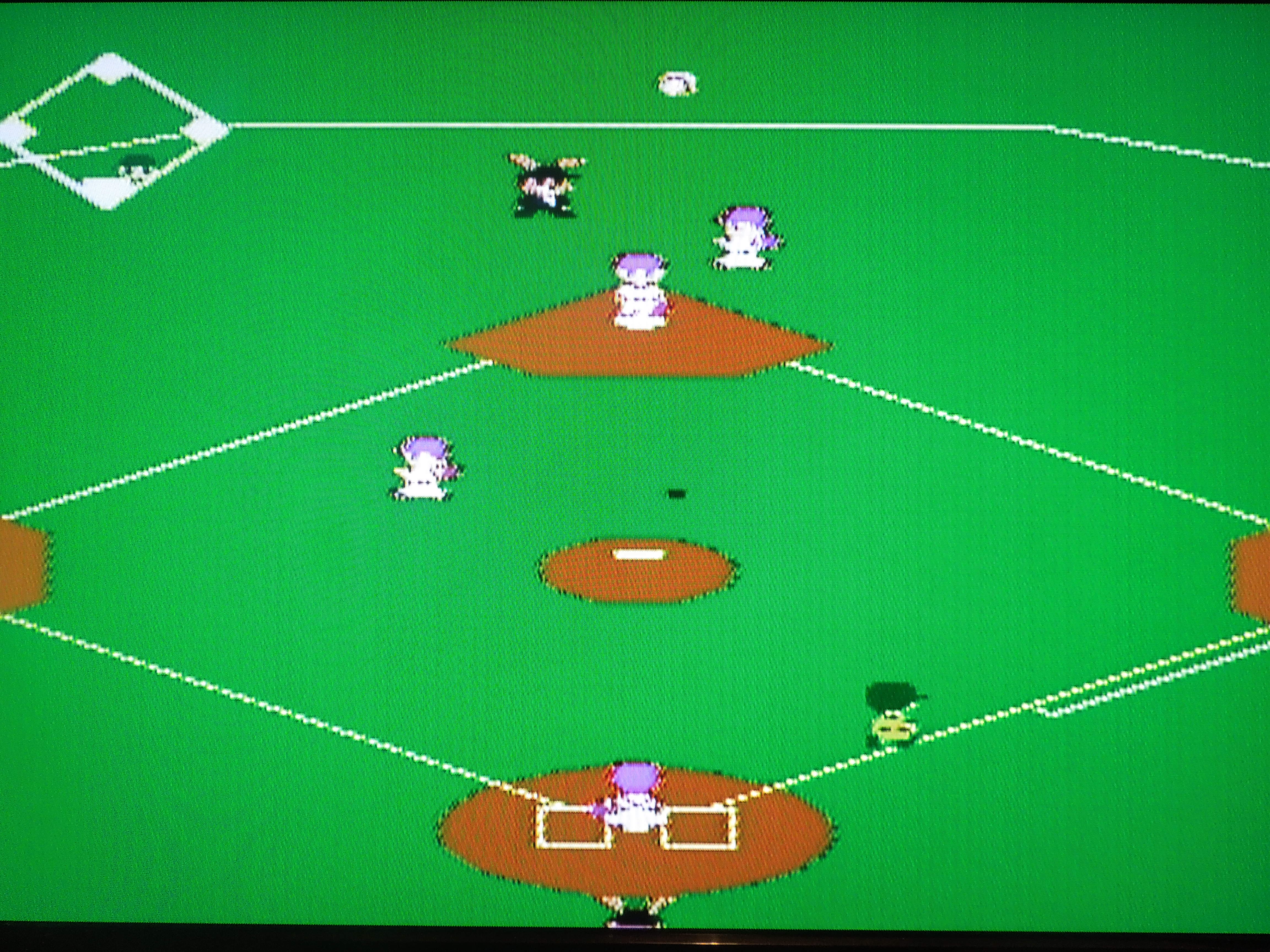
One Player Game: Pick a team and play a ‘season’ against the game’s other 11 teams. You pick which team you want to play first, second, etc. Beat them all, and you’re the World Champion.
Two Player Game: Play a three game series against a friend (even if one player wins the first 2 games, you’ll still play a 3rd game to go for the ‘sweep’).
One Player All-Star Game: Choose the Ultra League or Super League (All-Stars) and play a three game series against the CPU.
Two Player All-Star Game: One player selects the Ultra League, the other picks the Super League – best of 3 games series.
Spectator Mode: Pick two teams and watch a game.
Password: After winning a game in one-player Season Mode, you’ll get a password. Enter it here to continue your season.
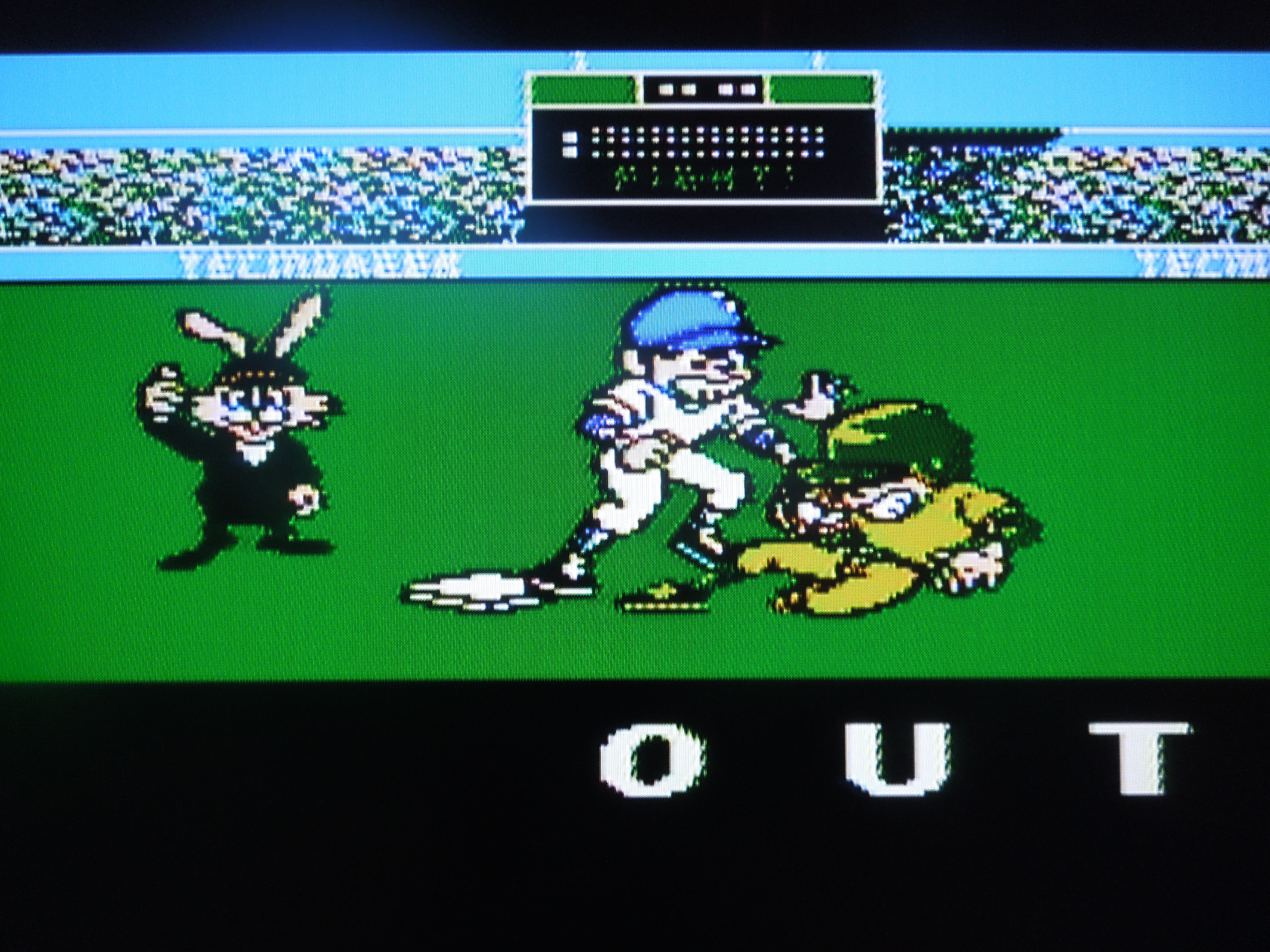
The Tecmo Bunny calls the game fair and square.
(Notice the ‘TecmoBeer’ advertisement on the wall)
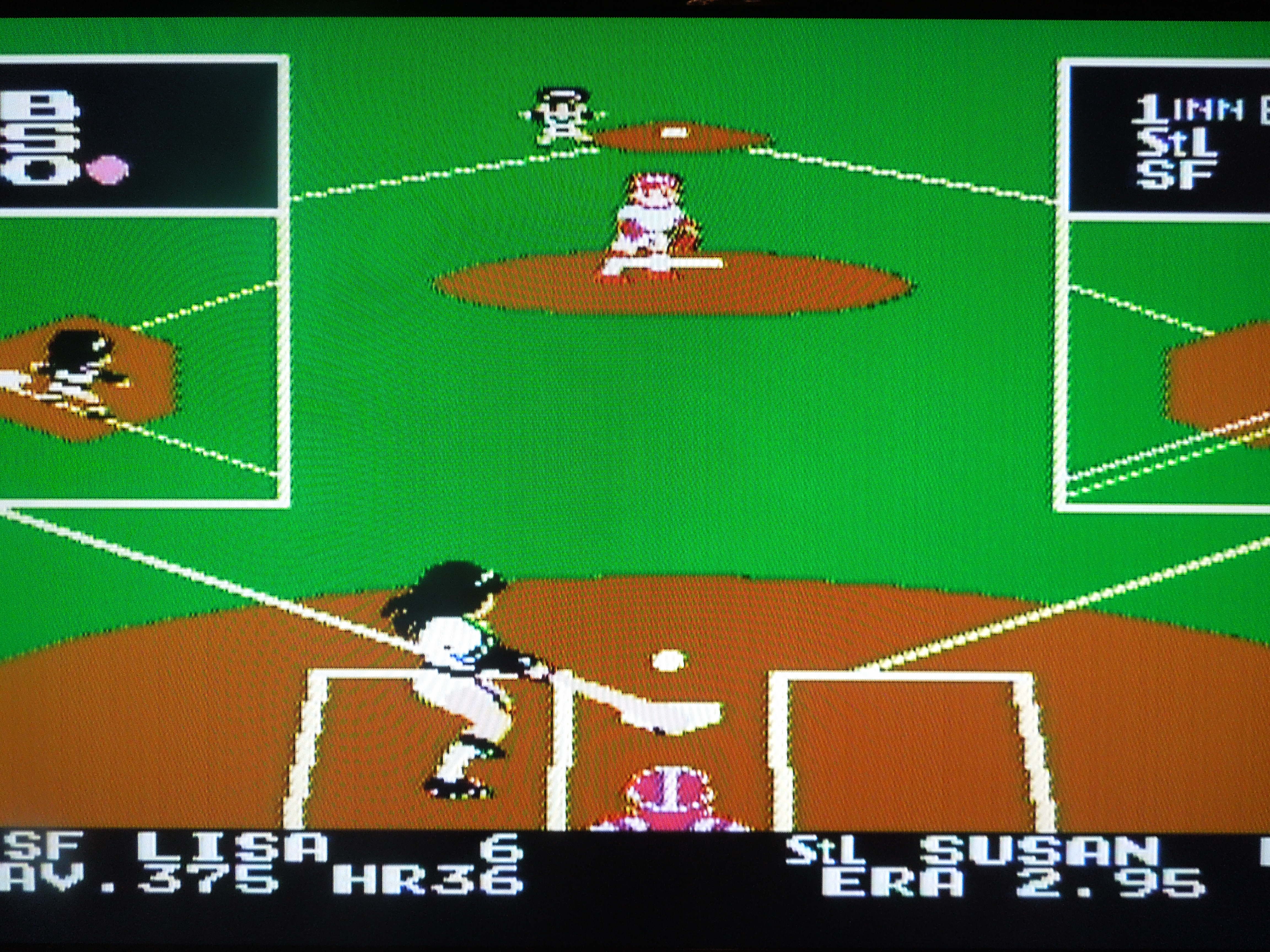
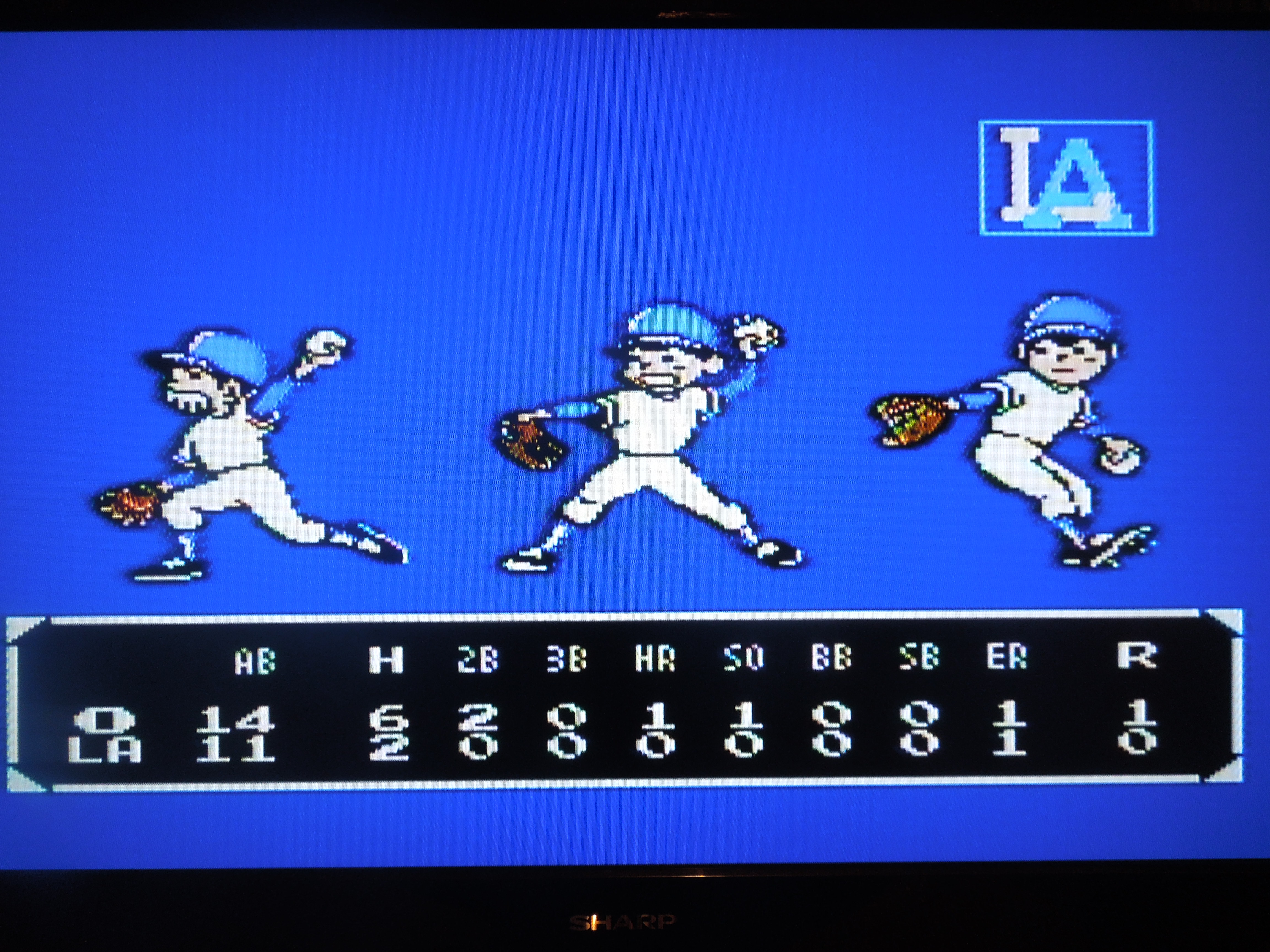
Teams: There are 12 available baseball teams in Bad News Baseball. There are no real player names or nicknames for the teams, as the game had no official MLB licenses. Some of the teams’ colors reflect their cities’ real-life professional team colors, like Oakland (green and yellow), while others do not, like Atlanta (white and pink). Each one has its own strengths and weaknesses. For example, Boston is excellent at hitting, but has slower’moving players. Texas has excellent pitchers, but not a lot of great hitters. You can view the stats for your players before games begin, including Arm Strength, Running Speed, Batting Average, Homeruns Hit, etc (you can also see some of these stats for each player when he comes to bat). You can change up your lineup before each game, and it’s good not to simply ‘press start’ and skip this, because often you’ll have a really good homerun-hitter or super fast player (great for stealing bases) that is warming the bench unless you swap him with someone in your starting lineup.
Super League – Boston, Detroit, Minnesota, Oakland, Texas, Toronto
Ultra League – Atlanta, Chicago, Los Angeles, New York, St. Louis, San Francisco
Cutscenes: What makes Bad News Baseball particularly memorable are the cutscenes. During big plays or close plays, cutscenes play that show a close up of the action. These typically occur during homeruns and close plays at bases, but also after wins and losses. Hit the ball out of the stadium and you’ll get a cutscene of the baseball headed towards the moon! Run for homeplate just as the throw is reaching the catcher and you’ll get a close up of a frantic catcher and a sliding runner. The cutscenes are very ‘bang bang!’ just like dramatic close plays in baseball, and you’ll know immediately if you were out or safe because the game has a voiceover for “Out!” or “Safe!” Beat the season mode and win the World Championship and you’ll get a cutscene that is equally bizarre and awesome – I won’t spoil it for you.
You can play as Girls’ teams if you enter a code.
Girls Mode: Hold Controller 1 down and left and Controller 2 up with the game powered on, then press Reset. Now you can play the Girls Mode. The teams are all the same, but the boys/men have been replaced with girls/women. This is a hilarious real quote from the game’s instruction manual: “Unfortunately, in this mode, the zoom-up display (cutscenes) shows only boy players. Sorry for letting you down.” I expected better from you, Tecmo.
Music & Sound: Very enjoyable. Different themes play for different teams, many of which stick in your head. The opening theme of the game is great, too. Sound effects are very good, from the crack of the bat, to the sound of dirt being kicked up when you slide, to the cheer of the crowd for hitting homeruns.
Password System: While the game’s ‘save system’ is a rather long password you’ll receive after winning games, it works great, and is more reliable than an old game battery. The game doesn’t count losses, but the password will remember which teams you’ve beaten, and they’ll no longer be selectable from your season roster once you enter the password. More importantly, and amazingly, frankly, is the password retains your pitchers’ stamina. So if you used your top two pitchers in Game 1, they’ll still be somewhat depleted for Game 2, so you’ll need to pick someone else from your bullpen of 6 pitchers. *It’s a good idea to keep a notebook handy for this game. Make sure you write down the password carefully, because 1 mistake will cause you to loose your spot in your Season.
Difficulty: Fair. Some teams you’ll dominate, and you won’t be able to stop hitting homers or getting hits. Other times you’ll get dominated, as your club won’t be able to get anything going. Sometimes you’ll play evenly matched games that come down to the final innings. The game plays under ‘Japan’ rules, which means you can play extra innings, but only up to 12. If you’re still tied after the 12th inning, the game will be called a draw (if you draw a team in season mode, you’ll have to play them again until you get a proper win).
Knock Outs: Sometimes, your players get ‘knocked out.’ You’ll know a player is knocked out if he is laid out on the field with stars circling his head. A KO’ed player will get up after a few seconds. KOs happen when a batter line drives a ball right into an in-fielders head or when an outfielder runs into the wall when going for a ball at the wall.
Diving and Jumping: A great feature of Bad News Baseball is the ability to dive for balls or jump for balls when you’re playing on defense. B + Up makes you jump vertically. B + Left or Right makes you dive. This allows you to make some spectacular catches or diving saves on balls that otherwise would go over your head or roll just out of your reach.
12 teams are available to choose from.
Computer: The computer AI (artificial intelligence), which can easily destroy you in some games with homerun hitters, can be taken advantage of in some situations. For example, if you have a runner on 3rd and 0 or 1 out, bunt the ball left or right. The pitcher will always run up, pick up the ball, and throw the runner out at 1st, even if it’s clear he could pick you off at home. It’s a great way to get runs. Another example of taking advantage of the computer: if you’re rounding 2nd, trying to make it to 3rd, and you realize the throw is going to beat you there, go ahead and run back to 2nd, even if you’re almost to 3rd. The computer will never throw the ball back to 2nd or try to catch you in a run-down, even if it’s obvious they could bust you for an easy out.
The umpire is a bunny? Heck yes, the Tecmo Bunny. This was Tecmo’s mascot – he appeared in other games also, like Tecmo Bowl Arcade and even on the game label of Tecmo Bowl for the Famicom.
Yep, Mr. T is there to congratulate you if you knock one out.
So, where can I find this game? It’s easy to find an inexpensive copy on eBay. The game has not been released for any download services, like Nintendo’s eShop. You can play the rom on a computer emulator.
Conclusion: Bad News Baseball is a fast, addictive NES baseball game. It has just enough ‘extras’ in gameplay to make it (way) better than games like RBI Baseball or Major League Baseball, but not too many added features that ruin the gameplay by making things too complicated. The password system is considered by some to be archaic, but I like it, and trying to beat all the teams in the game can be challenging. The cutscenes really make this game come into its own, and weren’t done in just a ‘tacked on’ kind of way. Everything controls well, and there is certainly strategy in rotating your pitchers, using pinch hitters, and looking at players’ stats.
The Southern Gentleman’s Opinion and Letter Grade: Is Bad News Baseball the best baseball game on the NES? The argument could certainly be made. It holds up today in a way that other NES baseball games do not. Recommended if you ever enjoyed any other NES baseball games – because this game is probably better. B+
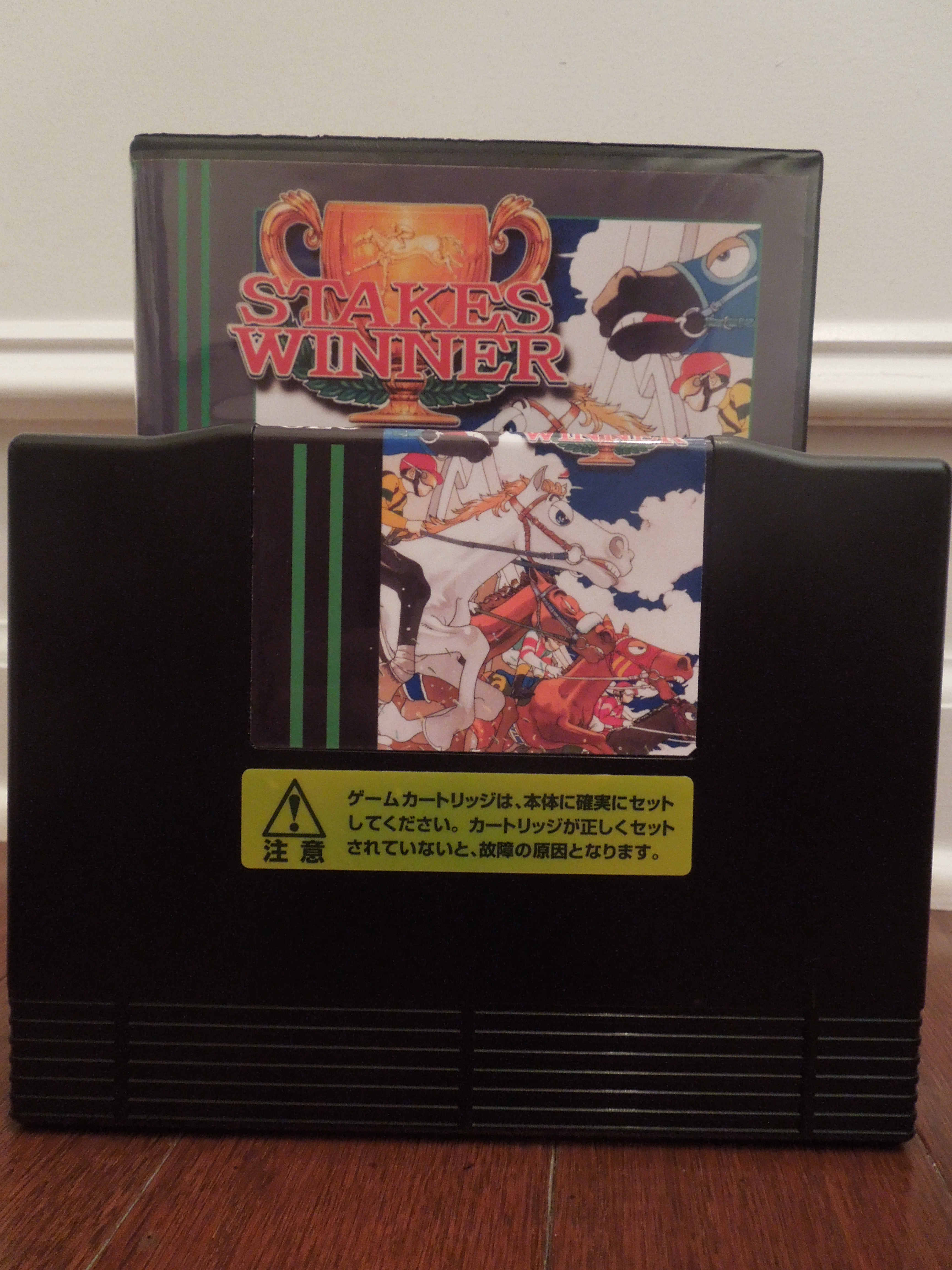
Stakes Winner for Neo Geo AES Stakes Winner is extremely rare for the AES; however, MVS arcade cartridges can be converted into AES cartridges.*Check out my youtube video about this game: My channel is ORO Video Games (just type it in the search engine). I’ve reviewed this game and several others. Thanks & God Bless!
Note 1: Like Neo Geo games? Check out my other Neo Geo reviews!
Note 2: This game was played on a Neo Geo AES home console that has been modified to output in component video (red, green, blue). It was connected to a 32-inch HD tv.
Quick History: Stakes Winner was released for the Neo Geo AES home console in 1995 in the United States in very small quantities. In Japan, where horse-racing games are more popular, the game was released in somewhat larger quantities – there just wasn’t a huge demand in the U.S. though, so original U.S. copies are exceedingly rare. Stakes Winner was also released for the Neo Geo MVS (arcade cabinet) in much larger quantities, and many of the MVS arcade cartridges can easily be found today. Because AES home console cartridges and MVS arcade-cabinet cartridges like Stakes Winner are the exact same game, today, MVS cartridges can be converted to AES cartridges. The copy of Stakes Winner used for this review is a professional AES conversion cartridge (meaning the board from the MVS arcade cartridge of Stakes Winner was placed into an AES cartridge).
Players: 1 or 2 player
Gameplay: In Stakes Winner, you compete in twelve horse races in Japan. Each race includes 8 horses, and the goal is to finish in the top 3 (preferably 1st) in each race. If you finish in the top 3, you’ll get a pre-determined cash-payout based on your placement. Part of the fun of the game, in addition to the racing, is trying to accumulate as much money as possible (the highest race payout is $1,300,000), making getting a high score part of the game. If you don’t finish in the top 3, you’ll have to use one of your 4 Credits (continues) and try the race again. Use all 4 of your Credits, and it’s Game Over!
Naming your Jockey: At the beginning of the game, you name your jockey. You have up to 4 letters to use, and the name you enter will be used throughout the game.
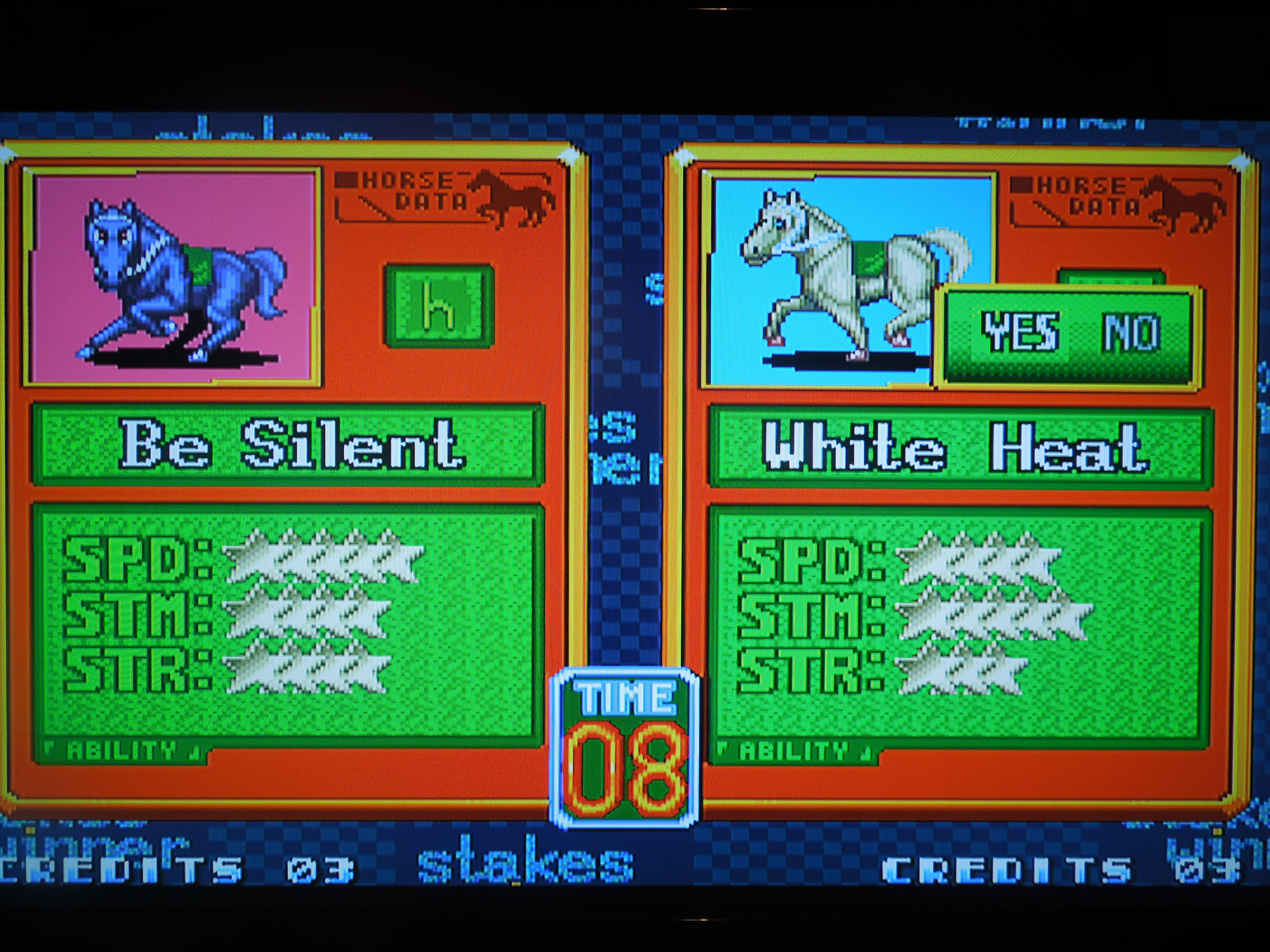
You have 8 horses to choose among, all with their own advantages. You’ll have 3 chances to ‘train’ your horse in order to boost his stats.
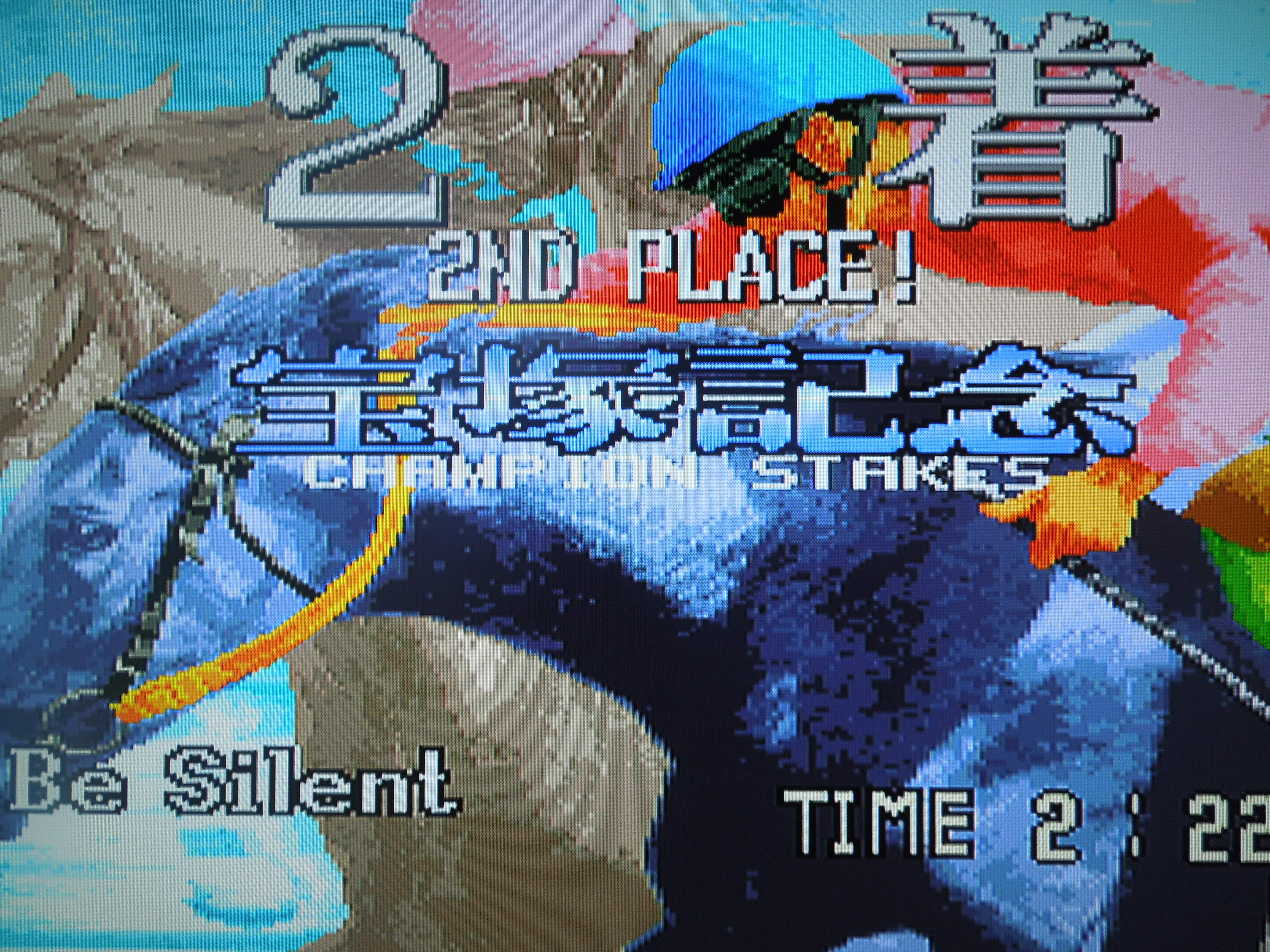
Selecting your Horse: There are 8 selectable horses in the game, each with their own particular advantages: Asian Hope, Be Silent, Brave Lady, Euro Union, Hot Sand, Sky Dancer, U.S. Fighter, and White Heat. The horses have 3 attributes – Speed, Stamina, and Strength – with a set number of stars that indicate how strong they are in each area. Speed tells you how fast their top speed is; Stamina tells you how long they can hold out running without getting tired; Strength tells you how fast they can run uphill. Between certain races, you have opportunities to ‘train’ your horse in 1 of 3 selectable areas by having them run an obstacle course. If you do well on the obstacle course, you’ll gain extra stars, boosting your horse’s stats and overall performance. Each horse is surprisingly different, and finding one that suites your playing style is quite fun. For example, some horses are quick out of the gate, but taper off because of a low top speed; some are slow out of the gate, but speedy in the home stretch. If you lose a race, you can change horses if you choose to.
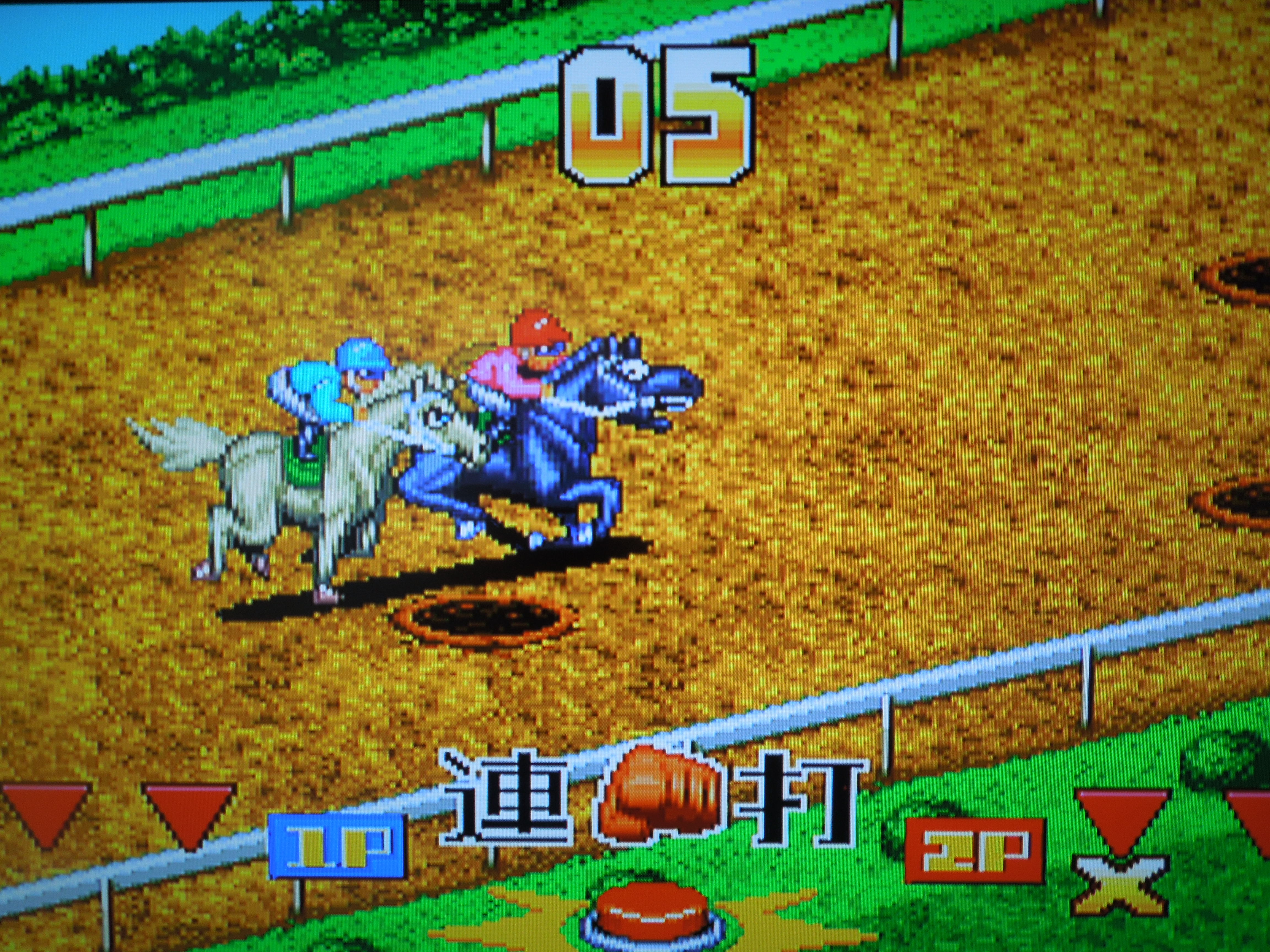
Control: While riding your horse, tapping A pulls the reigns, making your horse gallop at a steady rate – this uses only a little of your horse’s ‘power bar.’ Tapping B makes you whip your horse, causing him to gallop much faster – this uses a lot of your horse’s power bar. If you whip your horse for too long, he’ll start shaking his head (a small ‘horse-head’ icon is on-screen during races that shows how your horse is doing) – if you keep whipping him after he shakes his head, he’ll stop running and walk slowly, exhausted. Note: In the last few hundred meters of a race, you can whip your horse repeatedly without him shaking his head – the horse senses the end of the race, evidently. If you use all of your horse’s power bar before the finish line, your horse will stop altogether, and you’ll be disqualified. While running, if another horse is in front of you, you can double tap forward to butt the horse out of your way, which is quite useful. Also, if a rider is coming up hard on your heels, you can double tap backwards and you’ll brake, making the horse behind you stall.
Rankings are displayed after each race.
Items: While racing, certain icons will appear on the track, and these can be the difference between finishing in the top 3 or the bottom 5. Simply riding your horse over these icons picks them up, and they take effect immediately. ‘Wing’ icons give your horse a tremendous 3-4 second speed boost. ‘Carrot’ icons replenish some of your horse’s power bar, extremely useful during long races when your horse is low on power. ‘Poison Bottle’ icons cause your horse to slow down considerably for 3-4 seconds. ‘Mole hole’ icons slow your horse down for approximately 2 seconds. ‘Question Mark’ icons give you one of the 4 aforementioned items. ‘Exclamation Point’ icons…I can’t tell what effect these have, but it doesn’t seem to be
anything negative, at least.
2 player mode: 2 player mode is exactly like 1 player mode – no split screen or anything like that, like in some racing games. A nice feature of 2 player mode is if one player gets left behind, the game will automatically push him or her forward, not far behind the other player. This is because the camera always follows whoever is in the lead. This method works well if you’re playing with one experienced player and one inexperienced player, particularly. If you’re both good, however, you’ll both probably stay within a few meters of each other anyway. Also, both players can choose the same horse.
The amount of money you earn serves as your high score.
Music & Sound: A digitized version of ‘Camptown Races’ plays during certain parts of the game, adding to the horse-racing atmosphere. During races, catchy tunes play that are appropriate for the sport and compliment the gameplay well. During the end of races, an upbeat and frantic tune plays, letting you know it’s time to start whipping your horse to push hard for the home stretch. The sound effects are well done as well, from the crack of the whip, to the yelling of the jockeys when you bump their horses (which is in Japanese!), to the neighing of the horses.
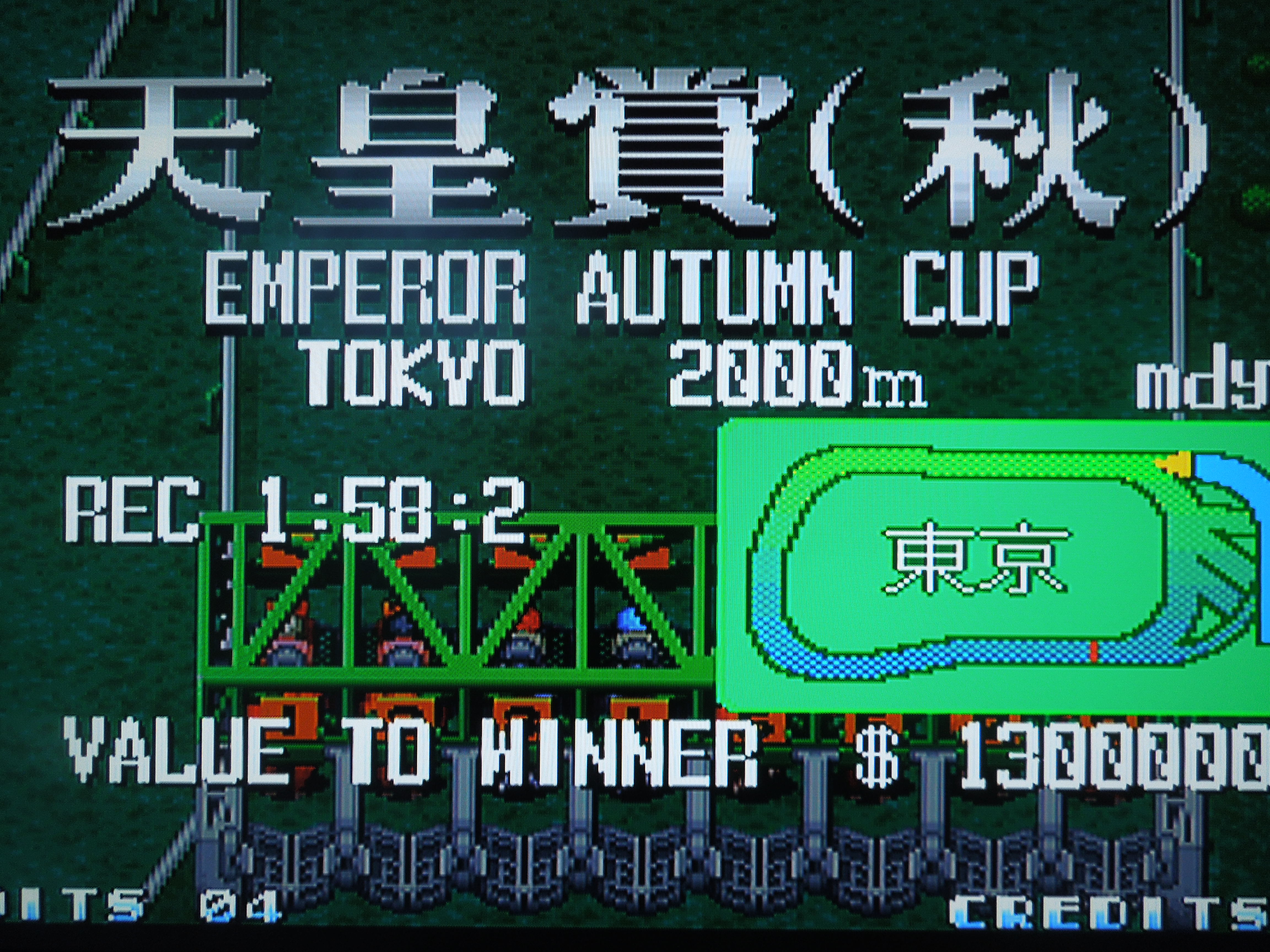
Races: Here is a list of the twelve tracks in Stakes Winner. Finish all twelve in the top 3 before losing all 4 of your Credits, and you’ll beat the game.
Race Name Distance in Meters Payout for 1st
1. Maidens 1,000 m $59,000
2. Sapporo Juvenile 1,200 m $320,000
3. Juvenile Stakes 1,600 m $540,000
4. 2000 Guineas 2,000 m $970,000
5. Derby Stakes 2,400 m $1,300,000
6. St. Leger 3,000 m $1,110,000
7. Japan Grandprix 2,500 m $1,300,000
8. Emperor Spring Cup 3,200 m $1,300,000
9. Champion Stakes 2,200 m $1,300,000
10. Emperor Autumn Cup 2,000 m $1,300,000
11. Japan Cup 2,400 m $1,300,000
12. Japan Grandprix 2,500 m $1,300,000
*Note: I’d read online that 2 additional ‘hidden’ races, the Breeder’s Cup Classic and Prix de le Arc Triumphe, became available if you finish in first place in the 5th (or 9th) race or 12th race, respectively. However, the Breeder’s Cup Classic seems only to be available when the game is on Normal, MVS, or Hard, and it seems to be a random selection of which race (5th OR 9th) you need to come in 1st in in order to unlock the Breeder’s Cup. In order to get the true ending of the game, you’ll have to unlock and come in 1st place on the Prix de le Arc Triumphe.
Each track has its own distinct length and payout for finishing 1st.
Difficulty: Before each match, you can set the difficulty from Easy, Normal, MVS (arcade difficulty), and Hard. You won’t have much trouble beating the game on Easy or even Normal.
Memory Card: If you have a Neo Geo memory card, you can save your game after you lose all 4 of your Credits. You can then re-start with 4 credits from the last race you were on. While this is helpful, the true challenge of the game is trying to beat it using only the 4 given Credits, or even only 1 Credit.
Language: Although this review is for the U.S. version of the game, you’ll notice Japanese writing in some parts of the game. This in no way affects gameplay. Everything major is in English.
So, where can I find this game? Good luck finding an original U.S. AES copy of Stakes Winner since they’re so rare. There are many MVS arcade copies available however, and some websites on the Internet specialize in professionally converting MVS arcade cartridges to AES home console cartridges. There is also a Neo Geo CD ‘special edition’ version which adds some features, but I believe it is a Japan-only release. You can download the rom for play on a computer, of course.
Note: Stakes Winner was also released for the Sega Saturn, but that seems to be some type of ‘special edition’ version, like the Neo Geo CD version. In that version, features are added like ‘breeding race horses,’ and training your horse before big races. Additionally, there is a ‘best of 3 races’ 2 player VS mode, but you cannot play through the game together like on the Neo Geo AES version. While the Saturn version seems to have some intriguing ideas, it takes away from the ‘pick-up-and-play, arcade’ feel of the Neo Geo AES version. Also, it was a Japan-exclusive game, and almost everything is in Japanese, including the game’s multiple menus and constant dialogue boxes from your ‘coach’. If you can read Japanese, it’s probably a good ‘special edition’ – if not, I wouldn’t recommend the Saturn version.
It’s not always a sunny day on the track.
Conclusion: It’s a shame that horse-racing games never caught on in the United States, because Stakes Winner is awesome. After a few races, I was hooked. It’s unlike any other racing game I’ve ever played, and there’s far more strategy involved than other racing games (easy-to-learn strategy, mind you). So much of the game has to do with pacing your horse, then making your move at the right time. It’s extremely addictive. The game looks great – very colorful tracks, horses, and jockeys (except when it’s a rainy day on the track, but the dreariness is a nice change-of-pace), and the music and sound effects complete the package.
The Southern Gentleman’s Opinion and Letter Grade: I didn’t think this game would be anything special, but was thrilled to be proven wrong. Recommended if you’re looking for something new. A
Doki Doki Panic for NES Brother carries a Bigface item in DDP. In SMB2, Brother was changed to Toad and the controversial Bigface became a turtle shell.
Note 1: Like platforming/action games? Check out my reviews of Kid Dracula, I’m Kid Dracula, Splatterhouse, and Super Back to the Future, Part II!
Note 2: This game was played on an NES 101 model (toploader) that was modified to output in AV composite (red, yellow, white) just like the original NES. It was connected to a 32-inch HD tv.
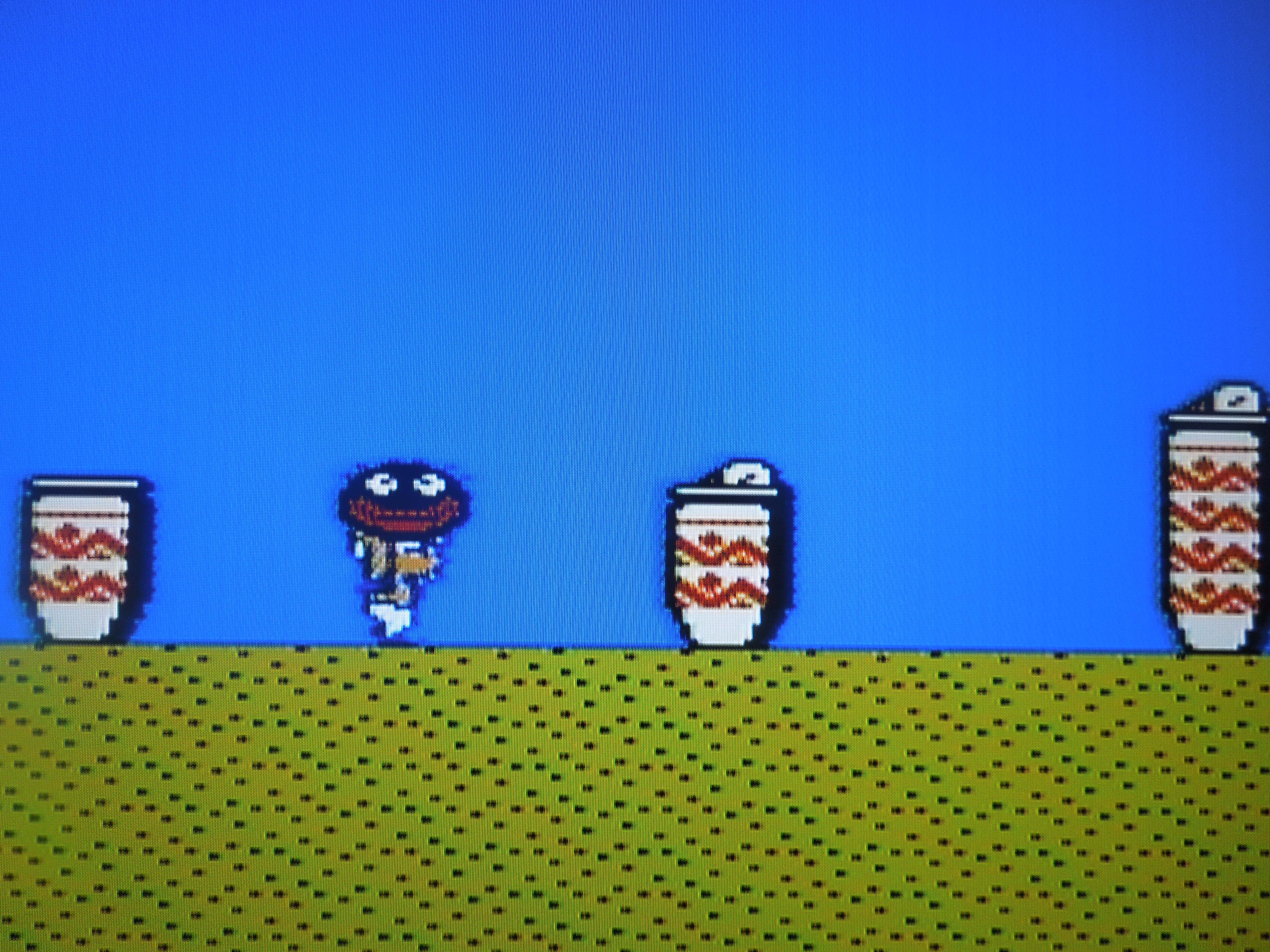
Quick History: Yume Kōjō: Doki Doki Panic was originally a disk game released for the Famicom Disk System, a console that was exclusive to Japan. The game came out in 1987. In 1988, Doki Doki Panic was modified and released in the U.S. as Super Mario Bros. 2, which is a well-known American game today. While the gameplay in Super Mario Bros. 2 was essentially the same as Doki Doki Panic, the characters, the story, the game’s title, and some of the items in the game were altered for the U.S. release. Many U.S. gamers were initially confused as to why Super Mario Bros. 2 looked and played so much differently than the original Super Mario Bros., and this was the reason – because it wasn’t originally a ‘Mario’ game at all! The version reviewed here is a fan modification of Super Mario Bros. 2 that removes the Mario characters and some other ‘U.S.’ added items and replaces them with their original characters, item incarnations, and story from Doki Doki Panic. This game is notexactly the same as the original Famicom Disk System release, as it keeps many elements from Super Mario Bros. 2. (like the ability to dash) that were not in the original release. The primary changes in this version are simply the characters and items. This game is basically like playing the U.S. Super Mario Bros. 2 with Doki Doki Panic characters and items.
Story: This NES Doki Doki Panic mod basically keeps the story from the original FDS release. Two young children, Joe and Bob, are reading a story book when the hand of the evil Wart reaches out and grabs them, pulling them into the story. A family, consisting of Papa, Mama, Brother, and Sister jump in after the children in order to rescue them.
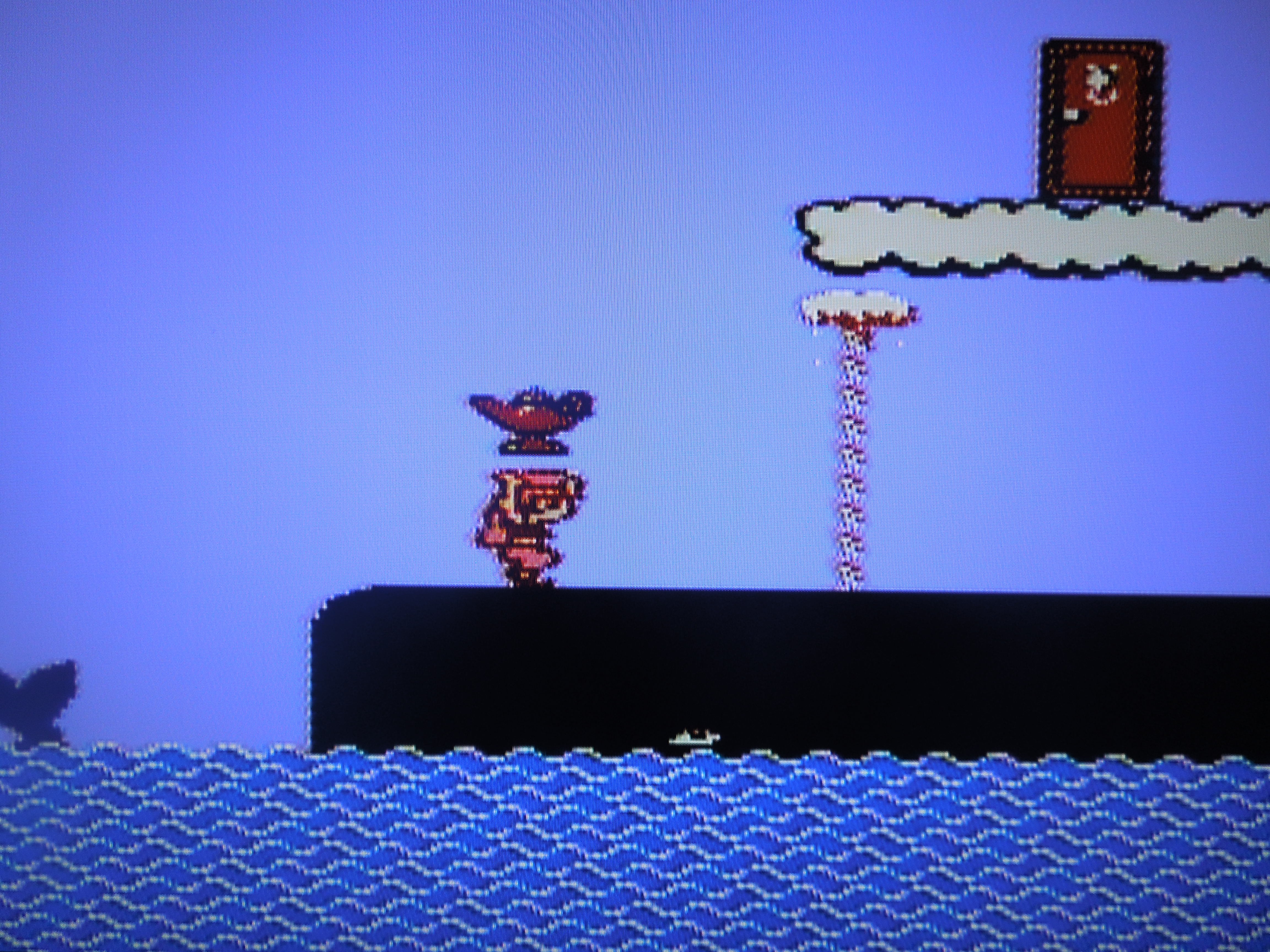
Sister carries a magic lamp in Doki Doki Panic. Sister became Princess Peach and the lamp a potion in Super Mario Bros. 2.
Controls: B makes you run if you hold it down. Pressing B while on top of some enemies, face blocks, or vegetables causes you to pull them up. Pressing B while holding something causes you to throw it. A makes you jump. Holding down makes you duck, and after a few seconds, your character will turn white, and you can then press A to execute a super jump.
Gameplay: You must travel through 7 levels, each with 3 stages (except for level 7, which has 2 stages), to rescue Rick and Bob from Wart. At the beginning of each stage, you can select between Papa (changed to Mario for the U.S. game), Mama (later changed to Luigi), Brother (later changed to Toad), and Sister (later changed to Princess Peach). At the beginning of each stage, you are allowed to change which character you want to play as. Each of the 4 family members controls differently: Papa is balanced with an average jump and average speed of picking up items; Mama jumps the highest, but is the slowest at picking up items; Brother has the lowest jump but picks up items the fastest; Sister has the 2nd highest jump (and the ability to kind of ‘hover’), but has below-average speed picking up objects. During each level, you can find magic lamps (later changed to magic potions in the U.S.) that allow your character to temporarily enter Sub-Space in order to collect Heart power-ups (later changed to Mushrooms in the U.S.) or coins to use in bonus games for extra lives between levels. You’ll frequently face mini-bosses at the end of most stages.
So, where can I find this game? You can find the rom online (again,this is not the original Doki Doki Panic FDS game, but a mod that puts those characters into Super Mario Bros. 2 the way they were supposed to be) for play on a computer emulator. The rom can be put onto an NES cartridge, and there are many NES reproduction websites on the Internet that can create a cartridge for you, which is the best way to play the game.
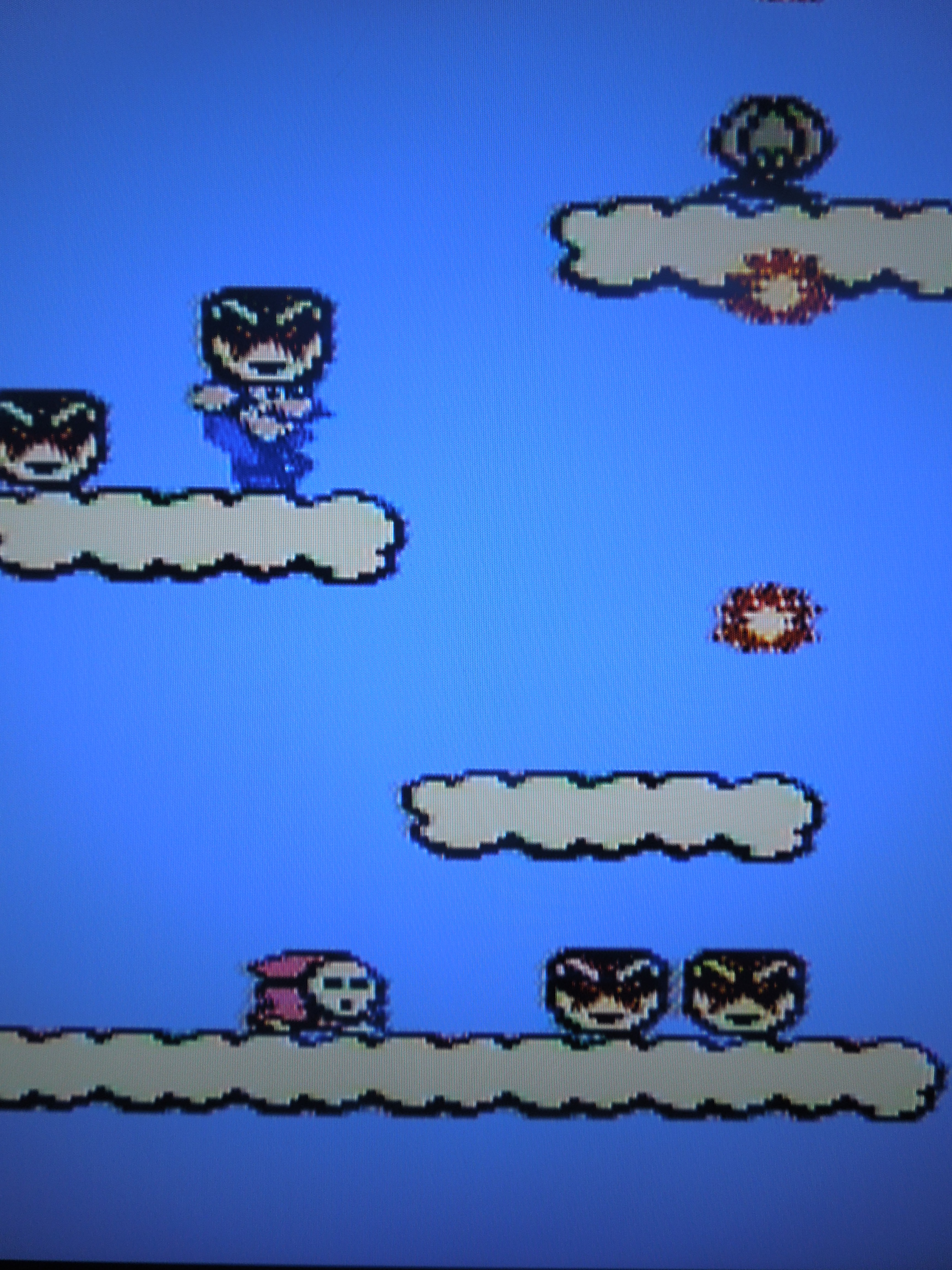
Game glitch: If Mama is little and picks up an object, she turns into a blue Luigi.
Interesting quirks: Brother and Sister don’t have a ‘little’ mode when they get to only 1 bar of health left – they’re always little. Mama, when little, becomes Luigi when ducking, climbing, or holding an item/enemy – albeit a blue Luigi.
List of major changes in this version of Doki Doki Panic: Mario was changed back to Papa. Luigi was changed back to Mama. Toad was changed back to Brother. Princess was changed back to Sister. Red turtle shells were changed back to Bigfaces. Magic potions were changed back to Magic lamps. Exit Hawk Faces were changed back to Exit Mask faces. Mushroom Blocks were changed back to assorted face blocks. Phantos (those things that chase you when you pick up a key) look like they originally did – not as evil as they do in SMB2.
Ending: The ending of the game is still the Super Mario Bros. 2 ending. When Wart is carried out at the end of the game, however, the 4 Doki Doki Panic characters are present instead of the 4 Mario characters, but the Mario ‘dream’ sequence still plays.
Why such a short review? Chances are if you are a gaming enthusiast, you’ve probably played Super Mario Bros. 2, and because Doki Doki Panic basically is SMB2, I don’t think much more need be written.
Conclusion: Doki Doki Panic is a fun game, and it’s easy to see why this was the game that was chosen to create Super Mario Bros. 2 by changing the characters. It has a decent amount of challenge, but with the ability to find ‘secret warps’ in particular stages, it won’t take you too long to beat. It’s interesting to play the game with its original characters.
The Southern Gentleman’s Opinion and Letter Grade: Recommended if you’re a huge Super Mario Bros. 2 fan. B
God Bless! Proverbs 3:6
The ending of the game has the Doki Doki Panic characters (somewhat glitchy), but it is still the ‘Mario’ ending.
Warriors of Fate for Sega Saturn Warriors of Fate was never ported to any U.S. home consoles.
Note 1: Like Beat ‘Em Ups? Check out my reviews of Bare Knuckle III, Crows: The Battle Action, D & D, Double Dragon II, Final Fight Guy, Final Fight II, Mighty Final Fight, Nekketsu Oyako, and Sengoku 3!
Note 2: This game was played on a U.S. Sega Saturn with a 4M Action Replay cartridge plugged into the cartridge slot to allow Japanese games to play on the console. The console was connected to a 32-inch HD tv using S-video cables.
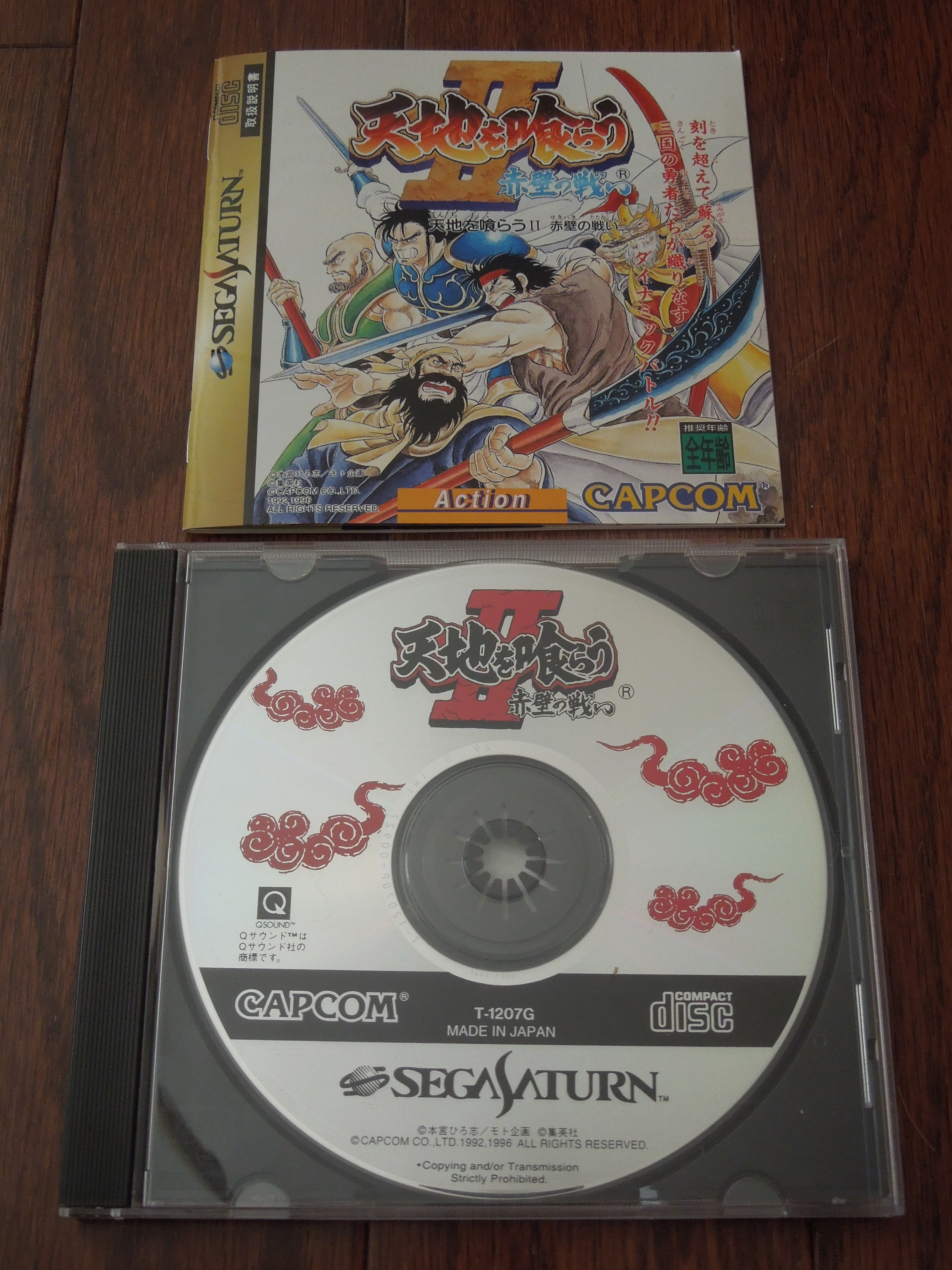
Quick History: Warriors of Fate, or Tenchi o Kurau 2: Sekiheki no Tatakai in Japanese (translated: The Devouring of Heaven and Earth II: Battle of Red Cliffs) was released for the Sega Saturn in 1996exclusively in Japan. The game is an arcade-perfect port of the arcade game released in 1992. There were 2 versions of the arcade game released in 1992, a Japanese version and an international (including releases in U.S. arcades) version. While the gameplay in both arcade versions was the same, the international version changed the story, changed the character names, and took out what was a somewhat-controversial scene. The version reviewed here, the Sega Saturn Japan-only release, is a direct port of the Japanese version of the arcade game, not the international version. The only differences between the Japanese arcade release of Warriors of Fate and the Sega Saturn port of Warriors of Fate were the addition of an Options menu in the Saturn release and a reduction in the maximum number of human players. In the arcade, up to 3 players can play at once; on the Saturn, only 2 players can play at once.
Story: Based on the historical novel ‘Romance of the Three Kingdoms,’ in Warriors of Fate, you fight as one (or two in co-op mode) of Liu Bei’s 5 warriors against the armies and generals of the ‘evil’ warlord Cao Cao, who is attempting to expand his territory and his power by conquering new lands and killing innocent people.
Control: Warriors of Fate utilizes only 3 of the Sega Saturn’s buttons (making it an ideal game for arcade sticks like the Real Arcade VF): Buttons A, B, and C. A swings you weapon or punches, depending on your character. B jumps. C executes your Special Attack, which drains some of your health when it connects with an enemy. Additionally, you have other special moves at your disposal. Pressing Down + B makes your character do a dash attack. Presing, Down, Up, A makes your character do a vertical jumping attack. You’ll automatically grab enemies when you get close to them. Pressing A + right or left with a grabbed opponent throws him. Pressing A + Down with a grabbed enemy, for some characters, executes a specific move like biting (Chou-Hi). Jumping (B) with a grabbed opponent followed by pressing A executes a special move, like a pile driver. Each of the game’s 5 selectable characters executes different moves.
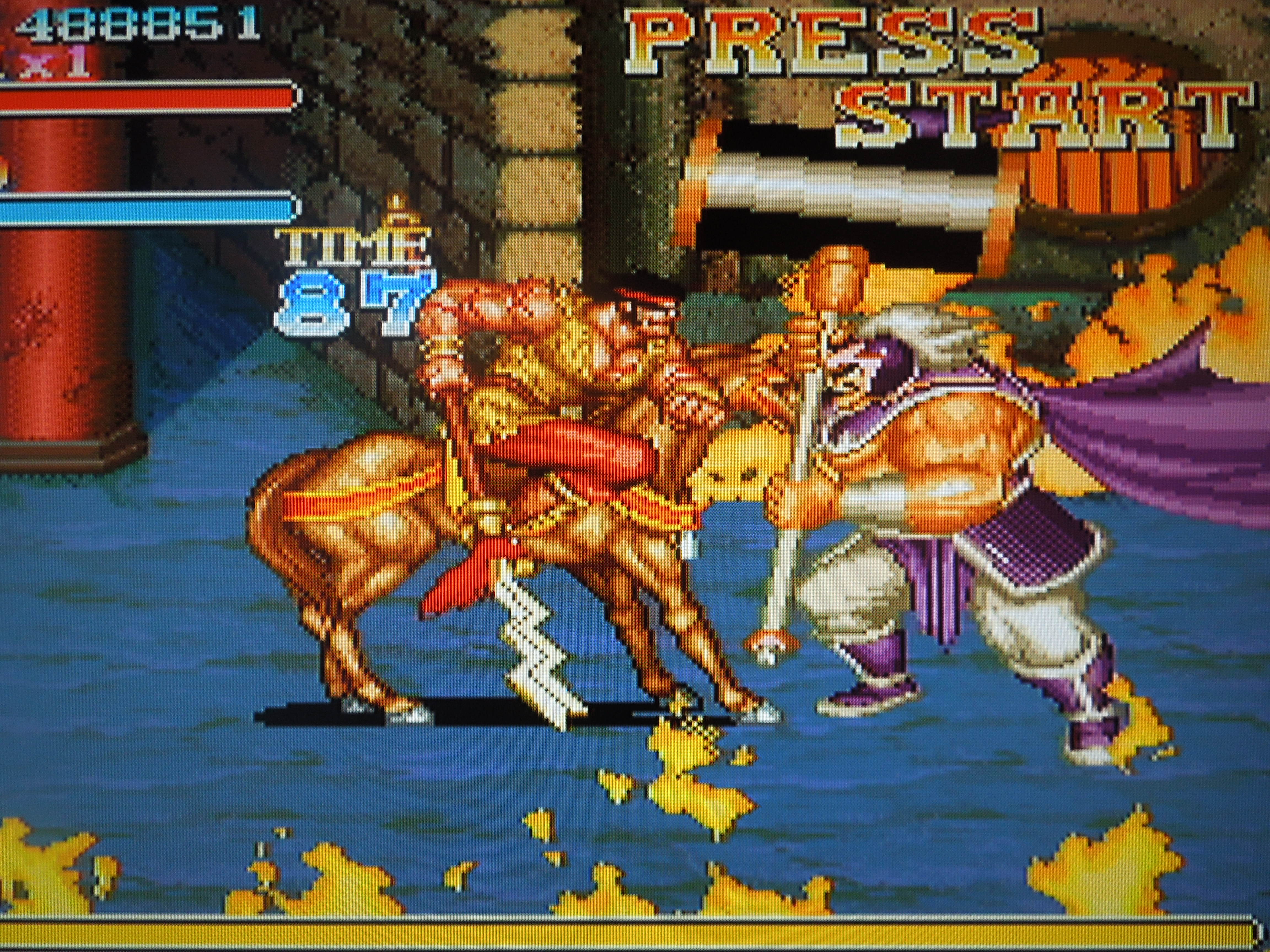
Battling on horse-back makes this Beat ‘Em Up stand out from the rest.
Controls on Horseback: At certain points in the game, you can battle on horseback, which is executed very well in this game. A swings your lance from horseback. A + left or right changes your direction as long as no enemies are around you. B + forward makes your horse charge. While charging, continually pressing B causes you to whirl your lance, knocking out multiple enemies and doing great damage. Rapidly tapping A while standing still causes you to execute a flurry attack with your lance. Getting in close to enemy soldiers and pressing A executes a spear-and-toss throw on individual soldiers. You can also still use your energy draining special attack by pressing C. Down + A will dismount. You can usually get knocked off your horse once and it will wait for you to return, but after a second knock-off, your horse will bolt from the battle.
Some characters are clearly better than others.
Characters: Kan-U, Chou-Hi, Chou-Un, Kou-Chuu, and Gi-En make up your selectable characters. Each vary in their playability in terms of speed and strength. 3 (Chou-Un, Kou-Chuu, Gi-En) carry weapons (swords or a bow) at all times, and 2 (Kan-U, Chou-Hi) fight bare-handed unless you pick up a weapon found in the game. Having played with all the characters, they don’t all seem to be balanced fairly. Kan-U and Chou-Hi (two bare-handed fighters) are both wrecking machines and great choices for trying to beat the game; Kou-Chuu and Gi-En (two characters with swords) are average – they don’t seem to do enough damage to enemies when you want them to); Kou-Chuu (archer) definitely seems far weaker than the other characters – expect to die a lot with him unless you find a way to master his abilities.
Gameplay: In Warriors of Fate, you take your character(s) through 9 rounds of Beat ‘Em Up action in combat against the armies of Cao Cao. Swarms of soldiers attack you at one time, so mastering the special moves is a must if you want to avoid getting killed often. At the end of each stage is a boss, one of the generals of Cao Cao. You’ll never fight the bosses alone either, as there are always enemy soldiers present to help their general. As you fight both enemy soldiers (which include foot soldiers, archers, bomb-throwers, wrestlers) and generals, you can execute ‘kill moves’ if you use one of your special attacks when an enemy is almost defeated. These kill moves cause your character to chop enemy soldiers in half along the mid-section (even bare-handed fighters Kan-U and Chou-Hi can do these). There are additional gory features to the game like blood spurting from enemies following Chou-Hi’s bite move, and blood issuing from characters shot with arrows.
The backbone of any good Beat ‘Em Up: Co-op gameplay.
Food, Special Weapons, & Treasure: Breaking open barrels and chests will reveal gold or other items that increase your point total, different food items to replenish your energy bar, or special weapons like huge swords, maces, and hammers that do massive damage to enemies. There are also 3 extremely powerful weapons hidden in certain stages of the game. You can use any weapon you find until an enemy knocks it out of your hands twice, at which time it will disappear.
Music & Sound: Excellent. Very dramatic overtures play during rounds, cutscenes, and in boss fights, and the battle slashes, death screams, and individual main character voice-overs are well-done.
Options: In the Options menu, you can change the control scheme and alter when your character gets extra lives from points acquired. The default extra lives allowance is ‘Every 200,000 Points,’ which is the best way to go if you want to beat the game. You can also select the game’s difficulty from Easy, Normal, or Hard.
You get exactly 10 credits to try to beat the game.
Credits: The game gives you 10 credits (shared by both characters in 2 player co-op), and you cannot alter this at all. No ‘Free Play,’ no adding or reducing the number of credits. You get two lives per credit, but remember you do gain extra lives from gaining points, so staying alive and racking up points counts. Also, you can change characters every time you continue and use a credit.
Loading Times? Very, very short between stages and cutscenes, not an issue at all.
Language Barrier? No, basically. The story in the game is in Japanese, and there are cutscenes between each of the games 9 rounds that advance the story, complete with Japanese text. However, even without being able to read the language, the scenes do a good job of telling the story – Cao Cao’s army is slaughtering innocents and you must stop them. Almost everything else is in English – the Options menu, the character names (on the gameplay screen at least, although they’re alongside the Japanese letters of the characters’ names), enemy names. The ONLY time there’s an issue is at the very end of the game, when you’re given the choice to let Cao Cao go, or kill him. Because the text is in Japanese, you won’t know what you’re selecting. The top choice is to fight him, and the bottom choice is to let him live. If you choose to fight him, you’ll only have 15 seconds to beat him or he’ll escape.
So, where can I find this game? Ebay. The arcade version was ported to both the Sega Saturn and the original Playstation, although I’ve read that the Playstation version is inferior and not arcade-perfect. You can also download the rom for play on a computer emulator.
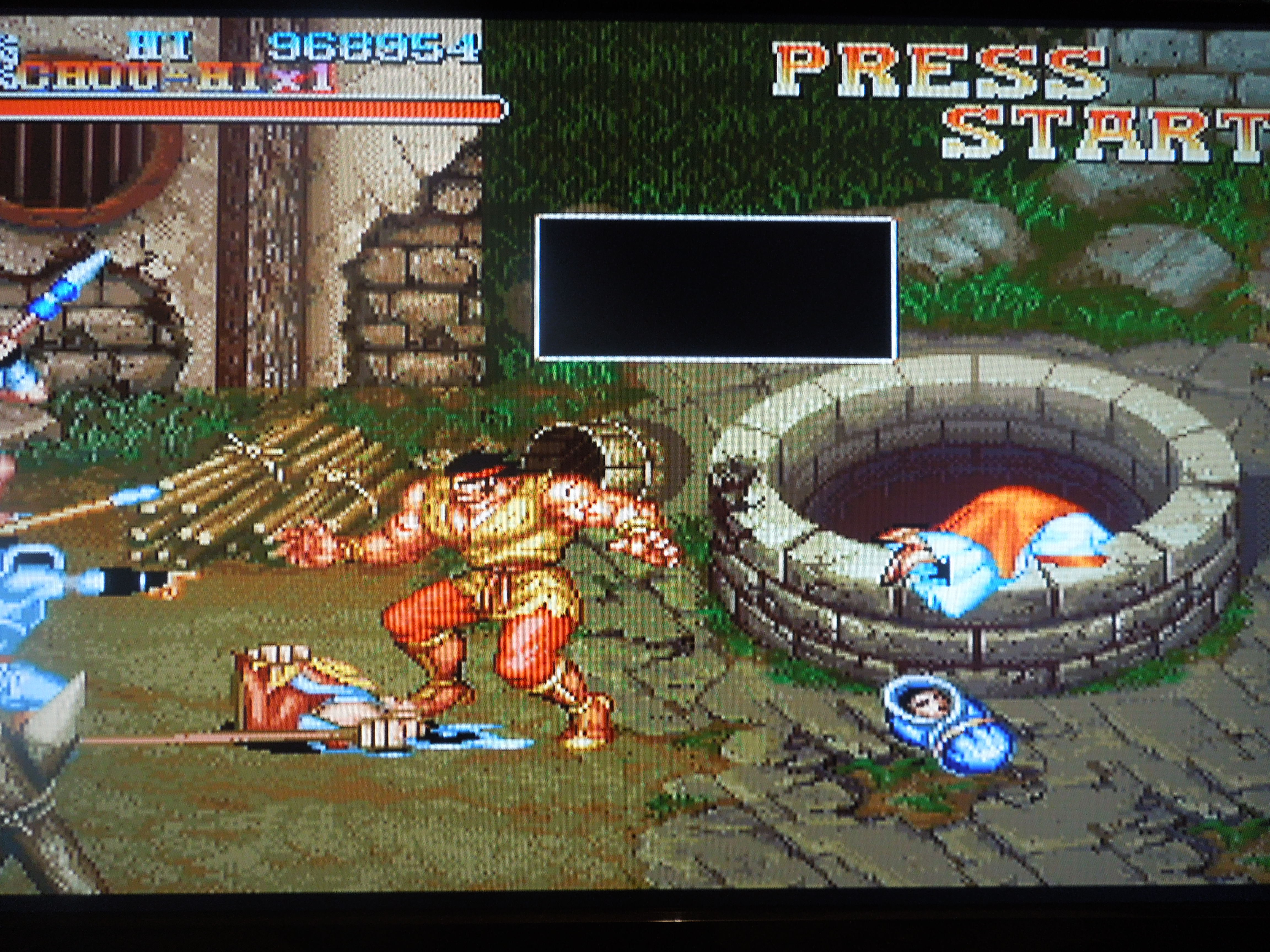
This controversial scene where a woman abandons her baby before throwing herself down a well was removed from the international arcade version of Warriors of Fate.
Conclusion: Warriors of Fate for the Sega Saturn is another outstanding Beat ‘Em Up. The control, the graphics, and the sound all come together wonderfully to create a memorable gaming experience. I particularly like the ’10 credits only’ design. The fact that the game isn’t set to ‘Free Play,’ but instead, assigns you an unchangeable number of continues means you’ll have to actually perfect your playing abilities. 10 credits seems just right for this game, too – there have been many times I’ve played all the way to the end of the game and come up 1 life short against the final boss, or managed to beat him with no lives to spare. Also, you can’t ‘cheat’ by pressing Start on controller 2 once you’ve used up all your credits and jump back into the game as Player 2 with 10 credits, because Player 2 shares them with Player 1. Make no mistake though, 2 player co-op in Warriors of Fate is a blast, just make sure your partner isn’t terrible if you want to beat the game!
The Southern Gentleman’s Opinion and Letter Grade: Could challenge Dungeons and Dragons: Shadow over Mystara on the Sega Saturn as the best Beat ‘Em Up. A+
 I’m Kid Dracula for the NES
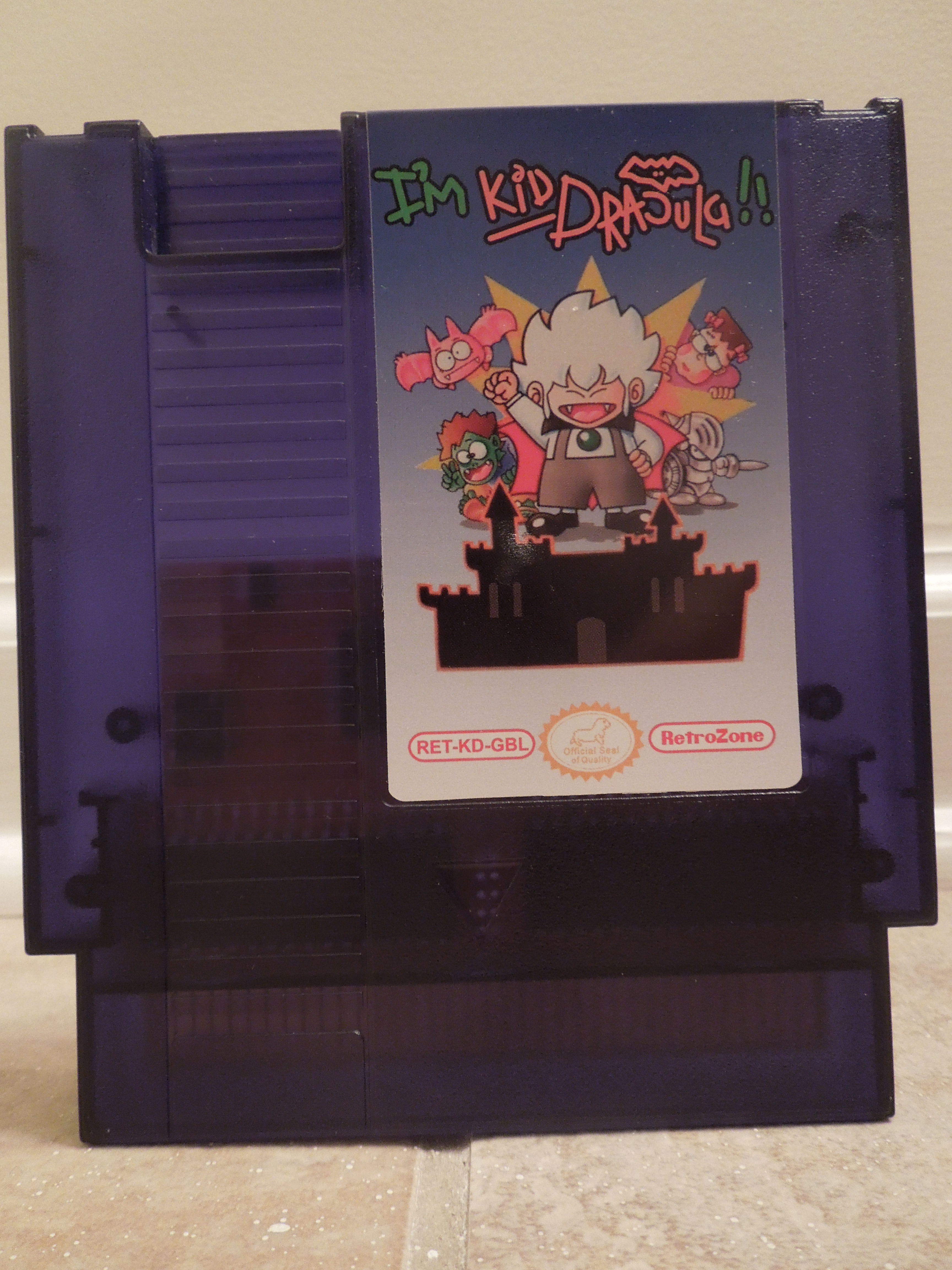 I’m Kid Dracula was originally only available for the Famicom in Japan.
 Heart Containers can be found throughout the game’s 9 levels.
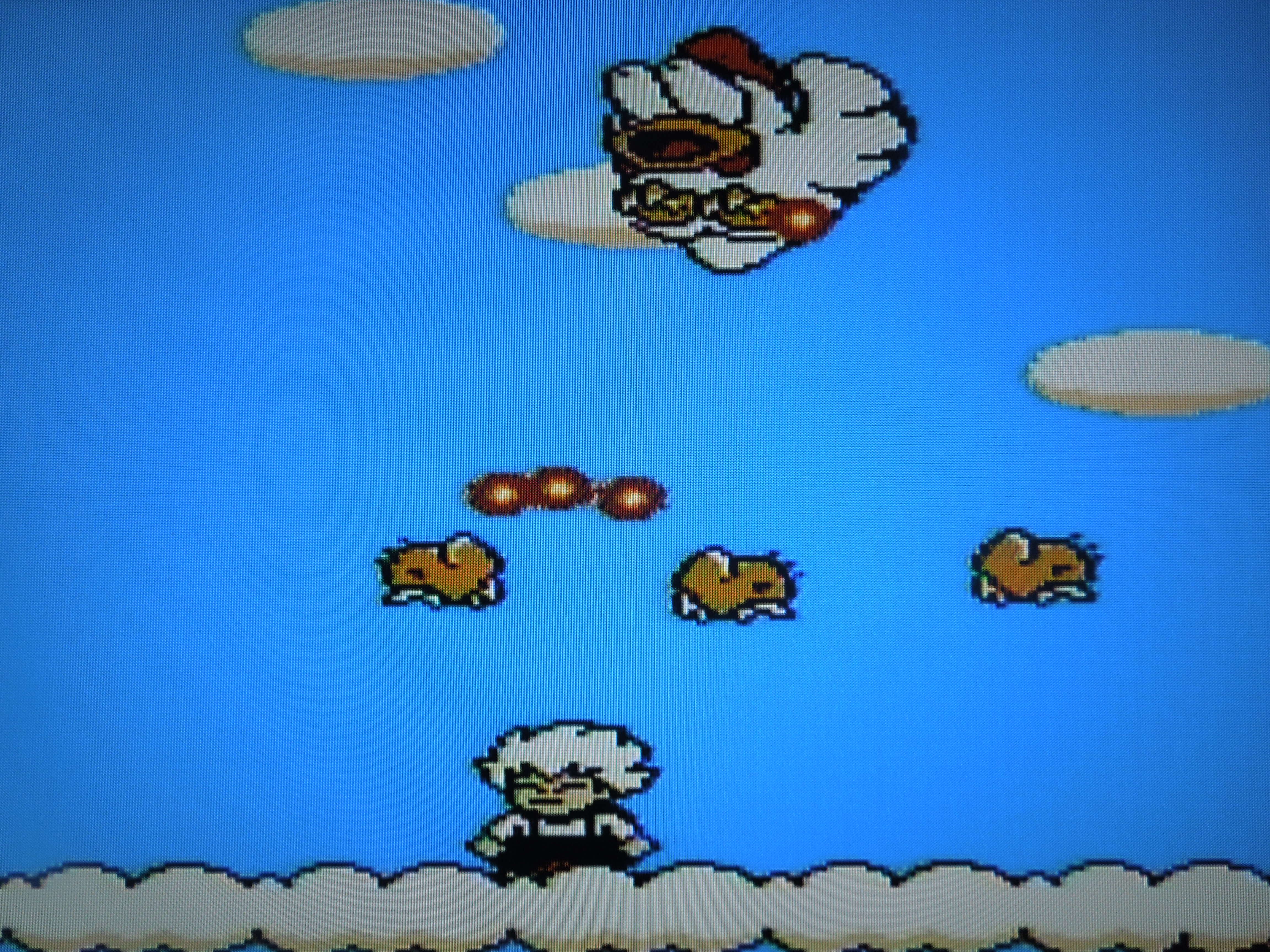 Each stage has its own unique boss.
 You’ll acquire new spells after each level.




















 Obscure Video Games