Neo Geo – Nightmare in The Dark

Nightmare in the Dark for the Neo Geo AES Nightmare in the Dark for the Neo Geo AES

Note 1:  Like Neo Geo games?  Check out my reviews of Sengoku 3, Football Frenzy, Dunk Dream, Neo Bomberman, Super Dodge Ball, King of the Monsters 2, Battle Flip Shot, and Shock Troopers: 2nd Squad!

Note 2:  This game was played on a Neo Geo AES home console that has been modified to output in component video (green, blue, red).  The Neo Geo AES was connected to a 32-inch HD tv.

Quick HistoryNightmare in the Dark was published by Gavaking/Eleven and released for the Neo Geo MVS (arcade cabinet) in 2000.  Like several other games, it was never released for the Neo Geo AES home console.  This copy of Nightmare in the Dark is a Neo Geo AES conversion of an MVS copy of the game.

An AES conversion of Nightmare in the Dark An AES conversion of Nightmare in the Dark

Players: 1 or 2, co-op

Memory Card Support:  Yes.  After losing all of your Credits, or choosing not to continue after losing a life, you can save your progress, and continue later at the exact stage you left off on.

AES settings:  When played on the AES, the game gives you a limit of 4 Credits per player. You get one life per Credit.  Also, your character has a health bar, and he has to be hit 3 times before losing a life (Credit).  You cannot alter the difficulty, and I believe the difficulty level is pre-set to Normal or perhaps MVS (Arcade) difficulty.

Story:  Your character(s) is a gravekeeper, and his task is to keep the cemetery free of ghosts and ghouls that have recently been showing up.

Gameplay:  Guide your gravekeeper through 5 single-screen-platforming Worlds (with 5 stages each), battling ghosts, zombies, and all sorts of evil creatures.  Your gravekeeper attacks these creatures with his lantern, which he is able to shoot small fireballs from.  Once he sets a creature on fire (with multiple small fireballs), the creature becomes a massive round fireball, which can then be used to roll at other enemies in order to kill them.  Once all the enemies are eliminated from a stage, you advance to the next one.  At the end of each World, you’ll fight a boss, whom you attack in the same way – light smaller enemies on fire and hurl the huge fireball at the boss.
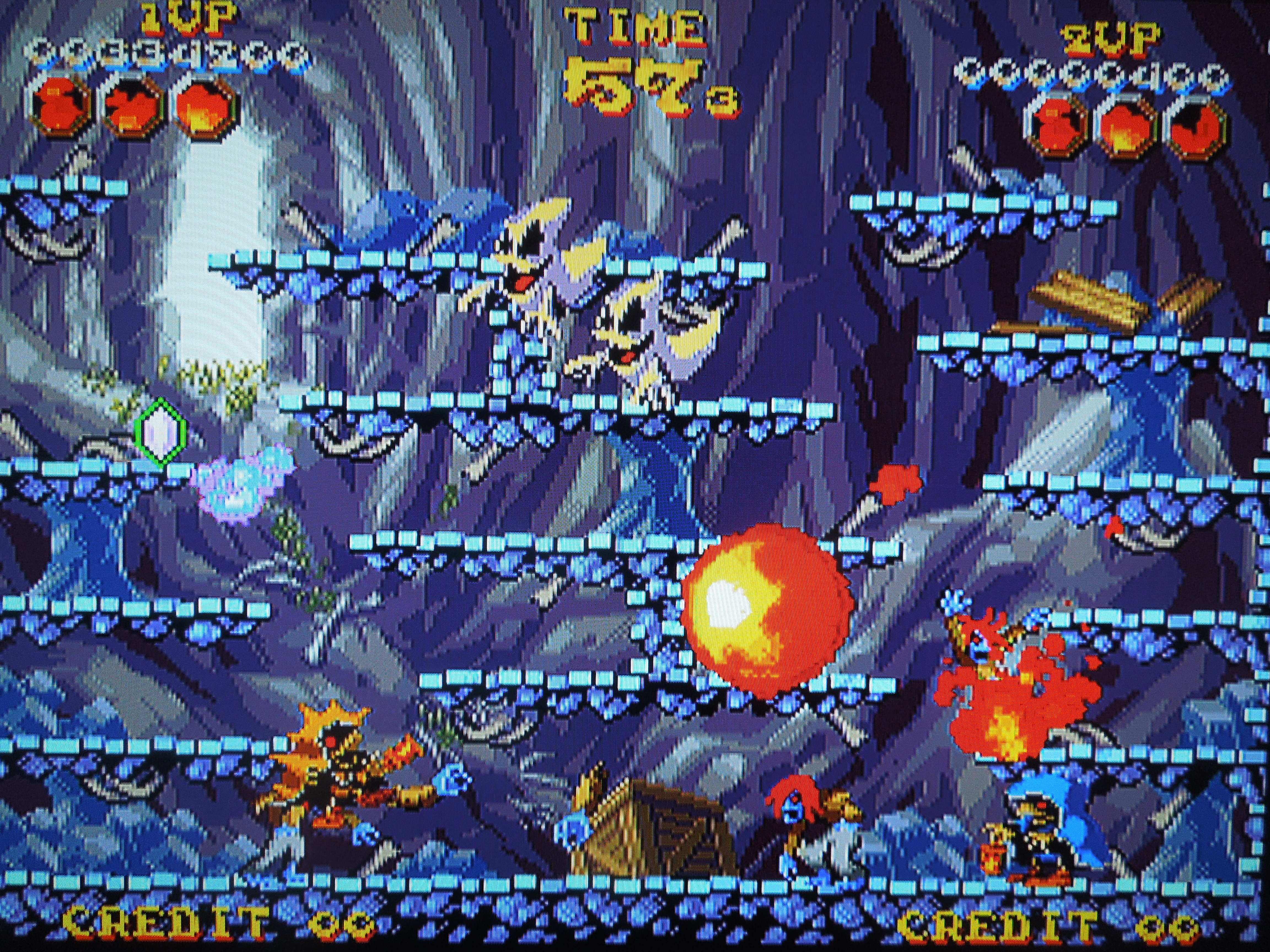
Turn monsters into great balls of fire and hurl them at other monsters. Turn monsters into great balls of fire and hurl them at other monsters.

Control: A or C shoots a fireball from your lantern, as well as rolls a massive fireball once you acquire one.  B jumps.  You can jump up to any platform in the single-screen stages, but you cannot jump down.  However, some stages have ‘holes’ on the bottom platform of the screen – falling through these transports your character to the top platform on the screen.  Select pauses the game.

Items:  As you destroy enemies, you’ll release potions that can boost your gravekeeper’s abilities.  Red potions (Fire Up) allow you to transform enemies into rolling fireballs faster (by having to throw less small fireballs at them before they transform), yellow potions (Range Up) allow you to attack from further away (your small fireballs shoot further across the screen), and blue potions (Move Up) allow you to move faster.  In addition to potions, you’ll pick up different-sized diamonds and treasure chests, all of which boost your score, and have a ‘points-multiplier’ effect if you continue to pick them up without having been hit by an enemy (picking up additional potions when you’re already powered gives multiplier points as well).  Getting hit even once will cause you to lose any abilities you’ve acquired or points-multipliers you have in place, so learn to avoid enemies at all costs.  Additionally, when you beat a boss, he’ll release a meat ‘Life Up’ item that restores 1 bar of health to your health bar.

Timer: Each stage is timed, giving you between 60 and 99 seconds to beat the stage.  You’ll rarely run short on time, however, and typically finish a stage in half the time that’s present at the start of the clock.  If, however, the clock does hit zero, then a Purple Jack-O’-Lantern (or two Purple Jack-O’-Lanterns if you’re playing with two players) will descend from the top of the screen to try and attack you (you can’t attack it, either).  The Jack-O’-Lantern moves really, really slow, however, and is easy to avoid while you clear up the other enemies in the stage.  If the Jack-O’-Lantern does hit you, however, it only takes one of your health bars away, and then it flies away, resetting the clock to its original time in the process.

Beat each stage before the clock expires or the dreaded Purple Jack-O'-Lantern will come for you. Beat each stage before the clock expires or the dreaded Purple Jack-O’-Lantern will come for you.

Music and Sound Effects:  You would expect the music for a game with a title like Nightmare in the Dark to be creepy, but it’s not, at all.  The music is a type of light jazz that I actually really, really enjoy.  Each World has a different sound track, and the boss fights have their own track as well.  I particularly love the track for World 2.  The sound effects, while there aren’t a lot, are satisfying.  Your fireball attack, jumping, and item collecting all sound appropriate.

Difficulty:  As I mentioned above, the difficulty for Nightmare in the Dark I would categorize as Normal.  With a bit of practice, you can breeze through Worlds 1 and 2, and still make it all the way to Stage 3-5 before taking a hit – the boss of World 3 is a tough challenge.  I love that the AES settings are defaulted to 4 Credits, as this presents a great challenge for trying to beat the game.

*Note:  Holding B or C or D or A+C or B+D before pressing Start at the game’s intro will change the color of the cloak of your gravekeeper – his default is Blue, but this allows you to have a red, green, yellow, orange, or dark-purple-cloaked gravekeeper.

5 boss fights await, with the first couple being quite simple. 5 boss fights await, with the first couple being quite simple.

Conclusion:  I’ve read elsewhere that Nightmare in the Dark has a lot in common with games like Bubble Bobble and Snow Bros.  However, I’ve never played those games, so I can’t give an adequate comparison.  What I can tell you is that Nightmare in the Dark is a really addictive single-screen platform game.  The real point of the game is in setting a high score, and that gives the game a ton of replayability.  I spent a few hours on it, trying to get my score as high as possible on 1 Credit (your scores resets to zero after every Credit), and managed to make it to Stage 3-5 before dying, having gotten over 4 million points.  Like most Neo Geo games, the memory card won’t save your high score (unless you have a unibios installed, in which case it WILL save your high score!), so go with the tried-and-true notebook or dry-erase board.  The game is amazingly short, and you can easily breeze through it in approximately 20 minutes.  The length doesn’t hurt the replay value, in my opinion.  Sure, more stages would have been great, but the gameplay is so fun it serves as a good counter-balance.  Co-op is fun too, as you work together with a friend to beat stages, and you can also compete for the high score as well.

The Southern Gentleman’s Opinion and Letter Grade:  Extremely simple and engaging ‘high score’ platforming game on a system without many.  B+

God Bless! Proverbs 3:6

NES – New Ghostbusters II

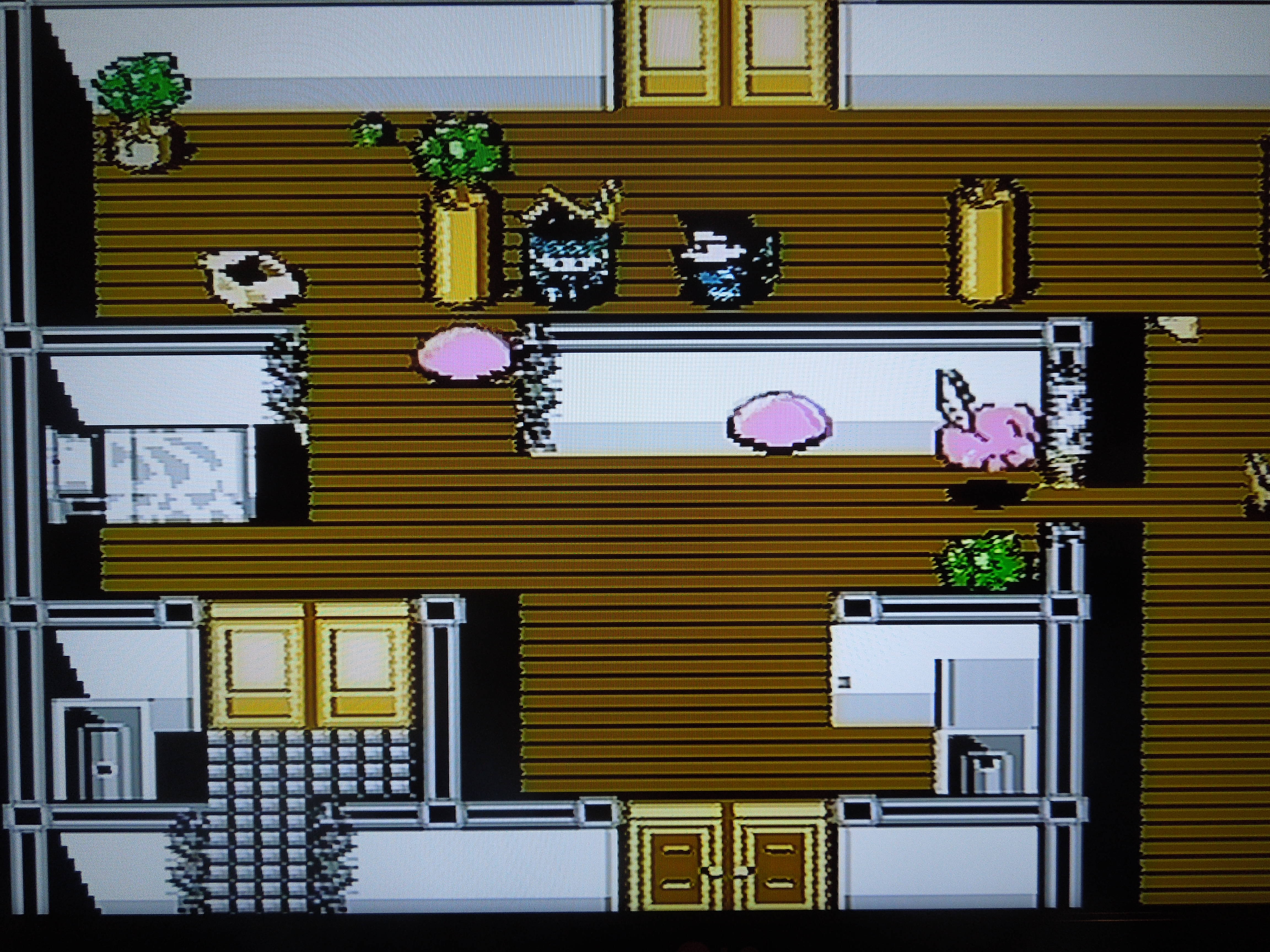
New Ghostbusters II for the NES New Ghostbusters II for the NES

Note: This game was played on a NES 101 (top loader) console that has been modified to output in AV (red, yellow, white), just like the original NES. The NES was connected to a 25-inch HD tv.

Players:  1 player

Battery Backup or Password Feature?  No.

Quick History: New Ghostbusters II, developed by HAL Laboratory, was released in Europe and Japan in 1990.  However, due to issues with licensing, it was never released in the United States.  Another Ghostbusters game, simply titled Ghostbusters II, was released for the NES in the U.S., but it was a completely different game developed by Activision.  Today, however, reproduction cartridges of New Ghostbusters II have been made that allow U.S. gamers to enjoy this great version of the game that was previously unavailable.

NGBII was never released in the U.S., but today, reproduction cartridges compatible with U.S. consoles are available. NGBII was never released in the U.S., but today, reproduction cartridges compatible with U.S. consoles are available.

Gameplay:  Before gameplay begins, you select from one of the 5 Ghostbusters from the film that was released in 1989: Egon Spengler, Ray Stanz, Peter Venkman, Winston Zeddemore, and Louis Tully.  Each Ghostbuster controls the same, so your choice is simply based on your favorite characters.  You pick a 2-man team; the first selection will be the primary character you control, whose job is to zap the ghosts you encounter with his proton gun; the second selection you make will be for the secondary, computer-controlled character, who will trail behind you and ‘trap’ ghosts you zap in the ‘ghost trap’ box.  Together, you’ll traverse 6 ‘Rounds,’ all of which are made up of locations from the film.  In each Round, you’ll travel through multiple screens, zapping and trapping ghosts, in order to advance.  The Courthouse, Subway Tunnel, Dana Barrett’s Apartment, The River of Slime, The Art Museum, and Vigo’s Altar comprise the 6 Rounds.  Each Round (except for Round 3) has a boss fight at the end, and Round 6 is just a boss fight with Vigo.  Only your primary character can be ‘killed’ by ghosts (when they touch you); your secondary character cannot be hit.

Select a 2-man team from the 5 available Ghostbusters. Select a 2-man team from the 5 available Ghostbusters.

Control: You control the primary character completely, and can move him all around each screen, but he cannot walk diagonally.  Fortunately, your character walks very quickly, so dodging ghosts isn’t too hard.  Button A causes your character to shoot his proton gun at ghosts.  Button B causes your secondary character (whom you do not have direct control over) to open the trap.  In order for you to trap/kill the ghosts you encounter, you have to keep zapping the ghosts until your partner puts himself in position to open the trap near the ghosts. Most of the time, your partner stays right near you to trap the ghosts right after you zap them, but sometimes he’ll wander off or get stuck on a barrier, causing you to have to stop zapping and go get him.

Zapping and trapping ghosts is the name of the game. Zapping and trapping ghosts is the name of the game.

Music and Sound:  Great music in this game.  Each Round has a different song, and you’ll immediately notice the Ghostbusters theme upon turning on the game.  The sound effects are great too, from the zap of your proton beam, to the train whistle in the subway station, to the cackling of ghosts.

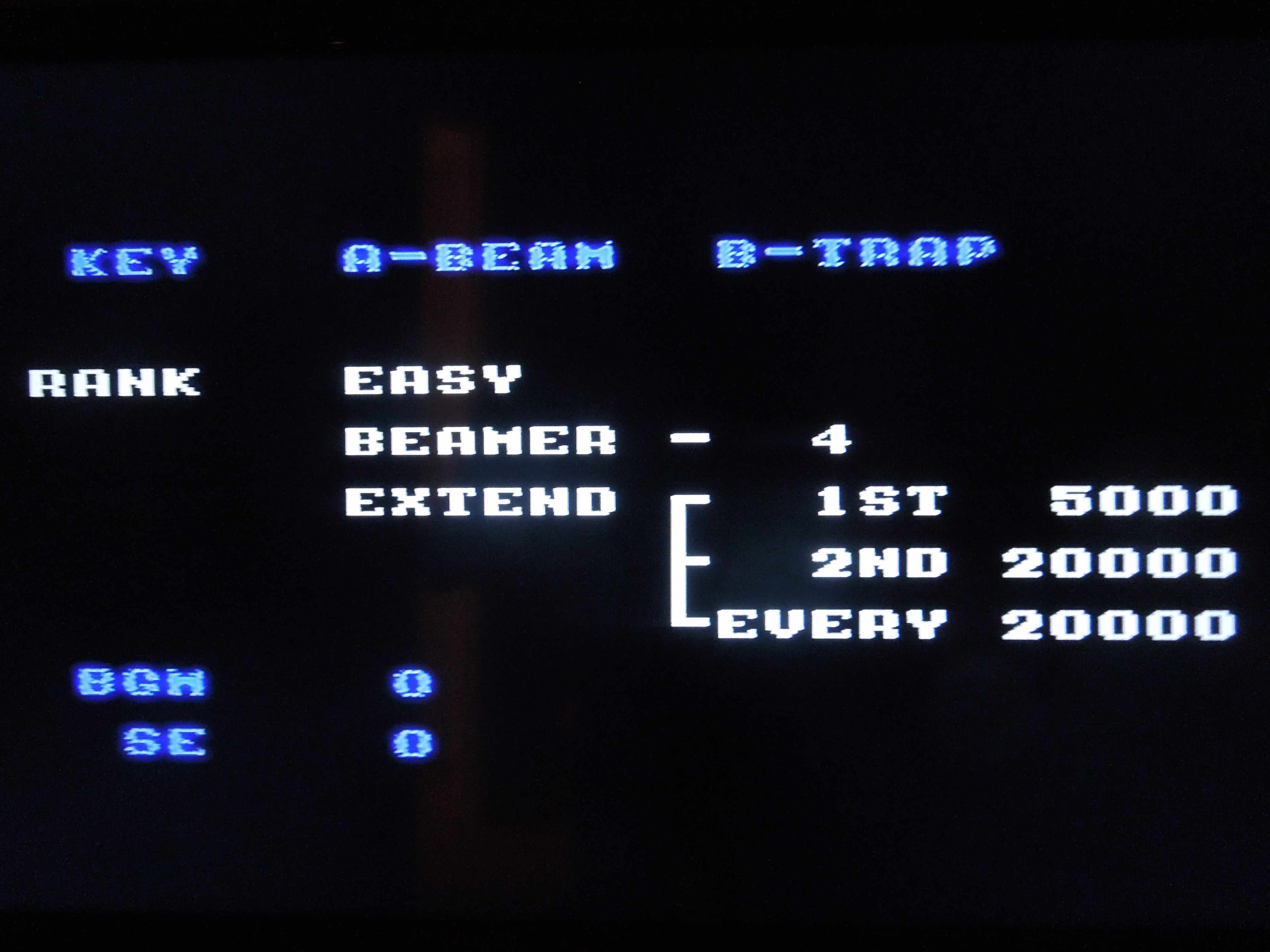
Code: Holding A + B at the title screen pulls up a hidden options menu, allowing you to listen to the different songs and sounds from the game, change the difficulty from its Normal setting to Easy, Hard, or Pro, and change up the button layout for zapping and trapping.  Changing the difficulty allows you to give yourself more or less lives based on which one you select, and this also affects how often you gain extra lives (you gain extra lives by zapping ghosts and earning points, and you gain extra lives by reaching certain point totals).  I really like the ability to change the button layout, as the game (for me) is much easier to play with the zap button assigned to button B and the trap button assigned to button A, as opposed to the default setup.

A hidden options menu is accessible by pressing A+B on the title screen.A hidden options menu is accessible by pressing A+B on the title screen. A hidden options menu is accessible by pressing A+B on the title screen.A hidden options menu is accessible by pressing A+B on the title screen.

No 2 player co-op?  Sadly, no.  I’m not sure why, either, as it seems like this would have been easy for the developers to implement – simply give control of the second character to a human player.  I have read elsewhere that a second human player CAN control the ‘trap’ by pressing B on the second controller; I tested this, and it does not work.  This game is a 1-player affair.

Difficulty:  The learning curve isn’t steep, but it will take you some time to learn the boss fight’s nuances.  You get 3 Credits to beat the game, but expect to practice and hone your skills before being able to master this one.

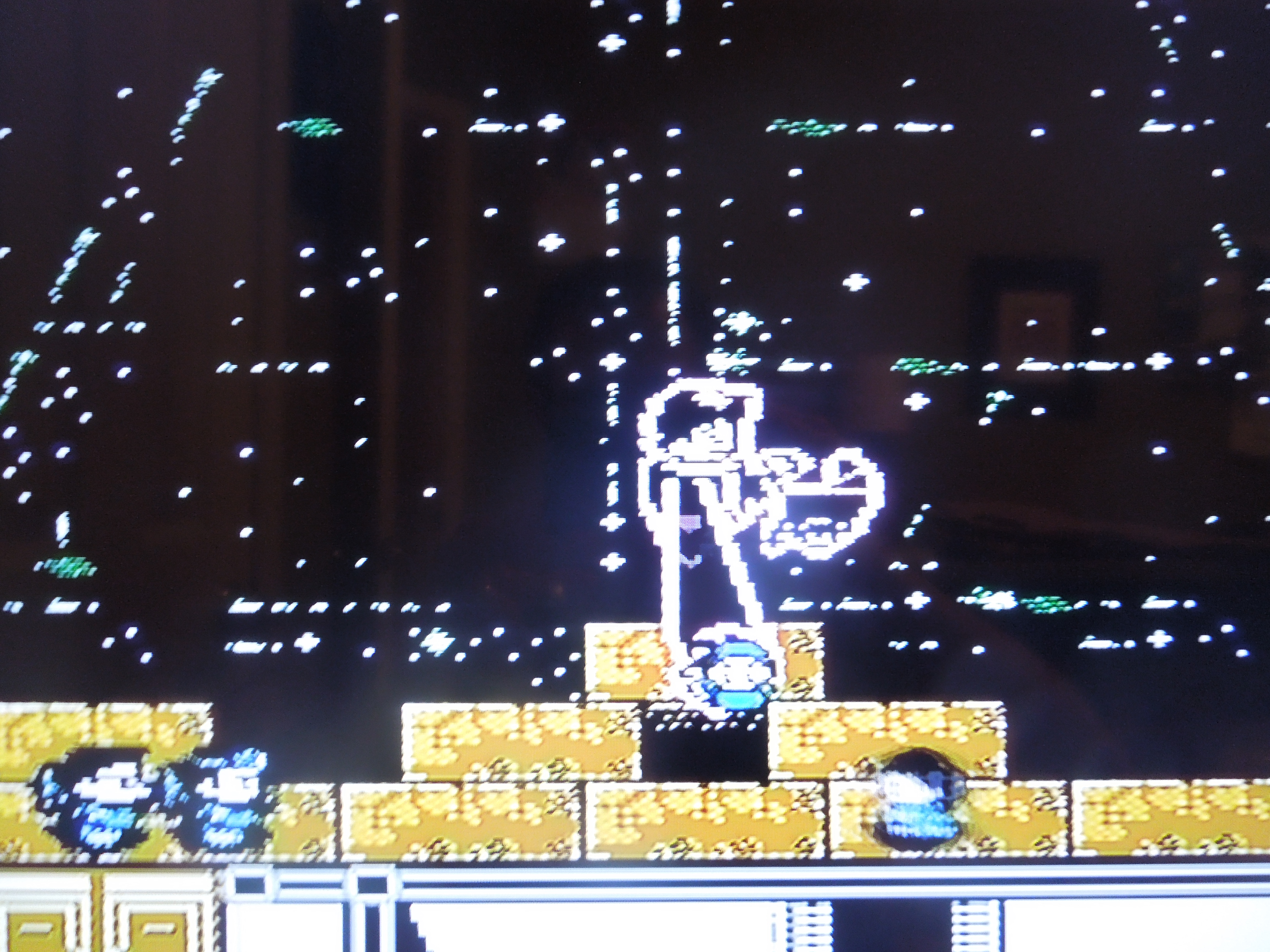
Scenes from the movie play out well in New Ghostbusters II.Scenes from the movie play out well in New Ghostbusters II. Scenes from the movie play out well in New Ghostbusters II.

Conclusion:  I have never played the Ghostbusters II by Activision that WAS released in the U.S., so I cannot give a comparison of that version to this one.  However, I don’t think the U.S. Activision version was well-received from what I’ve read.  What I do know is that New Ghostbusters II is a really, really fun game, and, if you’re familiar with the film, you’ll recognize a lot of things from it in the game.  The music is fantastic, the control is spot on, the look of the game is wonderful (kind of reminded me of overhead games like Zelda: A Link to the Past), and the gameplay is simple, yet addictive.  The difficulty (even if you set the game to Easy in the hidden options menu) is perfect to – practice, perseverance, timing, and accuracy are all required to beat the game.  The only negative I can really find is the lack of a 2-player mode.

The Southern Gentleman’s Opinion and Letter Grade: Another simple masterpiece for the NES. A

God Bless! Proverbs 3:6


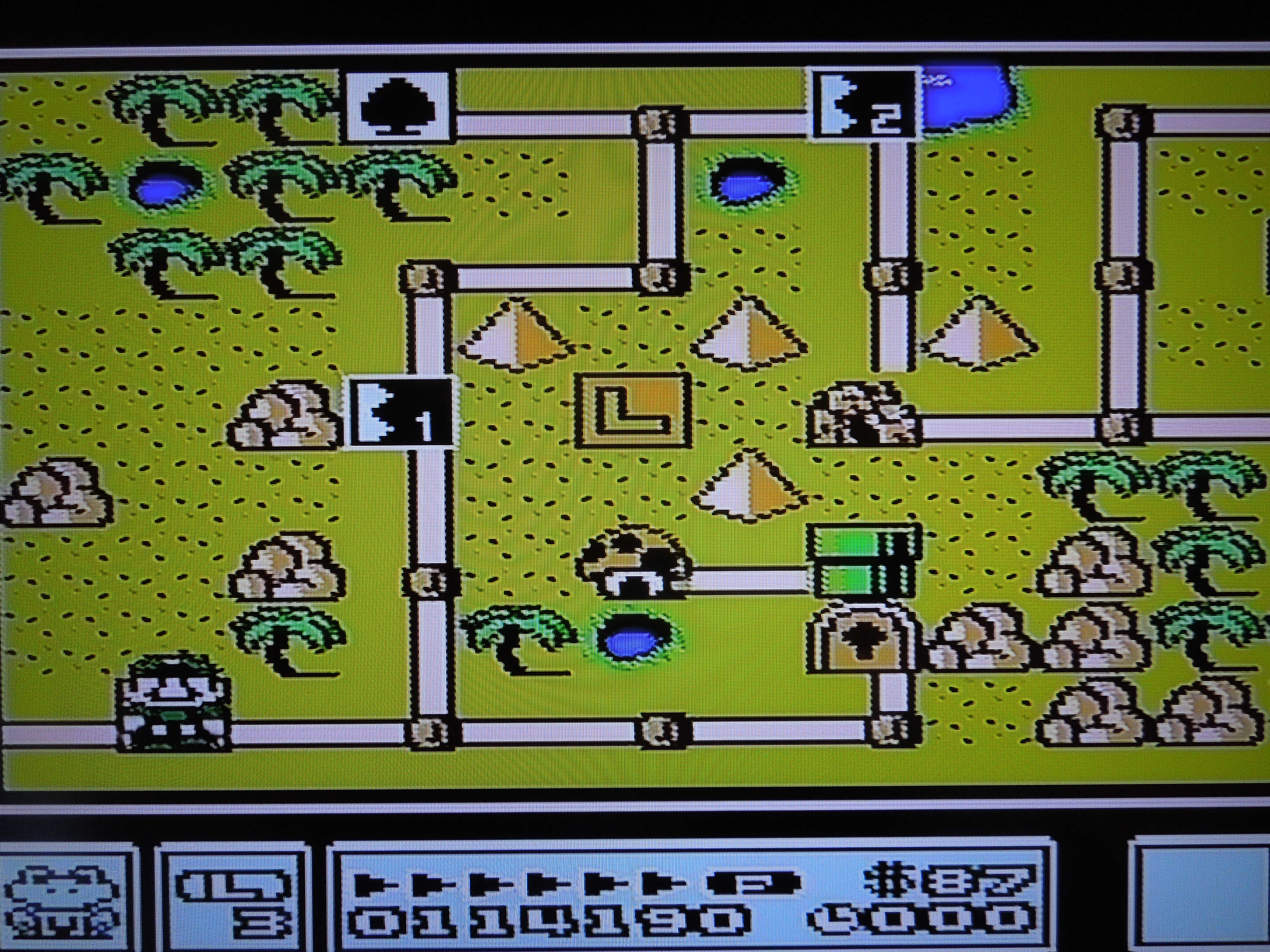
NES – Super Mario 3: The Lost Levels

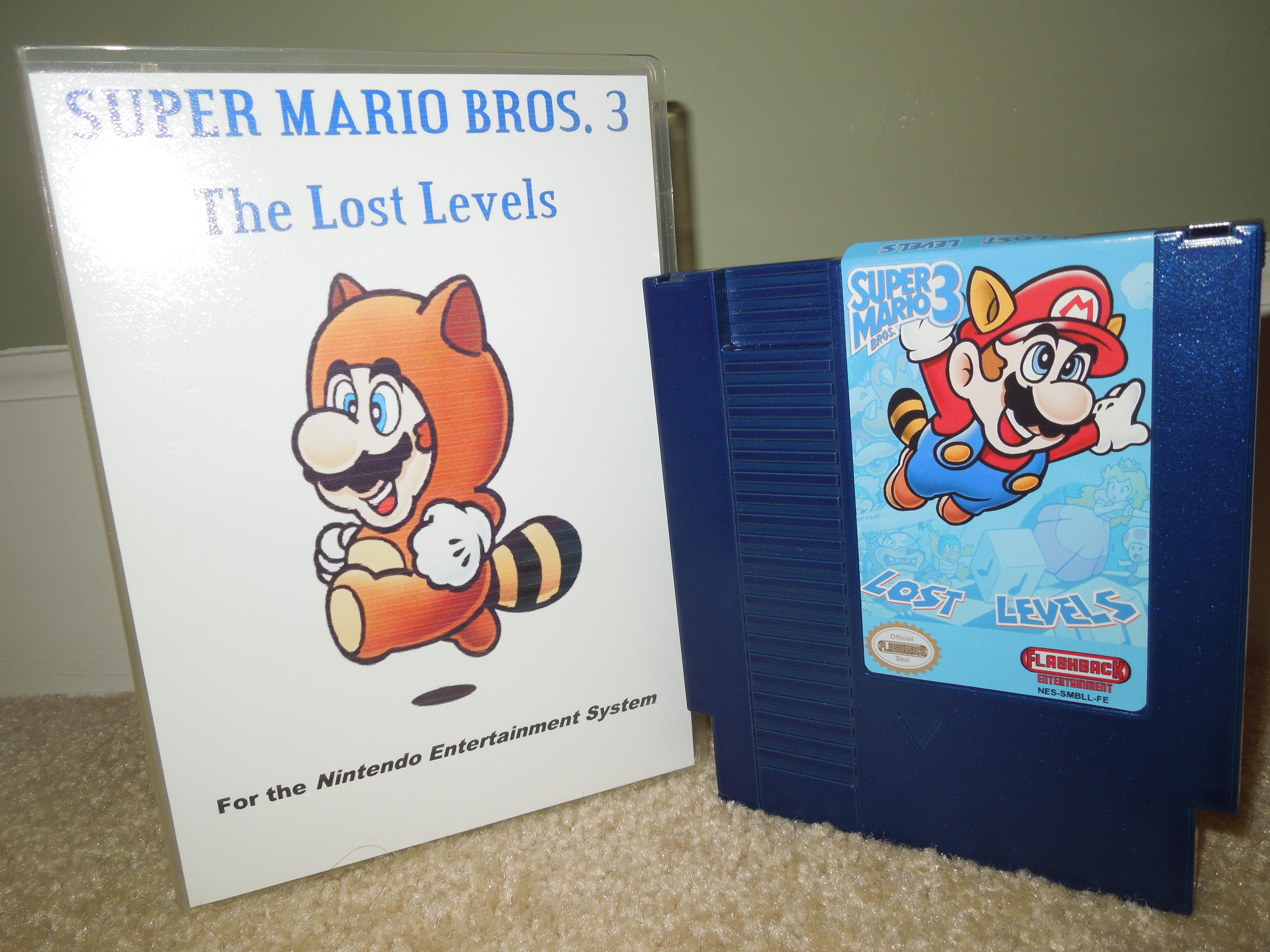
Super Mario Bros 3: The Lost Levels for the NES Super Mario Bros 3: The Lost Levels for the NES


Note: This game was played on a NES 101 (top loader) console that has been modified to output in AV (red, yellow, white), just like the original NES.  The NES was connected to a 25-inch HD tv.

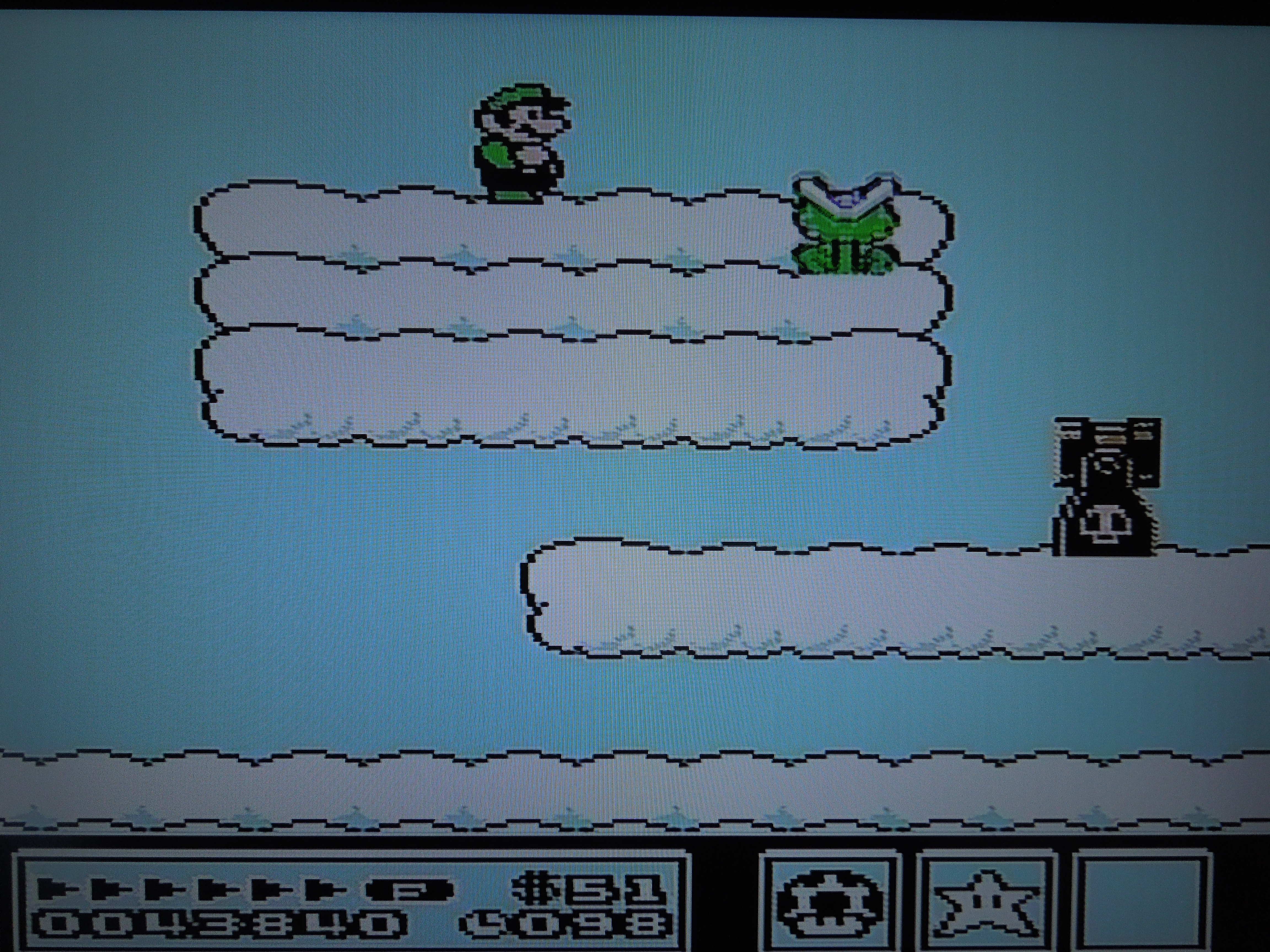
The original World 1 stages have been replaced with the Lost Levels. The original World 1 stages have been replaced with the Lost Levels.

Quick History:  When Super Mario Bros. 3 was released for the NES in 1990, approximately 12 ‘levels’ were left out of the game proper, yet these levels were accessible using a Game Genie device since they still existed within the game’s source code.  Some of these levels were incomplete, too easy, or glitchy, hence the likely reasons why they weren’t included in the game.  Today, however, modders have created a version of SMB3 that inserts the 12 missing levels into the first world of the game (replacing the original levels).  The levels have mostly remained unchanged; however, some of the levels previously had no ‘end,’ so endings were added to allow players to complete each level.

Changes from the original SMB3: All of the stages from World 1 have been removed, and in their place are the 12 Lost Levels.  The castle/air ship battle is still the same for World 1.  Following the Lost Levels in World 1, you can play through the rest of the worlds of SMB3, with one difference – many of the other world’s levels are not there!  For example, the Fortress level in World 2 cannot be played, because the Fortress has already been destroyed when you arrive in World 2!  Many of the worlds have A LOT of levels that have been, for some reason, taken out, and they are marked with an ‘L’ or ‘M’ as if they had already been beaten.  This may have something to do with the game’s glitchy save feature.

DSCN8322

Saving:  That’s right, you can save your game in The Lost Levels!  After every level, the game auto-saves your progress.  So, if you beat the first 2 levels of World 1, you can turn off the system, come back later, and pick up where you left off at World 1, level 3!  Most of the time, this works the way it should.  Unfortunately, however, the saving feature malfunctions sometimes.  I played the game and made it to World 7, and turned off the game.  When I turned it on later to play, I was back at World 1!  All of the levels of World 1 were still beaten, and I had all of my items that I’d gained on my way to World 7, but I was stuck in the World 1 map!  So, I had to reset the game and ‘Erase Data’ and start back over.  So, essentially, this game is best played through in a single sitting because of the inconsistency of the save feature.

The Lost Levels adds an auto-save feature. The Lost Levels adds an auto-save feature.

The Lost Levels:  The main reason to play the game is for the actual ‘lost’ levels, of course.  The levels, for the most part, don’t feel like they fit in with the rest of the game.  Stage 5 had no proper ending (where you grab a Mushroom, Flower, or Star card), and ends when you grab a treasure box with a Cloud item in it.  The Fortress lost level simply has rooms full of power-ups and 1UPs, then a boss fight – that’s it.  A few of the other stages have the ‘card’ endings that levels traditionally have, although it appears that modders inserted them into random places (although this was necessary, of course, to allow players to ‘beat’ the level).  Many of the stages have color glitches, or enemies stuck in walls.  Despite all these things, however, the lost levels are still fun.  Stage 8 is a challenging swimming level that includes an enemy not found in the official release of SMB3 – the gold cheep cheep (fish).

Card Game Glitch:  Another glitch I found while playing through the game was the Card-Matching Game glitch.  Occasionally, the card game would constantly reappear on the world map in the exact spot where I was standing, causing me to continuously play the game until I matched all the right cards.  While this was a good way to gain items, it was really frustrating because I was forced to play the game without being able to move to another spot on the map.

Perhaps the best lost level is Stage 8, a swimming level that includes the gold cheep cheep enemy - an enemy that wasn't included in any stage in the official release of SMB3. Perhaps the best lost level is Stage 8, a swimming level that includes the gold cheep cheep enemy – an enemy that wasn’t included in any stage in the official release of SMB3.

So, where can I find this game?  I found a copy for sale on eBay.  It has Flashback Entertainment on the game sticker, which I believe is an NES reproduction website.  I believe the modded rom can be found online.

Conclusion:  The Lost Levels is essentially an abridged version of the original Super Mario Bros. 3 that includes the 12 levels that were left out of the original game minus many of the other levels from the rest of the game.  Although it has a save feature, which is most welcome, it does not function the way it should, meaning the game is best enjoyed when you have the time to sit down and play through it in one sitting, just like the original release.  *On a side note, you can only obtain one Warp Whistle since the original World 1 whistles are no longer available.  The lost levels themselves in World 1 are short but fun.

The Lost Levels removes many levels from the game's Worlds, like the Fortress stage from World 2. The Lost Levels removes many levels from the game's Worlds, like the Fortress stage from World 2 The Lost Levels removes many levels from the game’s Worlds, like the Fortress stage from World 2. The Lost Levels removes many levels from the game’s Worlds, like the Fortress stage from World 2

The Southern Gentleman’s Opinion and Letter Grade: SMB3: The Lost Levels is nothing overly special.  Is it worth a purchase?  Probably not, honestly, although it is interesting, and it’s fun to play ‘original’ SMB3 levels made by the game’s original programmers, not just fan-modded ones like you find in other reproductions.  The save feature would be the best addition to the game, if only it worked properly.  However, because of the lack of longevity to the lost levels and save feature issue, I would stick to the original release.  C

God Bless! Proverbs 3:6


Neo Geo – Battle Flip Shot

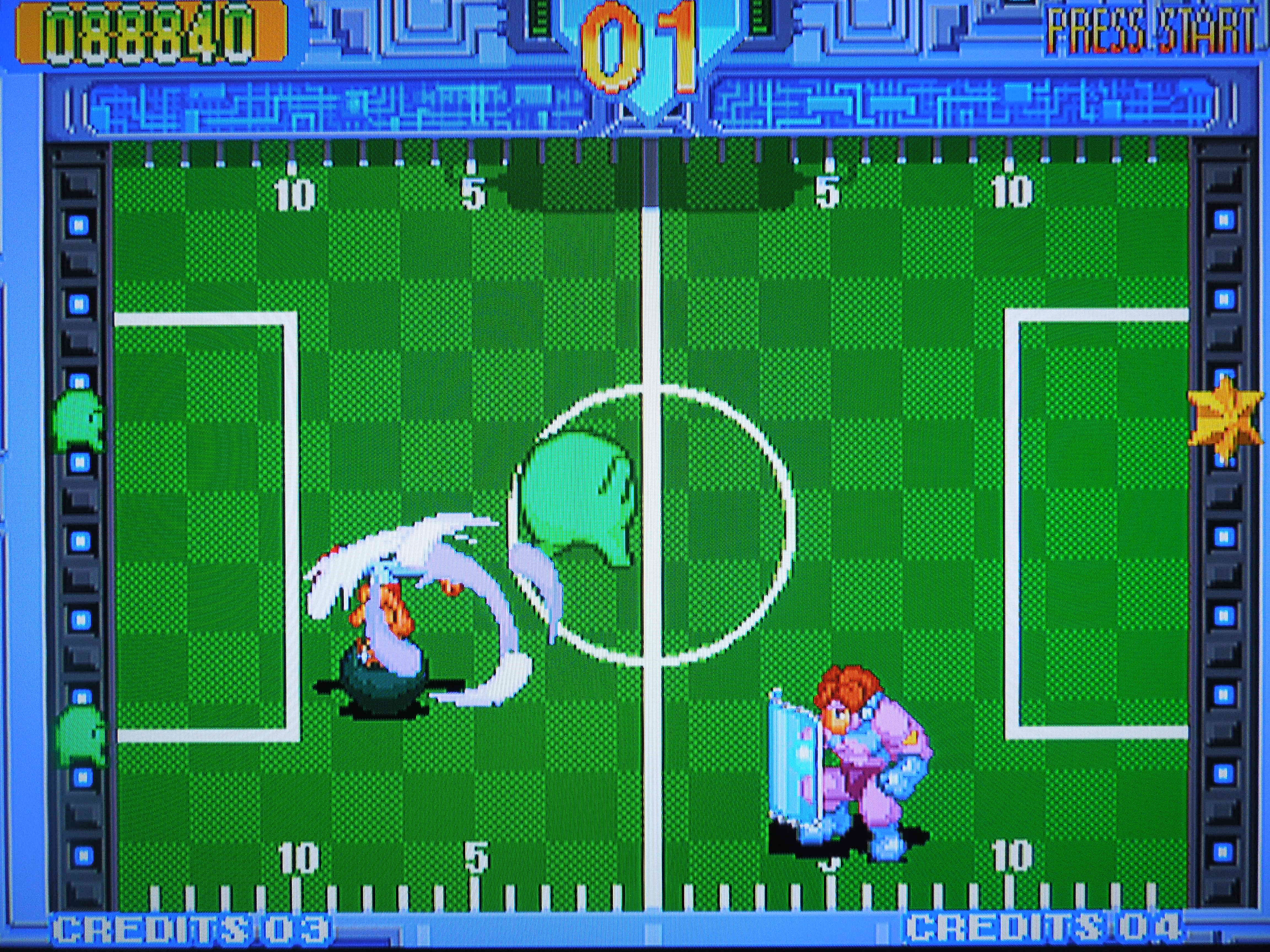
Battle Flip Shot for the Neo Geo AES Battle Flip Shot for the Neo Geo AES 

Check out my youtube video about this game:  My channel is ORO Video Games (just type it in the search engine).  I’ve reviewed this game and several others.  God Bless!

Note 1:  This game was played on a Neo Geo AES home console with U.S. settings.  The console has been modified to output in component video (red, green, blue).  It was connected to a 32-inch HD tv.

Note 2: If you’re interested in Neo Geo games, I have already reviewed several others.  Check them out!

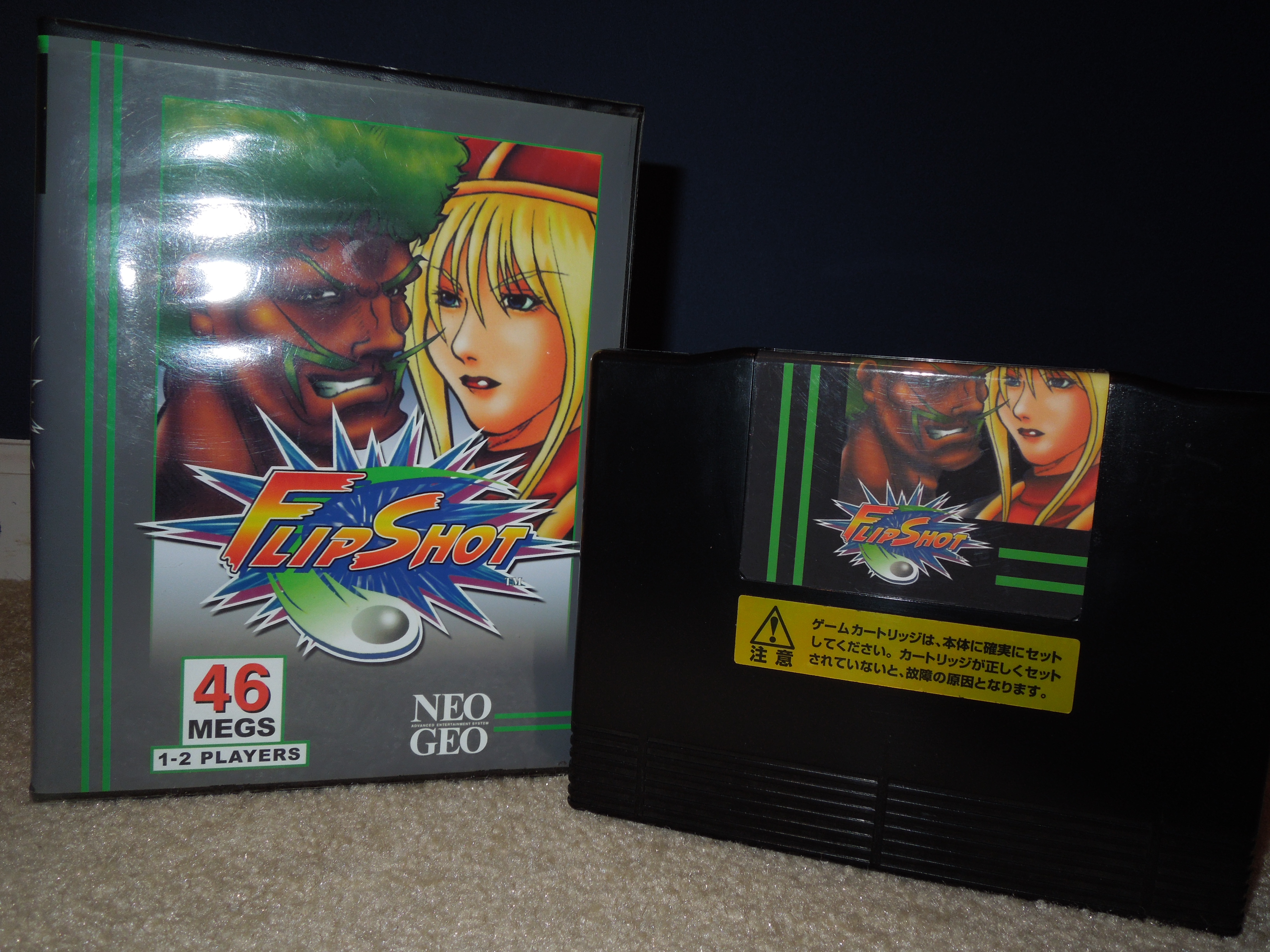
Quick History: Battle Flip Shot, sometimes referred to as just Flip Shot, was released for the Neo Geo MVS arcade cabinet in 1998.  The game was never released for the Neo Geo AES home console.  Today, however, Neo Geo MVS arcade cartridges can be converted into AES home console cartridges.  The Battle Flip Shot cartridge used for this review is an AES conversion.

Battle Flip Shot was never released for the AES but conversions now make it possible to play on a home console.Battle Flip Shot was never released for the AES in 1998, but conversions now make it possible to play on a home console. Battle Flip Shot was never released for the AES but conversions now make it possible to play on a home console.

Players: 1 or 2, competitive

Neo Geo Memory Card Support:  Yes. If you don’t continue after losing a match (you have 4 Credits, or 4 times to continue), you’ll be asked if you want to save your game.  Saving your game will allow you to return to the opponent you last lost to, with the exception of the last boss – if you lose to her and elect either Continue (if you have Credits) or save your game at that point, you’ll be sent back to the opponent you faced just before her.

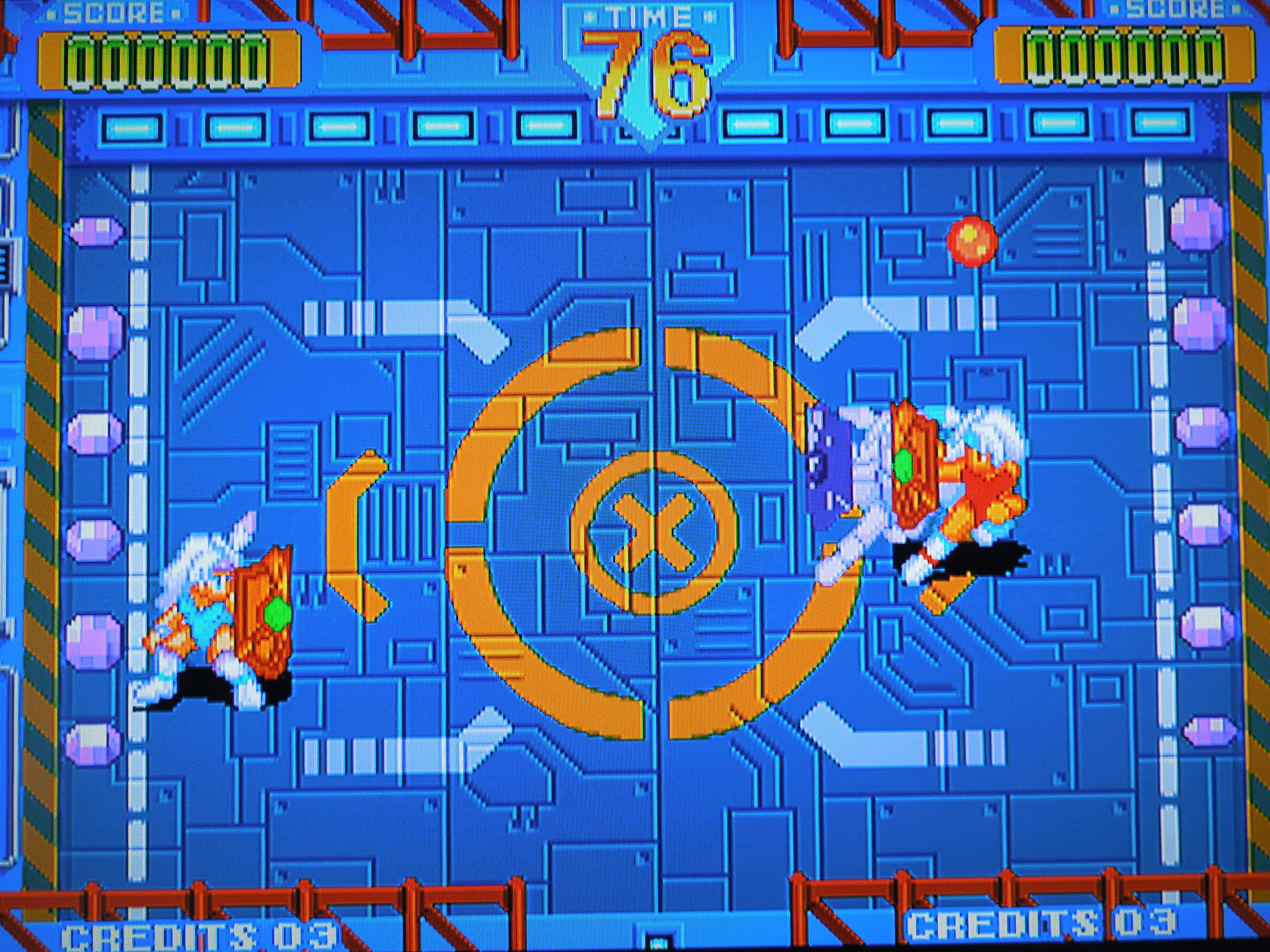
Gameplay:  Battle Flip Shot reminded me of Pong, one of the first arcade games ever made, where two players bounced a ball back and forth across the screen, trying not to miss it with their paddle.  In Battle Flip Shot, you pick your player (among 5) and play Best of 3 Round matches against all the other characters (including a mirror match vs. your character) and a ‘Boss’ character for a total of 6 matches.  During matches, one character occupies half of the screen in one of 6 different arenas.  A line down the center separates the sides, and while characters can move wherever they like on their designated side, they cannot cross into their opponents territory.  Your objective is to use your character’s shield and bounce and bash a ball across the arena into your opponents territory, trying to hit targets set up along his or her back wall.  Your opponent, meanwhile, will try to do the same to you, and you must successfully defend your own targets.  Both you and your opponent have 6 targets, and once all 6 have been destroyed by the bouncing ball, you’ll win the round (or lose the round).  There is a timer, and if it hits 0 without someone’s targets being destroyed, then the character with the most targets remaining wins.  If both characters have the same amount of targets left, then the match is a Draw, and both characters are awarded a win.  If you Draw in both Rounds 1 and 2, then the Match is over and you’ll lose a Credit.

With 2 players, you can both choose the same character. With 2 players, you can both choose the same character.

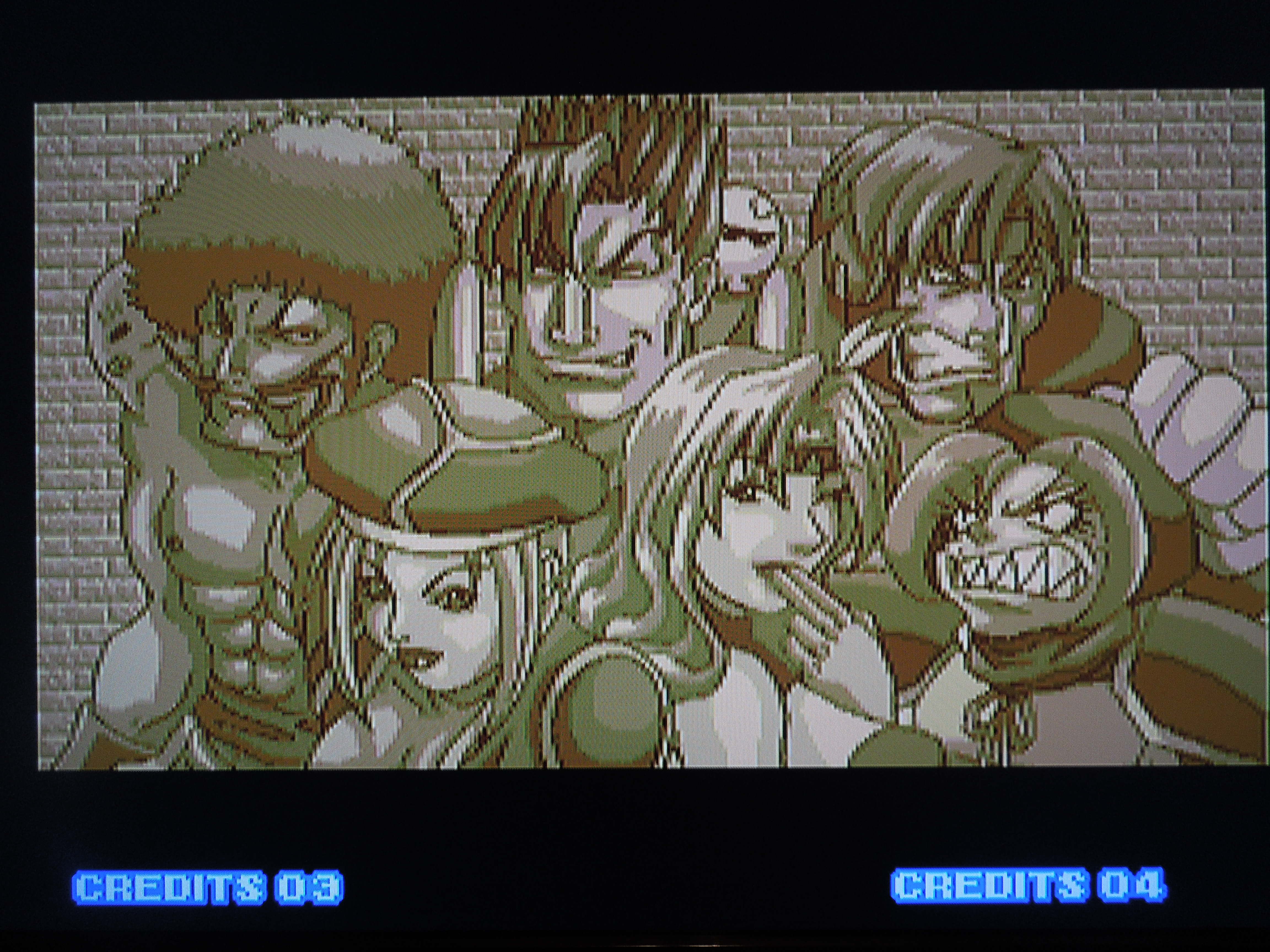
Characters:  5 interesting looking characters can be chosen:  Chinta Nemoto, Siren, Saimon, Bloody Wolf, and Mr. Justice.  Siren and Bloody Wolf are female, and the others are male.  Each character has a bio that plays during the game’s demo, showing the character’s nationality, job, and what type of ‘power shot’ they use during matches.  This information is kind of random and funny – Mr. Justice is an American police officer, and Saimon is a debt collector…ok.  Each character appears to move at the same speed during matches from what I can tell, and any differences come from their power shots.  In my experience, Mr. Justice’s power shot, the Hard Shot, makes him a good choice because the ball transforms into a huge ball with spikes that can more easily hit targets (I can’t confirm this to be true, but I seem to win more often with him than with other characters, and this is my guess as to the reason why).  Bloody Wolf is also a good choice, as her power shot allows you to curve (bend) the ball slightly to hit targets – the other characters only hit the ball in a straight line in whatever direction you’re holding the joystick.  Saimon’s Trick Shot causes the ball to temporarily disappear, which is more useful when playing against another human than the CPU.

The super shots of each character are all unique. The super shots of each character are all unique.

Music and Sound Effects:  There isn’t a lot of music in the game – the same song plays during matches, but it feels appropriate, if forgettable.  A bizarre tune plays on the Continue? screen.  The sound effects sound great – the ball bouncing off the walls, smashing targets, and being smashed by super shots all sound good.  No complaints about the music or sound effects.

Winning Quotes:  One of the funniest aspects of the game is the ‘winning quotes’ your character delivers after finishing off an opponent.  Each character has a specific quote that he or she directs at the other characters (with the exception of the final boss).  Many of the quotes make absolutely no sense or have grammatical errors.  Here are some of my favorites: (Bloody Wolf after beating Mr. Justice) “Zcup bomber killed you.” (Chinta Nemoto after beating Siren) “Do not call me a monkey.”  (Saimon after beating Chinta Nemoto) “If you don’t give back the money you stole, I’ll stick Mukyu in your mouth.”  *For the record, mukyu is Saimon’s little green ‘pet’ that is always with him – but that quote is hilarious.  (Mr. Justice after beating Saimon) “I am not sure what happened but you are under arrest.”

Controls: The joystick moves your character in every corner of your side of the arena.  Simply placing your character in the path of the ball will cause your character to deflect the ball with his or her shield.  Pressing A when the ball gets to you activates your super shot – you can direct your  super shot up or down by holding the joystick in conjunction with pressing A.  Pressing B causes your character to slide in whatever direction you hold the joystick – this is a very useful way to get to the ball if it looks like you won’t be able to stop it from destroying your targets using your normal moving speed.  Button C taunts your opponent, and pressing B + C activates a different taunt.  Taunts are mainly for comedic purposes, but they do add 10 points to your score for every taunt you complete – you have to be careful though not to taunt too much while the ball whizzes right by you. Select pauses the game.

The winning quotes are priceless. The winning quotes are priceless.

Order of opponents:  No matter who you pick, you’ll face your opponents in this order: Stage 1:  vs. Siren, Stage 2: vs. Saimon, Stage 3: vs. Mr. Justice, Stage 4: vs. Bloody Wolf, Stage 5: vs. Chinta Nemoto, Stage 6: vs. (Unnamed Boss).  The Unnamed Boss is female, carries a large scythe, and looks to be a ‘Witch’ character, although she is not named at all.  I didn’t find the last boss to be any more difficulty then the regular characters, although she can use any of the 5 selectable characters’ power shots, and does so often.  The Witch seems to have not been ‘completed’ by the programmers.  By this I mean that her lack of a name, the lack of a ‘versus’ screen before your match with her (you get the versus screen before the other matches), and the fact that your character doesn’t have a winning quote to direct at her (your character gives the same quote that they gave to Chinta Nemoto) makes me wonder if the programmers didn’t have the time to add these things before the game went out to arcades.

The last boss (an unselectable character) can use all of the other characters' super shots. The last boss (an unselectable character) can use all of the other characters’ super shots.

Points:  You get points for: breaking each of your opponents’ targets (different amounts are given every time you smash one – I’m not sure what determines the amount), going through a round without having any of your targets broken, successfully taunting your opponent, and how much time is left on the clock when you beat an opponent in each round.  I have gotten over 100,000 points only once at this point, and it’s important to note that your Score Counter resets to zero once you continue -meaning you only have 1 Credit in which to set a high score – lose a match, and that’s it.  This makes for a great 1 Credit challenge, however.  Interestingly, the high score screen on Battle Flip Shot requires you to get at least 250,000 points to even put in your initials (the game nor memory card would actually save your high score once you turned off the Neo Geo AES UNLESS you had a unibios installed – my unibios 3.3 saves high scores on most games but it’s so hard to get a high score on this game that I can’t confirm if it would save or not).

Successfully executing taunts nets you 10 points, and some are hilarious. Successfully executing taunts nets you 10 points, and some are hilarious. Successfully executing taunts nets you 10 points, and some are hilarious.

Difficulty: You cannot select the difficulty in this game the way you can in many Neo Geo AES games (probably because this game was only intended as an arcade release).  Had I only played the game for a short amount of time, I would have described the difficulty as ‘Hard,’ but once I learned the game’s nuances, I would back that off to ‘Normal’ difficulty.  Although the bouncing of the ball and destruction of your opponents’ targets can be a bit random, there’s no randomness to how well you play defense and protect your own targets – either you do it well or you don’t.  Utilizing the slide move, directing the ball to the best of your ability, and knowing when to use super shots or when to simply deflect the ball – all of these elements play an important role in helping you win.  Some opponents, like Siren, play aggressively (use super shots constantly) and can be a bit tougher, while others, like Saimon, rely more on simply deflecting the ball, and are easier to beat.  Another thing I noticed is that sometimes your opponent simply mirrors what YOU do – if you don’t use a lot of super shots, then they won’t use a lot of super shots.  If you use super shots on all the time, they’ll use super shots all the time.

Battle Flip Shot is a flippin' good time. Battle Flip Shot is a flippin’ good time.


Conclusion:  Battle Flip Shot is an amazingly addictive, fast-paced game.  It is reminiscent of another Neo Geo AES game I reviewed, Flying Power Disc, although unlike that game, their isn’t as much diversity between characters in Battle Flip Shot.  However, compared to Flying Power Disc, I prefer Battle Flip Shot – it’s simply more frantic and ‘non-stop.’  Playing with 2 players is great fun as well, and two players CAN pick the same character, by the way.  The challenge of the game can be frustrating at first, but rewarding once you figure out how to play.  Trying to beat the game with only the allowed 4 Credits is perfect, and will take time as you perfect your skills.

The Southern Gentleman’s Opinion and Letter Grade:  Simple, quick, somewhat bizarre, updated version of Pong that requires you to actually practice to become a good player.  A

God Bless! Proverbs 3:6

Neo Geo – Stakes Winner 2

Stakes Winner 2 for the Neo Geo AES Stakes Winner 2 for the Neo Geo AES

Note 1:  This game was played on a Neo Geo AES home console with U.S. settings.  The console has been modified to output in component video (red, green, blue).  It was connected to a 32-inch HD tv.

Note 2: If you’re interested in Neo Geo games, I have already reviewed several others.  Check them out!

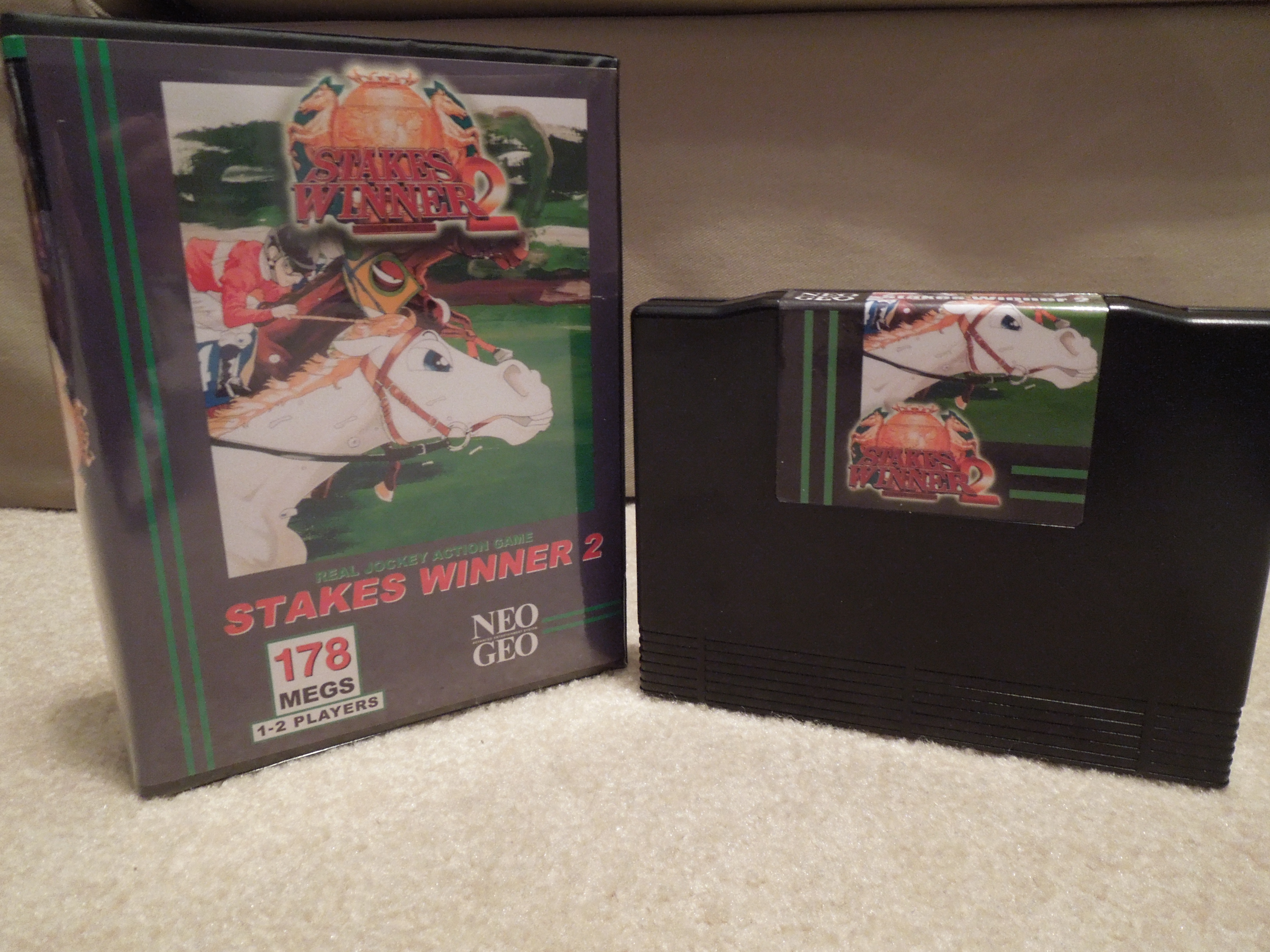
Quick History: Stakes Winner 2 is a horse-racing game released for the Neo Geo MVS (arcade) and the Neo Geo AES home console in 1996.  It is the sequel to Stakes Winner.  The AES home console cartridge didn’t receive a large production run, and it was only sold in Japan.  The MVS arcade cartridge, however, was common in the U.S. and Japan.  Today, MVS arcade cartridges can be converted into AES home console cartridges.  The Stakes Winner 2 used in this review was originally an MVS arcade cartridge, but was converted to an AES home console cartridge.

Stakes Winner 2 was released for the AES in short supply in 1996, but arcade cartridges can be converted into AES cartridges today. Stakes Winner 2 was released for the AES in short supply in 1996, but arcade cartridges can be converted into AES cartridges today.

Players: 1 or 2

Neo Geo Memory Card Support?  Yes.  If you lose your 4 given Credits, you’ll be asked if you want to save the game.  If you choose to save, you can start back at the last race you lost.

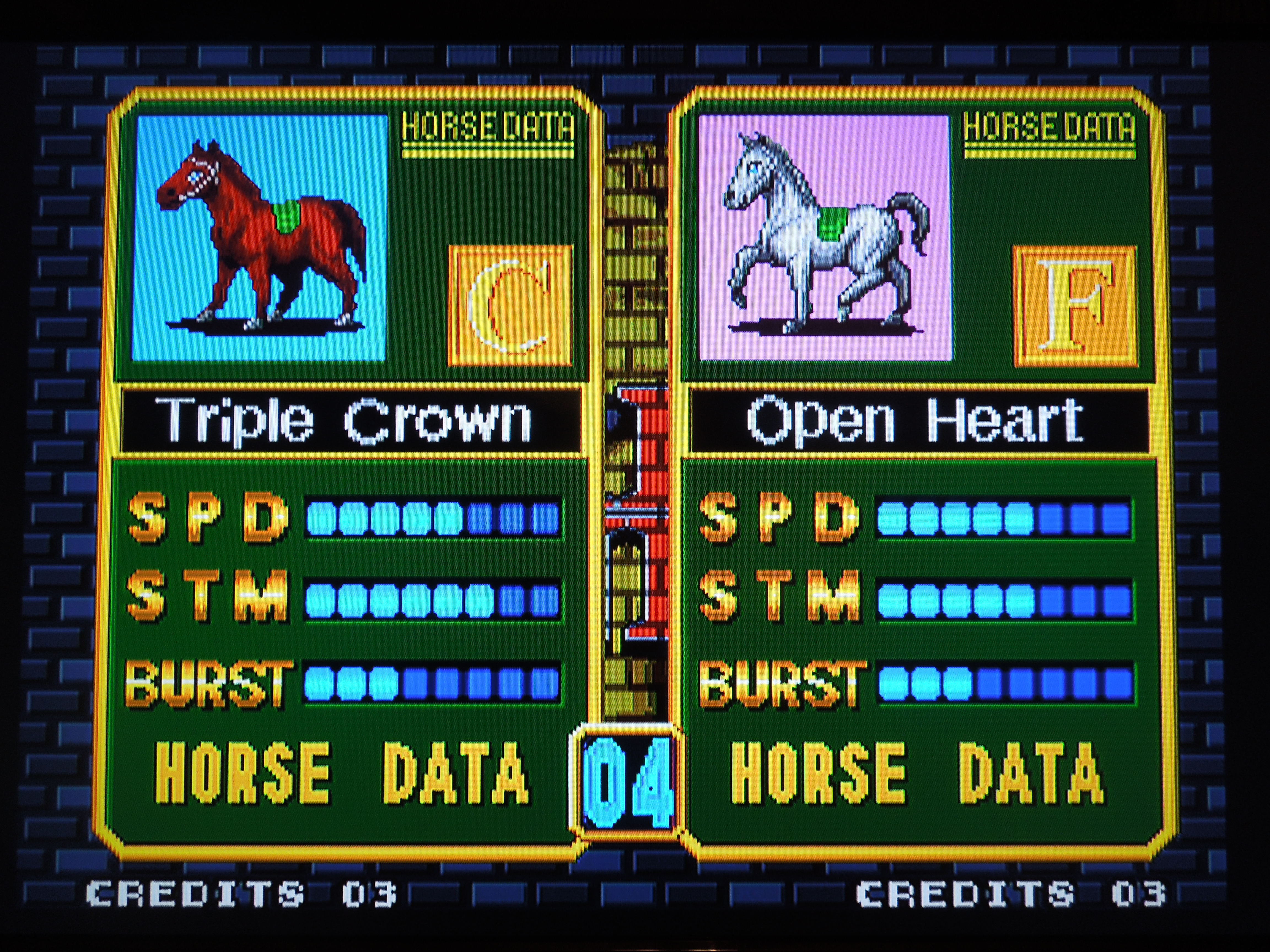
Horses:  Name your jockey (up to 4 characters) first.  Next, pick your horse from among 12 colts and fillies: Local Hope, Ghost Story, Earthquake, Scent of Rose, Shine Dancer, Blue Angels, Open Heart, Black Bird, Quarter Back, Super Model, Triple Crown, and Dance Step.  Each horse is rated in 3 categories: Speed, Stamina, and Burst.

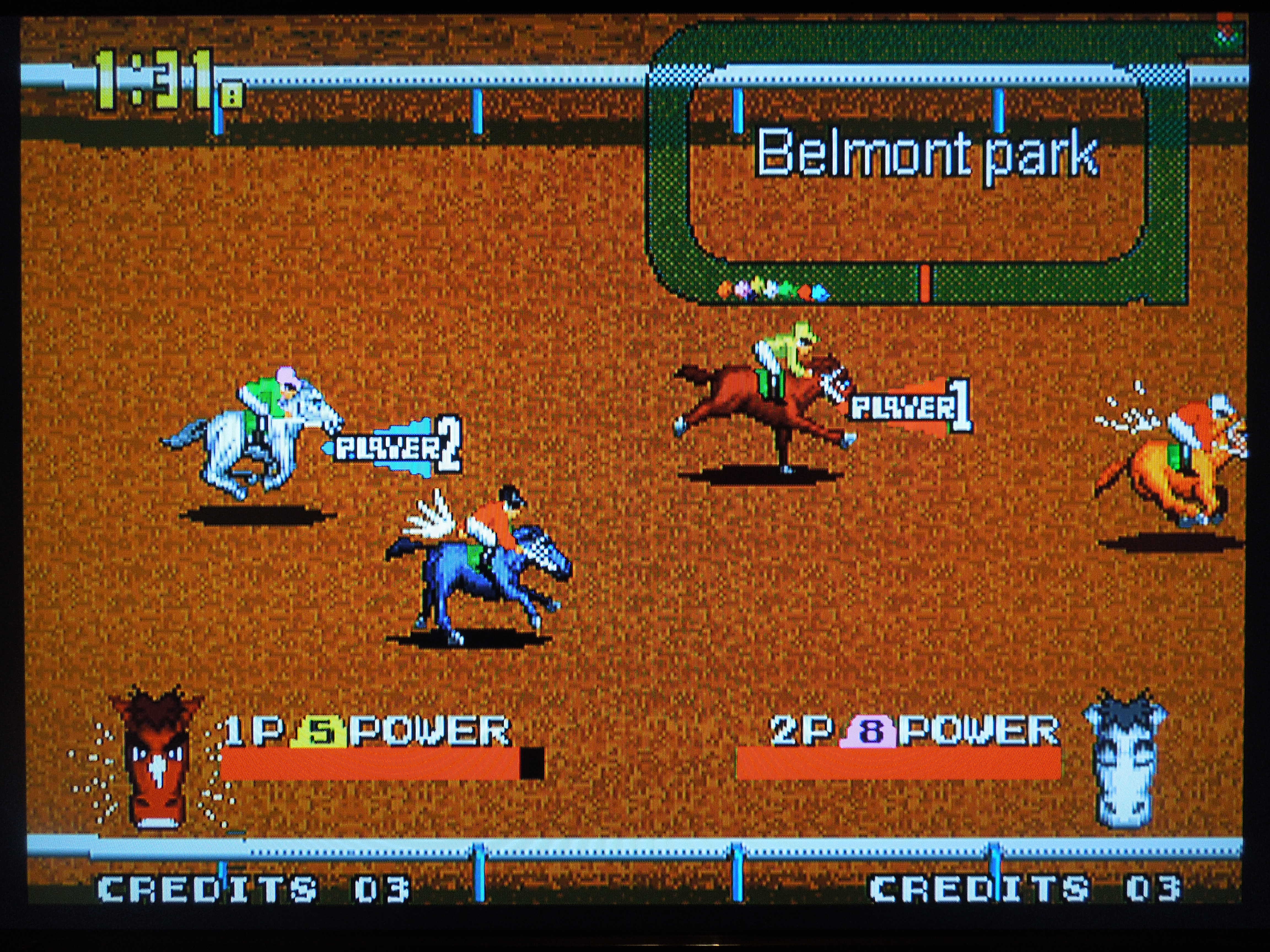
Control:  Rapidly tapping A keeps your horse running at a steady clip, and slowly drains his or her health bar.  B uses the whip, which makes your horse run even faster, but drains his health bar quickly.  If you whip him too much, he’ll simply stop running altogether and you’ll be disqualified from the race (watch your horse’s ‘face’ logo at the bottom of the screen – if he’s shaking his head, stop whipping him).  Button C is your ‘burst’ button.  Essentially, at the end of the race, when your horse’s power bar is nearly depleted (and if you lose all your horse’s energy before reaching the finish line, you’ll lose), press C to kick in some extra health (this just means you’ll get a small portion of health restored to your horse’s health bar).  Pressing Toward, Toward quickly on the joystick will cause your horse to ram other horses on the track, and will sometimes slow them down.  However, if you do this 3 times (yellow ‘foul’ icons appear at the bottom of the screen), your prize money for winning a race will be cut in half.

12 different horses offer different strengths and weaknesses. 12 different horses offer different strengths and weaknesses.

Races:  You’ll have to choose between Europe Mode and America Mode.  No matter which one you choose, you’ll race 16 races – 7 of the races are the exact same in either mode, but the other 9 are completely different races.  Here is a list:

EUROPE                                                  AMERICA

1.        Meiden                                        1. Meiden

2.        Prix de la Salamandre             2. Champagne Stakes

3.        Grand Criterium                      3. Breeder’s Cup Juv.

4.        2000 Guineas                           4. Santa Anita Derby

5.        Derby Stakes                             5. Kentucky Derby

6.        Irish Derby                                 6. Preakness Stakes

7.        King George Dia. Stakes         7. Belmont Stakes

8.        Prix de l’ Arc de Triomphe     8. Jockey Gold Cup

9.        BC Classic                                   9. BC Classic

10.     Japan Cup                                   10. Japan Cup

11.     Coronation  Cup                          11. Hong Kong Cup

12.     Grand Prix de Paris                   12. Santa Anita Handicap

13.     King George Dia. Stakes           13. K George Dia. Stakes

14.     Prix de l’ Arc de Triomphe       14. Prix de l’ Arc de Tri.

15.     BC Classic                                     15. BC Classic

16.     Japan Cup                                     16. Japan Cup           

*Note:  If you play Stakes Winner 2 on a Japanese Neo Geo AES or a European Neo Geo AES (or if you have a uniBios that allows you to change the internal region settings of your console), then races will be somewhat different from those listed above, as will the payouts for coming in 1st place.  For example, if you play Stakes Winner 2 on an American Neo Geo, then the 3rd race on the Europe Mode will be the Grand Criterium with a  payout of $200,000, as listed above.  But if you play Stakes Winner 2 on a European Neo Geo, then the 3rd race on the Europe Mode will be the Prix Marcel Boussac with a payout of $160,000.

Payouts/High Score:  Some races offer large sums for finishing 1st (BC Classic – $1,560,000), while others have smaller sums (Prix de Salamandre – $80,000).  The races in the America Mode, on average, pay more than the races on the Europe Mode.  In addition to winning 1st place, if you set a new track record on each course, you’ll get an extra $100,000.  Also, if you consistently win 1st place, you’ll get ‘Horse of the Year’ awards at certain points, and you’ll get more bonus money.  Upon beating the game, you will get bonus money as well.  If you don’t finish a race in either 1st, 2nd, or 3rd place, you’ll have to try the race again (if you have any Credits left).

Winning 1st place and breaking track records pays big (most of the time). Winning 1st place and breaking track records pays big (most of the time).

Helpful and Harmful Items on the Track:  4 icons appear on the track in certain locations: Carrot (adds a small amount to your horse’s health bar), Wings (gives your horse a very helpful, temporary, speed boost), Mole (slows your horse down for 2-3 seconds), Poison (‘paralyzes’ your horse for 4-5 seconds).  Although the locations are always the same, what icon will appear can change every time you play a race.  Unfortunately, because your horse is running so fast, it is usually nearly impossible to avoid hitting these icons if you’re in position to run over them – so, what that means is, it’s a complete gamble whether you will pick up a Carrot or a Mole – you don’t have time to get your horse out of the way if you notice you’re about to hit a Mole.  However, a way to circumvent this problem is to simply learn where icons typically appear on a track (usually at the end of a long stretch) and have your horse on the opposite side of the track.  You don’t need extra Carrots and Wings to dominate the game, although they don’t hurt, either.

Hammer the B button in the home stretch to make your horse turn it on. Hammer the B button in the home stretch to make your horse turn it on.

Stable Shop:  Between races, you will have the option to buy items that will help you for the upcoming race.  Several items are available for purchase, but here are the most crucial ones – these can be the difference between placing in the top 3 or not:  Carrot-minis (adds one last portion of health to your horse’s health bar, even after you use up your Burst health portion) and Horse Shoes (grips that are only available for purchase if it’s raining on the track – they allow your horse to continue running at a good rate without getting bogged down.  Carrot-minis start out at $50,000.   Horse shoes start out at $30,000.  You are only allowed to buy one item per each visit to the Stable Shop, and items you have purchased previously increase by $5,000 when you return.

The stable shop items can be expensive, but depending on the race coming up, helpful. The stable shop items can be expensive, but depending on the race coming up, helpful.

Horse and Jockey Training:  4 times between the American Mode races, and 2 times between the Europe Mode races, you can ‘train’ your horse in one of 3 areas: Turf (Speed), Dirt (Burst), Pool (Stamina).  After you select your course, you have 30 seconds to guide your horse through a small obstacle course.  It’s easy to complete in under 30 seconds, and your horse’s stats will be boosted afterwards. Additionally, there is an optional ‘Jockey Training’ selection.  Jockey Training involves you paying a large sum of money for a ‘special’ move for your horse.  For example, ‘Extra Push’ is available for $150,000 (and that’s the cheapest special move).  These special moves require you to input particular joystick motions during races – in my experience, these special moves are not worth the money, nor do you need them to dominate races.

Training your horse will boost his stats for upcoming races. Training your horse will boost his stats for upcoming races.

Rivals:  In 1 Player Mode, ‘rivals’ will occasionally turn up and badmouth you right before a race.  In order to get a rival to show up, you’ll have to constantly win races while setting new course times.  If you beat a rival, he’ll then teach you a ‘special move,’ like the ones you can buy from the Jockey Training session, but they’ll be free!  The easiest rival to get to appear is Dan, a jerk who typically appears before the 16th race and reminds you that “It takes class to win.”  Rivals do not seem to appear at all in 2 player mode.

World Cup Race:  I have not confirmed if this exists on America Mode, but on Europe Mode, if you win all 16 races while setting new course records in all of them, a 17th race, the World Cup, will be available to you.  Its payout for 1st place is $2,400,000 – the highest payout in the game.

2 Player Mode:  In two player mode, since there is no split-screen, if one player gets far ahead, the other player will be automatically pulled close behind him, so that both players are always visible on the screen at the same time.  It sounds funny, but it works well, particularly if one player is experienced and the other isn’t.

2 Players can play through the game together, each with 4 Credits each. 2 Players can play through the game together, each with 4 Credits each.

Improvements over the original Stakes WinnerThe game plays faster than the original – this time it’s a really fast-paced racing game.  There are far more races in Stakes Winner 2 than the original Stakes Winner, more horses to select from, and more ways to earn money/increase your high score.  Buying items is an interesting improvement.

Regression from the original Stakes WinnerIn Stakes Winner 2, it’s practically impossible to avoid icons on the track that you don’t want (like Poision) IF your horse is running in the lane in which the icons appear.  In the original Stakes Winner, you had time to see the item coming, and either move to pick it up or move to avoid it.  In Stakes Winner 2, the “ramming move” is not nearly as effective as it was in the original Stakes Winner.  In 2, the move doesn’t slow down other horses nearly as much as it did in the original.  Last, the horses (graphics) were larger in the original game – they’ve been shrunken down a bit for 2.

How may other video games give you a chance to participate in event that's been happening every year since 1875?How may other video games give you a chance to participate in an event that's been happening every year since 1875? How may other video games give you a chance to participate in event that’s been happening every year since 1875?

So, where can I find this game?  Since it was only originally only released for the Neo Geo AES in Japan, and in small numbers, it’s tough to locate an original.  The MVS arcade cartridge is very common, however, and easy to find – you can always get an AES conversion like the one I used for this review.  Stakes Winner 2 was also released for the Sega Saturn, only in Japan.  That version does have an English language option that changes most of the language in the game to English.  You can play the rom on a computer emulator.

Conclusion:  Stakes Winner 2 is an enjoyable racing game.  When we think of racing games, ‘horses’ aren’t something that typical American gamers think of, but that’s a shame, because this game, like its predecessor, is addictive.  It’s not difficult to win races, even on Hard Mode, and trying to beat your high score is great fun.  You’ll find yourself weighing your options – “The Carrot-minis cost $50,000 – do I really need them to finish this race?”  My current high score is $17,624,000 using Super Model on the America Mode (Hard).  Is this game better than the original?  Yes, slightly – although the first Stakes Winner was quite good too in my opinion.

The Southern Gentleman’s Opinion and Letter Grade:  A racing game that breaks the mold of ‘racing’ games.  A bit easy, but quite fun. A

God Bless! Proverbs 3:6


Neo Geo – King of the Monsters 2

King of the Monsters 2 for the Neo Geo AES King of the Monsters 2 for the Neo Geo AES

Note 1:  This game was played on a Neo Geo AES home console that has been modified to output in component video (red, green, blue).  It was connected to a 32-inch HD tv.

Note 2: If you’re interested in Neo Geo games, I have already reviewed several others.  Check them out!

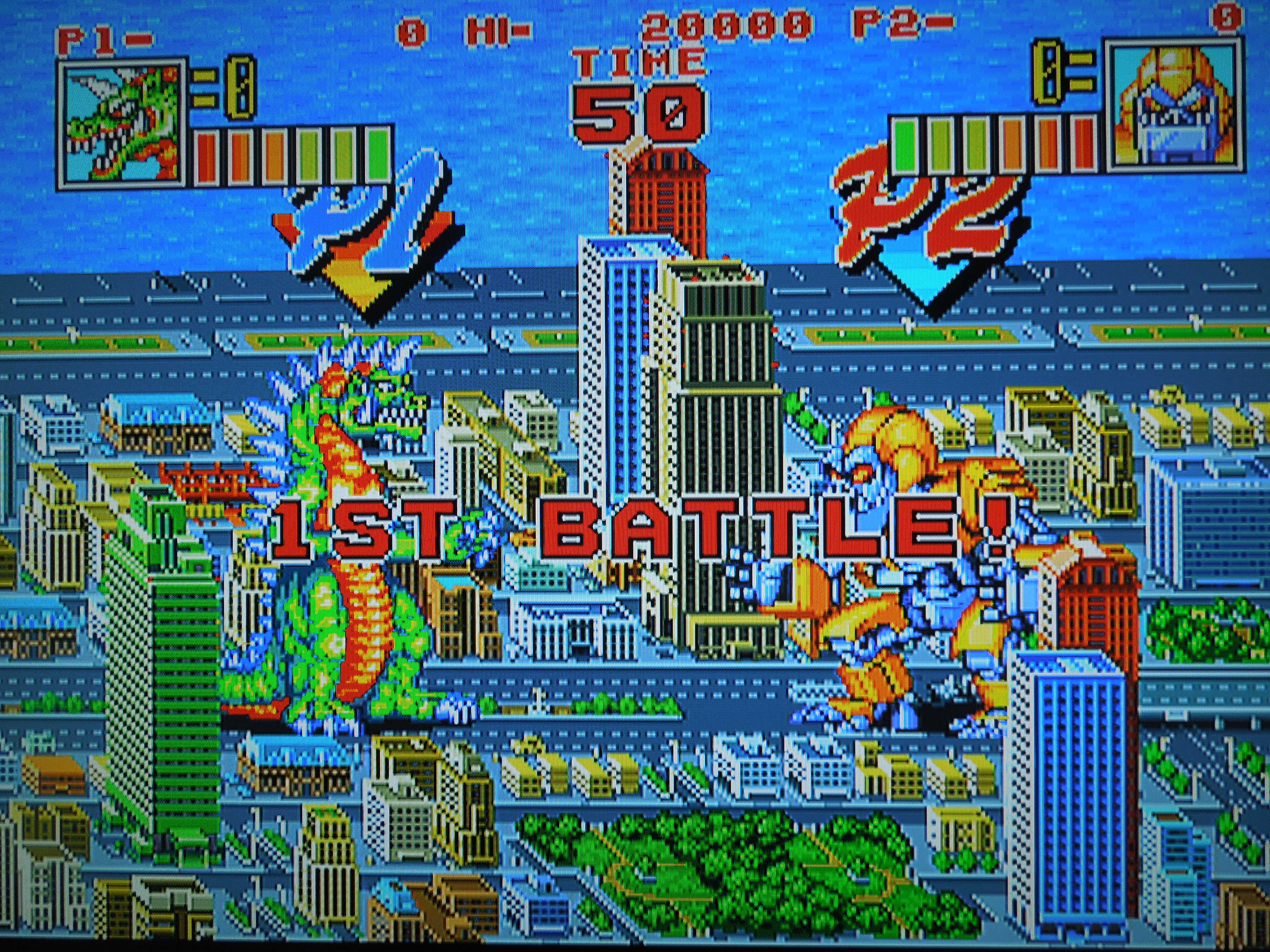
Quick History: King of the Monsters 2: The Next Thing was released for the Neo Geo AES home console in 1992.  It is the sequel to the original King of the Monsters, a game in which the player (or 2 players co-op) selected one (or two) of 6 monsters and fought through 12 levels of ‘monster battles.’  King of the Monsters 2 follows very much in its predecessor’s footsteps, with a few changes.  The game is very reminiscent of Godzilla or King Kong movies in both its ‘monsters’ and some of the ‘city’ stages in which battles take place.

King of the Monsters 2 is not difficult to find for the AES. King of the Monsters 2 is not difficult to find for the AES.

Players:  1 or 2 Players, either co-op or competitive

Memory Card Support: Yes.  After you use up your 4 given Credits (3 lives per Credit), you can save your game, and start back on the last stage you were on.

Story:  Believe it or not, there actually is a story.  3 years after the events in the first King of the Monsters, only 3 of the original 6 monsters have survived, and they’ve become even more powerful.  The 3 monsters travel around the globe to protect cities from invading alien monsters, lead by the evil Famardy (yes, that is the final boss’ name).

Selectable characters: Super Geon (Godzilla-type creature), Cyber Woo (mechanized King Kong creature), Atomic Guy (super-hero creature)

Gameplay:  After you pick your monster (in 2 player co-op, you cannot choose the same character), you’ll play through 7 stages, two with the names ‘American City’ and ‘French City,’ and some with obscure locations like deep under the sea or inside a volcano.  Most stages include a short scrolling sequence where you’ll battle minor enemies like planes, tanks, or bizarre aliens before quickly arriving at the stage’s boss.  The final stage of the game has you running the gauntlet of the previous 6 bosses before finally getting to battle Famardy.

2 Player VS Gameplay:  Each player picks one of the 3 monsters (you cannot pick the same monster), and battles in a Best of 3 match-up.  If matches end in a draw, you’ll keep battling until one fighter has won 2 matches.  You can find power up icons in the city you fight in, and occasionally, planes or other minor enemies may attack either players’ monster.

VS. mode, although simplistic, is quite fun. VS. mode, although simplistic, is quite fun.

Control:  A punches.  B kicks.  C jumps.  Holding A for a few seconds, then releasing it creates a charge attack (a projectile attack typically).  Holding B for a few seconds, then releasing it creates a different charge attack (you have to ‘level up’ before you can use the Holding B attack).  Jumping forward with C then pressing A causes a jumping attack.  When a boss you’re fighting is knocked down, you can kick or punch him while he’s on the ground by pressing A or B.  If you get in close to a boss, you’ll automatically get locked in a grapple.  Rapidly tapping A (if you win the grapple) executes a special throw, like a German-suplex with Atomic Guy.  Rapidly tapping B (if you win the grapple) executes a different special throw (Atomic guys uses a shock move, for example).

Leveling up and Pick-Ups: Your monster can ‘level up’ twice by picking up Power (P) icons.  When he levels up, his color palette changes.  At levels 2 and 3, your character gains more powerful charge attacks.  You can also pick up Power Down icons – they are a reversed, darker ‘P’ that will drop your character down a level (not a good idea), Life Up (L) icons, which restore some of your health, and Points Pick Ups (gold bars).  There are also Question Mark (?) icons that could be any of the previously mentioned icons.  You find icons by defeating minor enemies or destroying objects like buildings in each stage.

2 Player Co-op somewhat lessens the game's difficulty.2 Player Co-op somewhat lessens the game's difficulty. 2 Player Co-op somewhat lessens the game’s difficulty.

1UPS and Bonus Stages:  Some stages begin with your monster falling out of the sky.  Just before you hit the ground, you’ll be encouraged to hit ‘A’.  If you time it just right, you’ll land on your feet and be awarded a 1UP.  Also, between some stages, you’ll engage in short ‘Bonus Battles’ for extra points (no extra lives are ever awarded for reaching particular point totals, unfortunately).

The Stages: The stages, although short, look fantastic.  You’ll recognize national landmarks (that you can destroy) like the Eiffel Tower and Mount Rushmore (which is incorrectly placed in the Grand Canyon).  A lot of detail has been put into each stage, and the explosions from destroyed enemies and objects look great, and they add to the ‘destructive’ feel of the game.

Difficulty:  Hard, very hard (even if you select ‘Easy’ mode).  The bosses that you’ll face at the end of each stage look unique (and awesome).  The first few aren’t TOO bad, but the problem is that when you grapple with them (and you’ll typically grapple a lot), they will win at least 75% of the time.  When you first encounter them, you can typically win the first grapple or two, but that’s it, at least until they kill you and you start back with a new life.  Then you can typically win a grapple or two again before they dominate you.  However, you can repeatedly use jumping attacks with some success, and if you hit a Level 3 charging projectile attack on them, you can often set yourself up to keep on doing it every time they get up.  With two players, the game becomes slightly easier, but without being able to win even half of the grapples, you’ll need to utilize cheap tactics to come out on top without using up lives and Credits.

Famardy: The last stage is absolutely brutal with the gauntlet of bosses, followed by Famardy.  Famardy might be the hardest, ‘cheapest’ boss in the history of video games.  You can’t grapple with him, meaning you can only chip away with punches and kicks and hope to have enough time to power up for a charge attack.  I honestly think it’s literally impossible to beat the game with only 4 Credits (3 lives per Credit), even if you use a Memory Card and start at the final stage, Stage 7.  If you somehow survive the gauntlet and actually make it to Famardy, that is an accomplishment unto itself.  I had to use an infinite life cheat code from my system’s uniBios to beat the game.

Charge Attacks are the key to advancing far into the game. Charge Attacks are the key to advancing far into the game.

So, where can I find this game?  It’s not terribly tough to locate this Neo Geo AES game.  It can be found on eBay usually.  I believe there was a Neo Geo CD version, and it was also ported to the SNES and Sega Genesis, although I think those ports changed some thing up from the Neo Geo game.

Conclusion:  Despite the game’s small roster of playable monsters and extremely tough difficulty, I really enjoy playing King of the Monsters 2.  It’s a great co-op game, and you can definetly make it farther with two players working together (you cannot hit each other in 2 player co-op, fortunately).  I’ve made it as far as the Stage 5 boss, Aqua Slug, using the given 4 Credits.  In order to not get really frustrated with this game and be successful, you’ll really have to learn how to utilize the jump attacks and the charge attacks.  The game is reminiscent of playing the much more well known Rampage games – that’s the only comparison I can think to make.  If you can handle the difficulty and learn to counter the bosses cheap grapple-wins with your own cheap tactics, this can be a fun game.  But forget about the final boss – he really, really sucks.

The Southern Gentleman’s Opinion and Letter Grade:  Average game in most ways, but there’s something timeless about fighting monsters.  C+

God Bless! Proverbs 3:6

PC Engine – Street Fighter II: Champion Edition

Street Fighter II: Champion Edition for the PC Engine

Note 1:  This game was played on a PC Engine home console.  The console was connected to 32-inch HD tv with AV cables (red, yellow, white).

Note 2: I played this game with the standard 2 button PC Engine controller, and there appears to be no way to Pause the game when playing with this controller (that I could determine).  Therefore, some of the pictures I took required me to use the Freeze button on my tv remote control, which slightly blurs the images of the sprites and words on screen.

The hu-card for this game is slightly bigger than most PC Engine games. The hu-card for this game is slightly bigger than most PC Engine games.

Quick History:  Street Fighter II: Champion Edition was released for the PC Engine in Japan in 1993.  While many versions of Street Fighter II were released in the United States for the Super Nintendo, Sega Genesis, and other gaming systems, the Turbografx 16 (the U.S. version of  the PC Engine) never received this game nor any version of Street Fighter II.  This Japan-exclusive PC Engine game is a (not arcade perfect) port of Street Fighter II: Champion Edition, the arcade game, which was released in 1992.  Unlike follow-up games in the Street Fighter series, this PC Engine version does not include any ‘turbo’ features (speed-ups in gameplay).  Rather, it is intended to purely re-create the experience of playing the original arcade game.

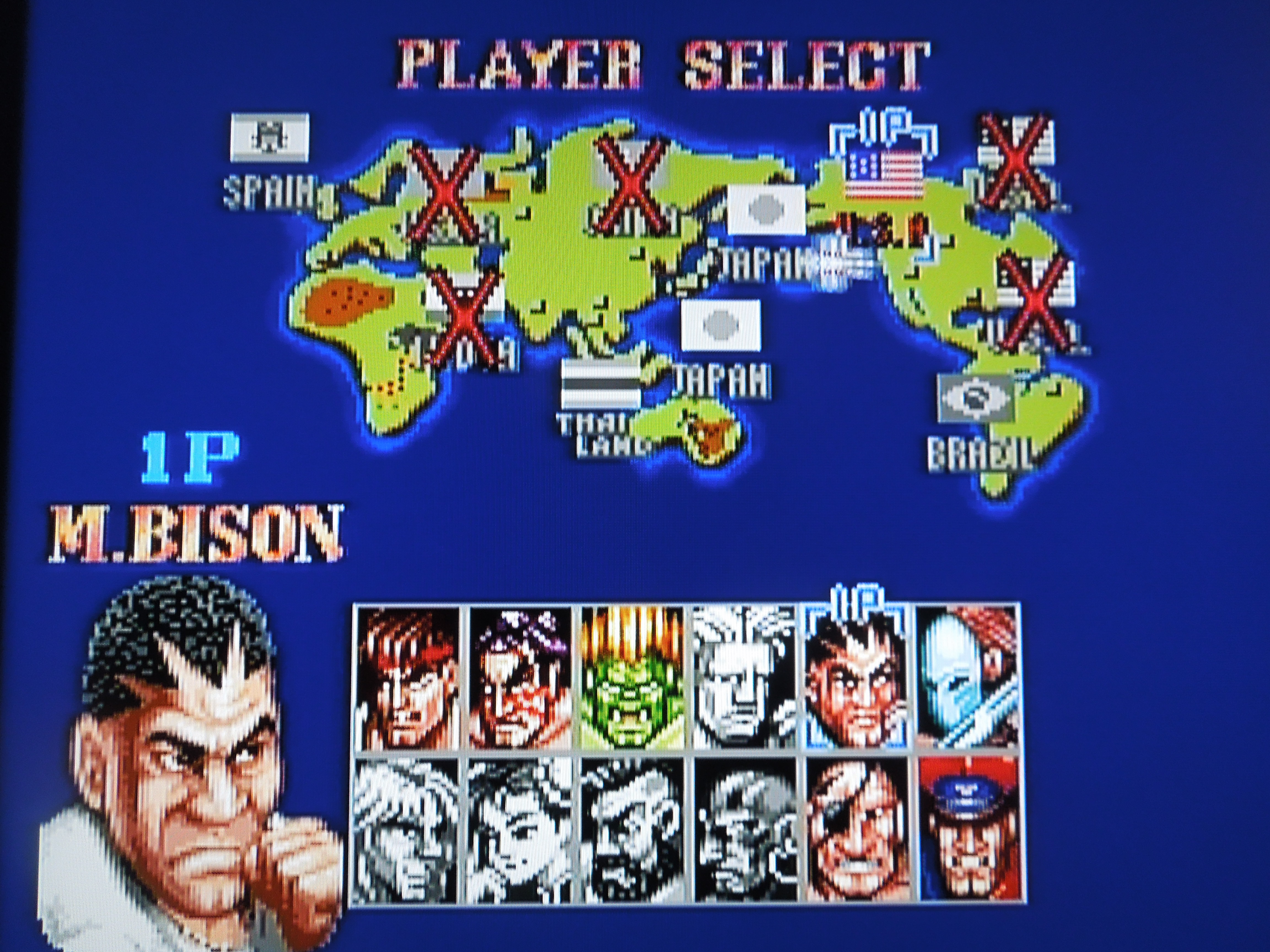
Characters and Issues with Names: SFII: Champion Edition includes 12 selectable characters from across the globe: Ryu, Ken, Chun Li, Dhalsim, Blanka, E. Honda, Zangief, and Guile.  4 boss characters – M. Bison, Balrog, Sagat, and Vega are also selectable.  While many people are familiar with Street Fighter II, a lesser known fact is that the names of 3 of the 4 boss characters are switched from Japan to the U.S.  The boxer character in Japan is known as M. Bison, but his name was changed to Balrog in the U.S.  In Japan, the character of M. Bison bears a striking resemblance to real-life U.S. boxer Mike Tyson, so the boxer’s name needed to be changed to avoid any legal trouble before being released in the U.S.  So, the names of 3 characters were swapped around for the U.S. releases of all Street Fighter II games.  On this PC Engine hu-card version, however, the characters retain their original names – the boxer is M. Bison, the mask-wearing cage-fighter is Balrog, and the evil final boss is Vega.

The bosses in this version all have their original names. The bosses in this version all have their original names.

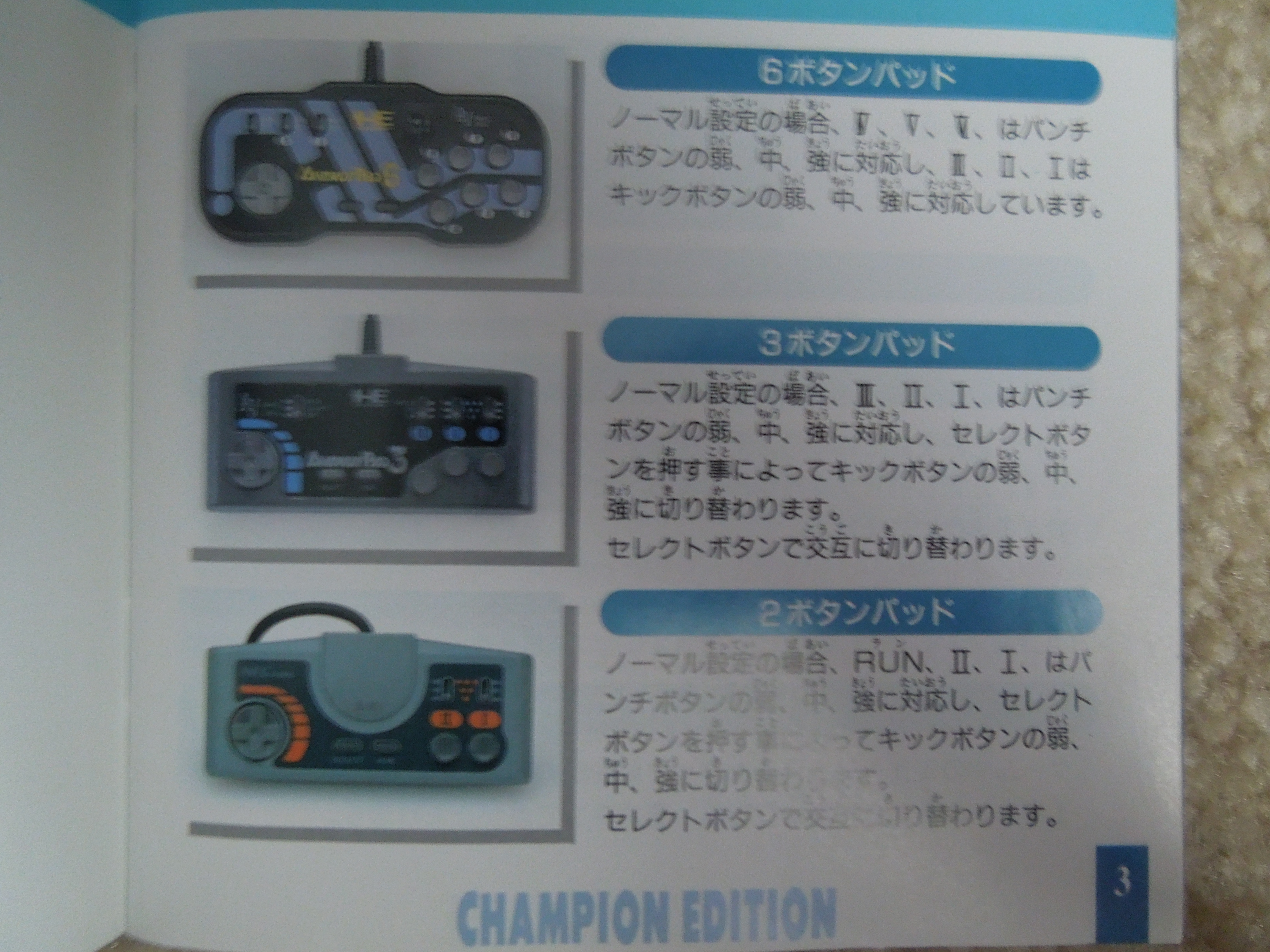
Controls: I played this game using the standard PC Engine controller, which has a total of 4 buttons – Select, Run, II, and I.  While many reviews (and even the game manual) recommend playing with a 6-button controller for the optimum experience, I had no problem playing and mastering the game with the standard controller.  Pressing Select changes the mapping of the 3 attack buttons from punch to kick, and back again.  The Run button is weak punch or kick, button II is medium punch or kick, and button I is strong punch or kick.  You can change whether you want your character to kick or punch on the fly, anytime during a match.  The Sega Genesis version employed a similar style on its 3-button controller.  While many might not like having to swap between kick and punch buttons, I actually found it to be a somewhat different and enjoyable experience – it added a new level of challenge, but wasn’t as bothersome as I’d read about in other reviews.  As far as pulling off special moves, everything worked flawlessly – great control.

Playing the game with the standard PC Engine controller is a different experience, but not difficult. Playing the game with the standard PC Engine controller is a different experience, but not difficult.

Sound, Colors, Music:  As far as comparisons to other gaming systems (like the SNES and Sega Genesis), I can’t give an adequate list of ‘better than,’ ‘worse than.’  What I can say is that everything looks and sounds great.  The only Street Fighter II game I’ve played much of over the years is Street Fighter II: The World Warrior for the SNES.  Now, compared to that particular game, this PC Engine hu-card version is far better for its character selection and the ability for 2 players to actually select the same characters for VS.  The music, sound effects, and colors all sound and look quite comparable between the SNES game and this PC Engine game (I’m sure there are websites that do a great job of analyzing the differences in colors and sounds between these versions).  The music is not quite as good as what the SNES can produce.  I didn’t notice any absence of sound effects or voices in the PC Engine game, either.

The game keeps up with your win/loss stats during 2 player VS. The game keeps up with your win/loss stats during 2 player VS.

Pausing the game?  I could not figure out if this is possible with the standard controller.  In most PC Engine games, the Run button pauses the game, but here, the Run button is used for weak punch or weak kick.  I tried using different combinations of buttons to pause, but nothing worked.  If I had a controller that didn’t require the Run button to function as an action button, I suppose I could pause the game.  UPDATE:  I did recently discover that you can hold SELECT on the map screen between rounds to pull up the button configuration window.  It will stay up until you select EXIT and move on to the next fight.  While this isn’t as good as being able to pause in a match, you can at least take a break and not have to worry about playing through every match without stopping.

Missing scenes from the arcade version, SNES, or Genesis version:  The intro and character bios that can be found in other versions of the game are not included in the PC Engine version.

Language Barrier?  No.  You will see Japanese with the ‘winning’ quotes characters issue after matches, during the ‘endings’ for each character when you beat the game, and in the win/loss statistics of 2-Player Vs.  Everything else, from character names, country names, and voice-overs, are in English.

So, where can I find this game?  It’s easy enough to find on eBay.  If you want to play it on a U.S. Turbografx 16, you’ll need a system mod or an adapter that will allow you to play Japanese games on U.S. systems.  Remember, whether you’re playing on a U.S. Turbografx 16 or a Japanese PC Engine, if you want to play with 2 players, you’ll need to buy a multi-tap, as the system for either country only has 1 controller port.  You can also play the rom on a computer emulator.

Each character has a unique ending. Each character has a unique ending.

Conclusion: Street Fighter II: Champion Edition for the PC Engine is a great fighting game.  If you’re interested in buying a PC Engine game console, this is one of the first games you should buy.

The Southern Gentleman’s Opinion and Letter Grade:  There are so many choices when it comes to playing Street Fighter II games.  While this one doesn’t stand out from nor fall behind other versions of the game, it is interesting if for no other reason than it was released for the PC Engine.  Remember, this version has no ‘turbo’ features, but I didn’t find gameplay to be too slow at all.  Recommended if you’re interested in the PC Engine, or if you’re interested in a basic, fun, extremely playable, no extra bells and whistles version of Street Fighter II with the main 12 characters.  B+

God Bless! Proverbs 3:6
SNES – Tales of Phantasia

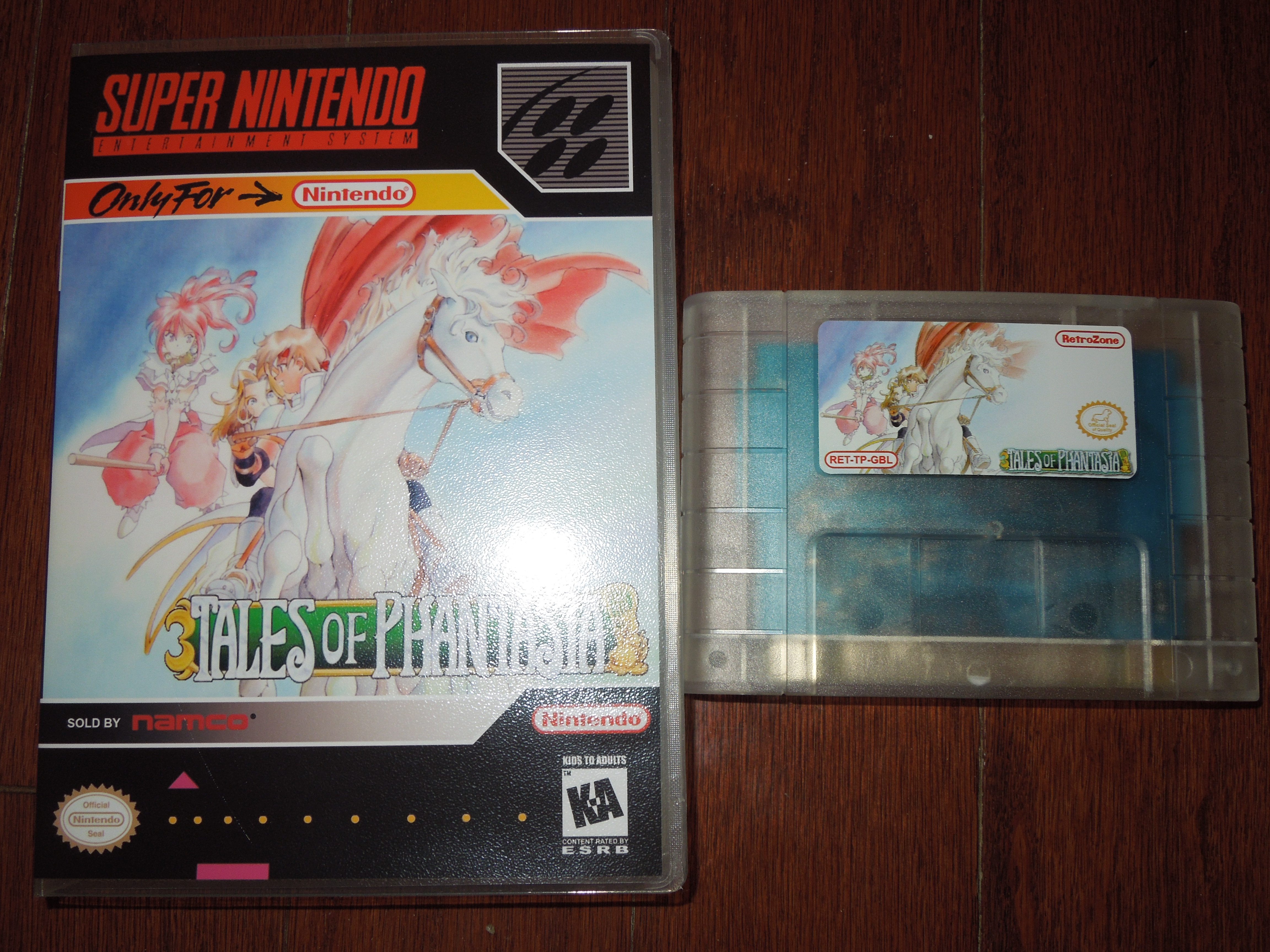
Tales of Phantasia for the Super Nintendo Tales of Phantasia for the Super Nintendo
Tales of Phantasia was originally a Japan-exclusive RPG. Tales of Phantasia was originally a Japan-exclusive RPG, but today, translated reproduction cartridges are available.

Note 1: Like RPG/Adventure games?  Check out my reviews of Ancient Stone Tablets, BS Legend of Zelda, and Zelda: Parallel Worlds Remodel.

Note 2:  This game was played on an original model SNES console using S-video cables.  The SNES was connected to a 32-inch HD tv.

Quick History: Tales of Phantasia was an RPG released for the Super Famicom (the name of the Super Nintendo in Japan) in 1995.  Although there would be a Game Boy Advance version released in the U.S. in 2006, U.S. Super Nintendo owners were out of luck, as this RPG, like many others, never received a translation and release in the western hemisphere in the 1990’s.  Today, however, the game has received an unofficial translation by DeJap Translations, and the rom can be placed onto a cartridge for play on a SNES.

Brief Story Summation: The story is a fairly complex time travel tale, but here is a quick overview:  Dhaos, a seemingly evil sorcerer, has been released from his magical imprisonment in the ‘present’ time, and five hereoes – Cless, Chester, Claus, Mint, and Arche (Mint and Arche are female) are tasked with stopping him.  The group pursues Dhaos through time, battling him 100 years in the past, in the ‘present’ timeline, and 50 years in the future.  In all timelines, Dhaos wages war against individual countries and kingdoms, with his true motivation not revealed until the end of the game.

Gameplay: Despite the fact that you eventually acquire 5 members in your party, as you traverse the towns, country, and overworld map (all in a top-down perspective), only 1 character is visible.  This is your ‘lead’ character.  When you have major (dialogue) interactions, or when you enter battles, the other characters become visible.  During the game’s 30+ hour adventure, you’ll travel among towns, castles, dungeons, ships, and the countryside battling monsters.  As you progress, your characters will learn magic, obtain new weapons, and grow stronger (gain levels).

Save your game anywhere on the Overworld Map. Save your game anywhere on the Overworld Map.

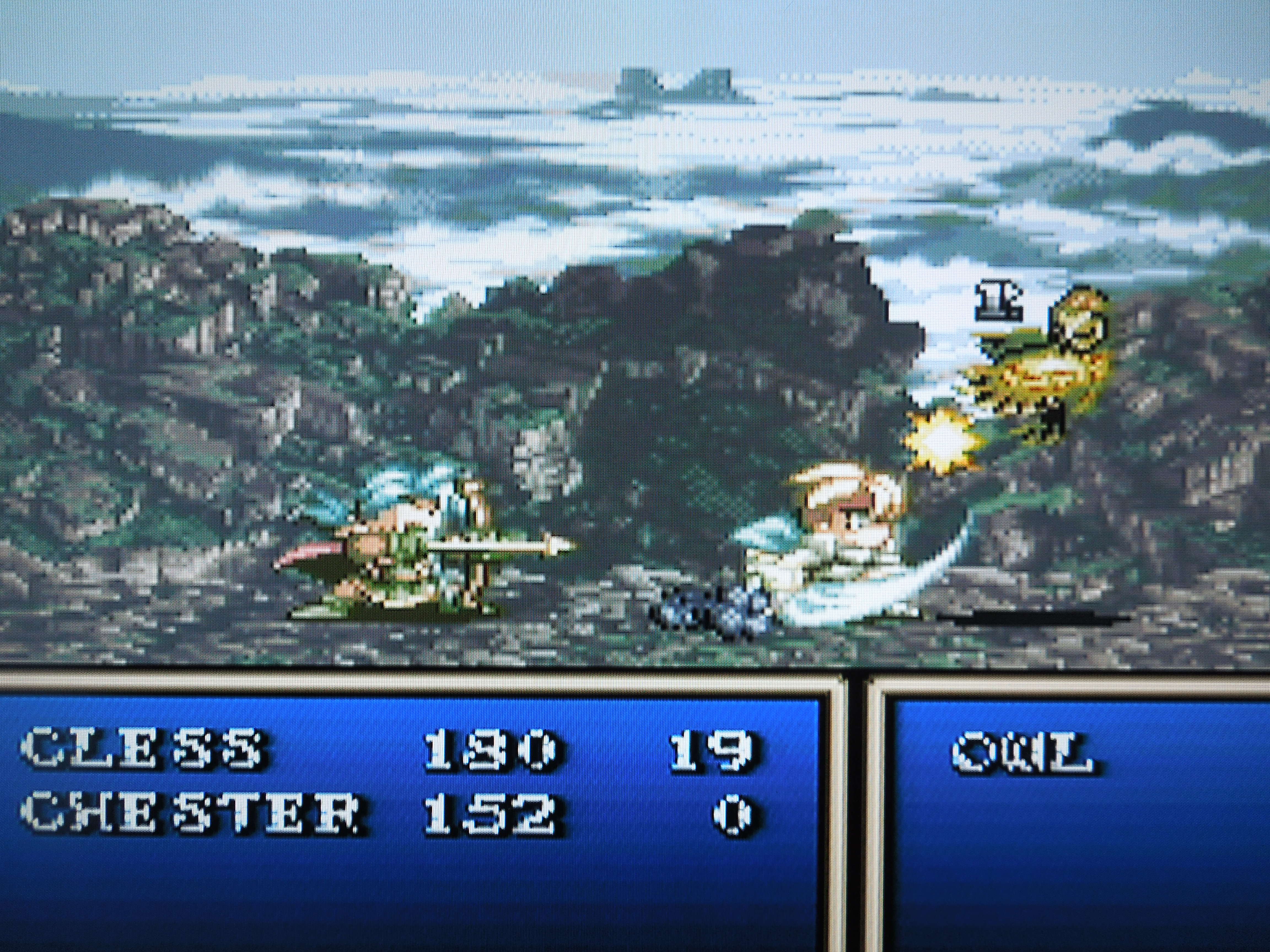
Battles: Tales of Phantasia implemented a unique battle system, which is far different from other RPGs.  Battles occur randomly when your party is traveling in certain areas (mostly anywhere outside of towns).  Although these battles occur frequently, you can buy Holy Water to drastically cut down on the amount of battles you’ll encounter.  When you enter a battle, the game switches to the Linear Motion Battle System.  Essentially this is a 2D plane with your enemies on the right side of the screen, and 4 of your 5 party members on the left (sometimes enemies appear on both sides with your party in the middle).  You can physically control Cless, moving him left and write and attacking with button A.  While you cannot directly control your party members, you can give them commands, instructing them to cast spells, attack, stay away from the enemies, etc.  After each battle, you’ll acquire experience points to ‘level’ up your character, making him or her stronger.  You’ll also gain new fighting abilities throughout the course of the game.

The Linear Motion Battle System is absolutely fantastic. The Linear Motion Battle System is absolutely fantastic.

Music:  Absolutely amazing.  The game opens with a 3-minute song called ‘The Dream Will Not End’ (that is actually sung in Japanese), and it’s beautiful.  Throughout the game, sweeping scores accompany the story, superbly enhancing the gameplay.  This particular game had to be made with a special chip to accommodate the extra music.  There is even an option on the Start menu of the game to listen to the tracks from the game – this is a great addition.

Sound Effects:  There is a male Japanese voiceover at the beginning of the game, and during gameplay, English (although they can be tough to discern) and Japanese battle cries are issued from the characters – they’re nothing great, but I do think they add to the game.

You will acquire 5 members of your party as the game advances - each with a dynamic personality. You will acquire 5 members of your party as the game advances – each with a dynamic personality.

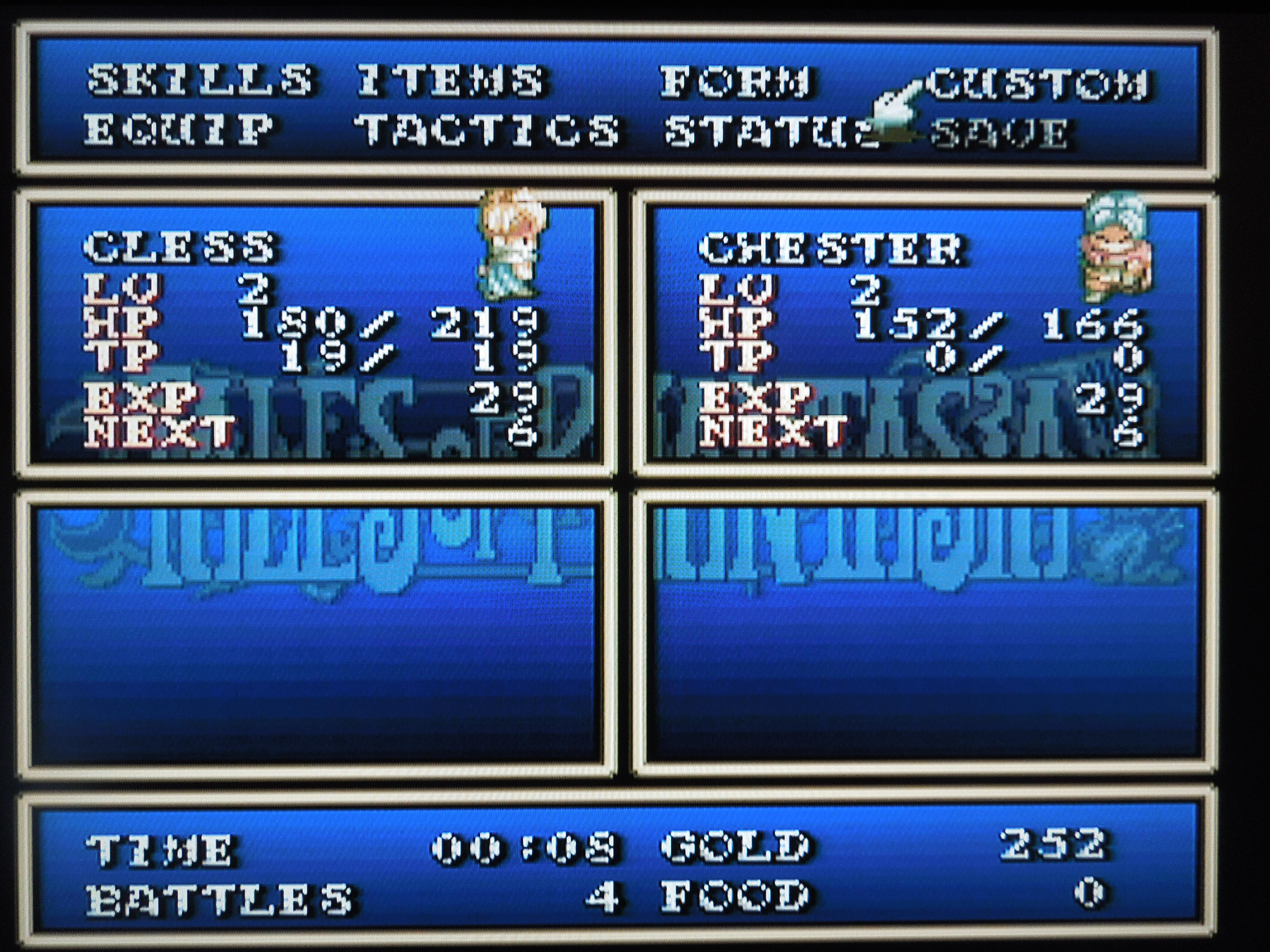
Difficulty:  Relatively tough, but certainly not unbeatable.  I played all the way through the game, and it took me just over 36 hours to beat (the game keeps track of the time you’ve spent playing).  There are frequent save points in the game’s dungeons and castles, and you can save anywhere on the Overworld map.  The ‘random’ battles occur constantly, however, and can be frustrating UNLESS you keep a heavy supply of Holy Water with you at all times – this makes the frequency of battles more bearable.  Of course, the more you battle, the faster you’ll gain levels to strengthen your characters.  The bosses in the game’s castles and dungeons can be exceedingly tough if you’re under-prepared, so a lot of ‘level-grinding’ against weak enemies is necessary.

Translation: While it’s great that there is a translation for this game, and the story is captivating, unfortunately, the translators incorporated way, way too many vulgarities and dirty jokes into their ‘translation’.  The ‘F’ word appears several times, as well as many other curse words.  While I have nothing against crude language in the right setting, here, it is simply not needed, and actually hurts the experience of the game.  Many RPGs have moments of innuendo that cause you to chuckle and that fit well with the game’s story, but some of the dialogue in this game is so tasteless and over-the-top that you’ll wonder what the translators were thinking.  If you’re playing this particular translated version, do not play it around young children.  Additionally, there are other noticeable grammatical errors and typos to be found here and there.  All in all, however, the translation does do a good job of explaining the story and building up the storylines of the characters.

Dhaos is the game's antagonist, and he's not your stereotypical 'bad guy.' Dhaos is the game’s antagonist, and he’s not your stereotypical ‘bad guy’.

So, where can I find this game?  You can buy the original Super Famicom game on eBay.  I’m unsure how much of that version is actually in English – most likely, none of the story is, but possibly the menus are in English.  If you want to play the English translated version, several SNES reproduction websites sell the game, or can create one for you by request.  *Note – be sure to do some investigating about reproduction cartridges before you obtain Tales of Phantasia.  Because the game requires some special chips in order to be made, I believe it may be a more difficult game for makers to create, and thus there could be problems with the cartridge, like what I’ve experienced with my reproduction cartridge.  While my cartridge saves just fine, unfortunately, approximately 20 times during my 36-hour playthrough, the cartridge would inexplicably flash to a black screen and stop working – I would have to turn the power off, then back on to get it to work again.  Why did this happen?  I have no idea – sometimes it would happen after playing for 5 minutes, sometimes after 2 hours – maybe something was overheating?  I’ve never experienced this with any other reproduction cartridges.  The point is, simply email the reproduction maker and ask if they’ve had any problems with Tales of Phantasia – it is possible of course, that most reproduction cartridges of the game are fine, and it’s just my copy that has the issue.

A good overall translation is marred by moments of out-of-place, crude dialogue. A good overall translation is marred by moments of out-of-place, crude dialogue.

Conclusion: I was honestly a bit surprised with how good this game is.  The story, which honestly can be a bit difficult to follow at times, is still fascinating, particularly as it incorporates elements of time travel.  The character development and twisting plotlines are great – you genuinely care what happens to the members of your party after only a few hours of playing.  While the battles occur far too often for my liking, I think the Linear Motion Battle System is fantastic – it almost has the feel of a 2D fighter like Street Fighter 2.  The characters, enemies, and bosses (during battles) all look visually stunning as well.  The only real problem, as I’ve mentioned, is with the translation – a good ‘PG’ version, or at least, a more tasteful adult version would have been far better than the sophomoric dialogue that sometimes occurs.

The Southern Gentleman’s Opinion and Letter Grade: This is a really, really good RPG.  Frustrating at times?  Oh yeah – very much so.  Still, it has an addictive quality that you look for in RPGs, and it has a different ‘feeling’ because of its well-thought-out battle system.  B (would be higher if not for the lude translation – sorry to beat that dead horse so much; remember, this is just my personal opinion, and others may not mind the translation at all)

God Bless! Proverbs 3:6

Controllers – SNES C&L Championship Joystick

The C & L Championship Joystick for the SNES The C & L Championship Joystick for the SNES

Note:  Like arcade controllers?  Check out my reviews of the Analogue Interactive Arcade Stick and the VF Dash!

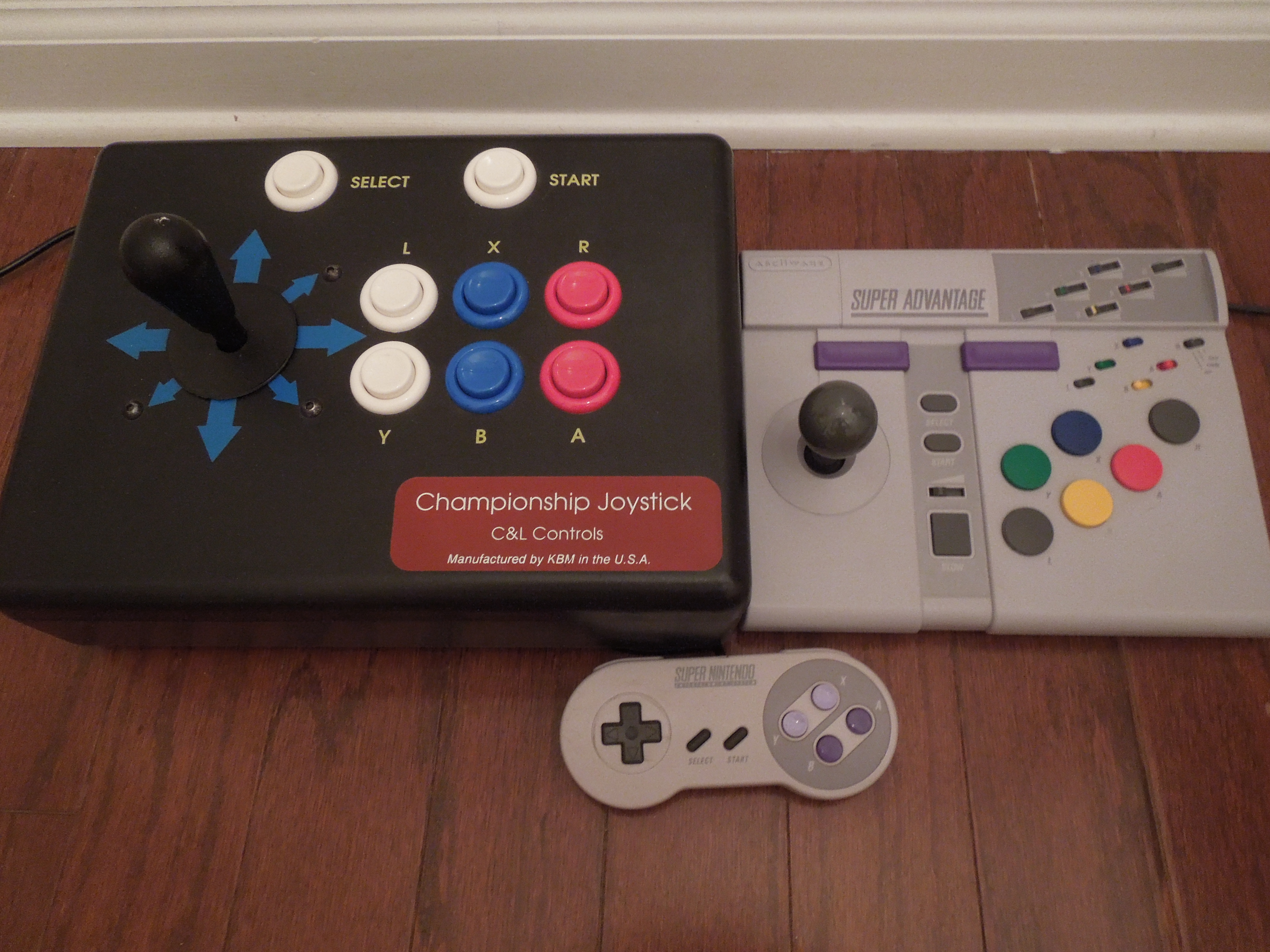
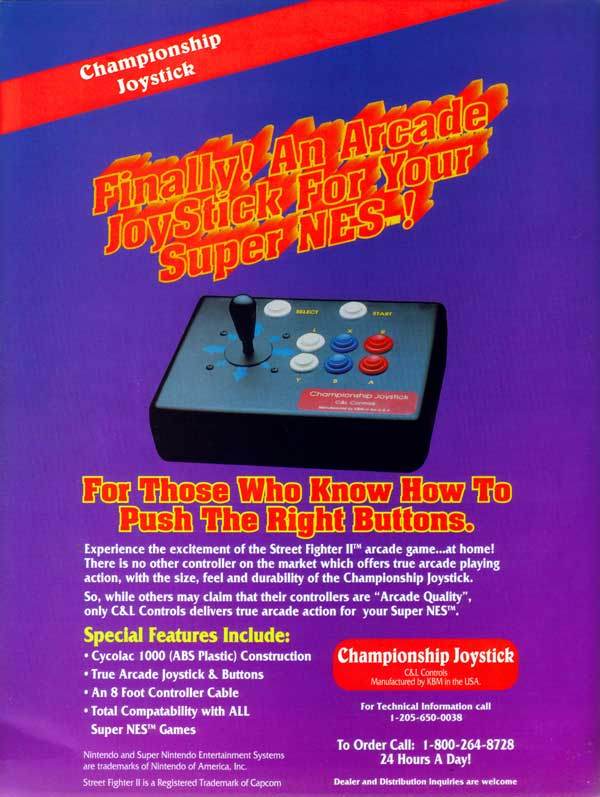
Quick Super Nintendo controller history:  There are A LOT of controllers for the Super Nintendo Entertainment System.  Of the ‘arcade joystick’ variety, the most popular is the SNES Advantage, the successor to the NES Advantage.  The SNES Advantage has an ‘arcade-style’ joystick, buttons that are much larger than those on the standard controller, and turbo switches.  All in all, the SNES Advantage is a decent alternative to the standard SNES controller, although the biggest complaint critics find with the controller is its awkward button layout and none-too-long cord.  Additionally, the SNES Advantage doesn’t really ‘re-create’ the arcade experience quite like a real arcade joystick due to its cheaper parts.  Enter the C & L Championship Joystick, a joystick that claims (according to an old ad I found online) to have ‘true arcade joystick & buttons’ and to deliver ‘true arcade action.’  I’m not sure what year it was released, as there isn’t a lot of helpful information about it online, but it was released by a company known as KBM.

The C & L is larger, and yet lighter, than the SNES Advantage. The C & L is larger, and yet lighter, than the SNES Advantage.

The Controller:  The C & L Joystick is quite large, although not terribly heavy.  Comparatively, it isn’t quite as heavy as the SNES Advantage, although it’s firm enough to stay in place if you’re playing with it resting on a coffee table.  Its body is made from a very durable and sturdy plastic.  The joystick is not the more-typical ‘ball’ joystick, but rather a rounded handle with a grip surface.  In addition to the Start and Select buttons at the top of the controller, there are 6 action buttons: Y, B, and A on the bottom row, and right above them, L, X, and R.  The buttons are concave rather than convex (like the buttons on the Analogue Interactive Arcade Stick or VF Dash, for example).  The arcade stick is ‘clicky’ when rotated, and the buttons have a nice ‘clicky’ feel to them as well – not too loud, but very much what you would experience in the arcade.  The cord is 8 feet long – about as good as you can ask for from a SNES controller (without having to buy extensions).  It has 4 knubby, rubbery plastic legs on the bottom.

This old ad boasted the advantages of using the C & L Joystick. This old ad boasted the advantages of using the C & L Joystick.

Can I open the controller?  There are no visible screws anywhere on the C & L Joystick.  There is a seam along the middle of the controller, but it seems to be sealed in place.  So, can it be opened?  It doesn’t look like it.

So, where can I find this controller?  I have no idea about the production run of this controller.  The most information I could find suggested that this controller was expensive when it was initially released around 20 years ago.  I found only one on eBay, but I’m sure they pop up there from time to time.

Conclusion: Wow, was I impressed with this controller.  The only shortcoming I found was with its weight – I wish it was a bit heavier.  This is not to suggest that because it’s NOT extremely heavy that it feels cheap – it doesn’t, not at all.  The control stick and the buttons are perfect and really enhance the experience of gaming on the SNES – it truly does have that ‘true arcade action’ feel.  I played several SNES arcade games using the C & L Joystick (Turtles in Time, Sunset Riders, Knights of the Round, King of Dragons), and it’s a far, far better experience than the standard SNES controller or the SNES advantage.  The action buttons can really take a beating, and the response time of your character’s on-screen actions is quicker when you’re using the C & L compared to the regular controllers (my opinion, at least).  I think the placement of the buttons is perfect.  Unfortunately, I was unable to test the C & L with fighting games like Street Fighter II, but I do know that the layout on this controller is supposed to be ideal for fighters.

The Southern Gentleman’s Opinion and Letter Grade:  This is the best controller ever made for the Super Nintendo.  A+

God Bless! Proverbs 3:6

Controllers – Analogue Walnut Neo Geo Arcade Stick

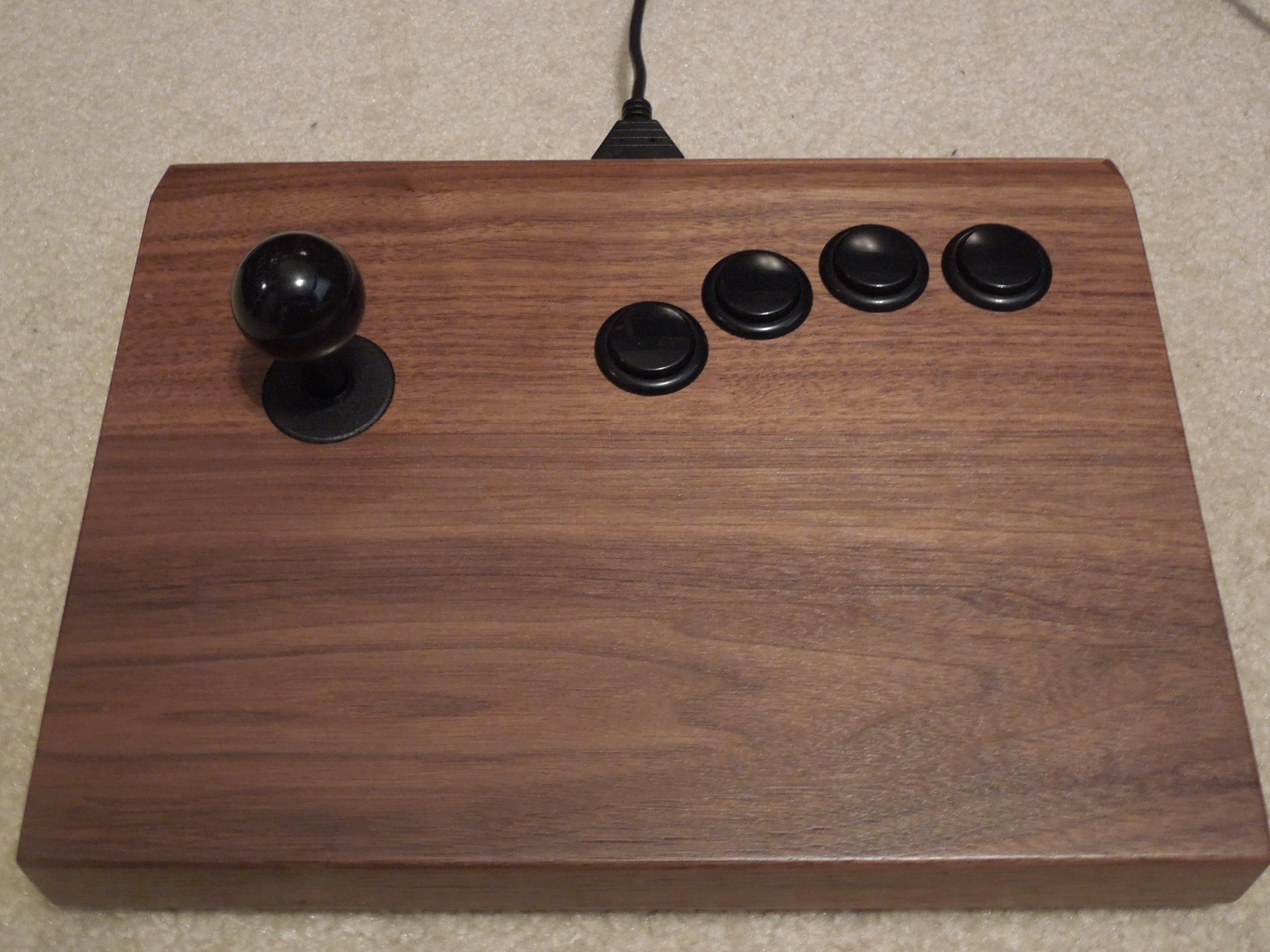
The Analogue Interactive Walnut Arcade Stick for the Neo Geo AES. The Analogue Interactive Walnut Arcade Stick for the Neo Geo AES.

Note 1: Interested in arcade sticks/controllers?  Check out my review of the Sega Saturn VF Dash!

Note 2:  Like Neo Geo AES games?  Check out my reviews of 3 Count Bout, Cyber-Lip, Dunk Dream, Flying Power Disc, Football Frenzy, Neo Bomberman, Sengoku 3, Shock Troopers: 2nd Squad, Stakes Winner, and Super Dodge Ball!

Quick Neo Geo Controller History:  There are 3 common Neo Geo AES controllers: The traditional Neo Geo Arcade Joystick, the Neo Geo Arcade Controller Pro, and the Neo Geo CD controller.  The first two, the Arcade Joystick and the Pro, are larger controllers that have your traditional arcade joysticks with 4 large, arcade style (although not arcade quality) buttons.  They both work very well with the Neo Geo AES home console.  The Pro is smaller than the Arcade Joystick, and its actual joystick is shaped differently.  The ball on the Arcade Joystick tends to crack over time, while the Pro’s design is more sturdy.  The 3rd controller, the Neo Geo CD controller, is a more traditional ‘console’ controller (think Sega Genesis or SNES controllers).  The CD controller also works well with the Neo Geo AES, although dirt and dust can quickly accumulate in the thumbstick, causing the contacts to not function properly – this results in you not being able to move in a certain direction in the game you’re playing.  The CD controller can be taken apart and cleaned, but this takes time and precision.  There are also other Neo Geo AES controllers, from the Japanese HORI Sticks (that feature turbo switches), to the small company/fan-made ‘Arcade’ variety joysticks.

The Walnut Arcade Stick weighs almost 4 pounds. The Walnut Arcade Stick weighs almost 4 pounds.

Analogue Interactive Products:  You can easily Google the website, but Analogue Interactive started making Neo Geo consolized-MVS home consoles a couple of years ago.  These are basically consoles that will play Neo Geo MVS arcade cartridges (since these larger cartridges won’t fit into the Neo Geo AES console).  In addition to this home system, Analogue Interactive also produces arcade sticks that work on their own consolized MVS system, or your Neo Geo AES (and actually the Neo Geo CD system too – the controller will work on all 3 consoles).  This review is of their Walnut Arcade Stick.

The Controller:  You can look at all their ‘Tech Specs’ (and I encourage you to do so) on their website, but basically, the controller is made of 100% hand-crafted, walnut wood – it has a smooth, glossy finish.  The joystick and buttons are the exact same parts, quality, and design as you would find on a Japanese MVS arcade machine.

The Stick:  I am not an expert on arcade sticks, although I enjoy playing games with them, but I know this – this joystick kicks some serious tail.  It has a light ‘clicking’ noise when you pull it in all directions, and from my experience, perfectly mirrors a real arcade stick from an arcade cabinet.  The ball is comfortable and smooth, and you’ll have no problem executing special moves in fighting games or getting your on-screen character to do what you want in whatever game you’re playing.

The Buttons:  The buttons are not labeled like on other Neo Geo AES controllers, but that doesn’t matter.  A, B, C, and D are all comfortably placed, ergonomically speaking, for playing any Neo Geo game.  The Start and Select buttons are actually not on the main ‘face’ of the controller, but rather on its front.  Personally, I don’t care for this as much, but they’re not hard to reach and you don’t use them much in any case.  The buttons themselves are fantastic.  I noticed an immediate difference between playing Neo Geo games with the traditional controllers and this one – the Analogue Interactive Arcade Stick is way, way, WAY better.  Particularly in games like 3 Count Bout or Stakes Winner where you are required to furiously beat button A – the response is so much smoother and faster with the AI Arcade Stick than the other controllers.  The buttons also just seem much, much nicer than the older ones – I assume this is because they use the ‘original arcade parts.’

The Start and Select buttons are not on the face, and you can unplug the cord from the controller. The Start and Select buttons are not on the face, and you can unplug the cord from the controller.

Cut the cord: Another great thing about the controller is the fact that you can remove the wire from the back if you want to – no more wrapping the wire around the controller when you need to store it – this is a nice touch.

Can I open the controller up?  The answer appears to be ‘No.’  The only visible screws on the controller are on the bottom – 4 of them.  I removed them to see if I could get the bottom to come off and see what was inside, but the wood on the bottom appears to be sealed on separately – the screws, perhaps, were just holding the joystick in place – I’m honestly not sure.  The controller is of the highest quality, and I anticipate no problems with is functionality, but it would be more comforting to know that I could easily get into it to clean/repair if I ever needed to.  There may be a way to pry off the bottom without damaging the controller, but I’m not sure I’d every risk it.

So, where can I find this controller?  Check out the Analogue Interactive website.  Many other websites have reviewed this controller (and their console, for that matter), and I’ve yet to read anything negative.  My controller took over 2 months to arrive, so keep that in mind.

The Walnut Arcade Stick dwarves (somewhat) the Neo Geo Pro Controller and the SNES Advantage. The Walnut Arcade Stick dwarves (somewhat) the Neo Geo Pro Controller and the SNES Advantage.

Conclusion:  This controller is something special.  It is superior, in appearance and playability, to the regular Neo Geo controllers.  The fact that it’s made from Walnut is incredible – I’ve never heard of anything else like it.  It is quite a hefty controller (it felt heavier than the actually Neo Geo AES console), but this is what you want in an arcade controller.  While I’m not crazy about the location of the Start and Select buttons, and I find it slightly concerning that you can’t easily (or possibly not at all) get into the controller if you ever had a problem with a button, this controller is of the highest quality – that much is clear.

UPDATE:  About a year after buying this controller (and using it often), the SELECT button stopped working completely (which was odd considering I rarely even used it, since it only functions as ‘pause’ in Neo Geo AES games).  I tried the controller test on my Neo Geo and sure enough, it wasn’t functioning.  I have no idea why, and unfortunately, because I couldn’t open the controller, I ended up selling it on eBay and bought a used MAS Neo Geo stick as a replacement, which has been going strong for years now (working ‘good as new’ as of 2018).  Needless to say I was quite disappointed in Analogue since I would have assumed this controller would last for a long time, not just over a year.  I don’t know if this was a problem with their other controllers (hopefully it was just mine that had some internal issue), and while I played using the controller, I always took great care of it, but this sadly was my complete experience with it.

The Southern Gentleman’s Opinion and Letter Grade:   A+, had it worked for years and years.  D- for me, however, since for the price and time it took to be delivered, it malfunctioned in a year.

God Bless! Proverbs 3:6